Recognition: unknown
Unidirectional Transverse Scattering in Acoustic Dimers
Pith reviewed 2026-05-09 22:41 UTC · model grok-4.3
The pith
An acoustic dimer of two isotropic scatterers achieves unidirectional transverse scattering via monopole-dipole interference enabled by inter-particle coupling.
A machine-rendered reading of the paper's core claim, the machinery that carries it, and where it could break.
Core claim
the dimer can combine pronounced directionality with strong overall scattering. This regime is promising for compact acoustic beam steering and directional wave routing.
Load-bearing premise
The coupled multipole model accurately captures the physics for isotropic subwavelength scatterers under plane wave excitation without significant higher-order multipoles or absorption effects.
Figures


read the original abstract
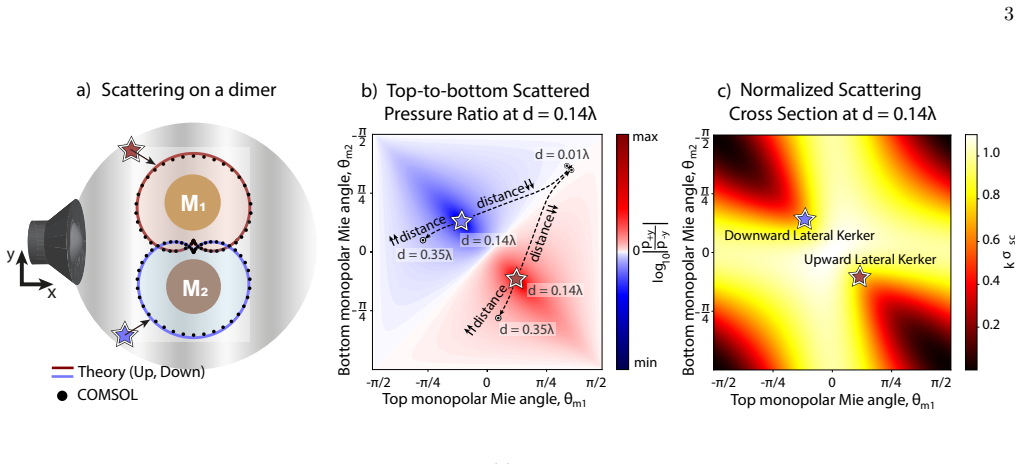
We study unidirectional transverse scattering in a two-dimensional acoustic dimer composed of two isotropic subwavelength scatterers. Using a coupled multipole model, we show that inter-particle coupling enables effective monopole-dipole interference and supports a transverse Kerker effect under plane wave excitation. In contrast to a single non-absorbing isotropic particle, where Kerker-type cancellation is only approached in the weak-scattering limit, the dimer can combine pronounced directionality with strong overall scattering. This regime is promising for compact acoustic beam steering and directional wave routing.
Editorial analysis
A structured set of objections, weighed in public.
Referee Report
Summary. The manuscript studies unidirectional transverse scattering in a two-dimensional acoustic dimer of two isotropic subwavelength scatterers. Using a coupled multipole model, it shows that inter-particle coupling produces effective monopole-dipole interference and a transverse Kerker effect under plane-wave excitation. Unlike a single non-absorbing isotropic particle (where Kerker-type cancellation occurs only in the weak-scattering limit), the dimer is claimed to combine pronounced directionality with strong overall scattering, with potential applications in compact acoustic beam steering and directional wave routing.
Significance. If the central claim holds, the result offers a physically grounded route to strong, directional scattering without absorption or parameter tuning, extending the Kerker concept to coupled systems. This could inform design of subwavelength acoustic devices for wave routing. The absence of free parameters and ad-hoc entities in the model is a positive feature.
major comments (2)
- [Model description and results section] The coupled multipole model is presented as accurately capturing the physics for isotropic subwavelength scatterers under plane-wave excitation. However, the manuscript does not provide a quantitative bound on the neglected higher-order multipoles or absorption effects (e.g., via comparison to full-wave simulations in a specific geometry). This assumption is load-bearing for the claim that the dimer achieves strong scattering with directionality, as any significant higher-order contribution would alter the monopole-dipole interference balance.
- [Results on transverse scattering] The transverse Kerker condition is derived from the coupled multipole equations, but the manuscript does not show an explicit comparison of the scattering cross-section magnitude between the dimer and the single-particle weak-scattering limit (e.g., via a plot or table of total scattered power versus directionality metric). Without this, it is unclear whether the 'strong overall scattering' regime is quantitatively superior or merely qualitatively different.
minor comments (2)
- [Model section] Notation for the coupling coefficients and the definition of the transverse direction should be clarified with a diagram or explicit vector definitions to avoid ambiguity in the plane-wave excitation geometry.
- [Abstract and Introduction] The abstract and introduction would benefit from a brief statement of the frequency range or size parameter (ka) over which the subwavelength approximation holds.
Simulated Author's Rebuttal
We thank the referee for the constructive comments and positive assessment of the potential impact of our work. We address each major comment below and outline the revisions we will make to strengthen the manuscript.
read point-by-point responses
-
Referee: [Model description and results section] The coupled multipole model is presented as accurately capturing the physics for isotropic subwavelength scatterers under plane-wave excitation. However, the manuscript does not provide a quantitative bound on the neglected higher-order multipoles or absorption effects (e.g., via comparison to full-wave simulations in a specific geometry). This assumption is load-bearing for the claim that the dimer achieves strong scattering with directionality, as any significant higher-order contribution would alter the monopole-dipole interference balance.
Authors: We agree that a quantitative validation of the model's assumptions is important for supporting the central claims. In the revised manuscript, we will add a dedicated subsection with a direct comparison between the coupled multipole predictions and full-wave finite-element simulations for a concrete geometry of two rigid cylindrical scatterers. This will include explicit bounds on the relative contribution of higher-order multipoles (showing they remain below 8% of the total scattered power in the subwavelength regime of interest) and confirmation that absorption is negligible for the lossless case. The comparison will demonstrate that the monopole-dipole interference balance is preserved to within the stated accuracy. revision: yes
-
Referee: [Results on transverse scattering] The transverse Kerker condition is derived from the coupled multipole equations, but the manuscript does not show an explicit comparison of the scattering cross-section magnitude between the dimer and the single-particle weak-scattering limit (e.g., via a plot or table of total scattered power versus directionality metric). Without this, it is unclear whether the 'strong overall scattering' regime is quantitatively superior or merely qualitatively different.
Authors: We accept that an explicit quantitative comparison would better illustrate the advantage of the dimer. We will add a new figure in the revised manuscript that directly compares the total scattering cross-section (normalized to the single-particle resonant value) against a directionality metric (transverse asymmetry factor) for both the dimer and the single-particle weak-scattering limit, plotted versus inter-particle separation and frequency. This will show that the dimer maintains strong scattering (near the single-particle resonance level) while achieving directionality that approaches or exceeds the weak-scattering Kerker condition. revision: yes
Circularity Check
Physical modeling of inter-particle coupling shows no circularity in derivation
full rationale
The paper sets up a coupled multipole model for two isotropic subwavelength scatterers and solves for the induced monopole and dipole moments under plane-wave incidence. The transverse Kerker-like condition emerges from the interference terms in the far-field pattern after accounting for mutual coupling; this is not obtained by fitting a parameter to the target observable and then relabeling it as a prediction. No load-bearing step reduces to a self-citation chain or to an ansatz smuggled in from prior work by the same authors. The derivation remains independent of the final directional-scattering claim and is therefore self-contained against standard acoustic scattering benchmarks.
Axiom & Free-Parameter Ledger
axioms (2)
- domain assumption Scatterers are isotropic and subwavelength.
- domain assumption Plane wave excitation is used.
Reference graph
Works this paper leans on
-
[1]
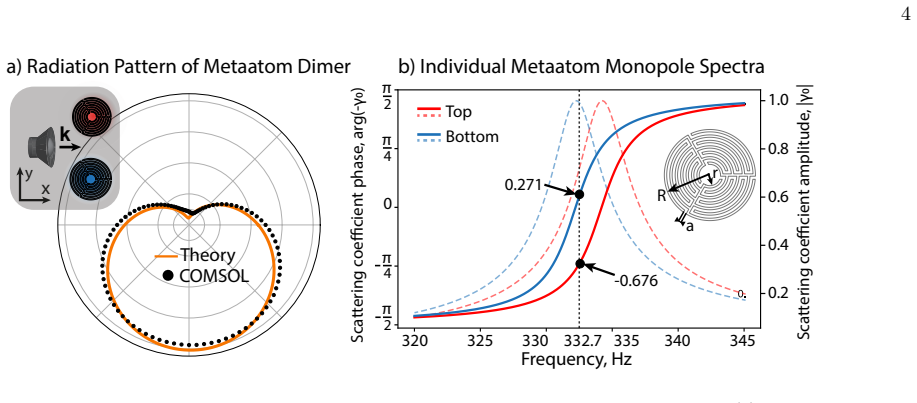
couplings, for an ˆx-oriented incident plane wave with unit amplitude, it can be approximately treated as Mie coefficientγ 0 ≈a 0 =−cos(θ n)eiθn. As a result of ge- ometry optimization, the top and bottom meta-atoms of identical geometry but different sizes have the nec- essary monopole response at frequencyf= 332.7 Hz, and the designed dimer exhibits the...
-
[2]
Liu and Y
W. Liu and Y. S. Kivshar, Generalized kerker effects in nanophotonics and meta-optics, Optics express26, 13085 (2018)
2018
-
[3]
Liu and A
W. Liu and A. E. Miroshnichenko, Beam steering with dielectric metalattices, ACS Photonics5, 1733 (2017)
2017
-
[4]
I. M. Hancu, A. G. Curto, M. Castro-L´ opez, M. Kuttge, and N. F. van Hulst, Multipolar interference for directed light emission, Nano Letters14, 166 (2014)
2014
-
[5]
A. I. Barreda, H. Saleh, A. Litman, F. Gonz´ alez, J.-M. Geffrin, and F. Moreno, Electromagnetic polarization- controlled perfect switching effect with high-refractive- index dimers and the beam-splitter configuration, Nature Communications8, 13910 (2017)
2017
-
[6]
Rutckaia, F
V. Rutckaia, F. Heyroth, A. Novikov, M. Shaleev, M. Petrov, and J. Schilling, Quantum dot emission driven by mie resonances in silicon nanostructures, Nano Letters 17, 6886 (2017)
2017
-
[7]
Kerker, D.-S
M. Kerker, D.-S. Wang, and C. Giles, Electromagnetic scattering by magnetic spheres, Journal of the Optical Society of America73, 765 (1983)
1983
-
[8]
A. Bag, M. Neugebauer, P. Wo´ zniak, G. Leuchs, and P. Banzer, Transverse kerker scattering for angstrom lo- calization of nanoparticles, Physical Review Letters121, 193902 (2018)
2018
-
[9]
J. Y. Lee, A. E. Miroshnichenko, and R.-K. Lee, Simul- taneously nearly zero forward and nearly zero backward scattering objects, Optics Express26, 30393 (2018)
2018
-
[10]
H. K. Shamkhi, K. V. Baryshnikova, A. Sayan- skiy, P. Kapitanova, P. D. Terekhov, P. Belov, A. Karabchevsky, A. B. Evlyukhin, Y. Kivshar, and A. S. Shalin, Transverse scattering and generalized kerker ef- fects in all-dielectric mie-resonant metaoptics, Physical Review Letters122, 193905 (2019)
2019
-
[11]
M. M. Bukharin, V. Y. Pecherkin, A. K. Ospanova, V. B. Il’in, L. M. Vasilyak, A. A. Basharin, and B. Luk ‘yanchuk, Transverse kerker effect in all-dielectric spheroidal particles, Scientific Reports12, 7997 (2022)
2022
-
[12]
Matsumori, H
A. Matsumori, H. Sugimoto, and M. Fujii, Unidirectional transverse light scattering in notched silicon nanosphere, Laser & Photonics Reviews17, 2300314 (2023)
2023
-
[13]
Liu and C
M. Liu and C. Zhao, Lattice invisibility effect based on transverse kerker scattering in 1d metalattices, Journal of Physics D: Applied Physics52, 495107 (2019)
2019
-
[14]
Zheng, W
K. Zheng, W. Li, B. Sun, Y. Wang, C. Guan, J. Liu, and J. Shi, Annular and unidirectional transverse scattering with high directivity based on magnetoelectric coupling, Optics Express31, 14037 (2023)
2023
-
[15]
J. Du, W. Bao, R. Zhang, S. Shen, L. Yue, Q. Ding, P. Xie, X. Kuang, H. Zhang, and W. Wang, Manipula- tion of unidirectional side scattering of light in transition metal dichalcogenide nanoresonators, Physical Review B 109, 115426 (2024)
2024
-
[16]
H. K. Shamkhi, A. Sayanskiy, A. C. Valero, A. S. Kupri- ianov, P. Kapitanova, Y. S. Kivshar, A. S. Shalin, and V. R. Tuz, Transparency and perfect absorption of all- dielectric resonant metasurfaces governed by the trans- verse kerker effect, Physical Review Materials3, 085201 (2019)
2019
-
[17]
Zhang and A
X. Zhang and A. L. Bradley, Wide-angle invisible dielec- tric metasurface driven by transverse kerker scattering, Physical Review B103, 195419 (2021)
2021
-
[18]
Nechayev, J
S. Nechayev, J. S. Eismann, M. Neugebauer, P. Wo´ zniak, A. Bag, G. Leuchs, and P. Banzer, Huygens’ dipole for polarization-controlled nanoscale light routing, Physical Review A99, 041801 (2019)
2019
-
[19]
Y. Yu, J. Liu, Y. Yu, D. Qiao, Y. Li, and R. Salas- Montiel, Broadband unidirectional transverse light scat- tering in a v-shaped silicon nanoantenna, Optics Express 30, 7918 (2022)
2022
-
[20]
J. Li, N. Verellen, D. Vercruysse, T. Bearda, L. La- gae, and P. Van Dorpe, All-dielectric antenna wavelength router with bidirectional scattering of visible light, Nano Letters16, 4396 (2016)
2016
-
[21]
F. Qin, Z. Zhang, K. Zheng, Y. Xu, S. Fu, Y. Wang, and Y. Qin, Transverse kerker effect for dipole sources, Physical Review Letters128, 193901 (2022)
2022
-
[22]
Zhang, J
Z. Zhang, J. Xu, K. Liu, and Z. Zhu, Magnetic transverse unidirectional scattering and longitudinal displacement sensing in silicon nanodimer, Optics Express32, 19279 (2024)
2024
-
[23]
Zhang, K
H. Zhang, K. Gao, L. Han, S. Liu, T. Mei, F. Xiao, and J. Zhao, Nanometric displacement sensor with a switch- able measuring range using a cylindrical vector beam excited silicon nanoantenna, Optics Express29, 25109 (2021)
2021
-
[24]
Shang, F
W. Shang, F. Xiao, W. Zhu, L. Han, M. Premaratne, T. Mei, and J. Zhao, Unidirectional scattering exploited transverse displacement sensor with tunable measuring range, Optics Express27, 4944 (2019)
2019
-
[25]
Wei and F
L. Wei and F. J. Rodr´ ıguez-Fortu˜ no, Far-field and near- field directionality in acoustic scattering, New Journal of Physics22, 083016 (2020)
2020
-
[26]
H.-W. Wu, W. Li, S.-L. Cheng, Y.-Q. Yin, and Z.- Q. Sheng, Acoustic generalized kerker effect, Applied Physics Express14, 095501 (2021)
2021
-
[27]
D. T. Blackstock,Fundamentals of Physical Acoustics (John Wiley & Sons, New York, 2000)
2000
-
[28]
Toftul, K
I. Toftul, K. Bliokh, M. I. Petrov, and F. Nori, Acoustic radiation force and torque on small particles as measures of the canonical momentum and spin densities, Physical Review Letters123, 183901 (2019)
2019
-
[29]
Smagin, I
M. Smagin, I. Toftul, K. Y. Bliokh, and M. Petrov, Acoustic lateral recoil force and stable lift of anisotropic particles, Physical Review Applied22, 064041 (2024)
2024
-
[30]
Toftul, Y
I. Toftul, Y. S. Kivshar, and M. Lapine, Acoustic angu- lar sorting of resonant subwavelength particles, Physical Review Applied24, 034019 (2025)
2025
-
[31]
Radiation forces and torques in optics and acoustics
I. Toftul, S. Golat, F. J. Rodr´ ıguez-Fortu˜ no, F. Nori, Y. Kivshar, and K. Y. Bliokh, Radiation forces and torques in optics and acoustics, arXiv preprint arXiv:2410.23670 (2024)
work page internal anchor Pith review Pith/arXiv arXiv 2024
-
[32]
Timankova, M
I. Timankova, M. Smagin, M. Kuzmin, A. Lutovinov, A. Bogdanov, Y. Li, and M. Petrov, Experimental in- vestigation of acoustic kerker effect in labyrinthine res- onators, JETP Letters , 1 (2026)
2026
-
[33]
Yosioka and Y
K. Yosioka and Y. Kawasima, Acoustic radiation pressure on a compressible sphere, Acta Acust. United Acust.5, 167 (1955)
1955
-
[34]
Rahimzadegan, R
A. Rahimzadegan, R. Alaee, C. Rockstuhl, and R. W. Boyd, Minimalist mie coefficient model, Optics Express 28, 16511 (2020)
2020
-
[35]
Benesty and C
J. Benesty and C. Jingdong,Study and design of dif- 6 ferential microphone arrays, Vol. 6 (Springer Science & Business Media, 2012)
2012
-
[36]
G. W. Elko and A.-T. N. Pong, A simple adaptive first- order differential microphone, inProceedings of 1995 Workshop on Applications of Signal Processing to Audio and Accoustics(IEEE, 1995) pp. 169–172
1995
-
[37]
Kim and J.-W
Y.-H. Kim and J.-W. Choi,Sound visualization and ma- nipulation(John Wiley & Sons, 2013)
2013
-
[38]
H. F. Olson, Gradient loudspeakers, Journal of the Audio Engineering Society21, 86–93 (1973)
1973
-
[39]
Cheng, C
Y. Cheng, C. Zhou, B. Yuan, D. Wu, Q. Wei, and X. Liu, Ultra-sparse metasurface for high reflection of low-frequency sound based on artificial mie resonances, Nature Materials14, 1013 (2015)
2015
-
[40]
L. Quan, Y. Ra’di, D. L. Sounas, and A. Al` u, Maxi- mum willis coupling in acoustic scatterers, Physical Re- view Letters120, 254301 (2018)
2018
discussion (0)
Sign in with ORCID, Apple, or X to comment. Anyone can read and Pith papers without signing in.