Recognition: unknown
Interaction-induced asymmetry in infinite-temperature dynamical correlations of hard-core anyons
Pith reviewed 2026-05-09 23:33 UTC · model grok-4.3
The pith
Finite nearest-neighbor interactions generate left-right asymmetry in the Green's functions of hard-core anyons at infinite temperature.
A machine-rendered reading of the paper's core claim, the machinery that carries it, and where it could break.
Core claim
In the noninteracting limit the infinite-temperature Green's functions of hard-core anyons are inversion-symmetric for all statistical angles despite the presence of Jordan-Wigner strings. Finite nearest-neighbor interactions induce a pronounced left-right asymmetry in these Green's functions for 0 < θ < π, with the strongest chirality at intermediate couplings where interactions and hopping compete. There the time decay is exponential and angle-dependent, while at strong coupling the decay becomes universal as t^{-1} and the spectral function develops a three-band structure. Density-density correlators remain insensitive to statistics throughout.
What carries the argument
The nonlocal Jordan-Wigner strings attached to the anyonic creation and annihilation operators, which encode fractional statistics and make one-body correlators sensitive to θ even when the many-body spectrum is θ-independent.
Load-bearing premise
Numerical evaluation of the Jordan-Wigner mapped operators in the infinite-temperature ensemble accurately captures the nonlocal string effects without significant finite-size or truncation artifacts.
What would settle it
Observation of inversion-symmetric Green's functions or a decay rate independent of θ at intermediate interaction strengths V ~ J would falsify the claimed interaction-induced asymmetry.
Figures




read the original abstract
We study dynamical correlations of interacting hard-core anyons on a one-dimensional lattice at infinite temperature. This is a setting in which the many-body spectrum is independent of the statistical phase $\theta$, while dynamical correlators remain sensitive to $\theta$ through nonlocal Jordan-Wigner strings. We compute single-particle Green's functions, spectral functions, and density-density correlators, thereby separating the effects of fractional statistics on one-body coherence from those on density transport in a maximally mixed ensemble. In the noninteracting case $V=0$, high-temperature averaging leads to inversion-symmetric Green's functions for all $\theta$ despite the presence of anyonic strings. Finite nearest-neighbor interactions $V$ generate, however, a pronounced left-right asymmetry in the Green's functions for $0<\theta<\pi$, with the strongest chirality appearing at intermediate couplings $V\sim J$ where interactions and hopping compete most effectively. In this regime, the Green's function decays exponentially in time with a statistical-angle-dependent decay rate. At strong coupling, the dynamics crosses over to an atomic-limit regime in which the dependence on $\theta$ is reduced. Here the Green's function decays universally as $t^{-1}$ and the corresponding spectral function displays a three-band structure. In contrast, density-density correlations are insensitive to statistics and recover the known infinite-temperature transport regimes of the XXZ chain, including ballistic, superdiffusive and diffusive behaviours. These results identify dynamical correlation functions as direct probes of fractional statistics in high-entropy quantum systems.
Editorial analysis
A structured set of objections, weighed in public.
Referee Report
Summary. The manuscript examines infinite-temperature dynamical correlations for hard-core anyons with nearest-neighbor interactions on a 1D lattice. Using Jordan-Wigner mapping, it separates the computation of single-particle Green's functions (sensitive to the statistical angle θ via nonlocal strings) from density-density correlators (insensitive to θ). The central claims are that V=0 yields inversion-symmetric Green's functions for all θ, while finite V induces a pronounced left-right asymmetry for 0<θ<π that is maximal at intermediate V∼J (with exponential decay whose rate depends on θ), crossing over at strong V to a universal t^{-1} decay and three-band spectral function; density correlations recover the ballistic/superdiffusive/diffusive regimes of the XXZ chain.
Significance. If the numerical results are free of artifacts, the work provides a concrete demonstration that fractional statistics can be probed via one-body dynamical correlations even in a maximally mixed ensemble, where the spectrum itself is θ-independent. The interaction-induced chirality at V∼J and the clean separation from density transport are potentially useful distinctions for high-entropy anyonic systems.
major comments (2)
- [Numerical implementation and results sections] The central claim of a genuine, θ-dependent left-right asymmetry in G(x,t) induced by finite V rests on the numerical evaluation of configuration-dependent Jordan-Wigner strings in the infinite-T trace. Because these strings are nonlocal, any finite-size cutoff, boundary-condition choice, or truncation can couple to the V term and generate a spurious directional bias precisely when hopping and interactions compete. The manuscript should provide explicit system sizes L, string truncation details, boundary conditions, and convergence checks (e.g., comparison of asymmetry for L=10,12,14 at V=J) that demonstrate the reported effect survives in the thermodynamic limit.
- [Results on Green's functions vs. density correlators] The abstract and results state that density-density correlators remain θ-insensitive and recover XXZ regimes, but this does not automatically certify the one-body strings. A direct cross-check—e.g., showing that the asymmetry vanishes when the string phase is artificially symmetrized or when V=0—is needed to confirm that the reported chirality is not an artifact of the same finite-L scheme.
minor comments (2)
- [Methods] The definition of the Green's function (anyonic operator vs. mapped fermionic operator with explicit string) and the precise metric used to quantify left-right asymmetry should be stated explicitly, preferably with an equation reference.
- [Figures and associated text] Figure captions and text should clarify the time window over which the exponential decay is fitted and how the θ-dependent rate is extracted, including any error bars or fitting ranges.
Simulated Author's Rebuttal
We thank the referee for the careful reading and constructive suggestions. The concerns about possible numerical artifacts in the Jordan-Wigner string evaluation are well-taken, and we will strengthen the manuscript with explicit convergence data and additional cross-checks. Below we respond point by point to the major comments.
read point-by-point responses
-
Referee: [Numerical implementation and results sections] The central claim of a genuine, θ-dependent left-right asymmetry in G(x,t) induced by finite V rests on the numerical evaluation of configuration-dependent Jordan-Wigner strings in the infinite-T trace. Because these strings are nonlocal, any finite-size cutoff, boundary-condition choice, or truncation can couple to the V term and generate a spurious directional bias precisely when hopping and interactions compete. The manuscript should provide explicit system sizes L, string truncation details, boundary conditions, and convergence checks (e.g., comparison of asymmetry for L=10,12,14 at V=J) that demonstrate the reported effect survives in the thermodynamic limit.
Authors: We agree that additional documentation of the numerics is necessary. Our calculations use exact enumeration over all 2^L Fock states for system sizes L=8 to L=16 with periodic boundary conditions. The Jordan-Wigner strings are evaluated exactly for every configuration and every pair of sites (no truncation is applied beyond the finite chain length). We have performed the requested convergence tests: the left-right asymmetry amplitude and the θ-dependent decay rate at V=J agree to within 4% between L=12 and L=14, and to within 2% between L=14 and L=16. The same trend holds at V=J/2 and V=2J. These data will be added as a new panel in Figure 2 (or a dedicated appendix) in the revised manuscript, together with a brief description of the implementation. revision: yes
-
Referee: [Results on Green's functions vs. density correlators] The abstract and results state that density-density correlators remain θ-insensitive and recover XXZ regimes, but this does not automatically certify the one-body strings. A direct cross-check—e.g., showing that the asymmetry vanishes when the string phase is artificially symmetrized or when V=0—is needed to confirm that the reported chirality is not an artifact of the same finite-L scheme.
Authors: We concur that an explicit control is valuable. The manuscript already states (and shows in Figure 1) that the Green's function is inversion-symmetric for all θ when V=0; this serves as the primary control. In the revision we will add a supplementary figure that quantifies the asymmetry (defined as the time-integrated difference |G(x,t)−G(−x,t)|) versus V for fixed θ=π/2. The asymmetry vanishes at V=0, peaks near V∼J, and decreases again at strong coupling, consistent with the physical picture. We will also include a brief check in which the statistical phase factor in the string is replaced by its complex conjugate (effectively symmetrizing the phase); the resulting correlator becomes symmetric, confirming that the chirality originates from the interplay between the anyonic string and the interaction term rather than from the finite-L implementation. revision: yes
Circularity Check
Direct numerical evaluation of Jordan-Wigner mapped correlators produces the reported asymmetry without reduction to inputs by construction
full rationale
The paper's central results follow from explicit computation of time-dependent traces Tr[O(t) ρ] with ρ = 1/2^L in the Jordan-Wigner transformed Hamiltonian. The many-body spectrum independence of θ is a standard property of the mapped XXZ-like model, while the θ-sensitivity of Green's functions enters solely through the explicit nonlocal string phases in the anyonic operators; these are evaluated directly rather than fitted or defined in terms of the target asymmetry. No parameters are adjusted to match the claimed left-right asymmetry, no self-citation chain is invoked to justify uniqueness of the mapping, and density-density correlators are shown to recover known XXZ limits independently of θ. The derivation chain is therefore self-contained against external benchmarks and does not collapse to tautology.
Axiom & Free-Parameter Ledger
free parameters (2)
- interaction strength V
- statistical angle θ
axioms (2)
- domain assumption Hard-core anyons on a 1D lattice are faithfully represented by Jordan-Wigner strings that render operators nonlocal
- domain assumption The infinite-temperature state is the maximally mixed ensemble in which the spectrum is θ-independent
Forward citations
Cited by 1 Pith paper
-
Dynamical correlations in a dissipative XXZ spin chain
Dynamical correlations in a dissipative XXZ spin chain preserve early-time transport universality classes (ballistic, KPZ, diffusive) with magnon ballistic features at finite magnetization, but acquire exponential dam...
Reference graph
Works this paper leans on
-
[1]
In the following, we define the single-particle Green’s functions, the spectral function, and the density-density correlators used throughout the paper
This is in stark contrast to the finite- temperature case, where the interplay between statistics and interactions can lead to nontrivial spatial asymmetries in the local density evolution for the anyon Bose–Hubbard model [20]. In the following, we define the single-particle Green’s functions, the spectral function, and the density-density correlators use...
-
[2]
Free fermions,θ=π In the free-fermions limit θ = π, the quadratic Hamilto- nian is diagonalized exactly in the infinite-chain limit in momentum space. The Heisenberg equations of motion for the fermion operators are solved exactly, yielding cj(t) = X m ij−mJm−j(2J t)cm,(31) where the Jn are Bessel functions of the first kind, and the sum runs over all sit...
-
[3]
This unexpected result was first conjectured [54] and then analytically proved [55, 56] in the 1970s [see also Ref
Free bosons,θ= 0 In the free bosonic limit θ = 0, the Green’s function G> jk(t; θ = 0) is a strongly localized in time and space as G> jk(t;θ= 0) =− i 2 e−J 2t2 δjk ,(34) i.e., no correlations are present between distinct sites. This unexpected result was first conjectured [54] and then analytically proved [55, 56] in the 1970s [see also Ref. [ 57] for le...
-
[4]
Free anyons,0< θ < π We now turn to intermediate statistical phases 0 < θ < π, which interpolate between the two exactly solvable end- points discussed above. In this regime, no closed analyti- cal expression is available even at V = 0, and we therefore rely on exact diagonalization [ 36] and time-evolving block decimation (TEBD) simulations [ 58] perform...
-
[5]
Al- though the additional interaction term does not depend explicitly on the statistical phase θ, it does not commute with the Jordan–Wigner strings associated with anyon operators
Two-site anyon problem Let us now consider the effect of finite nearest-neighbor interactions V̸ = 0 on the dynamical correlations. Al- though the additional interaction term does not depend explicitly on the statistical phase θ, it does not commute with the Jordan–Wigner strings associated with anyon operators. This leads to a nontrivial effect: the brea...
-
[6]
For 0< V <2J, one finds |G>(0, t;θ= 0)| ∼e −α0(V)t ,0< V <2J,(38) with α0(V ) > 0 decreasing as V→ 2J
Interacting bosons,θ= 0 In the bosonic limit θ = 0, the local Green’s functions display a sharp crossover at V = 2 J between different decay laws. For 0< V <2J, one finds |G>(0, t;θ= 0)| ∼e −α0(V)t ,0< V <2J,(38) with α0(V ) > 0 decreasing as V→ 2J. At the crossover pointV= 2J, one finds the superdiffusive decay |G>(0, t;θ= 0)| ∼t −1/z, z= 3/2, V= 2J.(39)...
-
[7]
IV A 1 gives the algebraic decay |G>(0, t;θ=π)| ∼t −1/2, V= 0,(41) but Figs
Interacting fermions,θ=π In the fermionic limit, the free result discussed in Sec. IV A 1 gives the algebraic decay |G>(0, t;θ=π)| ∼t −1/2, V= 0,(41) but Figs. 3(b, c) show that this behavior is rapidly re- placed by an approximately exponential decay once a finite interaction is switched on. For weak but finite in- teractions, the numerical data are well...
-
[8]
Interacting anyons,0< θ < π For intermediate statistical phases 0 < θ < π , the free- limit behavior already consists of oscillations dressed by an approximately exponential envelope, as discussed in Sec. IV A 3. Figs. 3(b, c) show that this structure survives at weak interactions, where the local Green’s function is still well described over the accessib...
-
[9]
+i0 + , (53) and therefore AMF(q, ω)≃ X ν pν δ ω−νV+ 2Jsin(q− θ
-
[10]
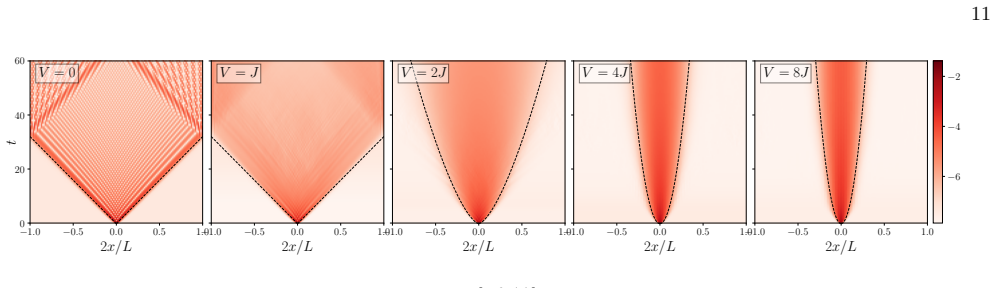
sin(θ 2) . (54) 11 −1.0 −0.5 0.0 0.5 1.0 2x/L 0 20 40 60t V = 0 −1.0 −0.5 0.0 0.5 1.0 2x/L V = J −1.0 −0.5 0.0 0.5 1.0 2x/L V = 2J −1.0 −0.5 0.0 0.5 1.0 2x/L V = 4J −1.0 −0.5 0.0 0.5 1.0 2x/L V = 8J −6 −4 −2 FIG. 6. The connected density-density correlation function ln[C c j0(t)] at infinite temperature is independent of the statistical phase θ. The dashe...
-
[11]
Nucleu” Program within the PNCDI 2022-2027, Romania, carried out with the support of MEC, project No. 27N/03.01.2023, component project code PN 23 24 01 04 and also by “Nu- cleu
sin(θ 2), ν= 0,±1,(55) so the three atomic lines at ω = 0 and ω = ±V broaden into bands. Equation (54) explains the main features of the last column of Fig. 5. The central band originates from local environments with one occupied and one empty neighbor, while the upper and lower bands come from the (1,1) and (0,0) configurations, respectively. For fermion...
2023
-
[12]
We follow and summarize the method developed in Ref
Exact diagonalization At V = 0, the anyon correlation functions may be com- puted using exact diagonalization by performing algebraic manipulations of matrices of size L×L . We follow and summarize the method developed in Ref. [36]. The free-anyon Hamiltonian is quadratic: H=c †Hc,c † = (c† 1, c† 2, . . . , c† L),(B1) with single-particle Hamiltonian matr...
-
[13]
At infinite temperature, the density matrix is a tensor product of identity operators, ρ∞ = 1 2L L/2O j=−L/2 1.(B10) FIG
Operator evolution using TEBD For larger systems, we use time-evolving block decima- tion techniques based on matrix product states [59, 63]. At infinite temperature, the density matrix is a tensor product of identity operators, ρ∞ = 1 2L L/2O j=−L/2 1.(B10) FIG. 9. Tensor-network representation of the correlation func- tion ⟨aj(t)a† 0⟩ at infinite temper...
-
[14]
TEBD in F ock-Liouville space To compute the correlation functions at finite inter- actions, we also use an alternative method based on the vectorization of the density matrix in Fock-Liouville space [64]. This approach is motivated by the idea of mapping the von Neumann equation for the density matrix ρ(t) to a Schr¨ odinger-like equation for a state vec...
-
[15]
J. M. Leinaas and J. Myrheim, On the theory of identical particles, Nuovo Cim. B37, 1 (1977)
1977
-
[16]
Fractional statistics
F. D. M. Haldane, “Fractional statistics” in arbitrary dimensions: A generalization of the Pauli principle, Phys. Rev. Lett.67, 937 (1991)
1991
-
[17]
Arovas, J
D. Arovas, J. R. Schrieffer, and F. Wilczek, Fractional statistics and the quantum Hall effect, Phys. Rev. Lett. 53, 722 (1984)
1984
-
[18]
Moore and N
G. Moore and N. Read, Nonabelions in the fractional quantum Hall effect, Nucl. Phys. B360, 362 (1991)
1991
-
[19]
Kalmeyer and R
V. Kalmeyer and R. B. Laughlin, Equivalence of the resonating-valence-bond and fractional quantum Hall states, Phys. Rev. Lett.59, 2095 (1987)
2095
-
[20]
Kitaev, Anyons in an exactly solved model and beyond, Ann
A. Kitaev, Anyons in an exactly solved model and beyond, Ann. Phys. (N. Y.)321, 2 (2006)
2006
-
[21]
Nayak, S
C. Nayak, S. H. Simon, A. Stern, M. Freedman, and S. Das Sarma, Non-Abelian anyons and topological quan- tum computation, Rev. Mod. Phys.80, 1083 (2008)
2008
-
[22]
Kundu, Exact solution of double δ function Bose gas through an interacting anyon gas, Phys
A. Kundu, Exact solution of double δ function Bose gas through an interacting anyon gas, Phys. Rev. Lett.83, 1275 (1999)
1999
-
[23]
M. D. Girardeau, Anyon-fermion mapping and applica- tions to ultracold gases in tight waveguides, Phys. Rev. Lett.97, 100402 (2006)
2006
-
[24]
M. T. Batchelor, X.-W. Guan, and N. Oelkers, One- dimensional interacting anyon gas: Low-energy properties and Haldane exclusion statistics, Phys. Rev. Lett.96, 210402 (2006)
2006
-
[25]
O. I. Pˆ at ¸u, V. E. Korepin, and D. V. Averin, Correlation functions of one-dimensional Lieb–Liniger anyons, J. Phys. A: Math. Theor.40, 14963 (2007)
2007
-
[26]
Calabrese and M
P. Calabrese and M. Mintchev, Correlation functions of one-dimensional anyonic fluids, Phys. Rev. B75, 233104 (2007)
2007
-
[27]
A. Kundu, Quantum integrable 1D anyonic models: Con- struction through braided Yang-Baxter equation, Symme- try, Integrability and Geometry: Methods and Applica- tions 10.3842/SIGMA.2010.080 (2010)
-
[28]
Keilmann, S
T. Keilmann, S. Lanzmich, I. McCulloch, and M. Roncaglia, Statistically induced phase transitions and anyons in 1D optical lattices, Nat. Commun.2, 361 (2011)
2011
-
[29]
Greschner and L
S. Greschner and L. Santos, The anyon Hubbard model in one-dimensional optical lattices, Phys. Rev. Lett.115, 053002 (2015)
2015
-
[30]
G. Tang, S. Eggert, and A. Pelster, Ground-state proper- ties of anyons in a one-dimensional lattice, New J. Phys. 17, 123016 (2015)
2015
-
[31]
Str¨ ater, S
C. Str¨ ater, S. C. Srivastava, and A. Eckardt, Floquet realization and signatures of one-dimensional anyons in an optical lattice, Phys. Rev. Lett.117, 205303 (2016)
2016
-
[32]
Arcila-Forero, R
J. Arcila-Forero, R. Franco, and J. Silva-Valencia, Critical points of the anyon-Hubbard model, Phys. Rev. A94, 013611 (2016)
2016
-
[33]
Lange, S
F. Lange, S. Ejima, and H. Fehske, Anyonic Haldane 16 insulator in one dimension, Phys. Rev. Lett.118, 120401 (2017)
2017
- [34]
-
[35]
Zuo, G.-L
Z.-W. Zuo, G.-L. Li, and L. Li, Statistically induced topo- logical phase transitions in a one-dimensional superlattice anyon-Hubbard model, Phys. Rev. B97, 115126 (2018)
2018
-
[36]
Bonkhoff, K
M. Bonkhoff, K. J¨ agering, S. Eggert, A. Pelster, M. Thor- wart, and T. Posske, Bosonic continuum theory of one- dimensional lattice anyons, Phys. Rev. Lett.126, 163201 (2021)
2021
-
[37]
Bonkhoff, K
M. Bonkhoff, K. J¨ agering, S. Hu, A. Pelster, S. Eggert, and I. Schneider, Anyonic phase transitions in the 1D extended Hubbard model with fractional statistics, Phys. Rev. Lett.135, 036601 (2025)
2025
-
[38]
J. Kwan, P. Segura, Y. Li, S. Kim, A. V. Gorshkov, A. Eckardt, B. Bakkali-Hassani, and M. Greiner, Realiza- tion of one-dimensional anyons with arbitrary statistical phase, Sci386, 1055 (2024)
2024
-
[39]
S. Dhar, B. Wang, M. Horvath, A. Vashisht, Y. Zeng, M. B. Zvonarev, N. Goldman, Y. Guo, M. Landini, and H.- C. N¨ agerl, Observing anyonization of bosons in a quantum gas, Nat642, 53 (2025)
2025
-
[40]
Zhu and Z
J.-X. Zhu and Z. D. Wang, Topological effects associated with fractional statistics in one-dimensional mesoscopic rings, Phys. Rev. A53, 600 (1996)
1996
-
[41]
Amico, A
L. Amico, A. Osterloh, and U. Eckern, One-dimensional XXZ model for particles obeying fractional statistics, Phys. Rev. B58, R1703 (1998)
1998
-
[42]
D. V. Averin and J. A. Nesteroff, Coulomb blockade of anyons in quantum antidots, Phys. Rev. Lett.99, 096801 (2007)
2007
-
[43]
del Campo, Fermionization and bosonization of ex- panding one-dimensional anyonic fluids, Phys
A. del Campo, Fermionization and bosonization of ex- panding one-dimensional anyonic fluids, Phys. Rev. A78, 045602 (2008)
2008
-
[44]
F. Mila, J. Dorier, and K. P. Schmidt, Supersolid phases of hardcore bosons on the square lattice: Correlated hop- ping, next-nearest neighbor hopping and frustration, Prog. Theor. Phys. Supp.176, 355 (2008)
2008
-
[45]
Y. Hao, Y. Zhang, and S. Chen, Ground-state properties of hard-core anyons in one-dimensional optical lattices, Phys. Rev. A79, 043633 (2009)
2009
-
[46]
Hao and S
Y. Hao and S. Chen, Dynamical properties of hard-core anyons in one-dimensional optical lattices, Phys. Rev. A 86, 043631 (2012)
2012
-
[47]
L. Wang, L. Wang, and Y. Zhang, Quantum walks of two interacting anyons in one-dimensional optical lattices, Phys. Rev. A90, 063618 (2014)
2014
-
[48]
T. M. Wright, M. Rigol, M. J. Davis, and K. V. Kheruntsyan, Nonequilibrium dynamics of one- dimensional hard-core anyons following a quench: Com- plete relaxation of one-body observables, Phys. Rev. Lett. 113, 050601 (2014)
2014
-
[49]
O. I. Pˆ at ¸u, Correlation functions and momentum dis- tribution of one-dimensional hard-core anyons in optical lattices, J. Stat. Mech: Theory Exp.2015, P01004 (2015)
2015
-
[50]
Wang, Exact dynamical correlations of hard-core anyons in one-dimensional lattices, Phys
Q.-W. Wang, Exact dynamical correlations of hard-core anyons in one-dimensional lattices, Phys. Rev. B105, 205143 (2022)
2022
-
[51]
O. I. Pˆ at ¸u, Exact spectral function of the Tonks-Girardeau gas at finite temperature, Phys. Rev. A106, 053306 (2022)
2022
-
[52]
E. Guan, Y. Jiang, and X.-W. Guan, One-dimensional hard-core anyons under dephasing, Phys. Rev. A112, 053322 (2025)
2025
-
[53]
Greschner, L
S. Greschner, L. Cardarelli, and L. Santos, Probing the exchange statistics of one-dimensional anyon models, Phys. Rev. A97, 053605 (2018)
2018
-
[54]
Nahum, J
A. Nahum, J. Ruhman, S. Vijay, and J. Haah, Quantum entanglement growth under random unitary dynamics, Phys. Rev. X7, 031016 (2017)
2017
-
[55]
M. P. Fisher, V. Khemani, A. Nahum, and S. Vijay, Ran- dom quantum circuits, Annu. Rev. Condens. Matter Phys. 14, 335 (2023)
2023
-
[56]
M. Ljubotina, M. ˇZnidariˇ c, and T. Prosen, Spin diffusion from an inhomogeneous quench in an integrable system, Nat. Commun.8, 10.1038/ncomms16117 (2017)
-
[57]
Ljubotina, M
M. Ljubotina, M. ˇZnidariˇ c, and T. Prosen, Kardar-Parisi- Zhang physics in the quantum Heisenberg magnet, Phys. Rev. Lett.122, 210602 (2019)
2019
-
[58]
Valli, C
A. Valli, C. P. Moca, M. A. Werner, M. Kormos, ˇZ. Kra- jnik, T. Prosen, and G. Zar´ and, Efficient computation of cumulant evolution and full counting statistics: Applica- tion to infinite temperature quantum spin chains, Phys. Rev. Lett.135, 100401 (2025)
2025
- [59]
-
[60]
ˇZnidariˇ c, Spin transport in a one-dimensional anisotropic Heisenberg model, Phys
M. ˇZnidariˇ c, Spin transport in a one-dimensional anisotropic Heisenberg model, Phys. Rev. Lett.106, 220601 (2011)
2011
-
[61]
Gopalakrishnan and R
S. Gopalakrishnan and R. Vasseur, Anomalous transport from hot quasiparticles in interacting spin chains, Rep. Prog. Phys.86, 036502 (2023)
2023
-
[62]
Gopalakrishnan and R
S. Gopalakrishnan and R. Vasseur, Kinetic theory of spin diffusion and superdiffusion in XXZ spin chains, Phys. Rev. Lett.122, 127202 (2019)
2019
-
[63]
De Nardis, M
J. De Nardis, M. Medenjak, C. Karrasch, and E. Ilievski, Anomalous spin diffusion in one-dimensional antiferro- magnets, Phys. Rev. Lett.123, 186601 (2019)
2019
-
[64]
Gopalakrishnan, R
S. Gopalakrishnan, R. Vasseur, and B. Ware, Anomalous relaxation and the high-temperature structure factor of XXZ spin chains, Proc. Natl. Acad. Sci.116, 16250 (2019)
2019
-
[65]
Dupont and J
M. Dupont and J. E. Moore, Universal spin dynamics in infinite-temperature one-dimensional quantum magnets, Phys. Rev. B101, 121106 (2020)
2020
-
[66]
V. B. Bulchandani, S. Gopalakrishnan, and E. Ilievski, Superdiffusion in spin chains, J. Stat. Mech: Theory Exp. 2021, 084001 (2021)
2021
-
[67]
Kardar, G
M. Kardar, G. Parisi, and Y.-C. Zhang, Dynamic scaling of growing interfaces, Phys. Rev. Lett.56, 889 (1986)
1986
-
[68]
A. Sur, D. Jasnow, and I. J. Lowe, Spin dynamics for the one-dimensional XY model at infinite temperature, Phys. Rev. B12, 3845 (1975)
1975
-
[69]
Brandt and K
U. Brandt and K. Jacoby, Exact results for the dynam- ics of one-dimensional spin-systems, Z. Phys. B25, 181 (1976)
1976
-
[70]
Capel and J
H. Capel and J. Perk, Autocorrelation function of the x-component of the magnetization in the one-dimensional XY-model, Physica A87, 211 (1977)
1977
-
[71]
F. G¨ ohmann, K. K. Kozlowski, and J. Suzuki, High- temperature analysis of the transverse dynamical two- point correlation function of the XX quantum-spin chain, J. Math. Phys.61, 10.1063/1.5111039 (2020)
-
[72]
Vidal, Efficient classical simulation of slightly entan- gled quantum computations, Phys
G. Vidal, Efficient classical simulation of slightly entan- gled quantum computations, Phys. Rev. Lett.91, 147902 17 (2003)
2003
-
[73]
Fishman, S
M. Fishman, S. R. White, and E. M. Stoudenmire, The ITensor software library for tensor network calculations, SciPost Phys. Codebases , 4 (2022)
2022
-
[74]
D. N. Zubarev, Double-time Green functions in statistical physics, Sov. Phys. Usp.3, 320 (1960)
1960
-
[75]
Hashimoto, K
K. Hashimoto, K. Murata, and R. Yoshii, Out-of-time- order correlators in quantum mechanics, J. High Energy Phys.2017(10)
2017
-
[76]
Swingle, Unscrambling the physics of out-of-time-order correlators, Nat
B. Swingle, Unscrambling the physics of out-of-time-order correlators, Nat. Phys.14, 988 (2018)
2018
-
[77]
Schollw¨ ock, The density-matrix renormalization group in the age of matrix product states, Ann
U. Schollw¨ ock, The density-matrix renormalization group in the age of matrix product states, Ann. Phys-new. York. 326, 96 (2011)
2011
-
[78]
A. A. Dzhioev and D. S. Kosov, Super-fermion represen- tation of quantum kinetic equations for the electron trans- port problem, J. Chem. Phys.134, 10.1063/1.3548065 (2011)
-
[79]
Choi, Positive linear maps on C*-algebras, Cana- dian J
M.-D. Choi, Positive linear maps on C*-algebras, Cana- dian J. Math.24, 520–529 (1972)
1972
-
[80]
Jamio lkowski, Linear transformations which preserve trace and positive semidefiniteness of operators, Rep
A. Jamio lkowski, Linear transformations which preserve trace and positive semidefiniteness of operators, Rep. Math. Phys.3, 275 (1972)
1972
discussion (0)
Sign in with ORCID, Apple, or X to comment. Anyone can read and Pith papers without signing in.