Recognition: unknown
Dynamical correlations in a dissipative XXZ spin chain
Pith reviewed 2026-05-08 16:06 UTC · model grok-4.3
The pith
Dissipative XXZ spin chains preserve early-time spin-transport universality classes while adding exponential damping and magnon ballistic fronts at finite magnetization.
A machine-rendered reading of the paper's core claim, the machinery that carries it, and where it could break.
Core claim
Under full Lindbladian dynamics with uniform spin-loss and pumping, the XXZ spin chain preserves its unitary universality classes for longitudinal and transverse correlators at early times, while long-time correlations are exponentially damped; at finite magnetization, magnon propagation superimposes additional ballistic light-cone spreading.
What carries the argument
The Lindbladian master equation for the open XXZ chain, with vectorized TEBD numerics and exact Pfaffian plus third-quantization solutions in the noninteracting XX limit.
If this is right
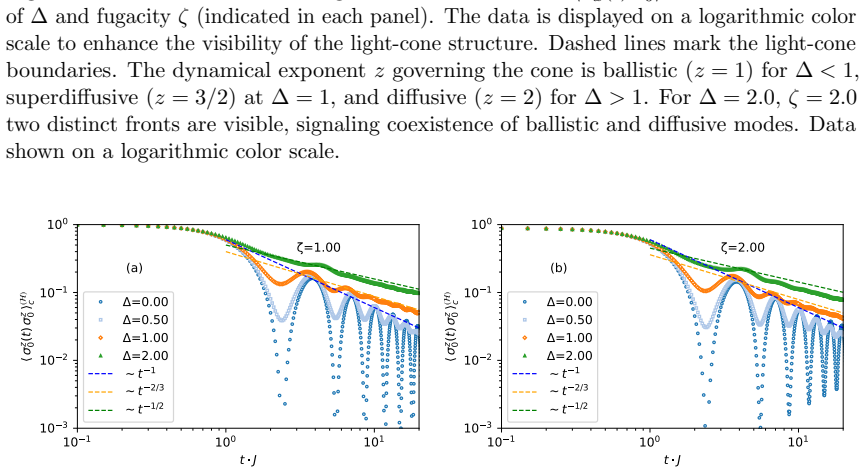
- Longitudinal correlators reproduce ballistic, KPZ superdiffusive, and diffusive scaling according to the anisotropy, with an additional ballistic light cone from magnons at finite magnetization.
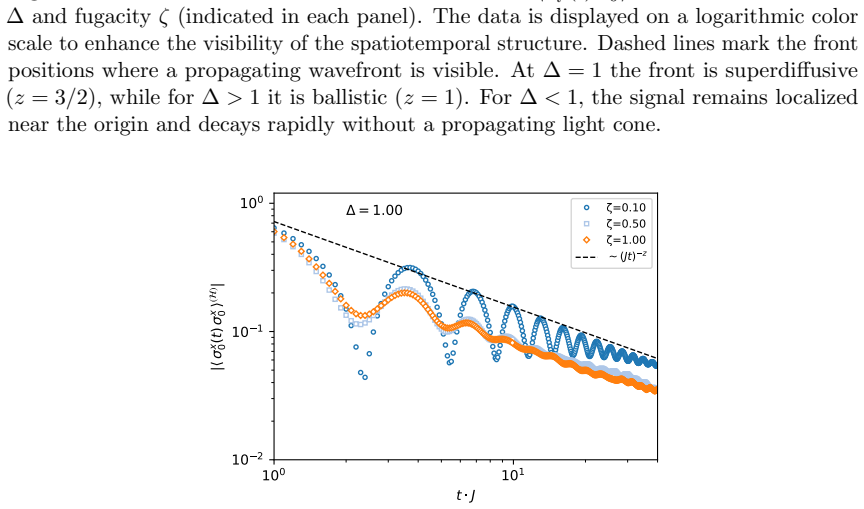
- Transverse correlators show fast exponential decay without wavefront in the easy-plane regime, KPZ scaling at the isotropic point due to SU(2) symmetry, and ballistic spreading in the easy-axis regime.
- All universality classes remain unchanged at early times under the Lindblad evolution.
- Correlations acquire an overall exponential damping in the long-time limit regardless of the early-time class.
Where Pith is reading between the lines
- The separation of early-time scaling from late-time damping suggests dissipation can be tuned to set correlation lifetimes without changing short-time transport exponents.
- Magnon-induced ballistic fronts at finite magnetization may be directly detectable in quantum simulators such as trapped-ion or Rydberg arrays with engineered loss.
- The results imply that similar preservation-plus-damping behavior could appear in other open interacting spin models, offering a route to stabilize transient dynamical phases.
Load-bearing premise
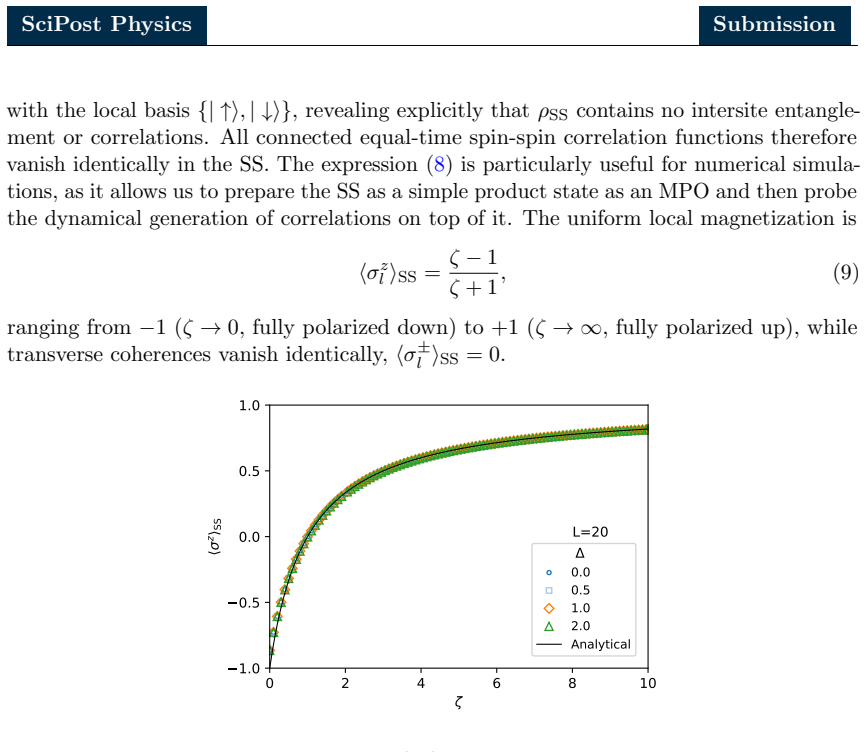
The mixed steady state is featureless except for its finite magnetization, so all dynamical structure in the two-point correlators arises solely from the time evolution.
What would settle it
Numerical or experimental data showing that early-time scaling exponents for longitudinal or transverse correlators deviate from the known unitary XXZ values, or that long-time decay lacks uniform exponential damping independent of the universality class.
Figures






read the original abstract
We study dynamical spin correlations in a dissipative XXZ spin chain subject to uniform local spin-loss and pumping. Starting from a mixed steady state that is featureless albeit possessing finite magnetization, rich dynamics emerges in time-dependent two-point correlators evaluated on top of it. For unitary evolution in which the reservoir is absent, the longitudinal correlators reproduce the established hierarchy of spin-transport universality classes - ballistic, Kardar-Parisi-Zhang (KPZ) superdiffusive, and diffusive - across the phase diagram. However, for finite magnetization, additional ballistic light cone propagation gets superimposed on the previous universality classes, arising from magnon propagation.The transverse correlator displays very fast, exponential decay of correlations without wavefront propagation in the easy-plane case. At the isotropic point, it follows KPZ scaling due to $SU(2)$ symmetry, while in the easy-axis regime, it is characterized by ballistic spreading of correlations. Under full Lindbladian dynamics, the universality classes are preserved at early times, while the correlations acquire an overall exponential damping in the long-time limit. In terms of methods, we have used vectorized TEBD for numerical simulations and exact analytical results obtained via a Pfaffian representation and the third-quantization framework for the noninteracting XX case.
Editorial analysis
A structured set of objections, weighed in public.
Referee Report
Summary. The paper studies dynamical two-point spin correlations in an open XXZ chain governed by a Lindblad master equation with uniform local spin-loss and pumping. Starting from a mixed, featureless steady state possessing finite magnetization, the authors compare unitary evolution (reproducing the known ballistic/KPZ/diffusive hierarchy, plus magnon-induced ballistic light cones at finite magnetization) to the full dissipative case. They report that the unitary universality classes survive at early times while long-time correlations acquire an overall exponential damping; transverse correlators exhibit regime-dependent behavior (fast exponential decay without wavefronts in the easy-plane limit, KPZ at the isotropic point, ballistic spreading in the easy-axis regime). Methods combine vectorized TEBD numerics with exact Pfaffian and third-quantization analytics in the XX limit.
Significance. If the central claims hold, the work clarifies how continuous dissipation interacts with transport universality classes in quantum spin chains, showing that early-time scaling can remain intact before damping dominates. The combination of tensor-network numerics and exact solutions for the non-interacting limit provides a useful benchmark for open-system dynamics, with potential relevance to experiments in quantum simulators or cold-atom setups with engineered dissipation.
major comments (2)
- [Abstract and numerical methods] Abstract and numerical-methods section: The central claim that unitary universality classes (ballistic/KPZ/diffusive) are preserved at early times under continuous Lindblad evolution requires explicit verification of a dissipation-independent time window. The manuscript does not report quantitative checks—such as extracted exponents versus the unitary case for multiple dissipation rates, or bounds on the dissipative strength relative to the fitting interval—leaving the time-scale separation unverified despite the skeptic note that the superoperator acts from t=0.
- [Results on transverse correlators] Results on transverse correlators: The regime-dependent claims (exponential decay without wavefronts for easy-plane, KPZ at isotropy, ballistic for easy-axis) are load-bearing for the overall picture yet lack explicit linkage to data panels, scaling collapses, or error estimates on the extracted exponents; without these, it is difficult to assess whether the reported behaviors are robust or sensitive to fitting choices.
minor comments (3)
- [Abstract and methods] Abstract and methods: No error bars, bond-dimension convergence data, or time-step validation are provided for the vectorized TEBD simulations, which would be needed to support the reported scaling exponents.
- [Setup] Setup section: More explicit verification that the mixed steady state is indeed featureless (e.g., vanishing steady-state two-point correlations beyond the imposed magnetization) would clarify that the observed dynamics arise purely from the time evolution rather than hidden initial-state structure.
- [Figures] Figures: Scaling plots and light-cone visualizations would benefit from overlaid unitary reference curves and quantitative insets showing the onset of exponential damping, improving readability and direct comparison.
Simulated Author's Rebuttal
We thank the referee for the careful reading of our manuscript and the constructive comments. We address each major point below and describe the revisions we will implement to strengthen the presentation and verification of our claims.
read point-by-point responses
-
Referee: [Abstract and numerical methods] Abstract and numerical-methods section: The central claim that unitary universality classes (ballistic/KPZ/diffusive) are preserved at early times under continuous Lindblad evolution requires explicit verification of a dissipation-independent time window. The manuscript does not report quantitative checks—such as extracted exponents versus the unitary case for multiple dissipation rates, or bounds on the dissipative strength relative to the fitting interval—leaving the time-scale separation unverified despite the skeptic note that the superoperator acts from t=0.
Authors: We agree that the time-scale separation between early-time unitary-like dynamics and late-time damping merits more explicit quantitative support. In the revised manuscript we will add a dedicated analysis (new figure panel and accompanying text) that extracts the effective transport exponents from the longitudinal correlators for several small values of the dissipation rate γ. These will be compared directly to the unitary (γ=0) benchmarks, with explicit bounds on the fitting time windows chosen such that t ≪ 1/γ. This will demonstrate that the unitary universality classes are recovered within a dissipation-independent window before exponential damping becomes appreciable. revision: yes
-
Referee: [Results on transverse correlators] Results on transverse correlators: The regime-dependent claims (exponential decay without wavefronts for easy-plane, KPZ at isotropy, ballistic for easy-axis) are load-bearing for the overall picture yet lack explicit linkage to data panels, scaling collapses, or error estimates on the extracted exponents; without these, it is difficult to assess whether the reported behaviors are robust or sensitive to fitting choices.
Authors: We acknowledge that the transverse-correlator results would benefit from clearer figure references and quantitative error analysis. In the revision we will (i) explicitly cite the relevant data panels for each regime, (ii) include scaling-collapse plots for the KPZ and ballistic cases, and (iii) report error estimates on the fitted exponents obtained from multiple system sizes and fitting windows. These additions will allow readers to evaluate the robustness of the reported behaviors. revision: yes
Circularity Check
No circularity; claims rest on independent numerical and exact computations
full rationale
The paper derives its results on preserved early-time universality classes and long-time damping directly from vectorized TEBD simulations of the Lindbladian dynamics and from exact Pfaffian/third-quantization solutions for the XX limit. These are forward computations of correlators from the master equation starting at the featureless mixed steady state; no parameters are fitted to the target scaling exponents, no self-citations supply load-bearing uniqueness theorems, and no ansatz is smuggled in. The time-dependent two-point functions are evaluated explicitly rather than being redefined or renamed from prior inputs. The skeptic concern about explicit verification of a dissipation-independent window is a question of numerical evidence strength, not a reduction of the derivation to its own assumptions by construction.
Axiom & Free-Parameter Ledger
Reference graph
Works this paper leans on
-
[1]
M. Rigol, V. Dunjko and M. Olshanii,Thermalization and its mechanism for generic isolated quantum systems, Nature452, 854 (2008), doi:10.1038/nature06838
-
[2]
A. Polkovnikov, K. Sengupta, A. Silva and M. Vengalattore,Colloquium: Nonequilib- rium dynamics of closed interacting quantum systems, Rev. Mod. Phys.83(3), 863 (2011), doi:10.1103/RevModPhys.83.863
-
[3]
I. Bloch, J. Dalibard and W. Zwerger,Many-body physics with ultracold gases, Rev. Mod. Phys.80, 885 (2008), doi:10.1103/RevModPhys.80.885
-
[4]
C. Gross and I. Bloch,Quantum simulations with ultracold atoms in optical lattices, Science357, 995 (2017), doi:10.1126/science.aal3837
-
[5]
J. T. Barreiro, M. M¨ uller, P. Schindler, D. Nigg, T. Monz, M. Chwalla, M. Hennrich, C. F. Roos, P. Zoller and R. Blatt,An open-system quantum simulator with trapped ions, Nature470(7335), 486 (2011), doi:10.1038/nature09801. 27 SciPost Physics Submission
-
[6]
F. Verstraete, M. M. Wolf and J. I. Cirac,Quantum computation and quantum-state engineering driven by dissipation, Nat. Phys.5(9), 633 (2009), doi:10.1038/nphys1342
-
[7]
L. M. Sieberer, M. Buchhold and S. Diehl,Keldysh field theory for driven open quantum systems, Rep. Prog. Phys.79(9), 096001 (2016), doi:10.1088/0034-4885/79/9/096001
-
[8]
C. N. Yang and C. P. Yang,One-dimensional chain of anisotropic spin- spin interactions. I. Proof of Bethe’s hypothesis, Phys. Rev.150, 321 (1966), doi:10.1103/PhysRev.150.321
-
[9]
M. Takahashi,Thermodynamics of One-Dimensional Solvable Models, Cambridge University Press, Cambridge, doi:10.1017/CBO9780511524332 (1999)
-
[10]
T. Giamarchi,Quantum physics in one dimension, vol. 121, Clarendon press, doi:10.1093/acprof:oso/9780198525004.001.0001 (2003)
work page doi:10.1093/acprof:oso/9780198525004.001.0001 2003
-
[11]
O. A. Castro-Alvaredo, B. Doyon and T. Yoshimura,Emergent hydrodynamics in integrable quantum systems out of equilibrium, Phys. Rev. X6(4), 041065 (2016), doi:10.1103/PhysRevX.6.041065
-
[12]
B. Bertini, M. Collura, J. De Nardis and M. Fagotti,Transport in out-of-equilibrium XXZ chains: Exact profiles of charges and currents, Phys. Rev. Lett.117(20), 207204 (2016), doi:10.1103/PhysRevLett.117.207204
-
[13]
J.-S. Caux,The quench action, J. Stat. Mech: Theory Exp. p. 064006 (2016), doi:10.1088/1742-5468/2016/06/064006
-
[14]
Doyon,Lecture notes on generalised hydrodynamics, SciPost Physics Lecture Notes p
B. Doyon,Lecture notes on generalised hydrodynamics, SciPost Physics Lecture Notes p. 18 (2020), doi:10.21468/SciPostPhysLectNotes.18
-
[15]
M. Ljubotina, M. ˇZnidariˇ c and T. Prosen,Kardar-Parisi-Zhang physics in the quantum Heisenberg magnet, Phys. Rev. Lett.122(21), 210602 (2019), doi:10.1103/PhysRevLett.122.210602
-
[16]
E. Ilievski, J. De Nardis, M. Medenjak and T. Prosen,Superdiffusion in one- dimensional quantum lattice models, Phys. Rev. Lett.121(23), 230602 (2018), doi:10.1103/PhysRevLett.121.230602
-
[17]
J. De Nardis, S. Gopalakrishnan, E. Ilievski and R. Vasseur,Superdiffusion from emergent classical solitons in quantum spin chains, Phys. Rev. Lett.125, 070601 (2020), doi:10.1103/PhysRevLett.125.070601
-
[18]
V. B. Bulchandani,Kardar-Parisi-Zhang universality from soft gauge modes, Phys. Rev. B101(4), 041411 (2020), doi:10.1103/PhysRevB.101.041411
-
[19]
X. Zotos, F. Naef and P. Prelovˇ sek,Transport and conservation laws, Phys. Rev. B 55(16), 11029 (1997), doi:10.1103/PhysRevB.55.11029
-
[20]
B. Bertini, F. Heidrich-Meisner, C. Karrasch, T. Prosen, R. Steinigeweg and M. ˇZnidariˇ c,Finite-temperature transport in one-dimensional quantum lattice models, Rev. Mod. Phys.93(2), 025003 (2021), doi:10.1103/RevModPhys.93.025003
-
[21]
On the generators of quantum dynamical sem igroups
G. Lindblad,On the generators of quantum dynamical semigroups, Commun. Math. Phys.48(2), 119 (1976), doi:10.1007/BF01608499
-
[22]
Completely Positive Dynamical Semigroups of N-Level Systems,
V. Gorini, A. Kossakowski and E. C. G. Sudarshan,Completely positive dynamical semigroups of n-level systems, J. Math. Phys.17(5), 821 (1976), doi:10.1063/1.522979. 28 SciPost Physics Submission
-
[23]
H.-P. Breuer and F. Petruccione,The Theory of Open Quantum Systems, Oxford University Press, Oxford, doi:10.1093/acprof:oso/9780199213900.001.0001 (2002)
work page doi:10.1093/acprof:oso/9780199213900.001.0001 2002
-
[24]
T. Prosen,Open XXZ spin chain: Nonequilibrium steady state and a strict bound on ballistic transport, Phys. Rev. Lett.107(13), 137201 (2011), doi:10.1103/PhysRevLett.107.137201
-
[25]
ˇZnidariˇ c,Spin transport in a one-dimensional anisotropic Heisenberg model, Phys
M. ˇZnidariˇ c,Spin transport in a one-dimensional anisotropic Heisenberg model, Phys. Rev. Lett.106(22), 220601 (2011), doi:10.1103/PhysRevLett.106.220601
-
[26]
T. Prosen and M. ˇZnidariˇ c,Diffusive high-temperature transport in the one-dimensional Hubbard model, Phys. Rev. B86(12), 125118 (2012), doi:10.1103/PhysRevB.86.125118
-
[27]
Lax,Formal theory of quantum fluctuations from a driven state, Phys
M. Lax,Formal theory of quantum fluctuations from a driven state, Phys. Rev.129(5), 2342 (1963), doi:10.1103/PhysRev.129.2342
-
[28]
H. J. Carmichael,An Open Systems Approach to Quantum Optics, vol. 18 ofLecture Notes in Physics, Springer, Berlin, doi:10.1007/978-3-540-47620-7 (1993)
-
[29]
V. Alba and F. Carollo,Spreading of correlations in markovian open quantum systems, Phys. Rev. B103(2), L020302 (2021), doi:10.1103/PhysRevB.103.L020302
-
[30]
X. Turkeshi and M. Schir´ o,Diffusion and thermalization in a boundary-driven dephased XXZ chain, Phys. Rev. B104, 144301 (2021), doi:10.1103/PhysRevB.104.144301
-
[31]
F. Weiner, P. Schmitteckert, S. Bera and F. Evers,High-temperature spin dy- namics in the Heisenberg chain: Magnon propagation and emerging Kardar-Parisi- Zhang scaling in the zero-magnetization limit, Phys. Rev. B101, 045115 (2020), doi:10.1103/PhysRevB.101.045115
-
[32]
ˇZ. Krajnik and T. Prosen,Kardar–parisi–zhang physics in integrable rotationally symmetric dynamics on discrete space–time lattice, J. Stat. Phys.179(1), 110 (2020), doi:10.1007/s10955-020-02523-1
-
[33]
C. P. Moca, M. A. Werner, A. Valli, T. Prosen and G. Zar´ and,Kardar-Parisi- Zhang scaling in the Hubbard model, Phys. Rev. B108(23), 235139 (2023), doi:10.1103/PhysRevB.108.235139
-
[34]
M. Zwolak and G. Vidal,Mixed-state dynamics in one-dimensional quantum lattice systems: A time-dependent superoperator renormalization algorithm, Phys. Rev. Lett. 93, 207205 (2004), doi:10.1103/PhysRevLett.93.207205
-
[35]
S. Paeckel, T. K¨ ohler, A. Swoboda, S. R. Manmana, U. Schollw¨ ock and C. Hubig, Time-evolution methods for matrix-product states, Ann. Phys. (N. Y.)411, 167998 (2019), doi:10.1016/j.aop.2019.167998
-
[36]
C. P. Moca, M. A. Werner,¨O. Legeza, T. Prosen, M. Kormos and G. Zar´ and,Simulating Lindbladian evolution with non-Abelian symmetries: Ballistic front propagation in the SU(2) Hubbard model with a localized loss, Phys. Rev. B105(19), 195144 (2022), doi:10.1103/PhysRevB.105.195144
-
[37]
Prosen,Third quantization: a general method to solve master equations analytically, New J
T. Prosen,Third quantization: a general method to solve master equations analytically, New J. Phys.10(4), 043026 (2008), doi:10.1088/1367-2630/10/4/043026
-
[38]
H. Weimer, A. Kshetrimayum and R. Or´ us,Simulation methods for open quantum many-body systems, Rev. Mod. Phys.93, 015008 (2021), doi:10.1103/RevModPhys.93.015008. 29 SciPost Physics Submission
-
[39]
S. Diehl, A. Micheli, A. Kantian, B. Kraus, H. P. B¨ uchler and P. Zoller,Quantum states and phases in driven open quantum systems with cold atoms, Nat. Phys.4(11), 878 (2008), doi:10.1038/nphys1073
-
[40]
F. Damanet, D. Braun and J. Martin,Atom-only descriptions of the driven-dissipative dicke model, Phys. Rev. A99(3), 033845 (2019), doi:10.1103/PhysRevA.99.033845
-
[41]
F. H. L. Essler and M. Fagotti,Quench dynamics and relaxation in isolated inte- grable quantum spin chains, J. Stat. Mech: Theory Exp.2016(6), 064002 (2016), doi:10.1088/1742-5468/2016/06/064002
-
[42]
H. Spohn,Fluctuating hydrodynamics approach to equilibrium time correlations for anharmonic chains, In S. Lepri, ed.,Thermal Transport in Low Dimensions: From Statistical Physics to Nanoscale Heat Transfer, vol. 921 ofLecture Notes in Physics, pp. 107–158. Springer International Publishing, Cham, doi:10.1007/978-3-319-29261-8 3 (2016)
-
[43]
J. De Nardis, D. Bernard and B. Doyon,Diffusion in generalized hy- drodynamics and quasiparticle scattering, SciPost Phys.6(4), 049 (2019), doi:10.21468/SciPostPhys.6.4.049
-
[45]
U. Schollw¨ ock,The density-matrix renormalization group in the age of matrix product states, Ann. Phys. (N. Y.)326(1), 96 (2011), doi:10.1016/j.aop.2010.09.012
-
[46]
F. Verstraete, V. Murg and J. I. Cirac,Matrix product states, projected entangled pair states, and variational renormalization group methods for quantum spin systems, Adv. Phys.57(2), 143 (2008), doi:10.1080/14789940801912366
-
[47]
Interaction-induced asymmetry in infinite-temperature dynamical correlations of hard-core anyons
D. Sticlet, O. I. Pˆ at ¸u, B. D´ ora and C. P. Moca,Interaction-induced asymmetry in infinite-temperature dynamical correlations of hard-core anyons(2026),2604.20697
work page internal anchor Pith review Pith/arXiv arXiv 2026
-
[48]
Vidal,Classical simulation of infinite-size quantum lattice systems in one spatial dimension, Phys
G. Vidal,Classical simulation of infinite-size quantum lattice systems in one spatial dimension, Phys. Rev. Lett.98(7), 070201 (2007), doi:10.1103/PhysRevLett.98.070201
-
[49]
M. Dupont and J. E. Moore,Universal spin dynamics in infinite-temperature one-dimensional quantum magnets, Phys. Rev. B101(12), 121109 (2020), doi:10.1103/PhysRevB.101.121109
-
[50]
ˇZnidariˇ c,Coexistence of diffusive and ballistic transport in a simple spin ladder, Phys
M. ˇZnidariˇ c,Coexistence of diffusive and ballistic transport in a simple spin ladder, Phys. Rev. Lett.110(7), 070602 (2013), doi:10.1103/PhysRevLett.110.070602
-
[51]
M. Medenjak, J. De Nardis and T. Yoshimura,Exact spin drude weight in the spin- 1 2 Heisenberg XXZ chain, Phys. Rev. X11(2), 021010 (2021), doi:10.1103/PhysRevX.11.021010
-
[52]
S. Gopalakrishnan, D. A. Huse, V. Khemani and R. Vasseur,Hydrodynamics of operator spreading and quasiparticle diffusion in interacting integrable systems, Phys. Rev. B98(22), 220303 (2018), doi:10.1103/PhysRevB.98.220303
-
[53]
M. Ljubotina, M. ˇZnidariˇ c and T. Prosen,Spin diffusion from an inho- mogeneous quench in an integrable system, Nat. Commun.8, 16117 (2017), doi:10.1038/ncomms16117. 30 SciPost Physics Submission
-
[54]
S. Sachdev,Quantum Phase Transitions, Cambridge University Press, Cambridge, doi:10.1017/CBO9780511622540 (2000)
-
[55]
H.-J. Mikeska and A. K. Kolezhuk,One-dimensional magnetism, InQuantum Magnetism, pp. 1–83. Springer, doi:10.1007/BFb0119591 (2004)
-
[56]
Korepin, N
V. Korepin, N. Bogoliubov and A. Izergin,Quantum Inverse Scattering Method and Correlation Functions, Cambridge University Press, Cambridge, UK (1993)
1993
-
[57]
F. Colomo, A. G. Izergin, V. E. Korepin and V. Tognetti,Temperature correlation functions in the XX0 Heisenberg chain. I, Theoretical and Mathematical Physics 94(1), 11 (1993), doi:10.1007/BF01016992
-
[58]
J. Settino, N. Lo Gullo, F. Plastina and A. Minguzzi,Exact Spectral Function of a Tonks-Girardeau Gas in a Lattice, Phys. Rev. Lett.126, 065301 (2021), doi:10.1103/PhysRevLett.126.065301
-
[59]
Wang,Exact dynamical correlations of hard-core anyons in one-dimensional lattices, Phys
Q.-W. Wang,Exact dynamical correlations of hard-core anyons in one-dimensional lattices, Phys. Rev. B105, 205143 (2022), doi:10.1103/PhysRevB.105.205143
-
[60]
O. I. Pˆ at ¸u,Exact spectral function of the Tonks-Girardeau gas at finite temperature, Phys. Rev. A106, 053306 (2022), doi:10.1103/PhysRevA.106.053306
-
[61]
E. Lieb, T. Schultz and D. Mattis,Two soluble models of an antiferromagnetic chain, Ann. Phys-new. York.16(3), 407 (1961), doi:10.1016/0003-4916(61)90115-4
-
[62]
Katsura,Statistical mechanics of the anisotropic linear Heisenberg model, Phys
S. Katsura,Statistical mechanics of the anisotropic linear Heisenberg model, Phys. Rev.127(5), 1508 (1962), doi:10.1103/PhysRev.127.1508
-
[63]
S. B. Bravyi,Lagrangian representation for fermionic linear optics, Proc. Spie.5(3), 216 (2005), doi:10.26421/QIC5.3-4
-
[64]
Calculation of reduced density matrices from correlation functions,
I. Peschel,Calculation of reduced density matrices from correlation functions, J. Phys. A: Math. Gen.36(14), L205 (2003), doi:10.1088/0305-4470/36/14/101
-
[65]
B. M. McCoy, E. Barouch and D. B. Abraham,Spin correlation functions of the x-y model, Phys. Rev. A4(6), 2331 (1971), doi:10.1103/PhysRevA.4.2331
-
[66]
Franchini,An Introduction to Integrable Techniques for One-Dimensional Quantum Systems, vol
F. Franchini,An Introduction to Integrable Techniques for One-Dimensional Quantum Systems, vol. 940 ofLecture Notes in Physics, Springer, doi:10.1007/978-3-319-48487-7 (2017)
-
[67]
A. Sur, D. Jasnow and I. J. Lowe,Spin dynamics for the one-dimensional XY model at infinite temperature, Phys. Rev. B12, 3845 (1975), doi:10.1103/PhysRevB.12.3845
-
[68]
U. Brandt and K. Jacoby,Exact results for the dynamics of one-dimensional spin- systems, Z. Phys. B25(2), 181 (1976), doi:10.1007/BF01320179
-
[69]
J. E. Bunder and R. H. McKenzie,Effect of disorder on quantum phase transitions in anisotropic XY spin chains, Phys. Rev. B60(1), 344 (1999), doi:10.1103/PhysRevB.60.344
-
[70]
E. H. Lieb and D. W. Robinson,The finite group velocity of quantum spin systems, Commun. Math. Phys.28(3), 251 (1972), doi:10.1007/BF01645779. 31 SciPost Physics Submission
-
[71]
S. Bravyi, M. B. Hastings and F. Verstraete,Lieb-Robinson bounds and the generation of correlations and topological quantum order, Phys. Rev. Lett.97(5), 050401 (2006), doi:10.1103/PhysRevLett.97.050401
-
[72]
V. Eisler,Crossover between ballistic and diffusive transport: the quantum exclu- sion process, J. Stat. Mech: Theory Exp.2011, P06007 (2011), doi:10.1088/1742- 5468/2011/06/P06007
-
[73]
V. Eisler and I. Peschel,Entanglement in the XX spin chain with an energy current, Phys. Rev. A89(3), 032321 (2014), doi:10.1103/PhysRevA.89.032321
-
[74]
J. De Nardis, D. Bernard and B. Doyon,Hydrodynamic diffusion in integrable systems, Phys. Rev. Lett.121(16), 160603 (2018), doi:10.1103/PhysRevLett.121.160603
-
[75]
Choi,Positive linear maps on C*-algebras, Canadian J
M.-D. Choi,Positive linear maps on C*-algebras, Canadian J. Math.24(3), 520–529 (1972), doi:10.4153/CJM-1972-044-5
-
[76]
A. Jamio lkowski,Linear transformations which preserve trace and positive semidefinite- ness of operators, Rep. Math. Phys.3(4), 275 (1972), doi:10.1016/0034-4877(72)90011- 0. 32
discussion (0)
Sign in with ORCID, Apple, or X to comment. Anyone can read and Pith papers without signing in.