Recognition: unknown
QuanForge: A Mutation Testing Framework for Quantum Neural Networks
Pith reviewed 2026-05-09 23:44 UTC · model grok-4.3
The pith
QuanForge provides a mutation testing framework for quantum neural networks using statistical killing criteria and nine operators to distinguish test suites and locate weak circuit areas.
A machine-rendered reading of the paper's core claim, the machinery that carries it, and where it could break.
Core claim
QuanForge establishes a mutation testing method for QNNs through statistical mutation killing and nine post-training mutation operators at gate and parameter levels. This enables distinguishing test suites and localizing vulnerable circuit regions, offering insights into data enhancement and structural assessment of QNNs.
What carries the argument
Statistical mutation killing criterion that accounts for randomness in mutations and measurements, together with nine gate- and parameter-level post-training mutation operators.
If this is right
- Test suites can be compared and ranked according to how many mutants they kill.
- Vulnerable regions inside a quantum circuit can be pinpointed for focused improvement.
- Training data can be augmented by targeting the weaknesses revealed through mutation analysis.
- QNN architectures can be assessed and refined using the structural insights from the mutants.
- The framework continues to function under simulated noise levels expected on near-term quantum devices.
Where Pith is reading between the lines
- The same mutation-based evaluation approach could be extended to other quantum machine learning models beyond neural networks.
- Integration with quantum error mitigation techniques might allow the operators to reflect hardware-specific faults more closely.
- Automated repair suggestions for QNN circuits could be derived by analyzing which mutations are hardest to kill.
- A combined classical-quantum mutation testing pipeline might emerge for hybrid quantum-classical systems.
Load-bearing premise
The nine chosen mutation operators adequately represent the kinds of errors that actually arise in quantum circuits and the statistical killing rule correctly handles the randomness from mutations and measurements.
What would settle it
A follow-up run on real quantum hardware where the mutants produced by QuanForge fail to produce error patterns matching observed device noise or gate faults.
Figures

read the original abstract
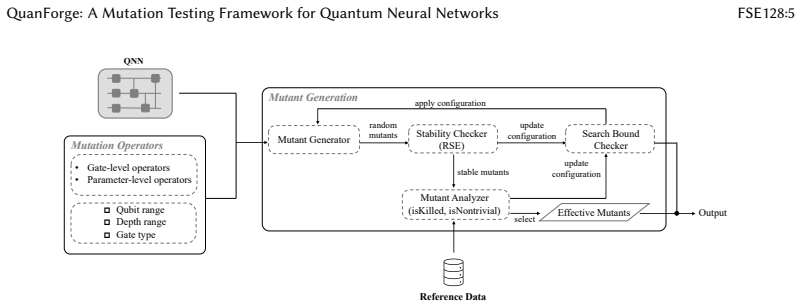
With the growing synergy between deep learning and quantum computing, Quantum Neural Networks (QNNs) have emerged as a promising paradigm by leveraging quantum parallelism and entanglement. However, testing QNNs remains underexplored due to their complex quantum dynamics and limited interpretability. Developing a mutation testing technique for QNNs is promising while requires addressing stochastic factors, including the inherent randomness of mutation operators and quantum measurements. To tackle these challenges, we propose QuanForge, a mutation testing framework specifically designed for QNNs. We first introduce statistical mutation killing to provide a more reliable criterion. QuanForge incorporates nine post-training mutation operators at both gate and parameter levels, capable of simulating various potential errors in quantum circuits. Finally, a mutant generation algorithm is formalized that systematically produces effective mutants, thereby enabling a robust and reliable mutation analysis. Through extensive experiments on benchmark datasets and QNN architectures, we show that QuanForge can effectively distinguish different test suites and localize vulnerable circuit regions, providing insights for data enhancement and structural assessment of QNNs. We also analyze the generation capabilities of different operators and evaluate performance under simulated noisy conditions to assess the practical feasibility of QuanForge for future quantum devices.
Editorial analysis
A structured set of objections, weighed in public.
Referee Report
Summary. The manuscript proposes QuanForge, a mutation testing framework for Quantum Neural Networks (QNNs). It introduces a statistical mutation killing criterion to handle stochasticity arising from mutation operators and quantum measurements, defines nine post-training mutation operators operating at gate and parameter levels to simulate potential circuit errors, and formalizes a mutant generation algorithm. Experiments on benchmark datasets and various QNN architectures are presented to demonstrate that the framework can distinguish different test suites, localize vulnerable circuit regions, analyze the generation capabilities of individual operators, and evaluate performance under simulated noisy conditions, thereby offering insights for data enhancement and structural assessment of QNNs.
Significance. If the experimental results hold with appropriate quantitative support and controls, this work represents a meaningful contribution to quantum software engineering by providing the first dedicated mutation testing approach tailored to QNNs. The explicit treatment of stochastic factors via the statistical killing criterion and the concrete set of post-training operators are practical strengths that could support more reliable development and validation of quantum machine learning models as hardware matures.
minor comments (2)
- [Abstract] The abstract contains the grammatically awkward phrase 'while requires addressing'; this should be rephrased for clarity (e.g., 'but requires addressing').
- A summary table listing the nine mutation operators, their levels (gate/parameter), and intended error types would improve readability and allow readers to quickly compare their effects.
Simulated Author's Rebuttal
We thank the referee for their positive summary of our work and for recommending minor revision. The referee's description accurately reflects the key elements of QuanForge, including the statistical mutation killing criterion, the nine post-training operators, and the experimental evaluation on benchmark QNNs. No major comments were raised in the report.
Circularity Check
No significant circularity; claims rest on novel framework and experiments
full rationale
The paper introduces QuanForge as a new mutation testing framework for QNNs, defining statistical mutation killing, nine post-training operators at gate/parameter levels, and a mutant generation algorithm. Effectiveness claims are supported by experiments on benchmark datasets and architectures rather than any derivation that reduces to its own inputs by construction. No self-definitional steps, fitted inputs renamed as predictions, or load-bearing self-citations appear in the provided text. The central results (distinguishing test suites, localizing vulnerable regions) are presented as empirical outcomes of the proposed method, making the derivation self-contained against external benchmarks.
Axiom & Free-Parameter Ledger
axioms (1)
- domain assumption Quantum measurements and mutations introduce inherent stochasticity that requires statistical handling for reliable testing
invented entities (2)
-
Statistical mutation killing criterion
no independent evidence
-
Nine post-training mutation operators
no independent evidence
Reference graph
Works this paper leans on
-
[1]
https://quantum.cloud.ibm.com/learning/en/courses/utility-scale- quantum-computing/error-mitigation
2024.IBM: Quantum noise and error mitigation. https://quantum.cloud.ibm.com/learning/en/courses/utility-scale- quantum-computing/error-mitigation
2024
-
[2]
https://github.com/KangHaiYue/partial-QEC-QVC
2025.Implementations of quantum noise. https://github.com/KangHaiYue/partial-QEC-QVC
2025
-
[3]
https://quantum.cloud.ibm.com/docs/en/guides/build-noise-models
2026.IBM: Build noise models. https://quantum.cloud.ibm.com/docs/en/guides/build-noise-models
2026
-
[4]
https://docs.pennylane.ai/en/stable/code/api/pennylane.NoiseModel.html
2026.PennyLane: NoiseModel. https://docs.pennylane.ai/en/stable/code/api/pennylane.NoiseModel.html
2026
-
[5]
Shaukat Ali, Paolo Arcaini, Xinyi Wang, and Tao Yue. 2021. Assessing the effectiveness of input and output coverage criteria for testing quantum programs. In2021 14th IEEE Conference on Software Testing, Verification and Validation (ICST). IEEE, 13–23
2021
-
[6]
Utkarsh Azad and Animesh Sinha. 2023. qLEET: visualizing loss landscapes, expressibility, entangling power and training trajectories for parameterized quantum circuits.Quantum Inf. Process.22, 6 (2023), 256. https://doi.org/10. 1007/S11128-023-03998-Z
2023
-
[7]
PennyLane: Automatic differentiation of hybrid quantum-classical computations
Ville Bergholm, Josh A. Izaac, Maria Schuld, Christian Gogolin, and Nathan Killoran. 2018. PennyLane: Automatic differentiation of hybrid quantum-classical computations.CoRRabs/1811.04968 (2018). arXiv:1811.04968 http: //arxiv.org/abs/1811.04968
work page internal anchor Pith review arXiv 2018
-
[8]
Nature549(7671), 195–202 (2017) https://doi.org/10.1038/nature23474
Jacob D. Biamonte, Peter Wittek, Nicola Pancotti, Patrick Rebentrost, Nathan Wiebe, and Seth Lloyd. 2017. Quantum machine learning.Nat.549, 7671 (2017), 195–202. https://doi.org/10.1038/NATURE23474
-
[9]
Gilles Blanchard, Gyemin Lee, and Clayton Scott. 2011. Generalizing from Several Related Classification Tasks to a New Unlabeled Sample. InAdvances in Neural Information Processing Systems 24: 25th Annual Conference on Neural Information Processing Systems 2011. Proceedings of a meeting held 12-14 December 2011, Granada, Spain, John Shawe-Taylor, Richard ...
2011
-
[10]
Marco Cerezo, Guillaume Verdon, Hsin-Yuan Huang, Lukasz Cincio, and Patrick J. Coles. 2022. Challenges and opportunities in quantum machine learning.Nat. Comput. Sci.2, 9 (2022), 567–576. https://doi.org/10.1038/S43588- 022-00311-3
-
[11]
Zico Kolter
Jeremy Cohen, Elan Rosenfeld, and J. Zico Kolter. 2019. Certified Adversarial Robustness via Randomized Smoothing. InProceedings of the 36th International Conference on Machine Learning, ICML 2019, 9-15 June 2019, Long Beach, California, USA (Proceedings of Machine Learning Research), Kamalika Chaudhuri and Ruslan Salakhutdinov (Eds.). PMLR, 1310–1320. ht...
2019
-
[12]
Iris Cong, Soonwon Choi, and Mikhail D. Lukin. 2018. Quantum convolutional neural networks.Nature Physics15 (2018), 1273 – 1278
2018
-
[13]
Evandro Chagas Ribeiro da Rosa, Eduardo Inacio Duzzioni, and Rafael de Santiago. 2025. Optimizing Gate Decomposi- tion for High-Level Quantum Programming.Quantum9 (2025), 1659. https://doi.org/10.22331/Q-2025-03-12-1659
- [14]
-
[15]
Yuxuan Du, Zhuozhuo Tu, Xiao Yuan, and Dacheng Tao. 2022. Efficient measure for the expressivity of variational quantum algorithms.Physical Review Letters128, 8 (2022), 080506
2022
-
[16]
Daniel Fortunato, José Campos, and Rui Abreu. 2022. Mutation testing of quantum programs: A case study with Qiskit. IEEE Transactions on Quantum Engineering3 (2022), 1–17
2022
-
[17]
Daniel Fortunato, José Campos, and Rui Abreu. 2022. QMutPy: a mutation testing tool for Quantum algorithms and applications in Qiskit. InISSTA ’22: 31st ACM SIGSOFT International Symposium on Software Testing and Analysis, Virtual Event, South Korea, July 18 - 22, 2022, Sukyoung Ryu and Yannis Smaragdakis (Eds.). ACM, 797–800. https: //doi.org/10.1145/353...
-
[18]
Ali Ghanbari, Deepak-George Thomas, Muhammad Arbab Arshad, and Hridesh Rajan. 2023. Mutation-based Fault Localization of Deep Neural Networks. In38th IEEE/ACM International Conference on Automated Software Engineering, ASE 2023, Luxembourg, September 11-15, 2023. IEEE, 1301–1313. https://doi.org/10.1109/ASE56229.2023.00171
-
[19]
Sinhué García Gil, Luis Llana Díaz, and José Ignacio Requeno Jarabo. 2024. QCRMut: Quantum Circuit Random Mutant generator tool.CoRRabs/2410.01415 (2024). https://doi.org/10.48550/ARXIV.2410.01415 arXiv:2410.01415
-
[20]
Maxwell Henderson, Samriddhi Shakya, Shashindra Pradhan, and Tristan Cook. 2020. Quanvolutional neural networks: powering image recognition with quantum circuits.Quantum Mach. Intell.2, 1 (2020), 1–9. https://doi.org/10.1007/ S42484-020-00012-Y
2020
-
[21]
Wassily Hoeffding. 1963. Probability inequalities for sums of bounded random variables.Journal of the American statistical association58, 301 (1963), 13–30
1963
-
[22]
Shahin Honarvar, Mohammad Reza Mousavi, and Rajagopal Nagarajan. 2020. Property-based testing of quantum programs in Q#. InProceedings of the IEEE/ACM 42nd International Conference on Software Engineering Workshops. 430–435. Proc. ACM Softw. Eng., Vol. 3, No. FSE, Article FSE128. Publication date: July 2026. FSE128:22 Minqi Shao, Shangzhou Xia, and Jianjun Zhao
2020
-
[23]
Nargiz Humbatova, Gunel Jahangirova, and Paolo Tonella. 2021. DeepCrime: mutation testing of deep learning systems based on real faults. InISSTA ’21: 30th ACM SIGSOFT International Symposium on Software Testing and Analysis, Virtual Event, Denmark, July 11-17, 2021, Cristian Cadar and Xiangyu Zhang (Eds.). ACM, 67–78. https: //doi.org/10.1145/3460319.3464825
-
[24]
Tak Hur, Leeseok Kim, and Daniel K. Park. 2022. Quantum convolutional neural network for classical data classification. Quantum Mach. Intell.4, 1 (2022). https://doi.org/10.1007/S42484-021-00061-X
-
[25]
Gunel Jahangirova and Paolo Tonella. 2020. An Empirical Evaluation of Mutation Operators for Deep Learning Systems. In13th IEEE International Conference on Software Testing, Validation and Verification, ICST 2020, Porto, Portugal, October 24-28, 2020. IEEE, 74–84. https://doi.org/10.1109/ICST46399.2020.00018
-
[26]
Yue Jia and Mark Harman. 2011. An Analysis and Survey of the Development of Mutation Testing.IEEE Trans. Software Eng.37, 5 (2011), 649–678. https://doi.org/10.1109/TSE.2010.62
- [27]
-
[28]
Jinhan Kim, Nargiz Humbatova, Gunel Jahangirova, Shin Yoo, and Paolo Tonella. 2025. MuFF: Stable and Sensitive Post- training Mutation Testing for Deep Learning.CoRRabs/2501.09846 (2025). https://doi.org/10.48550/ARXIV.2501.09846 arXiv:2501.09846
-
[29]
Yann LeCun, Léon Bottou, Yoshua Bengio, and Patrick Haffner. 1998. Gradient-based learning applied to document recognition.Proc. IEEE86, 11 (1998), 2278–2324. https://doi.org/10.1109/5.726791
-
[30]
Gushu Li, Yufei Ding, and Yuan Xie. 2019. Tackling the Qubit Mapping Problem for NISQ-Era Quantum Devices. In Proceedings of the Twenty-Fourth International Conference on Architectural Support for Programming Languages and Operating Systems, ASPLOS 2019, Providence, RI, USA, April 13-17, 2019, Iris Bahar, Maurice Herlihy, Emmett Witchel, and Alvin R. Lebe...
-
[31]
Gushu Li, Li Zhou, Nengkun Yu, Yufei Ding, Mingsheng Ying, and Yuan Xie. 2020. Projection-based runtime assertions for testing and debugging quantum programs.Proceedings of the ACM on Programming Languages4, OOPSLA (2020), 1–29
2020
-
[32]
Weikang Li, Zhide Lu, and Dong-Ling Deng. 2022. Quantum Neural Network Classifiers: A Tutorial.CoRR abs/2206.02806 (2022). https://doi.org/10.48550/ARXIV.2206.02806 arXiv:2206.02806
-
[33]
Yuechen Li, Kai-Yuan Cai, and Beibei Yin. 2025. Preparation and Utilization of Mixed States for Testing Quantum Programs.ACM Transactions on Software Engineering and Methodology34, 8 (2025), 1–44
2025
-
[34]
Peixun Long and Jianjun Zhao. 2024. Equivalence, identity, and unitarity checking in black-box testing of quantum programs.Journal of Systems and Software211 (2024), 112000
2024
-
[35]
Peixun Long and Jianjun Zhao. 2024. Testing multi-subroutine quantum programs: From unit testing to integration testing.ACM Transactions on Software Engineering and Methodology33, 6 (2024), 1–61
2024
- [36]
- [37]
-
[38]
Lei Ma, Fuyuan Zhang, Jiyuan Sun, Minhui Xue, Bo Li, Felix Juefei-Xu, Chao Xie, Li Li, Yang Liu, Jianjun Zhao, and Yadong Wang. 2018. DeepMutation: Mutation Testing of Deep Learning Systems. In29th IEEE International Symposium on Software Reliability Engineering, ISSRE 2018, Memphis, TN, USA, October 15-18, 2018, Sudipto Ghosh, Roberto Natella, Bojan Cuki...
-
[39]
Barren plateaus in quantum neural network training landscapes,
Jarrod R. McClean, Sergio Boixo, Vadim N. Smelyanskiy, Ryan Babbush, and Hartmut Neven. 2018. Barren plateaus in quantum neural network training landscapes.CoRRabs/1803.11173 (2018). arXiv:1803.11173 http://arxiv.org/abs/1803. 11173
-
[40]
Eñaut Mendiluze, Shaukat Ali, Paolo Arcaini, and Tao Yue. 2021. Muskit: A Mutation Analysis Tool for Quantum Software Testing. In36th IEEE/ACM International Conference on Automated Software Engineering, ASE 2021, Melbourne, Australia, November 15-19, 2021. IEEE, 1266–1270. https://doi.org/10.1109/ASE51524.2021.9678563
-
[41]
Andriy Miranskyy and Lei Zhang. 2019. On testing quantum programs. In2019 IEEE/ACM 41st International Conference on Software Engineering: New Ideas and Emerging Results (ICSE-NIER). IEEE, 57–60
2019
-
[42]
Kosuke Mitarai, Makoto Negoro, Masahiro Kitagawa, and Keisuke Fujii. 2018. Quantum circuit learning.Physical Review A(2018)
2018
-
[43]
2010.Quantum computation and quantum information
Michael A Nielsen and Isaac L Chuang. 2010.Quantum computation and quantum information. Cambridge university press
2010
-
[44]
Shyambabu Pandey, Nihar Jyoti Basisth, Tushar Sachan, Neha Kumari, and Partha Pakray. 2023. Quantum machine learning for natural language processing application.Physica A: Statistical Mechanics and its Applications627 (2023), 129123. Proc. ACM Softw. Eng., Vol. 3, No. FSE, Article FSE128. Publication date: July 2026. QuanForge: A Mutation Testing Framewor...
2023
-
[45]
Yang, Zachary DeVito, Martin Raison, Alykhan Tejani, Sasank Chilamkurthy, Benoit Steiner, Lu Fang, Junjie Bai, and Soumith Chintala
Adam Paszke, Sam Gross, Francisco Massa, Adam Lerer, James Bradbury, Gregory Chanan, Trevor Killeen, Zeming Lin, Natalia Gimelshein, Luca Antiga, Alban Desmaison, Andreas Köpf, Edward Z. Yang, Zachary DeVito, Martin Raison, Alykhan Tejani, Sasank Chilamkurthy, Benoit Steiner, Lu Fang, Junjie Bai, and Soumith Chintala. 2019. PyTorch: An Imperative Style, H...
2019
-
[46]
Adrián Pérez-Salinas, Alba Cervera-Lierta, Elies Gil-Fuster, and José I. Latorre. 2020. Data re-uploading for a universal quantum classifier.Quantum4 (2020), 226. https://doi.org/10.22331/Q-2020-02-06-226
-
[47]
Arthur Pesah, Marco Cerezo, Samson Wang, Tyler J. Volkoff, Andrew T. Sornborger, and Patrick J. Coles. 2020. Absence of Barren Plateaus in Quantum Convolutional Neural Networks.CoRRabs/2011.02966 (2020). arXiv:2011.02966 https://arxiv.org/abs/2011.02966
-
[48]
Weijun Shen, Jun Wan, and Zhenyu Chen. 2018. MuNN: Mutation Analysis of Neural Networks. In2018 IEEE International Conference on Software Quality, Reliability and Security Companion, QRS Companion 2018, Lisbon, Portugal, July 16-20, 2018. IEEE, 108–115. https://doi.org/10.1109/QRS-C.2018.00032
-
[49]
Mingrui Shi, Haozhen Situ, and Cai Zhang. 2024. Hybrid quantum neural network structures for image multi- classification.Physica Scripta99, 5 (2024), 056012
2024
-
[50]
Bing Sun, Jun Sun, Long H. Pham, and Tie Shi. 2022. Causality-Based Neural Network Repair. In44th IEEE/ACM 44th International Conference on Software Engineering, ICSE 2022, Pittsburgh, PA, USA, May 25-27, 2022. ACM, 338–349. https://doi.org/10.1145/3510003.3510080
- [51]
-
[52]
Jingyi Wang, Guoliang Dong, Jun Sun, Xinyu Wang, and Peixin Zhang. 2019. Adversarial sample detection for deep neural network through model mutation testing. InProceedings of the 41st International Conference on Software Engineering, ICSE 2019, Montreal, QC, Canada, May 25-31, 2019, Joanne M. Atlee, Tevfik Bultan, and Jon Whittle (Eds.). IEEE / ACM, 1245–...
- [53]
-
[54]
Xinyi Wang, Paolo Arcaini, Tao Yue, and Shaukat Ali. 2021. Application of combinatorial testing to quantum programs. In2021 IEEE 21st International Conference on Software Quality, Reliability and Security (QRS). IEEE, 179–188
2021
-
[55]
Xinyi Wang, Paolo Arcaini, Tao Yue, and Shaukat Ali. 2021. Generating failing test suites for quantum programs with search. InInternational symposium on search based software engineering. Springer, 9–25
2021
-
[56]
West, Shu Lok Tsang, Jia Shun Low, Charles D
Maxwell T. West, Shu Lok Tsang, Jia Shun Low, Charles D. Hill, Christopher Leckie, Lloyd C. L. Hollenberg, Sarah M. Erfani, and Muhammad Usman. 2023. Towards quantum enhanced adversarial robustness in machine learning.Nat. Mac. Intell.5, 6 (2023), 581–589. https://doi.org/10.1038/S42256-023-00661-1
-
[57]
Daan Wierstra, Tom Schaul, Tobias Glasmachers, Yi Sun, Jan Peters, and Jürgen Schmidhuber. 2014. Natural evolution strategies.J. Mach. Learn. Res.15, 1 (2014), 949–980. https://doi.org/10.5555/2627435.2638566
-
[58]
Huanhuan Wu, Zheng Li, Zhanqi Cui, and Jianbin Liu. 2022. GenMuNN: A mutation-based approach to repair deep neural network models.Int. J. Model. Simul. Sci. Comput.13, 2 (2022), 2341008:1–2341008:17. https://doi.org/10.1142/ S1793962323410088
2022
-
[59]
Shangzhou Xia, Jianjun Zhao, Fuyuan Zhang, and Xiaoyu Guo. 2025. Quantum Concolic Testing.Proc. ACM Softw. Eng.2, ISSTA (2025), 1146–1166. https://doi.org/10.1145/3728926
-
[60]
Han Xiao, Kashif Rasul, and Roland Vollgraf. 2017. Fashion-MNIST: a Novel Image Dataset for Benchmarking Machine Learning Algorithms.CoRRabs/1708.07747 (2017). arXiv:1708.07747 http://arxiv.org/abs/1708.07747
work page internal anchor Pith review arXiv 2017
-
[61]
Jiaqi Yang, Wei Xie, and Xiaohua Xu. 2025. Stability and Generalization of Quantum Neural Networks.CoRR abs/2501.12737 (2025). https://doi.org/10.48550/ARXIV.2501.12737 arXiv:2501.12737
-
[62]
Jiaming Ye, Shangzhou Xia, Fuyuan Zhang, Paolo Arcaini, Lei Ma, Jianjun Zhao, and Fuyuki Ishikawa. 2023. QuraTest: Integrating Quantum Specific Features in Quantum Program Testing. In38th IEEE/ACM International Conference on Automated Software Engineering, ASE 2023, Luxembourg, September 11-15, 2023. IEEE, 1149–1161. https://doi.org/10. 1109/ASE56229.2023...
discussion (0)
Sign in with ORCID, Apple, or X to comment. Anyone can read and Pith papers without signing in.