Recognition: unknown
Turbulence Mode Decomposition and Anisotropy in Magnetically Dominated Collisionless Plasmas
Pith reviewed 2026-05-09 22:42 UTC · model grok-4.3
The pith
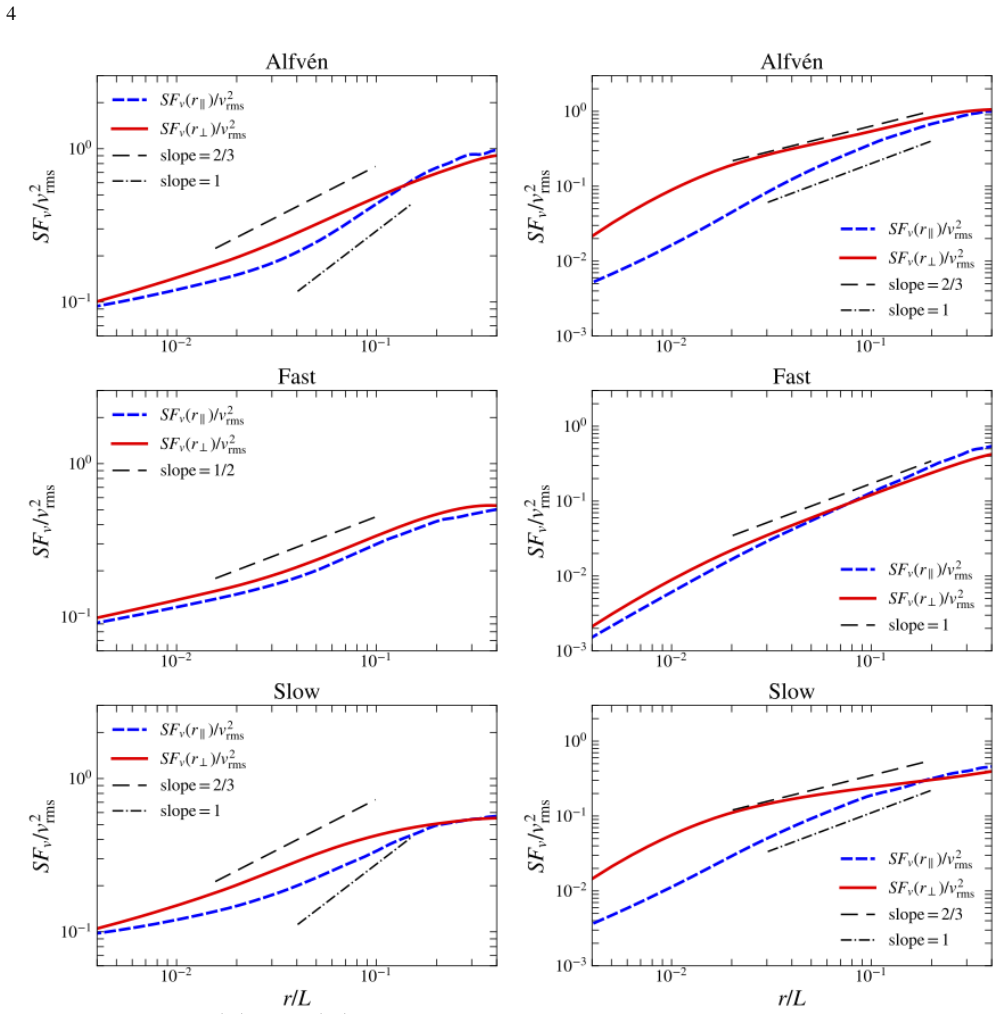
Alfvén and slow modes in relativistic collisionless plasma turbulence follow Goldreich-Sridhar anisotropy scaling while fast modes are isotropic with higher kinetic energy.
A machine-rendered reading of the paper's core claim, the machinery that carries it, and where it could break.
Core claim
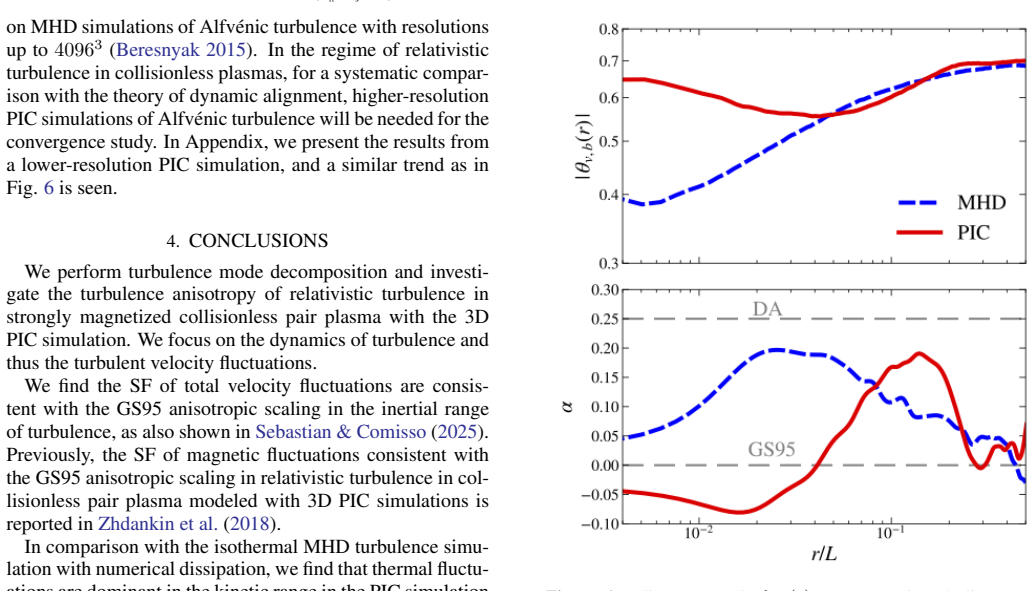
By extending the Cho and Lazarian decomposition to relativistic collisionless plasmas in 3D fully kinetic simulations, the work shows Alfvén and slow modes are anisotropic with Goldreich-Sridhar scaling, fast modes are isotropic, the kinetic energy fraction in fast modes exceeds non-relativistic MHD values suggesting stronger Alfvén-fast coupling, dynamic alignment exhibits weaker scale dependence, and thermal fluctuations flatten the turbulent velocity structure function while weakening anisotropy and alignment near kinetic scales.
What carries the argument
The Cho and Lazarian decomposition method extended to relativistic collisionless plasmas, which separates turbulence into Alfvén, fast, and slow modes to quantify their anisotropy, energy fractions, and scale-dependent alignment.
Load-bearing premise
The Cho and Lazarian decomposition technique developed for non-relativistic MHD turbulence applies to relativistic collisionless plasmas after only minor adjustments and still correctly identifies the physical modes.
What would settle it
A simulation result in which the kinetic energy fraction of fast modes equals the non-relativistic MHD value, or in which fast modes display clear anisotropy instead of isotropy, would contradict the central findings.
Figures




read the original abstract
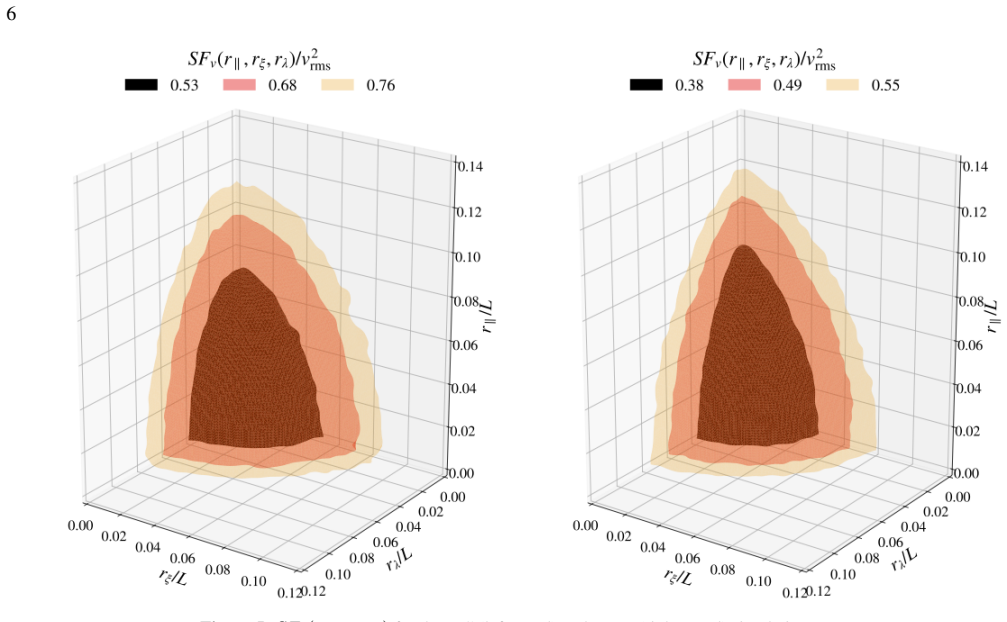
We use the 3D fully kinetic simulation to study different turbulence modes and turbulence anisotropy of relativistic turbulence in magnetically dominated collisionless plasmas. We extend the method developed by Cho & Lazarian (2002) for decomposing non-relativistic magnetohydrodynamic (MHD) turbulence into Alfv\'en, fast, and slow modes to the regime of collisionless plasmas. We find that Alfv\'en and slow modes are anisotropic, following the Goldreich & Sridhar (1995) scaling, while fast modes are isotropic. We observe a larger kinetic energy fraction of fast modes compared to that in the non-relativistic MHD turbulence, suggesting a stronger coupling of Alfv\'en and fast modes in relativistic magnetized turbulence in collisionless plasmas. We further examine the dynamic alignment and find a weaker scale dependence of the alignment angle than previously proposed. The dominant thermal fluctuations in the kinetic range can cause flattening of the turbulent velocity structure function and weakening of the turbulence anisotropy and dynamic alignment near the kinetic scales.
Editorial analysis
A structured set of objections, weighed in public.
Circularity Check
No significant circularity; results extracted from direct simulation diagnostics
full rationale
The paper extends the Cho & Lazarian (2002) decomposition to relativistic collisionless plasmas and applies it to 3D kinetic simulation outputs to measure mode energies, GS95 anisotropy scalings, and dynamic alignment. No equations reduce the reported kinetic energy fractions or anisotropy measurements to quantities defined by fitted parameters or self-referential inputs. The central claims are obtained from Fourier-space projections and structure functions computed on the simulation data itself, with the extension treated as a methodological choice rather than a derivation that collapses to its own assumptions by construction. This keeps the analysis self-contained against external benchmarks.
Axiom & Free-Parameter Ledger
axioms (1)
- domain assumption The Cho & Lazarian (2002) decomposition method applies to relativistic collisionless plasmas
Reference graph
Works this paper leans on
-
[1]
Armstrong, J. W., Rickett, B. J., & Spangler, S. R. 1995, ApJ, 443, 209, doi: 10.1086/175515
-
[2]
2025, The spectrum of magnetized turbulence in the interstellar medium
Bhattacharjee, A. 2025, The spectrum of magnetized turbulence in the interstellar medium. https://doi.org/10.1038/s41550-025-02551-5
-
[3]
Beresnyak, A. 2012, Monthly Notices of the Royal Astronomical Society, 422, 3495, doi: 10.1111/j.1365-2966.2012.20859.x —. 2014, The Astrophysical Journal Letters, 784, L20, doi: 10.1088/2041-8205/784/2/L20 —. 2015, The Astrophysical Journal Letters, 801, L9, doi: 10.1088/2041-8205/801/1/L9
-
[4]
2006, PhRvL, 96, 115002, doi: 10.1103/PhysRevLett.96.115002
Boldyrev, S. 2006, Phys. Rev. Lett., 96, 115002, doi: 10.1103/PhysRevLett.96.115002
-
[5]
Chen, C. H. K., Bale, S. D., Bonnell, J. W., et al. 2020, The Astrophysical Journal Supplement Series, 246, 53, doi: 10.3847/1538-4365/ab60a3
-
[6]
2021, ApJL, 923, L13, doi: 10.3847/2041-8213/ac3afa
Chernoglazov, A., Ripperda, B., & Philippov, A. 2021, ApJL, 923, L13, doi: 10.3847/2041-8213/ac3afa
-
[7]
Cho, J., & Lazarian, A. 2002, Phys. Rev. Lett., 88, 245001, doi: 10.1103/PhysRevLett.88.245001 —. 2003, Monthly Notices of the Royal Astronomical Society, 345, 325, doi: 10.1046/j.1365-8711.2003.06941.x
-
[8]
Cho, J., Lazarian, A., & Vishniac, E. T. 2002, The Astrophysical Journal, 564, 291, doi: 10.1086/324186
-
[9]
Cho, J., & Vishniac, E. T. 2000, The Astrophysical Journal, 539, 273, doi: 10.1086/309213
-
[10]
Comisso, L., Farrar, G. R., & Muzio, M. S. 2024, ApJL, 977, L18, doi: 10.3847/2041-8213/ad955f
-
[11]
Comisso, L., & Sironi, L. 2018, Phys. Rev. Lett., 121, 255101, doi: 10.1103/PhysRevLett.121.255101 —. 2019, The Astrophysical Journal, 886, 122, doi: 10.3847/1538-4357/ab4c33
-
[12]
2021, PhRvL, 127, 255102, doi: 10.1103/PhysRevLett.127.255102
Comisso, L., & Sironi, L. 2021, PhRvL, 127, 255102, doi: 10.1103/PhysRevLett.127.255102
-
[13]
Crutcher, R. M. 2012, Annual Review of Astronomy and Astrophysics, 50, 29, doi: 10.1146/annurev-astro-081811-125514 Del Zanna, L., Bucciantini, N., & Landi, S. 2025, A&A, 702, A171, doi: 10.1051/0004-6361/202556255
-
[14]
2022, Science Advances, 8, eabn7627, doi: 10.1126/sciadv.abn7627
Dong, C., Wang, L., Huang, Y .-M., et al. 2022, Science Advances, 8, eabn7627, doi: 10.1126/sciadv.abn7627
- [15]
-
[16]
1949, Physical Review, 75, 1169, doi: 10.1103/PhysRev.75.1169 21
Fermi, E. 1949, Phys. Rev., 75, 1169, doi: 10.1103/PhysRev.75.1169
-
[17]
Goldreich, P., & Sridhar, H. 1995, The Astrophysical Journal, 438, 763, doi: 10.1086/175121
-
[18]
Hu, Y ., Lazarian, A., & Xu, S. 2022, MNRAS, 512, 2111, doi: 10.1093/mnras/stac319 8
-
[19]
Hu, Y ., Xu, S., Arzamasskiy, L., Stone, J. M., & Lazarian, A. 2024, MNRAS, 527, 3945, doi: 10.1093/mnras/stad3493
-
[20]
2021, ApJ, 911, 37, doi: 10.3847/1538-4357/abea18
Hu, Y ., Xu, S., & Lazarian, A. 2021, ApJ, 911, 37, doi: 10.3847/1538-4357/abea18
-
[21]
Hu, Y ., Xu, S., Lazarian, A., Stone, J. M., & Hopkins, P. F. 2025, The Astrophysical Journal, 994, 142, doi: 10.3847/1538-4357/ae1127
-
[22]
Inoue, T., Asano, K., & Ioka, K. 2011, The Astrophysical Journal, 734, 77, doi: 10.1088/0004-637X/734/2/77
-
[23]
2010, The Astrophysical Journal, 720, 742, doi: 10.1088/0004-637X/720/1/742
Kowal, G., & Lazarian, A. 2010, The Astrophysical Journal, 720, 742, doi: 10.1088/0004-637X/720/1/742
-
[24]
Larson, R. B. 1981, Monthly Notices of the Royal Astronomical Society, 194, 809, doi: 10.1093/mnras/194.4.809
-
[25]
Lazarian, A., & Vishniac, E. T. 1999, The Astrophysical Journal, 517, 700, doi: 10.1086/307174
-
[26]
2001, The Astrophysical Journal, 562, 279, doi: 10.1086/323470
Lithwick, Y ., & Goldreich, P. 2001, The Astrophysical Journal, 562, 279, doi: 10.1086/323470
-
[27]
2026, Acta Mechanica Sinica, 42, 325230, doi: 10.1007/s10409-025-25230-x
Liu, X., Zhao, C., Zhou, Z., Cheng, W., & Si, T. 2026, Acta Mechanica Sinica, 42, 325230, doi: 10.1007/s10409-025-25230-x
-
[28]
2023, Advances in Aerodynamics, 5, 3, doi: 10.1186/s42774-022-00134-w
Ma, Q., Yang, C., Chen, S., Feng, K., & Zhang, J. 2023, Advances in Aerodynamics, 5, 3, doi: 10.1186/s42774-022-00134-w
-
[29]
Maron, J., & Goldreich, P. 2001, Astrophys. J., 554, 1175, doi: 10.1086/321413
-
[30]
Mason, J., Cattaneo, F., & Boldyrev, S. 2006, Phys. Rev. Lett., 97, 255002, doi: 10.1103/PhysRevLett.97.255002
-
[31]
McKee, C. F., & Ostriker, E. C. 2007, Annual Review of Astronomy and Astrophysics, 45, 565, doi: 10.1146/annurev.astro.45.051806.110602 N¨attil¨a, J. 2022, A&A, 664, A68, doi: 10.1051/0004-6361/201937402 —. 2024, Nature Communications, 15, 7026, doi: 10.1038/s41467-024-51257-1 N¨attil¨a, J., & Beloborodov, A. M. 2021, The Astrophysical Journal, 921, 87, d...
-
[32]
Sebastian, S. T., & Comisso, L. 2025, ApJL, 994, L1, doi: 10.3847/2041-8213/ae1696
-
[33]
Stone, J. M., Mullen, P. D., Fielding, D., et al. 2024, arXiv e-prints, arXiv:2409.16053, doi: 10.48550/arXiv.2409.16053
-
[34]
2016, The Astrophysical Journal Letters, 831, L11, doi: 10.3847/2041-8205/831/2/L11 —
Takamoto, M., & Lazarian, A. 2016, The Astrophysical Journal Letters, 831, L11, doi: 10.3847/2041-8205/831/2/L11 —. 2017, Monthly Notices of the Royal Astronomical Society, 472, 4542, doi: 10.1093/mnras/stx2292
-
[35]
TenBarge, J. M., Howes, G. G., Dorland, W., & Hammett, G. W. 2014, Computer Physics Communications, 185, 578, doi: 10.1016/j.cpc.2013.10.022
-
[36]
2023 Review of Solar Energetic Particle Prediction Models
Whitman, K., Egeland, R., Richardson, I. G., et al. 2023, Advances in Space Research, 72, 5161, doi: https://doi.org/10.1016/j.asr.2022.08.006
-
[37]
Yan, H., & Lazarian, A. 2008, The Astrophysical Journal, 673, 942, doi: 10.1086/524771
-
[38]
Zhdankin, V ., Uzdensky, D. A., Werner, G. R., & Begelman, M. C. 2018, MNRAS, 474, 2514, doi: 10.1093/mnras/stx2883
-
[39]
Zrake, J., & MacFadyen, A. I. 2012, The Astrophysical Journal, 744, 32, doi: 10.1088/0004-637X/744/1/32 9 Figure 7.Alignment angleθ v,b(r)(left panel) and alignment slopeα(right panel) measured in PIC simulations with different spatial resolu- tions. APPENDIX We perform a lower-resolution512 3 PIC simulation with the same initial conditions as detailed in...
discussion (0)
Sign in with ORCID, Apple, or X to comment. Anyone can read and Pith papers without signing in.