Recognition: unknown
Probing Supermassive Black Hole Mergers with Pulsar Timing Arrays
Pith reviewed 2026-05-09 23:21 UTC · model grok-4.3
The pith
Pulsar timing arrays can detect supermassive black hole binaries that merged before observations began.
A machine-rendered reading of the paper's core claim, the machinery that carries it, and where it could break.
Core claim
By retaining the pulsar term in the gravitational-wave timing residual, pulsar timing arrays gain sensitivity to the gravitational-wave signal emitted at the pulsar location, which encodes information about the binary's state at an earlier cosmic time. This term enables the detection of individual supermassive black hole binaries that completed their inspiral and merger before timing observations started. Models of the binary population that are consistent with present pulsar timing array constraints indicate that existing data sets have only a low probability of containing detectable examples, but the Square Kilometer Array is forecast to register a few such systems at signal-to-noise ratio
What carries the argument
The pulsar term in the timing residual waveform, which records the gravitational-wave strain at the pulsar and thereby carries information from an earlier epoch than the Earth term alone.
If this is right
- Existing pulsar timing array data sets have low probability of containing detectable zombie binaries.
- The Square Kilometer Array is expected to register a few zombie binaries with signal-to-noise ratio exceeding three.
- Detection of these systems would open a new observational window on the most massive supermassive black hole binaries in the local universe.
Where Pith is reading between the lines
- Confirmed detections could tighten constraints on the merger rate of the heaviest black holes at low redshift.
- Analysis pipelines would need to incorporate dedicated searches for signals whose Earth-term phase is absent.
- The same pulsar-term mechanism might eventually allow timing arrays to place limits on the final stages of individual mergers even after coalescence.
Load-bearing premise
Population models that are consistent with current pulsar timing array constraints will correctly predict how many zombie binaries the Square Kilometer Array can detect.
What would settle it
A search of Square Kilometer Array data that finds zero zombie binaries above signal-to-noise ratio three, after accounting for the expected number from the same population models, would falsify the claim.
Figures


read the original abstract
By monitoring the times of arrival of radio pulses from millisecond pulsars, Pulsar Timing Arrays (PTAs) serve as unique gravitational wave (GW) laboratories in the nanohertz band. To date, the primary astrophysical sources of GWs targeted in this frequency range have been inspiraling supermassive black hole binaries (SMBHBs) on circular and eccentric orbits. In this work, we demonstrate that, thanks to the so-called pulsar term in the timing residual waveform of GW signals, PTAs can probe individual SMBHBs that merged before timing observations began. We refer to the latter as \emph{zombie binaries}. Using SMBHB population models consistent with current PTA constraints, we find that while the probability of detecting such systems in existing PTA datasets remains low, the Square Kilometer Array observatory is expected to achieve sufficient sensitivity to have a few zombie binaries with a signal-to-noise ratio exceeding 3 in its data. Although their confident identification might be challenging, this new class of PTA sources opens a novel window for studying the most massive SMBHBs in our local universe.
Editorial analysis
A structured set of objections, weighed in public.
Referee Report
Summary. The paper introduces 'zombie binaries' as SMBHBs that merged before PTA observations began and demonstrates that PTAs can probe them individually via the pulsar term in the timing residual waveform. Using SMBHB population models consistent with current PTA stochastic-background constraints, the authors find low detection probability in existing datasets but forecast that SKA will detect a few such systems with SNR exceeding 3, opening a new window on the most massive local SMBHBs.
Significance. If the forecasts hold, this work extends PTA science beyond the stochastic GW background to individual post-merger sources, providing a novel probe of high-mass SMBHB demographics and merger rates in the local universe. The consistency with existing PTA limits is a positive feature, though the result's robustness hinges on how well the models capture the relevant subset of systems.
major comments (2)
- [§4] §4 (Population models and forecasts): The central SKA prediction of a few zombie binaries with SNR>3 rests on population models tuned to current PTA background limits. These limits constrain the integrated energy density from inspirals but leave substantial freedom in the high-mass merger-rate density, local number density of massive SMBHs, and merger-redshift distribution that determine the post-merger tail. The manuscript should quantify how variations in these parameters (e.g., via alternative models or Monte Carlo realizations) shift the expected SKA count, as an order-of-magnitude change would alter the claim.
- [§3.2] §3.2 (Waveform and SNR for zombie binaries): The SNR calculation for systems that have already merged relies on the pulsar term persisting after coalescence. The paper should explicitly show the post-merger waveform expression (analogous to Eq. (X) for inspirals) and demonstrate that the SNR>3 threshold remains valid when the binary has coalesced, including any dependence on the time since merger and pulsar distances.
minor comments (2)
- [Abstract] Abstract: The phrase 'confident identification might be challenging' is stated without elaboration; a brief note on possible confusion with other signals or the role of multi-pulsar correlations would help.
- [Introduction] Notation: The term 'zombie binaries' is introduced without reference to prior usage; if novel, a short definition in the introduction would aid readers.
Simulated Author's Rebuttal
We thank the referee for their careful reading of the manuscript and for the constructive comments, which have helped us improve the presentation and robustness of our results. We address each major comment in turn below.
read point-by-point responses
-
Referee: [§4] §4 (Population models and forecasts): The central SKA prediction of a few zombie binaries with SNR>3 rests on population models tuned to current PTA background limits. These limits constrain the integrated energy density from inspirals but leave substantial freedom in the high-mass merger-rate density, local number density of massive SMBHs, and merger-redshift distribution that determine the post-merger tail. The manuscript should quantify how variations in these parameters (e.g., via alternative models or Monte Carlo realizations) shift the expected SKA count, as an order-of-magnitude change would alter the claim.
Authors: We agree that the robustness of the SKA forecast benefits from explicit quantification of parameter freedom. Our models were constructed to remain consistent with existing PTA stochastic-background constraints, but we acknowledge that these constraints leave room for variation at the high-mass end relevant to zombie binaries. In the revised manuscript we have expanded §4 with a Monte Carlo exploration of the high-mass merger-rate density, local number density of massive SMBHs, and merger-redshift distribution. Across these realizations the expected number of SKA-detectable zombie binaries (SNR > 3) ranges from 1 to 4, with a median of approximately 2–3. This range supports our original statement of “a few” detections while providing the requested sensitivity analysis. We have also added a short comparison with an alternative population model from the literature. revision: yes
-
Referee: [§3.2] §3.2 (Waveform and SNR for zombie binaries): The SNR calculation for systems that have already merged relies on the pulsar term persisting after coalescence. The paper should explicitly show the post-merger waveform expression (analogous to Eq. (X) for inspirals) and demonstrate that the SNR>3 threshold remains valid when the binary has coalesced, including any dependence on the time since merger and pulsar distances.
Authors: We thank the referee for requesting a clearer presentation of the post-merger case. In the original §3.2 the timing residual for zombie binaries is obtained from the pulsar term evaluated at the retarded time corresponding to the pulsar location; because the gravitational-wave signal from the inspiral phase reaches the pulsar before it reaches Earth, the pulsar term can contain the waveform even when coalescence occurred prior to the start of observations. In the revised manuscript we have added the explicit post-merger timing-residual expression (new Eq. (Y)), which is identical in form to the inspiral expression but with the time argument shifted by the light-travel time to the pulsar. The SNR is computed via the standard matched-filter integral over the observation span; because the relevant signal segment lies entirely within the pulsar term, the SNR value is independent of the precise time since merger provided the merger occurred within the light-travel-time window set by typical pulsar distances (~10^3–10^4 yr). We have included a brief analytic demonstration and a short numerical check confirming that the SNR > 3 threshold remains valid across this window with only weak dependence on pulsar distance. revision: yes
Circularity Check
No significant circularity detected
full rationale
The paper's central forecast—that SKA can detect a few zombie binaries with SNR>3—rests on external SMBHB population models that are merely required to be consistent with existing PTA stochastic-background limits. This is a forward prediction under stated model assumptions rather than any quantity obtained by construction from the PTA data or from a self-referential fit. No self-definitional equations, fitted inputs renamed as predictions, load-bearing self-citations, or ansatz smuggling appear in the derivation chain. The result remains an independent extrapolation whose validity hinges on the external models' accuracy, not on circular reduction to the paper's own inputs.
Axiom & Free-Parameter Ledger
invented entities (1)
-
zombie binaries
no independent evidence
Reference graph
Works this paper leans on
-
[1]
– quantified by its root-mean-square error,σ MN – and the red noise process associated with the astrophysi- cal GW background. We model the latter using a power- law power spectral density model with a spectral index of 5 PTA Tobs [yr] Npsr ∆t[days] σMN T (max) [kyr] EPTA 10 25 5 1µs 12.8 IPTA 10 130 5 1µs 12.8 SKA 10 130 7 50 ns 20.4 TABLE II. PTAs confi...
-
[2]
J. Antoniadiset al., The second data release from the Eu- ropean Pulsar Timing Array. III. Search for gravitational wave signals, A&A678, A50 (2023), arXiv:2306.16214 [astro-ph.HE]
-
[3]
The NANOGrav 15-year Data Set: Evidence for a Gravitational-Wave Background
G. Agazieet al., The NANOGrav 15 yr Data Set: Ev- idence for a Gravitational-wave Background, ApJ951, L8 (2023), arXiv:2306.16213 [astro-ph.HE]
work page internal anchor Pith review arXiv 2023
-
[4]
H. Xuet al., Searching for the Nano-Hertz Stochastic Gravitational Wave Background with the Chinese Pulsar Timing Array Data Release I, Research in Astronomy and Astrophysics23, 075024 (2023), arXiv:2306.16216 [astro-ph.HE]
work page internal anchor Pith review arXiv 2023
-
[5]
D. J. Reardonet al., Search for an Isotropic Gravitational-wave Background with the Parkes Pulsar Timing Array, ApJ951, L6 (2023), arXiv:2306.16215 [astro-ph.HE]
work page internal anchor Pith review arXiv 2023
- [6]
-
[7]
M. Rajagopal and R. W. Romani, Ultra–Low-Frequency Gravitational Radiation from Massive Black Hole Bi- naries, ApJ446, 543 (1995), arXiv:astro-ph/9412038 [astro-ph]
- [8]
-
[9]
J. P. Ostriker and M. A. Hausman, Cannibalism among the galaxies: dynamically produced evolution of cluster luminosity functions., ApJ217, L125 (1977)
1977
-
[10]
Lacey and S
C. Lacey and S. Cole, Merger rates in hierarchical models of galaxy formation, MNRAS262, 627 (1993)
1993
-
[11]
M. Milosavljevi´ c and D. Merritt, Long-Term Evolution of Massive Black Hole Binaries, ApJ596, 860 (2003), arXiv:astro-ph/0212459 [astro-ph]
-
[12]
M. C. Begelman, R. D. Blandford, and M. J. Rees, Mas- sive black hole binaries in active galactic nuclei, Nature 287, 307 (1980)
1980
- [13]
- [14]
- [15]
-
[16]
J. M. Cordes and F. A. Jenet, Detecting Gravitational Wave Memory with Pulsar Timing, ApJ752, 54 (2012)
2012
- [17]
-
[18]
R. W. Hellings and G. S. Downs, Upper limits on the isotropic gravitational radiation background from pulsar timing analysis., ApJ265, L39 (1983)
1983
-
[19]
G. Agazieet al., Comparing Recent Pulsar Timing Array Results on the Nanohertz Stochastic Gravitational-wave Background, ApJ966, 105 (2024), arXiv:2309.00693 [astro-ph.HE]
-
[20]
A. Afzalet al., The NANOGrav 15 yr Data Set: Search for Signals from New Physics, ApJ951, L11 (2023), arXiv:2306.16219 [astro-ph.HE]
-
[21]
J. Antoniadiset al., The second data release from the Eu- ropean Pulsar Timing Array. IV. Implications for massive black holes, dark matter, and the early Universe, A&A 685, A94 (2024), arXiv:2306.16227 [astro-ph.CO]
- [22]
- [23]
- [24]
- [25]
-
[26]
M. Falxa and A. Sesana, Modeling non-Gaussianities in pulsar timing array data analysis using Gaussian mixture models, Phys. Rev. D113, 043047 (2026), arXiv:2508.08365 [astro-ph.IM]
-
[27]
Falxaet al., Modeling nonstationary noise in pulsar timing array data analysis, Phys
M. Falxaet al., Modeling nonstationary noise in pulsar timing array data analysis, Phys. Rev. D109, 123010 (2024), arXiv:2405.03295 [astro-ph.HE]
-
[28]
K. Grunthalet al., The MeerKAT Pulsar Timing Array: Maps of the gravitational wave sky with the 4.5-yr data release, MNRAS536, 1501 (2025), arXiv:2412.01214 [astro-ph.HE]
-
[29]
Agazieet al.(NANOGrav), Astrophys
G. Agazieet al., The NANOGrav 15 yr Data Set: Search for Anisotropy in the Gravitational-wave Background, ApJ956, L3 (2023), arXiv:2306.16221 [astro-ph.HE]
-
[30]
Y. Chenet al., Searching for anisotropy in the grav- itational wave background using the Parkes Pulsar Timing Array, Phys. Rev. D113, 043042 (2026), arXiv:2602.11529 [astro-ph.HE]
- [31]
- [32]
- [33]
- [34]
-
[35]
Antoniadiset al., The second data release from the European Pulsar Timing Array
J. Antoniadiset al., The second data release from the European Pulsar Timing Array. V. Search for continu- ous gravitational wave signals, A&A690, A118 (2024), arXiv:2306.16226 [astro-ph.HE]
-
[36]
Pitkin, J
M. Pitkin, J. Clark, M. A. Hendry, I. S. Heng, C. Mes- senger, J. Toher, and G. Woan, Is there potential com- plementarity between lisa and pulsar timing?, Journal of Physics: Conference Series122, 012004 (2008)
2008
- [37]
-
[38]
Detweiler, Pulsar timing measurements and the search for gravitational waves, ApJ234, 1100 (1979)
S. Detweiler, Pulsar timing measurements and the search for gravitational waves, ApJ234, 1100 (1979)
1979
-
[39]
A. Sesana and A. Vecchio, Measuring the parameters of massive black hole binary systems with pulsar timing ar- ray observations of gravitational waves, Phys. Rev. D81, 104008 (2010), arXiv:1003.0677 [astro-ph.CO]
-
[40]
P. C. Peters, Gravitational Radiation and the Motion of Two Point Masses, Physical Review136, 1224 (1964)
1964
-
[41]
P. C. Peters and J. Mathews, Gravitational Radiation from Point Masses in a Keplerian Orbit, Physical Review 131, 435 (1963)
1963
- [42]
- [43]
- [44]
-
[45]
Planck Collaborationet al., Planck 2018 results. VI. Cosmological parameters, A&A641, A6 (2020), arXiv:1807.06209 [astro-ph.CO]
work page internal anchor Pith review arXiv 2018
-
[46]
Daley and D
D. Daley and D. Vere-Jones,An Introduction to the Theory of Point Processes, Springer Series in Statistics (Springer New York, 2013)
2013
-
[47]
H. Middleton, W. Del Pozzo, W. M. Farr, A. Sesana, and A. Vecchio, Astrophysical constraints on massive black hole binary evolution from pulsar timing arrays, MNRAS 455, L72 (2016), arXiv:1507.00992 [astro-ph.CO]
-
[48]
Exploring the spectrum of stochastic gravitational-wave anisotropies with pulsar timing arrays,
G. Sato-Polito and M. Kamionkowski, Exploring the spectrum of stochastic gravitational-wave anisotropies with pulsar timing arrays, Phys. Rev. D109, 123544 (2024), arXiv:2305.05690 [astro-ph.CO]
-
[49]
E. S. Phinney, A Practical Theorem on Gravitational Wave Backgrounds, arXiv e-prints , astro-ph/0108028 (2001), arXiv:astro-ph/0108028 [astro-ph]
work page internal anchor Pith review arXiv 2001
- [50]
-
[51]
R. van Haasteren and M. Vallisneri, New advances in the Gaussian-process approach to pulsar-timing data anal- ysis, Phys. Rev. D90, 104012 (2014), arXiv:1407.1838 [gr-qc]
-
[52]
J. A. Ellis, M. Vallisneri, S. R. Taylor, and P. T. Baker, Enterprise: Enhanced numerical toolbox enabling a ro- bust pulsar inference suite, Zenodo (2020)
2020
-
[53]
J. P. W. Verbiest and G. M. Shaifullah, Measurement uncertainty in pulsar timing array experiments, Classical and Quantum Gravity35, 133001 (2018)
2018
- [54]
- [55]
-
[56]
Antoniadiset al.(EPTA), Astron
J. Antoniadiset al., The second data release from the European Pulsar Timing Array. I. The dataset and tim- ing analysis, A&A678, A48 (2023), arXiv:2306.16224 [astro-ph.HE]
- [57]
-
[58]
Gravitational wave astronomy with the SKA
G. Janssenet al., Gravitational Wave Astronomy with the SKA, inAdvancing Astrophysics with the Square Kilometre Array (AASKA14)(2015) p. 37, arXiv:1501.00127 [astro-ph.IM]
work page Pith review arXiv 2015
-
[59]
edu/research/parallax/, version used: March, 2025
Shami Chatterjee,https://hosting.astro.cornell. edu/research/parallax/, version used: March, 2025
2025
- [60]
-
[61]
F. Fastidio, E. Bortolas, A. Gualandris, A. Sesana, J. I. Read, and W. Dehnen, Realistic consecutive galaxy mergers form eccentric pulsar timing array sources, A&A 703, A86 (2025), arXiv:2506.16539 [astro-ph.GA]
-
[62]
A. T. Delleret al., Microarcsecond VLBI Pulsar Astrom- etry with PSRπII. Parallax Distances for 57 Pulsars, ApJ 875, 100 (2019), arXiv:1808.09046 [astro-ph.IM]
work page Pith review arXiv 2019
- [63]
-
[64]
Astropy Collaboration, The Astropy Project: Sustaining and Growing a Community-oriented Open-source Project and the Latest Major Release (v5.0) of the Core Package, ApJ935, 167 (2022), arXiv:2206.14220 [astro-ph.IM]
work page internal anchor Pith review Pith/arXiv arXiv 2022
-
[65]
Foreman-Mackey, corner.py: Scatterplot matrices in python, The Journal of Open Source Software1, 24 (2016)
D. Foreman-Mackey, corner.py: Scatterplot matrices in python, The Journal of Open Source Software1, 24 (2016)
2016
-
[66]
Bradburyet al., JAX: composable transformations of Python+NumPy programs (2018)
J. Bradburyet al., JAX: composable transformations of Python+NumPy programs (2018)
2018
-
[67]
C. R. Harriset al., Array programming with NumPy, Nature585, 357 (2020)
2020
-
[68]
Virtanenet al., SciPy 1.0: Fundamental Algorithms for Scientific Computing in Python, Nature Methods17, 261 (2020)
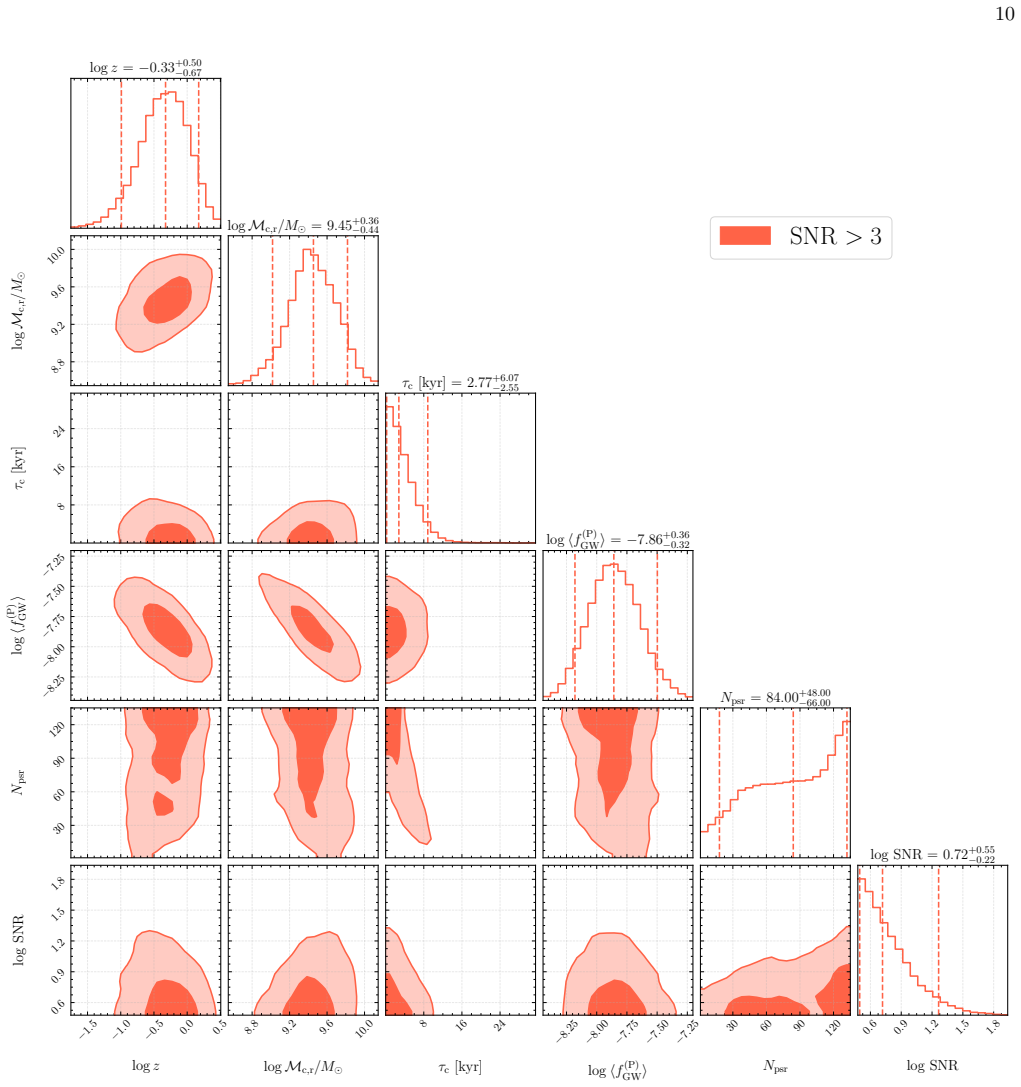
P. Virtanenet al., SciPy 1.0: Fundamental Algorithms for Scientific Computing in Python, Nature Methods17, 261 (2020). 10 log z = −0.33+0.50 −0.67 8.8 9.2 9.6 10.0 log Mc,r/M⊙ log Mc,r/M⊙ = 9 .45+0.36 −0.44 8 16 24 τc [kyr] τc [kyr] = 2 .77+6.07 −2.55 −8.25 −8.00 −7.75 −7.50 −7.25 log ⟨f (P) GW⟩ log ⟨f (P) GW⟩= −7.86+0.36 −0.32 30 60 90 120 Npsr Npsr = 84...
2020
discussion (0)
Sign in with ORCID, Apple, or X to comment. Anyone can read and Pith papers without signing in.