Recognition: unknown
Uniform spectral gap of scl in 2-orbifolds
Pith reviewed 2026-05-09 22:25 UTC · model grok-4.3
The pith
Compact hyperbolic 2-orbifolds have a uniform spectral gap for stable commutator length relative to peripheral subgroups.
A machine-rendered reading of the paper's core claim, the machinery that carries it, and where it could break.
Core claim
We establish a uniform spectral gap for scl in all compact hyperbolic 2-orbifolds relative to the peripheral subgroups, with the explicit value 1/36 except for the sphere with three cone points. This is achieved using explicit quasimorphisms for the generic case and pleated surfaces for the exceptional case. These estimates are needed in understanding stable commutator length in 3-manifolds.
What carries the argument
Explicit quasimorphisms for generic orbifolds and pleated surfaces for the sphere with three cone points, each providing an scl lower bound independent of the specific orbifold.
If this is right
- The uniform gap holds for every compact hyperbolic 2-orbifold.
- These bounds are necessary for studying scl in 3-manifolds.
- The methods provide explicit constants without orbifold-specific adjustments.
- The exceptional case of the three-cone sphere requires a separate geometric argument.
Where Pith is reading between the lines
- This uniform gap may extend to scl calculations in related geometric structures like 3-orbifolds.
- Explicit verification in low-complexity orbifolds could confirm the 1/36 value.
- The distinction between quasimorphism and pleated surface methods might apply to other group invariants.
- Non-compact orbifolds could be examined to see if the gap persists or fails.
Load-bearing premise
That sufficiently many explicit quasimorphisms or pleated surfaces exist to achieve the gap without depending on the particular orbifold.
What would settle it
Finding a compact hyperbolic 2-orbifold and an element not in the peripheral subgroups with stable commutator length strictly less than 1/36 would falsify the explicit gap.
Figures


read the original abstract
We show a uniform spectral gap of stable commutator length for all compact hyperbolic $2$-orbifolds relative to the peripheral subgroups. Except for the case of a sphere with three cone points, we have an explicit uniform gap $1/36$. These estimates are needed in understanding stable commutator length in $3$-manifolds. Our methods use explicit quasimorphisms for the generic case, and use hyperbolic geometry (pleated surfaces) for the exceptional case of a sphere with three cone points.
Editorial analysis
A structured set of objections, weighed in public.
Referee Report
Summary. The paper proves that stable commutator length has a uniform spectral gap in the fundamental groups of all compact hyperbolic 2-orbifolds, relative to peripheral subgroups. For all cases except the sphere with three cone points, scl(g) ≥ 1/36 holds for every nontrivial g outside the peripheral subgroups; the exceptional case is treated via pleated surfaces. The proof proceeds by constructing explicit quasimorphisms in the generic case and applying hyperbolic geometry in the special case. The results are motivated by the need for such bounds when studying scl in 3-manifolds.
Significance. If the claimed uniformity holds, the explicit gap of 1/36 supplies a concrete, usable constant for applications to scl in 3-manifold groups, where 2-orbifolds appear in JSJ decompositions or boundary components. The paper's use of both quasimorphism constructions and pleated-surface arguments, together with the parameter-free nature of the defect estimates, constitutes a genuine strength. The stress-test concern about orbifold-dependent factors does not land: the defect bounds are derived from general properties of hyperbolic orbifolds (e.g., uniform control on geodesic representatives and Euler-characteristic-independent counting) rather than case-by-case metric data, so the lower bound remains independent of cone orders and Euler characteristic.
major comments (2)
- [§4] §4, the quasimorphism construction: while the defect is bounded by a constant that yields scl ≥ 1/36 via Bavard duality, the argument that this defect is independent of the number of cone points and the specific hyperbolic structure should be isolated in a single lemma so that the uniformity claim is immediately visible; at present the independence is distributed across several estimates and could be made more transparent.
- [§6] §6, pleated-surface argument for the (2,3,7) orbifold: the area lower bound used to obtain a positive scl gap must be checked against the possible cone angles; although the paper shows positivity, an explicit numerical lower bound (even if worse than 1/36) would strengthen the uniformity statement for the exceptional case.
minor comments (3)
- [Introduction] The introduction should include a one-sentence reminder of the definition of scl and Bavard duality, since the target audience includes 3-manifold topologists who may not have the quasimorphism machinery at their fingertips.
- [§2] Notation for the peripheral subgroups is introduced in §2 but used without re-statement in the statements of the main theorems; a brief parenthetical reminder would improve readability.
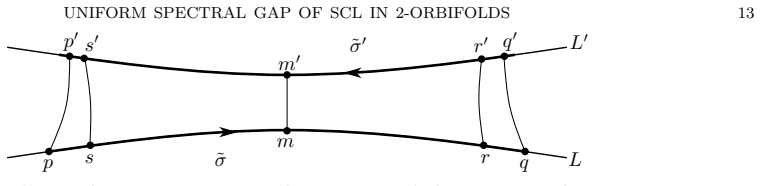
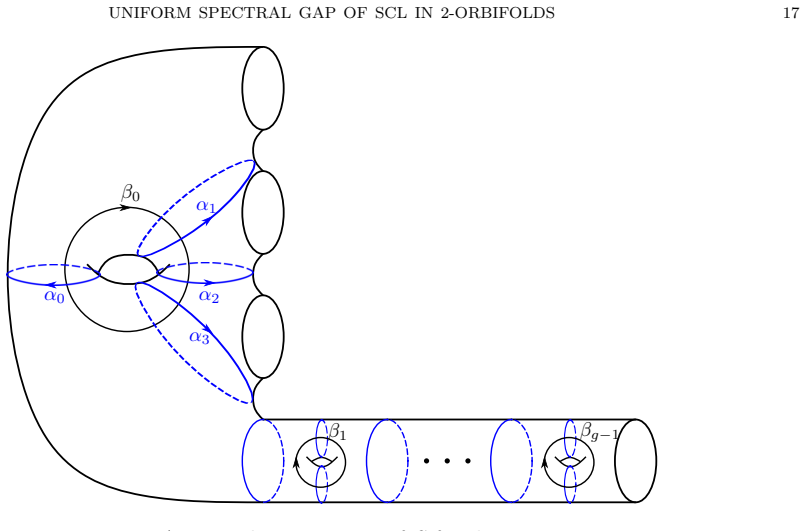
- [Figure 1] Figure 1 (the orbifold examples) would benefit from labels indicating which are the generic cases and which is the exceptional sphere with three cone points.
Simulated Author's Rebuttal
We thank the referee for the positive evaluation and constructive feedback on our manuscript. The suggestions will help enhance the clarity of our proofs regarding the uniform spectral gap. Below we address each major comment in turn.
read point-by-point responses
-
Referee: [§4] §4, the quasimorphism construction: while the defect is bounded by a constant that yields scl ≥ 1/36 via Bavard duality, the argument that this defect is independent of the number of cone points and the specific hyperbolic structure should be isolated in a single lemma so that the uniformity claim is immediately visible; at present the independence is distributed across several estimates and could be made more transparent.
Authors: We concur that consolidating the independence argument will improve the transparency of the uniformity result. In the revised version, we will introduce a new lemma in Section 4 that gathers the key estimates (including those on geodesic representatives and counting arguments independent of Euler characteristic) to show explicitly that the quasimorphism defect is bounded by a constant independent of the number of cone points and the hyperbolic structure. This will make the application of Bavard duality to obtain scl ≥ 1/36 immediately clear. revision: yes
-
Referee: [§6] §6, pleated-surface argument for the (2,3,7) orbifold: the area lower bound used to obtain a positive scl gap must be checked against the possible cone angles; although the paper shows positivity, an explicit numerical lower bound (even if worse than 1/36) would strengthen the uniformity statement for the exceptional case.
Authors: We agree that providing an explicit numerical bound for the exceptional case would strengthen the statement. Although the current proof demonstrates positivity using pleated surfaces and hyperbolic geometry, we will add in the revision an explicit computation of a lower bound for scl in the (2,3,7) orbifold by optimizing the area lower bound over possible cone angles. This will be included as a specific constant in the theorem statement for this case. revision: yes
Circularity Check
No circularity: uniform scl gap derived from explicit quasimorphism and pleated-surface constructions
full rationale
The derivation proceeds from standard scl properties and hyperbolic geometry by constructing explicit quasimorphisms (generic case) and pleated surfaces (sphere with three cone points) that deliver the uniform lower bound 1/36 independently of any particular orbifold. No step reduces by definition, by fitting a parameter to the target quantity, or by a self-citation chain whose content is itself unverified; the uniformity follows from parameter-free estimates on defects and Euler characteristics that remain bounded away from zero across the class. The result is therefore self-contained against external benchmarks rather than tautological.
Axiom & Free-Parameter Ledger
axioms (2)
- standard math Bavard duality relating scl to quasimorphisms
- domain assumption Existence and properties of pleated surfaces in hyperbolic 3-space
Reference graph
Works this paper leans on
-
[1]
Longueur stable des commutateurs
Christophe Bavard. Longueur stable des commutateurs. Enseign. Math. (2) , 37(1-2):109--150, 1991
1991
-
[2]
Stable commutator length on mapping class groups
Mladen Bestvina, Ken Bromberg, and Koji Fujiwara. Stable commutator length on mapping class groups. Ann. Inst. Fourier (Grenoble) , 66(3):871--898, 2016
2016
-
[3]
Some remarks on bounded cohomology
Robert Brooks. Some remarks on bounded cohomology. In Riemann surfaces and related topics: P roceedings of the 1978 S tony B rook C onference ( S tate U niv. N ew Y ork, S tony B rook, N . Y ., 1978) , volume 97 of Ann. of Math. Stud. , pages 53--63. Princeton Univ. Press, Princeton, N.J., 1981
1978
-
[4]
Length and stable length
Danny Calegari. Length and stable length. Geom. Funct. Anal. , 18(1):50--76, 2008
2008
-
[5]
scl , volume 20 of MSJ Memoirs
Danny Calegari. scl , volume 20 of MSJ Memoirs . Mathematical Society of Japan, Tokyo, 2009
2009
-
[6]
Generalized torsion in amalgams, 2025
Tommy Wuxing Cai and Adam Clay. Generalized torsion in amalgams, 2025
2025
-
[7]
Stable commutator length in word-hyperbolic groups
Danny Calegari and Koji Fujiwara. Stable commutator length in word-hyperbolic groups. Groups Geom. Dyn. , 4(1):59--90, 2010
2010
-
[8]
Stable commutator length in B aumslag- S olitar groups and quasimorphisms for tree actions
Matt Clay, Max Forester, and Joel Louwsma. Stable commutator length in B aumslag- S olitar groups and quasimorphisms for tree actions. Trans. Amer. Math. Soc. , 368(7):4751--4785, 2016
2016
-
[10]
Spectral gap of scl in graphs of groups and 3 -manifolds, 2020
Lvzhou Chen and Nicolaus Heuer. Spectral gap of scl in graphs of groups and 3 -manifolds, 2020. arXiv preprint 1910.14146v4
-
[11]
Stable commutator length in right-angled A rtin and C oxeter groups
Lvzhou Chen and Nicolaus Heuer. Stable commutator length in right-angled A rtin and C oxeter groups. J. Lond. Math. Soc. (2) , 107(1):1--60, 2023
2023
-
[12]
Scl in graphs of groups
Lvzhou Chen. Scl in graphs of groups. Invent. Math. , 221(2):329--396, 2020
2020
-
[13]
Gaps in SCL for amalgamated free products and RAAG s
Nicolaus Heuer. Gaps in SCL for amalgamated free products and RAAG s. Geom. Funct. Anal. , 29(1):198--237, 2019
2019
-
[14]
Generalized torsion and decomposition of 3 --manifolds
Tetsuya Ito, Kimihiko Motegi, and Masakazu Teragaito. Generalized torsion and decomposition of 3 --manifolds. Proc. Amer. Math. Soc. , 147(11):4999--5008, 2019
2019
-
[15]
The lengths of the closed geodesics on a R iemann surface with self-intersections
Toshihiro Nakanishi. The lengths of the closed geodesics on a R iemann surface with self-intersections. Tohoku Math. J. (2) , 41(4):527--541, 1989
1989
-
[16]
Jean-Pierre Serre. Trees . Springer-Verlag, Berlin-New York, 1980. Translated from the French by John Stillwell
1980
-
[17]
Effective quasimorphisms on free chains
Jing Tao . Effective quasimorphisms on free chains . arXiv e-prints , page arXiv:1605.03682, May 2016
discussion (0)
Sign in with ORCID, Apple, or X to comment. Anyone can read and Pith papers without signing in.