Recognition: unknown
Predicting the thermodynamics in the chromosphere from the translation of SDO data into the IRIS² inversion results using a visual transformer model
Pith reviewed 2026-05-09 21:12 UTC · model grok-4.3
The pith
A visual transformer model translates SDO images and magnetograms into estimates of chromospheric temperature and electron density that match IRIS inversion targets for most test cases.
A machine-rendered reading of the paper's core claim, the machinery that carries it, and where it could break.
Core claim
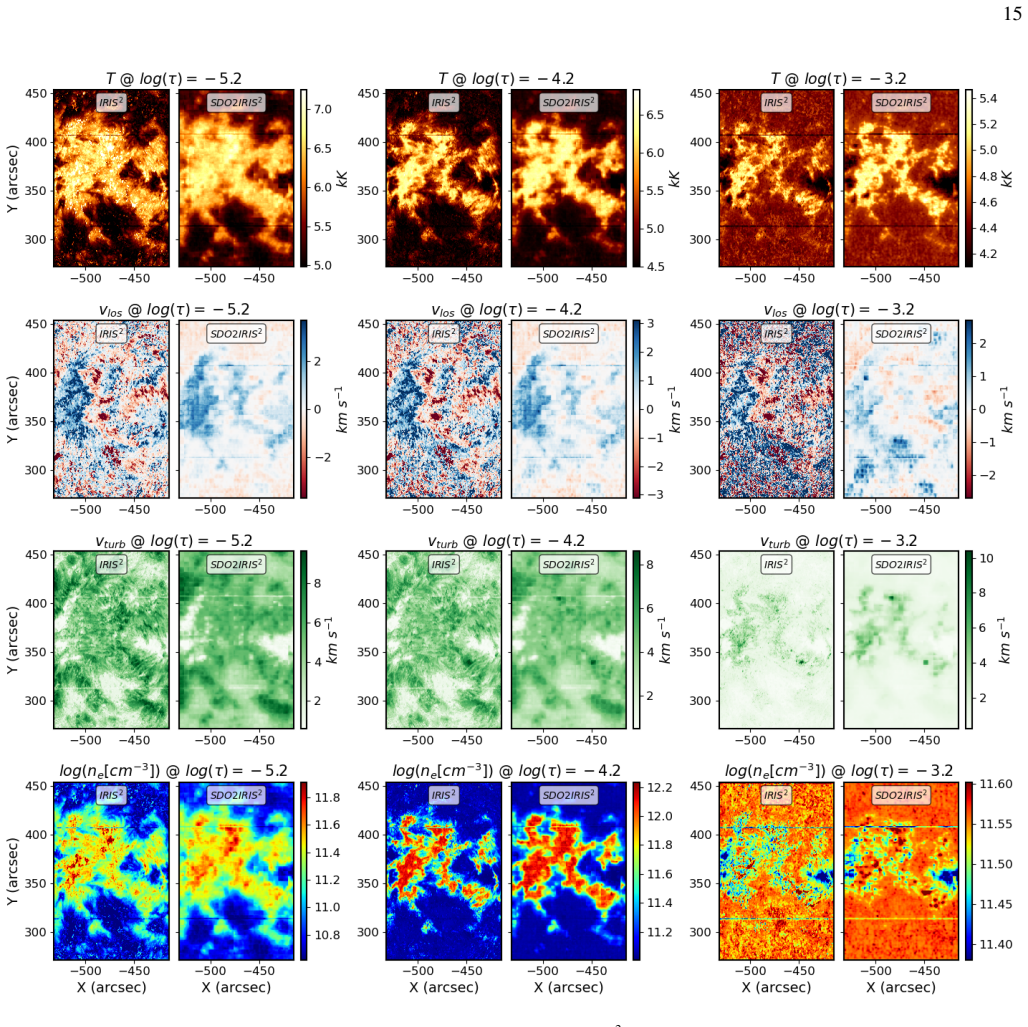
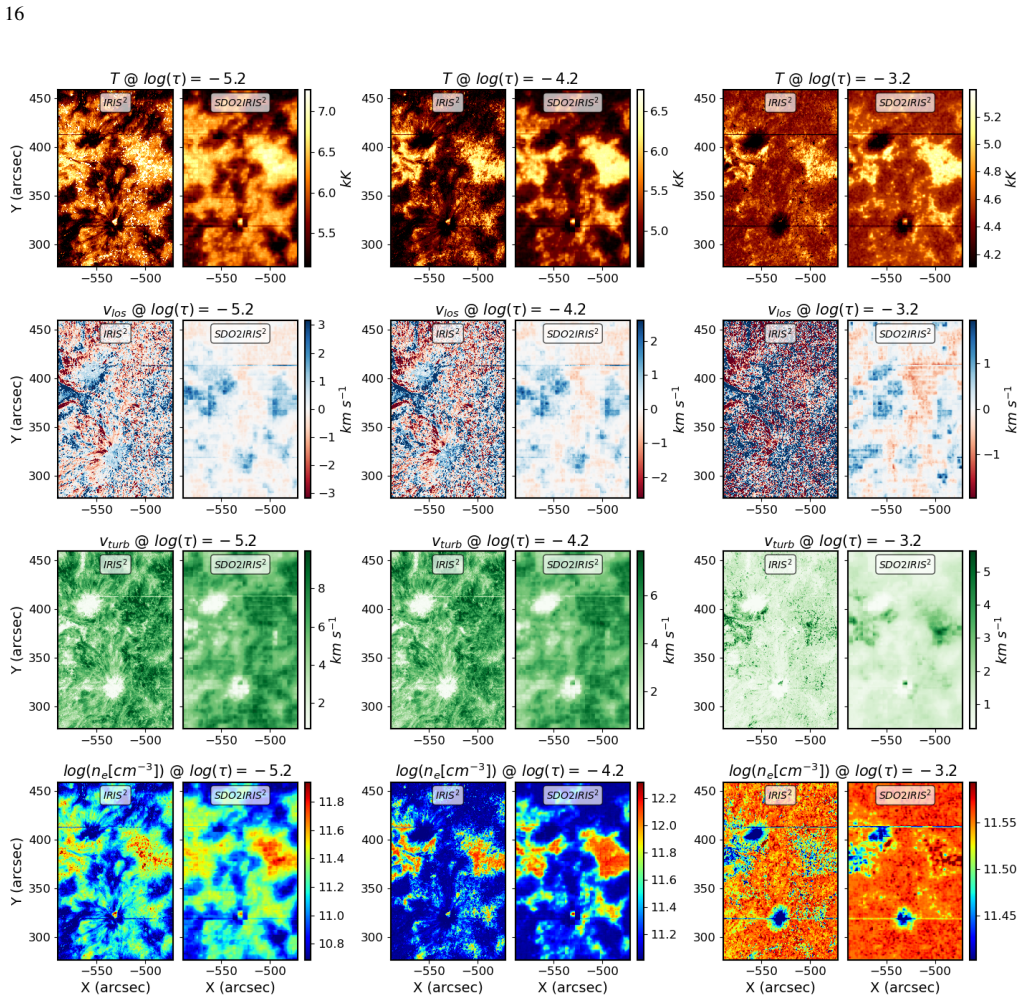
The SDO2IRIS² visual transformer learns a direct mapping from combined AIA intensity images of the chromosphere and transition region and HMI photospheric magnetograms to the temperature, line-of-sight velocity, turbulent velocity, and electron density that result from IRIS Mg II inversions. On independent test data the predicted temperature and electron density agree with the inversion results at a correlation of approximately 0.80 for about 80 percent of the samples, turbulent velocity reaches a moderate-to-strong correlation of 0.63 for 70 percent of the samples, and line-of-sight velocity shows only weak correlation. The model therefore supplies usable estimates of chromospheric state in
What carries the argument
The visual transformer architecture that ingests multi-channel AIA images and HMI magnetograms and regresses four thermodynamic quantities learned from IRIS inversion targets.
If this is right
- The model outputs can serve as stand-alone estimates of chromospheric thermodynamics or as complementary information when other data are available.
- The full set of thermodynamic maps is produced in a few minutes on CPU or GPU, far faster than direct inversion of spectral lines.
- SDO data alone become sufficient for estimating chromospheric state in locations or times when simultaneous IRIS observations are absent.
- The trained model can be applied repeatedly to the continuous, full-disk SDO archive to generate long time series of chromospheric conditions.
Where Pith is reading between the lines
- If the mapping remains stable across the solar cycle, the model could support near-real-time tracking of chromospheric heating and cooling using only SDO's routine observations.
- The same translation strategy could be retrained on other instrument pairs to estimate additional atmospheric parameters such as magnetic field strength or ionization state.
- The notably weaker performance on line-of-sight velocity indicates that purely spatial image inputs may miss essential dynamical information that spectral line profiles supply.
Load-bearing premise
The IRIS Mg II inversions used as training targets accurately represent true chromospheric conditions and the learned mapping applies to solar regions and times outside the training set.
What would settle it
Side-by-side comparison of model outputs with independent temperature and density measurements obtained from high-resolution ground-based spectroscopy or from forward-modeled synthetic spectra in solar regions never seen during training.
Figures



read the original abstract
We present SDO2IRIS$^2$: a visual transformer model that translates a combination of images of the chromosphere and transition region (TR), observed by AIA, and a line-of-sight magnetogram, provided by HMI, into temperature, line-of-sight velocity (v$_{los}$), velocity of the turbulent motions (v$_{turb}$), and electron density (n$_{e}$) in the chromosphere. Using the thermodynamic variables obtained from the inversion of the chromospheric lines Mg II h&k, observed by IRIS, as the target of the model, and the intensity images in the chromosphere and TR, and the photospheric magnetogram as the input, the predicted T and n$_{e}$ show a strong correlation ($\approx 0.80$) for $\approx$80% of the test inverted data, a moderate-to-strong correlation ($\approx0.63$) for 70% of the v$_{turb}$ of the target test inverted data, while for the $v_{los}$, the correlation is weak. Therefore, the predicted values by SDO2IRIS$^2$ may be used as an estimation of the thermodynamics in the chromosphere, either as a stand-alone result or as complementary information to other chromospheric data observed simultaneously. The execution time employed by SDO2IRIS$^2$ to obtain the thermodynamic values in the chromosphere is of the order of a few minutes, being $\le10$ minutes when using a CPU, and $\le5$ minutes when using a GPU. SDO2IRIS$^2$ opens a new avenue for the use of SDO data thanks to the inversions provided by IRIS observables.
Editorial analysis
A structured set of objections, weighed in public.
Referee Report
Summary. The manuscript introduces SDO2IRIS², a visual transformer model that maps combined AIA chromospheric/TR intensity images and HMI line-of-sight magnetograms to chromospheric thermodynamic quantities (temperature T, electron density n_e, line-of-sight velocity v_los, and turbulent velocity v_turb) derived from IRIS Mg II h&k inversions. The abstract reports Pearson correlations of ≈0.80 for T and n_e on ≈80% of the test data, ≈0.63 for v_turb on 70% of the test data, and weak correlation for v_los, concluding that the model outputs can serve as stand-alone or complementary estimates with inference times of a few minutes.
Significance. If the correlations demonstrate robust generalization beyond the training distribution, the work would offer a practical method to derive chromospheric thermodynamics from the extensive, high-cadence SDO dataset, extending coverage beyond IRIS's limited field of view and enabling broader statistical studies of chromospheric heating and dynamics. The visual-transformer architecture is a reasonable choice for this image-to-parameter regression task, and the reported execution times highlight potential for operational use.
major comments (3)
- [Abstract] Abstract: The training, validation, and test split protocol is not described. Solar imaging data exhibit strong spatial and temporal autocorrelations; without explicit confirmation that the test set uses independent active regions, disjoint time intervals, or a strict temporal buffer, the reported correlations cannot be interpreted as evidence of generalization to new solar regions or epochs.
- [Abstract] Abstract: The statement that correlations hold 'for ≈80% of the test inverted data' (and '70%' for v_turb) provides no selection criterion for the subset, no per-pixel or per-profile correlation distributions, and no uncertainty estimates or statistical tests, preventing assessment of whether the headline numbers are representative or driven by a small high-performing fraction.
- [Abstract] Abstract and model description: No information is supplied on the number of training samples, hyperparameter tuning, regularization, or any baseline comparisons (e.g., linear regression or simpler CNN), making it impossible to judge whether the visual transformer architecture is necessary or whether the performance is robust.
minor comments (1)
- [Abstract] The abstract states that the model 'opens a new avenue' but does not quantify how the predicted quantities would be validated against independent observations (e.g., other spectral lines or ground-based data) when IRIS inversions are unavailable.
Simulated Author's Rebuttal
We thank the referee for their detailed and constructive comments on our manuscript. We address each of the major comments below and outline the revisions we plan to implement in the updated version of the paper.
read point-by-point responses
-
Referee: [Abstract] Abstract: The training, validation, and test split protocol is not described. Solar imaging data exhibit strong spatial and temporal autocorrelations; without explicit confirmation that the test set uses independent active regions, disjoint time intervals, or a strict temporal buffer, the reported correlations cannot be interpreted as evidence of generalization to new solar regions or epochs.
Authors: We agree that the abstract does not provide details on the data splitting protocol. In the revised manuscript, we will include a clear description of the training, validation, and test split in the Methods section, explicitly confirming that the test set uses independent active regions, disjoint time intervals, and a strict temporal buffer to minimize the effects of spatial and temporal autocorrelations in solar imaging data. revision: yes
-
Referee: [Abstract] Abstract: The statement that correlations hold 'for ≈80% of the test inverted data' (and '70%' for v_turb) provides no selection criterion for the subset, no per-pixel or per-profile correlation distributions, and no uncertainty estimates or statistical tests, preventing assessment of whether the headline numbers are representative or driven by a small high-performing fraction.
Authors: We acknowledge that the abstract lacks information on the selection criterion for the reported percentages and does not include supporting distributions or statistical analyses. In the revision, we will specify the selection criterion used for the ≈80% and ≈70% subsets, provide per-pixel and per-profile correlation distributions, and include uncertainty estimates along with relevant statistical tests to allow proper assessment of the results' representativeness. revision: yes
-
Referee: [Abstract] Abstract and model description: No information is supplied on the number of training samples, hyperparameter tuning, regularization, or any baseline comparisons (e.g., linear regression or simpler CNN), making it impossible to judge whether the visual transformer architecture is necessary or whether the performance is robust.
Authors: The referee correctly identifies the absence of these details in the abstract and model description. We will revise the manuscript to report the number of training samples, describe the hyperparameter tuning and regularization methods, and add baseline comparisons with simpler models such as linear regression and convolutional neural networks. This will help demonstrate the robustness of the performance and the appropriateness of the visual transformer architecture. revision: yes
Circularity Check
No significant circularity; standard supervised ML mapping with independent test evaluation
full rationale
The paper trains a visual transformer to map SDO/AIA+HMI inputs to thermodynamic targets obtained from separate IRIS inversions. Reported correlations are computed on test-set outputs versus held-out IRIS targets; these are statistical results of learned weights, not algebraic identities or definitional equivalences to the inputs. No self-definitional equations, fitted parameters renamed as predictions, load-bearing self-citations, or ansatz smuggling appear in the abstract or described chain. The derivation is self-contained empirical modeling whose validity hinges on data-split independence rather than internal reduction to the training inputs.
Axiom & Free-Parameter Ledger
Reference graph
Works this paper leans on
-
[1]
, year = 2020, month = feb, volume =
The SunPy Project: Open Source Development and Status of the Version 1.0 Core Package , journal =. 2020 , month = feb, volume =. doi:10.3847/1538-4357/ab4f7a , url =
-
[2]
Astropy: A community Python package for astronomy , journal =. 2013 , volume =. doi:10.1051/0004-6361/201322068 , url =
-
[3]
The Astropy Project: Building an Open-science Project and Status of the v2.0 Core Package , journal =. 2018 , volume =. doi:10.3847/1538-3881/aabc4f , url =
-
[4]
The Astropy Project: Sustaining and Growing a Community-oriented Open-source Project and the Latest Major Release (v5.0) of the Core Package , journal =. 2022 , month = aug, volume =. doi:10.3847/1538-4357/ac7c74 , url =
work page internal anchor Pith review doi:10.3847/1538-4357/ac7c74 2022
-
[5]
, title =
Hunter, John D. , title =. Computing in Science & Engineering , year =
-
[6]
and Millman, K
Harris, Charles R. and Millman, K. Jarrod and van der Walt, Stéfan J and Gommers, Ralf and Virtanen, Pauli and Cournapeau, David and Wieser, Eric and Taylor, Julian and Berg, Sebastian and Smith, Nathaniel J. and Kern, Robert and Picus, Matti and Hoyer, Stephan and van Kerkwijk, Marten H. and Brett, Matthew and Haldane, Allan and Fernández del Río, Jaime ...
-
[7]
1995 , publisher=
Python reference manual , author=. 1995 , publisher=
1995
-
[8]
, title =
Van Rossum, Guido and Drake, Fred L. , title =. 2009 , isbn =
2009
-
[9]
Virtanen, Pauli and Gommers, Ralf and Oliphant, Travis E. and Haberland, Matt and Reddy, Tyler and Cournapeau, David and Burovski, Evgeni and Peterson, Pearu and Weckesser, Warren and Bright, Jonathan and. SciPy 1.0: Fundamental Algorithms for Scientific Computing in Python , journal =. 2020 , volume =. doi:10.1038/s41592-019-0686-2 , url =
-
[10]
Scikit-learn: Machine Learning in Python , journal =
Pedregosa, Fabian and Varoquaux, Ga. Scikit-learn: Machine Learning in Python , journal =. 2011 , volume =
2011
-
[11]
Bradski, Gary , title =. Dr. Dobb's Journal of Software Tools , year =
-
[12]
Keras , year =
Chollet, Fran. Keras , year =
-
[13]
PyTorch: An Imperative Style, High-Performance Deep Learning Library , booktitle =
Paszke, Adam and Gross, Sam and Massa, Francisco and Lerer, Adam and Bradbury, James and Chanan, Gregory and Killeen, Trevor and Lin, Zeming and Gimelshein, Natalia and Antiga, Luca and Desmaison, Alban and K. PyTorch: An Imperative Style, High-Performance Deep Learning Library , booktitle =. 2019 , url =
2019
-
[14]
2024 , eprint=
The Faiss library , author=. 2024 , eprint=
2024
-
[15]
and Hart, P
Cover, T. and Hart, P. , journal=. Nearest neighbor pattern classification , year=
-
[16]
Fifth Berkeley Sympos. Math. Statist. and Probability. I: Statistics , pages =
-
[17]
arXiv , author =:2009.07896 , primaryclass =
Captum: A unified and generic model interpretability library for PyTorch. arXiv e-prints , keywords =. doi:10.48550/arXiv.2009.07896 , archivePrefix =. 2009.07896 , primaryClass =
-
[18]
doi:10.5281/zenodo.3828935 , license =
Falcon, William and. doi:10.5281/zenodo.3828935 , license =
-
[19]
Roy, Sujit and Hegde, Dinesha V. and Schmude, Johannes and Lal, Rohit and Gaur, Vishal and Lin, Amy and Mandal, Kshitiz and Singh, Talwinder and Mu. SuryaBench: Benchmark Dataset for Advancing Machine Learning in Heliophysics and Space Weather Prediction , journal =. 2026 , issn =. doi:10.1038/s41597-026-06552-5 , url =
-
[20]
2025, Surya: Foundation Model for Heliophysics, arXiv, doi: 10.48550/arXiv.2508.14112
Surya: Foundation Model for Heliophysics. arXiv e-prints , keywords =. doi:10.48550/arXiv.2508.14112 , archivePrefix =. 2508.14112 , primaryClass =
-
[21]
A Unified Approach to Interpreting Model Predic- tions, November 2017
A Unified Approach to Interpreting Model Predictions. arXiv e-prints , keywords =. doi:10.48550/arXiv.1705.07874 , archivePrefix =. 1705.07874 , primaryClass =
-
[22]
Contributions to the Theory of Games II , editor =
A Value for n-Person Games , author =. Contributions to the Theory of Games II , editor =. 1953 , publisher =
1953
-
[23]
End-to-End Object Detection with Transformers. arXiv e-prints , keywords =. doi:10.48550/arXiv.2005.12872 , archivePrefix =. 2005.12872 , primaryClass =
-
[24]
On layer normalization in the transformer architecture, 2020
On Layer Normalization in the Transformer Architecture. arXiv e-prints , keywords =. doi:10.48550/arXiv.2002.04745 , archivePrefix =. 2002.04745 , primaryClass =
-
[25]
Adam: A Method for Stochastic Optimization
Adam: A method for stochastic optimization , author=. arXiv preprint arXiv:1412.6980 , year=
work page internal anchor Pith review Pith/arXiv arXiv
-
[26]
Edouard Grave, Armand Joulin, and Nicolas Usunier
Convolutional Sequence to Sequence Learning. arXiv e-prints , keywords =. doi:10.48550/arXiv.1705.03122 , archivePrefix =. 1705.03122 , primaryClass =
-
[27]
An Image is Worth 16x16 Words: Transformers for Image Recognition at Scale
An Image is Worth 16x16 Words: Transformers for Image Recognition at Scale. arXiv e-prints , keywords =. doi:10.48550/arXiv.2010.11929 , archivePrefix =. 2010.11929 , primaryClass =
work page internal anchor Pith review Pith/arXiv arXiv doi:10.48550/arxiv.2010.11929 2010
-
[28]
Attention Is All You Need. arXiv e-prints , keywords =. doi:10.48550/arXiv.1706.03762 , archivePrefix =. 1706.03762 , primaryClass =
work page internal anchor Pith review Pith/arXiv arXiv doi:10.48550/arxiv.1706.03762
-
[29]
Sur la division des corps mat\'eriels en parties. Bull. Acad. Polon. Sci. , volume = 4, pages =
-
[30]
doi:10.25495/7GXK-RD71 , url =
Zenodo , publisher =. doi:10.25495/7GXK-RD71 , url =
-
[31]
Bellot Rubio, L. and Orozco Su. Quiet Sun magnetic fields: an observational view. Living Rev Sol Phys , year = 2019, volume = 16, pages =. doi:https://doi.org/10.1007/s41116-018-0017-1 , adsurl =
-
[32]
Welsch, B. T. and Longcope, D. W. , title = ". ApJ. doi:10.1086/368408 , adsurl =
-
[33]
Go. The solar internetwork. I. Contribution to the network magnetic flux. , year = 2014, volume = 797, pages =. doi:https://doi.org/10.1088/0004-637X/797/1/49 , adsurl =
-
[34]
Go. The Solar Internetwork. II. Flux Appearance and Disappearance Rates. , year = 2016, volume = 820, pages =. doi:https://doi.org/10.3847/0004-637X/820/1/35 , adsurl =
-
[35]
On the nature of moving magnetic feature pairs around sunspots. , keywords =. doi:10.1051/0004-6361:20021807 , adsurl =
-
[36]
Signatures of ubiquitous magnetic reconnection in the deep atmosphere of sunspot penumbrae. , keywords =. doi:10.1051/0004-6361/202040171 , archivePrefix =. 2101.11321 , primaryClass =
-
[37]
IRIS ^ 2+ : A Comprehensive Database of Stratified Thermodynamic Models in the Low Solar Atmosphere. , keywords =. doi:10.3847/1538-4365/ad1e55 , archivePrefix =. 2211.09103 , primaryClass =
-
[38]
Differential emission measures from the regularized inversion of Hinode and SDO data. , keywords =. doi:10.1051/0004-6361/201117576 , archivePrefix =. 1201.2642 , primaryClass =
-
[39]
Semi-empirical model atmospheres for the chromosphere of the sunspot penumbra and umbral flashes. , keywords =. doi:10.1051/0004-6361/201935289 , archivePrefix =. 1905.08264 , primaryClass =
-
[40]
Force-free Magnetic Fields: The Magneto-frictional Method. , keywords =. doi:10.1086/164610 , adsurl =
-
[41]
Mark C. M. Cheung and Marc L. DeRosa , title =. The Astrophysical Journal , abstract =. 2012 , month =. doi:10.1088/0004-637X/757/2/147 , url =
-
[42]
V. M. J. Henriques and D. Kuridze and M. Mathioudakis and F. P. Keenan , title =. The Astrophysical Journal , abstract =. 2016 , month =. doi:10.3847/0004-637X/820/2/124 , url =
-
[43]
Impact on solar atmospheric heating
Evidence of the multi-thermal nature of spicular downflows. Impact on solar atmospheric heating. , keywords =. doi:10.1051/0004-6361/202141404 , archivePrefix =. 2108.02153 , primaryClass =
-
[44]
Evelyn Fix and J. L. Hodges , journal =. Discriminatory Analysis. Nonparametric Discrimination: Consistency Properties , urldate =
-
[45]
Evelyn Fix and J. L. Hodges , journal =. Discriminatory Analysis. Nonparametric Discrimination: Consistency Properties , year =
-
[46]
Frontiers in Astronomy and Space Sciences , keywords =
Chromospheric thermodynamic conditions from inversions of complex Mg II h & k profiles observed in flares. Frontiers in Astronomy and Space Sciences , keywords =. doi:10.3389/fspas.2023.1133429 , archivePrefix =. 2211.05459 , primaryClass =
-
[47]
Hunter, J. D. , Title =. Computing in Science & Engineering , Volume =
-
[48]
Billion-scale similarity search with
Johnson, Jeff and Douze, Matthijs and J. Billion-scale similarity search with. IEEE Transactions on Big Data , volume=. 2019 , publisher=
2019
-
[49]
Evolution of the Ratio of Mg II Intensities during Solar Flares. , keywords =. doi:10.3847/1538-4357/ad2a46 , archivePrefix =. 2402.11189 , primaryClass =
-
[50]
and Varoquaux, G
Pedregosa, F. and Varoquaux, G. and Gramfort, A. and Michel, V. and Thirion, B. and Grisel, O. and Blondel, M. and Prettenhofer, P. and Weiss, R. and Dubourg, V. and Vanderplas, J. and Passos, A. and Cournapeau, D. and Brucher, M. and Perrot, M. and Duchesnay, E. , journal=. Scikit-learn: Machine Learning in
-
[51]
and Haberland, Matt and Reddy, Tyler and Cournapeau, David and Burovski, Evgeni and Peterson, Pearu and Weckesser, Warren and Bright, Jonathan and
Virtanen, Pauli and Gommers, Ralf and Oliphant, Travis E. and Haberland, Matt and Reddy, Tyler and Cournapeau, David and Burovski, Evgeni and Peterson, Pearu and Weckesser, Warren and Bright, Jonathan and. Nature Methods , year =
-
[52]
Mass and energy flow in the solar chromosphere and corona. , keywords =. doi:10.1146/annurev.aa.15.090177.002051 , adsurl =
-
[53]
Information-based spectral sampling
Designing wavelength sampling for Fabry-P \'e rot observations. Information-based spectral sampling. , keywords =. doi:10.1051/0004-6361/202346230 , archivePrefix =. 2303.13875 , primaryClass =
-
[54]
Sainz Dalda, Alberto and de la Cruz Rodríguez, Jaime and Hansteen, Viggo and De Pontieu, Bart and Gošić, Milan , title =. The Astrophysical Journal , abstract =. 2026 , month =. doi:10.3847/1538-4357/ae274c , url =
-
[55]
Spectropolarimetric NLTE inversion code SNAPI. , keywords =. doi:10.1051/0004-6361/201833382 , archivePrefix =. 1806.08134 , primaryClass =
-
[56]
TIC: A Stokes Inversion Code for Scattering Polarization with Partial Frequency Redistribution and Arbitrary Magnetic Fields. , keywords =. doi:10.3847/1538-4357/ac745c , archivePrefix =. 2205.15666 , primaryClass =
-
[57]
Recovering Thermodynamics from Spectral Profiles Observed by IRIS. (II). Improved Calculation of the Uncertainties Based on Monte Carlo Experiments. , keywords =. doi:10.3847/1538-4357/acb2c7 , archivePrefix =. 2211.01563 , primaryClass =
-
[58]
, year = 2022, volume = 932, number = 1, pages =
Non-LTE Inversion of Prominence Spectroscopic Observations in H and Mg II h & k lines. , year = 2022, volume = 932, number = 1, pages =
2022
-
[59]
Fast Inversion of Solar Ca II Spectra in Non-local Thermodynamic Equilibrium. , keywords =. doi:10.3847/1538-4357/ab1d4c , archivePrefix =. 1904.11843 , primaryClass =
-
[60]
, keywords =
A non-LTE inversion procedure for chromospheric cloud-like features. , keywords =
-
[61]
Non-LTE inversion of chromospheric \ Ii\ cloud-like features. , keywords =. doi:10.1051/0004-6361:20000257 , adsurl =
-
[62]
Estructura y din \'a mica de concentraciones magn \'e ticas en la superf \' cie solarEstructura y din \'a mica de concentraciones magn \'e ticas en la superf \' cie solarStructure and dynamics of magnetic regions on the solar surface
-
[63]
The Effects of Rotation on the Evolution of Rising Omega Loops in a Stratified Model Convection Zone. , keywords =. doi:10.1086/318320 , archivePrefix =. astro-ph/0008501 , primaryClass =
-
[64]
, year = 1970, month = feb, volume =
The Structure of the Magnetic Field in a Sunspot with a Photospheric Light-Bridge at Two Levels in the Solar Atmosphere. , year = 1970, month = feb, volume =
1970
-
[65]
Large-scale structure of a sunspot and its surrounding photosphere. , keywords =. doi:10.1007/BF00156373 , adsurl =
-
[66]
Observations of the Two-Level Structure of Sunspot Magnetic Fields (presented by N. S. Soboleva). Solar Magnetic Fields , year = 1971, editor =
1971
-
[67]
Bulletin of the Astronomical Institutes of Czechoslovakia , year = 1973, month = jan, volume =
On the Physical Relation between the Magnetic Field and the Brightness in the Sunspot Umbrae. Bulletin of the Astronomical Institutes of Czechoslovakia , year = 1973, month = jan, volume =
1973
-
[68]
On the Magnetic Fields and Motions in Sunspots at Different Atmospheric Levels. , keywords =. doi:10.1007/BF00162480 , adsurl =
-
[69]
On fine structure of the magnetic field and brightness in the penumbrae of sunspots. , keywords =. doi:10.1007/BF00153337 , adsurl =
-
[70]
On Mass Flow in a Complex Sunspot. , keywords =. doi:10.1007/BF00151393 , adsurl =
-
[71]
Magnetic Fields of Sunspots Based on Combined Optical and Radio Observations. , keywords =. doi:10.1007/BF00146645 , adsurl =
-
[72]
Observed Redshifts in the Solar Transition Region above Active and Quiet Regions. , keywords =. doi:10.1086/176454 , adsurl =
-
[73]
An Observational Examination of Models for Sunspot Magnetic Field Configurations. , keywords =. doi:10.1007/BF00154777 , adsurl =
-
[74]
Velocity measures in the sunspot Rome no. 7490 (July 5, 1979). , keywords =. doi:10.1007/BF00147503 , adsurl =
-
[75]
Magnetic field observations for the sunspot C. M. P. 1966 September 19. , year = 1969, month = jan, volume =. doi:10.1093/mnras/145.1.1 , adsurl =
-
[76]
, year = 1967, month = jan, volume =
Line contours in sunspot regions. , year = 1967, month = jan, volume =. doi:10.1093/mnras/136.1.71 , adsurl =
-
[77]
A Search for Sunspot Canopies Using a Vector Magnetograph. , keywords =. doi:10.1007/BF00645086 , adsurl =
-
[78]
, year = 1908, month = apr, volume =
Preliminary Note on the Rotation of the Sun as Determined from the Displacements of the Hydrogen Lines. , year = 1908, month = apr, volume =. doi:10.1086/141547 , adsurl =
-
[79]
III Spectrophotometry and preliminary model of a 2-component umbra
Photometric analysis of sunspot umbral dots. III Spectrophotometry and preliminary model of a 2-component umbra. , keywords =
-
[80]
I - Dynamical and structural behaviour
Photometric analysis of the sunspot umbral dots. I - Dynamical and structural behaviour. , keywords =
discussion (0)
Sign in with ORCID, Apple, or X to comment. Anyone can read and Pith papers without signing in.