Recognition: unknown
Cannon--Thurston maps for Anosov foliations
Pith reviewed 2026-05-08 13:43 UTC · model grok-4.3
The pith
For an Anosov foliation with branching on a hyperbolic manifold, the leftmost universal circle admits a Cannon-Thurston map to the ideal 2-sphere.
A machine-rendered reading of the paper's core claim, the machinery that carries it, and where it could break.
Core claim
The central claim is that an Anosov foliation with branching on a hyperbolic manifold has a leftmost universal circle that admits a Cannon-Thurston-type map to the ideal 2-sphere. This construction is new, arising from the foliation rather than from other known sources. As a corollary, the fundamental group of the manifold acts on the leftmost universal circle with pseudo-Anosov dynamics.
What carries the argument
The leftmost universal circle for the Anosov foliation with branching, which serves as the domain for the new Cannon-Thurston map to the ideal boundary sphere.
Load-bearing premise
An Anosov foliation with branching exists on the hyperbolic manifold and the leftmost universal circle is well-defined from earlier constructions.
What would settle it
A hyperbolic manifold with an Anosov foliation with branching where the leftmost universal circle has no continuous map to the ideal 2-sphere that extends the group action would falsify the result.
Figures








read the original abstract
Universal circles, introduced by Thurston and Calegari--Dunfield, are not well understood in general. Recently, the author together with Taylor showed that Anosov foliations with branching admit nonconjugate universal circles. We continue the study of these universal circles and show that for an Anosov foliation with branching on a hyperbolic manifold, the leftmost universal circle admits a Cannon--Thurston-type map to the ideal 2-sphere. This is a new type of construction of a Cannon--Thurston map. As a corollary, we show the fundamental group of the manifold acts on the leftmost universal circle with pseudo-Anosov dynamics.
Editorial analysis
A structured set of objections, weighed in public.
Referee Report
Summary. The paper proves that for an Anosov foliation with branching on a hyperbolic 3-manifold, the leftmost universal circle (defined via the ordering of nonconjugate circles from the author's prior work with Taylor) admits a Cannon-Thurston-type map to the ideal 2-sphere at infinity. The map is constructed by taking limits of geodesic rays asymptotic to leaves of the foliation; continuity and equivariance follow from controlling branching via the Anosov property and the leftmost choice. As a corollary, the fundamental group acts on the leftmost universal circle with pseudo-Anosov dynamics.
Significance. If the result holds, it supplies a new construction of Cannon-Thurston maps that does not rely on the usual Kleinian-group or fibration techniques, instead using the geometry of Anosov foliations and the ordering on universal circles. The pseudo-Anosov dynamics corollary directly links the boundary action to classical Teichmüller theory. The manuscript carries the existence of the foliation and the leftmost circle from prior work without circularity and provides an internally consistent argument with explicit control of limits and branching.
minor comments (3)
- [§2.3] §2.3: the definition of the leftmost universal circle is given only by reference to the Taylor collaboration; a self-contained one-sentence recap of the ordering would help readers who have not yet consulted that paper.
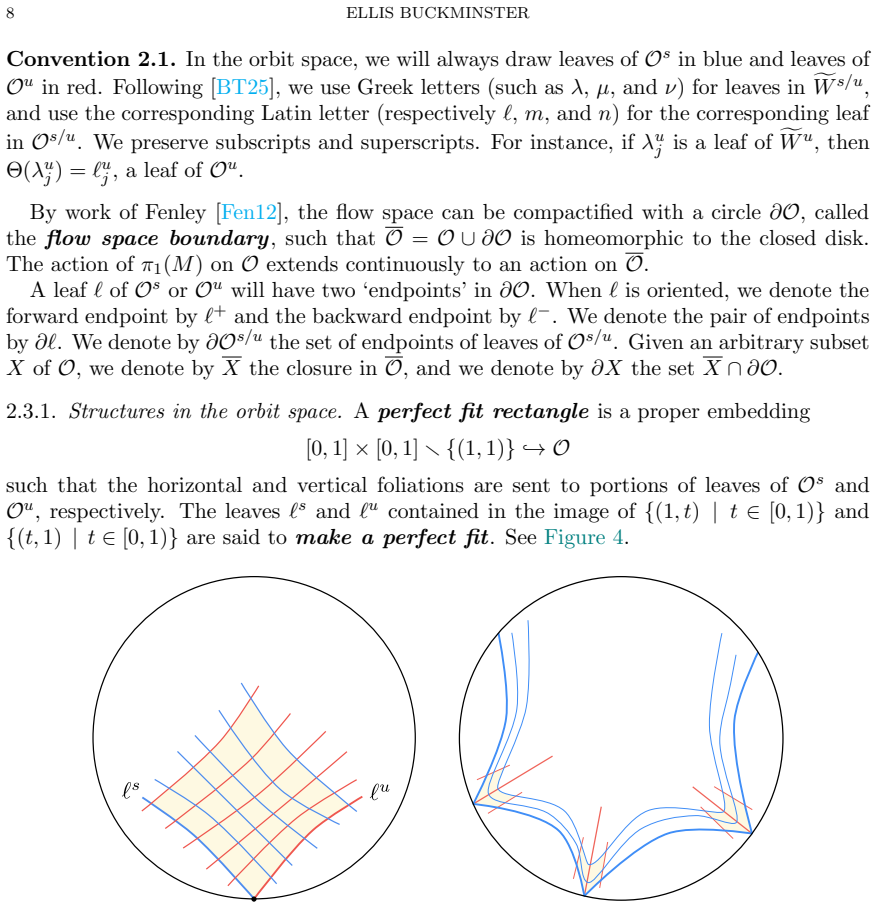
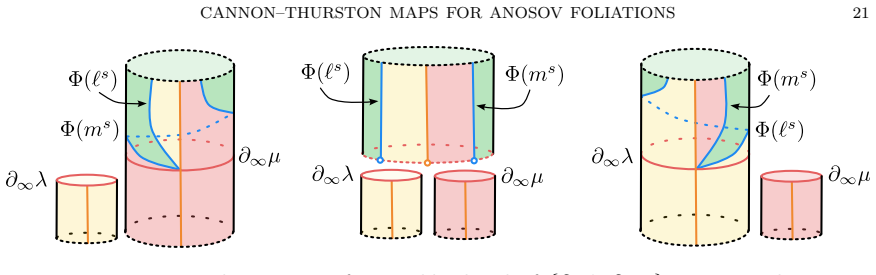
- [Figure 4] Figure 4: the caption does not indicate which rays are being used to define the map on the leftmost circle; adding a brief description of the limiting process shown would improve clarity.
- [Theorem 1.1] Theorem 1.1: the statement of the main result does not explicitly record the dependence on the Anosov property for the continuity argument; a parenthetical reference to the relevant lemma would make the logical structure clearer.
Simulated Author's Rebuttal
We thank the referee for their positive summary, assessment of significance, and recommendation of minor revision. The report confirms that the argument is internally consistent, avoids circularity with prior work, and provides a novel construction of Cannon-Thurston maps via Anosov foliations. We have no major comments to address and will incorporate any minor editorial suggestions in the revised version.
Circularity Check
Minor self-citation to prior joint work; central Cannon-Thurston construction is independent
full rationale
The paper cites its own prior collaboration with Taylor solely for the existence of nonconjugate universal circles on Anosov foliations with branching and for the ordering that defines the leftmost circle. The new result—the existence of a Cannon-Thurston map from that circle to the ideal 2-sphere—is obtained by a separate construction: taking limits of geodesic rays in the hyperbolic manifold that are asymptotic to leaves of the foliation, then proving continuity and equivariance from the Anosov property and the leftmost choice. No equation, fitted parameter, or uniqueness theorem in the present manuscript reduces the map existence to the inputs by definition; the prior citation supplies an external setup rather than a load-bearing self-referential step. The pseudo-Anosov dynamics corollary follows directly from the boundary map without further circular reduction.
Axiom & Free-Parameter Ledger
Reference graph
Works this paper leans on
-
[1]
[BM25] Thomas Barthelm´ e and Kathryn Mann
Preprint at arXiv:2211.10505. [BM25] Thomas Barthelm´ e and Kathryn Mann. Pseudo-Anosov flows: a plane approach.arXiv preprint arXiv:2509.15375,
- [2]
-
[3]
[CL24] Danny Calegari and Ino Loukidou. Zippers.arXiv preprint arXiv:2411.15610,
- [4]
-
[5]
Depth-one foliations, pseudo-Anosov flows and universal circles.ArXiv e-print 2410.07559,
[Hua24] Junzhi Huang. Depth-one foliations, pseudo-Anosov flows and universal circles.ArXiv e-print 2410.07559,
discussion (0)
Sign in with ORCID, Apple, or X to comment. Anyone can read and Pith papers without signing in.