Recognition: unknown
Align Generative Artificial Intelligence with Human Preferences: A Novel Large Language Model Fine-Tuning Method for Online Review Management
Pith reviewed 2026-05-09 22:34 UTC · model grok-4.3
The pith
Novel preference finetuning method aligns LLMs with human preferences for online review responses
A machine-rendered reading of the paper's core claim, the machinery that carries it, and where it could break.
Core claim
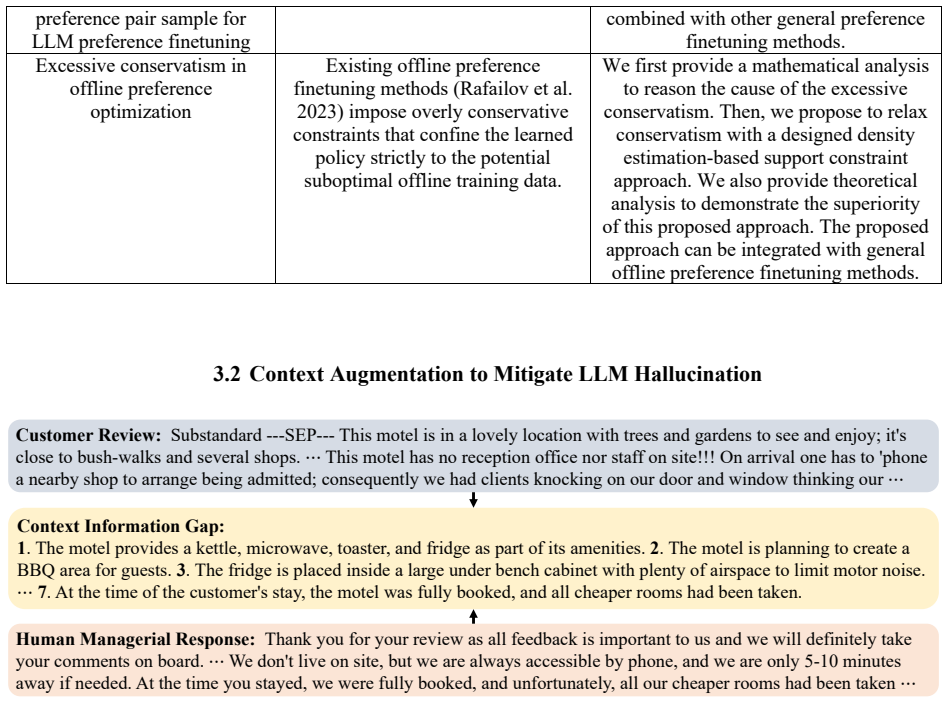
The central claim is that the proposed preference finetuning method, which mitigates hallucinations via context augmentation, represents human preferences through a theory-driven automatic construction of pairs, employs curriculum learning, and introduces a density estimation-based support constraint proven to have superior theoretical guarantees, successfully aligns LLMs for generating online review responses.
What carries the argument
Density estimation-based support constraint method that relaxes over-conservatism in offline policy optimization for preference fine-tuning.
Load-bearing premise
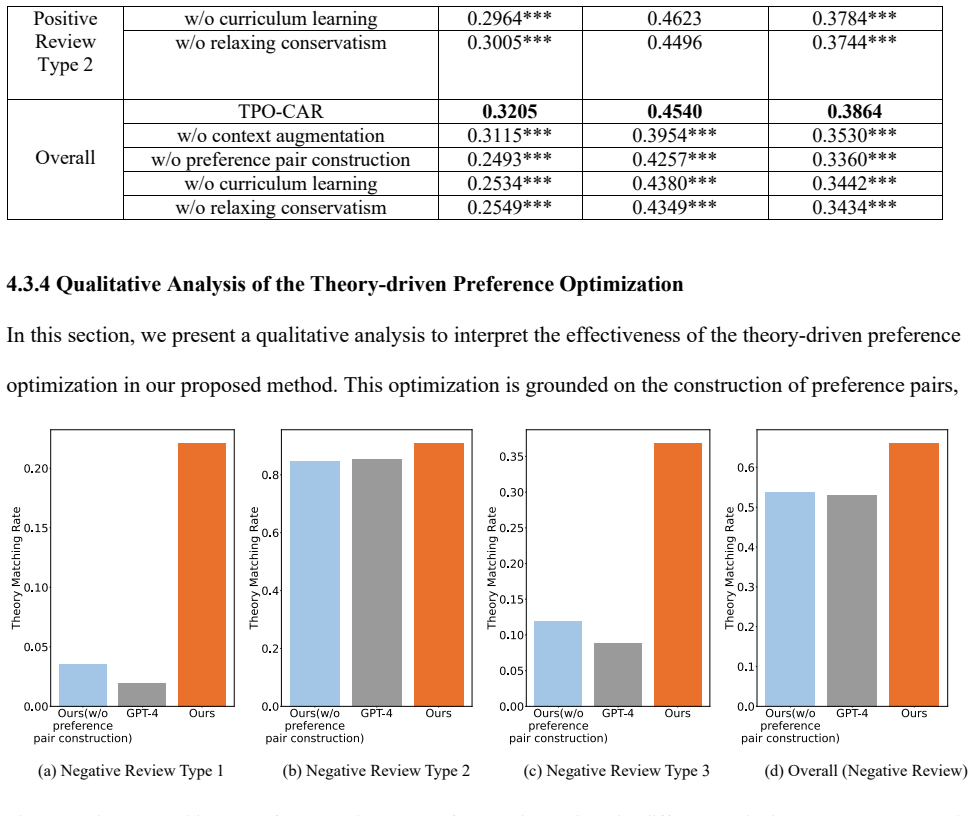
Automatically constructed preference pairs from the theory-driven method faithfully capture real human preferences in online review management without significant bias or gaps.
What would settle it
A comparative study where domain experts rate blinded responses from the proposed model versus baselines and standard fine-tuned models; failure to show higher preference rates or increased hallucination rates would disprove the alignment benefits.
Figures

read the original abstract
Online reviews have played a pivotal role in consumers' decision-making processes. Existing research has highlighted the significant impact of managerial review responses on customer relationship management and firm performance. However, a large portion of online reviews remains unaddressed due to the considerable human labor required to respond to the rapid growth of online reviews. While generative AI has achieved remarkable success in a range of tasks, they are general-purpose models and may not align well with domain-specific human preferences. To tailor these general generative AI models to domain-specific applications, finetuning is commonly employed. Nevertheless, several challenges persist in finetuning with domain-specific data, including hallucinations, difficulty in representing domain-specific human preferences, and over conservatism in offline policy optimization. To address these challenges, we propose a novel preference finetuning method to align an LLM with domain-specific human preferences for generating online review responses. Specifically, we first identify the source of hallucination and propose an effective context augmentation approach to mitigate the LLM hallucination. To represent human preferences, we propose a novel theory-driven preference finetuning approach that automatically constructs human preference pairs in the online review domain. Additionally, we propose a curriculum learning approach to further enhance preference finetuning. To overcome the challenge of over conservatism in existing offline preference finetuning method, we propose a novel density estimation-based support constraint method to relax the conservatism, and we mathematically prove its superior theoretical guarantees. Extensive evaluations substantiate the superiority of our proposed preference finetuning method.
Editorial analysis
A structured set of objections, weighed in public.
Referee Report
Summary. The paper claims to introduce a novel preference fine-tuning method for LLMs that aligns them with domain-specific human preferences for generating managerial responses to online reviews. It proposes context augmentation to mitigate hallucinations, a theory-driven approach to automatically construct preference pairs, curriculum learning for enhanced fine-tuning, and a density estimation-based support constraint (with a claimed mathematical proof of superior theoretical guarantees over existing offline methods) to address over-conservatism. The work asserts that extensive evaluations demonstrate the method's superiority in the online review management domain.
Significance. If the automatically constructed preference pairs are shown to faithfully represent human judgments and the theoretical guarantees are verified, the approach could meaningfully advance practical LLM alignment for high-volume business tasks such as review response generation, potentially lowering labor costs while improving response quality and customer relationship outcomes.
major comments (2)
- [Abstract] Abstract: the central claim rests on a 'theory-driven' automatic construction of human preference pairs that 'accurately represent domain-specific human preferences,' yet no details of the underlying theory, pair-construction procedure, or any empirical validation (e.g., comparison to human-annotated data or inter-rater agreement) are supplied; without this, the subsequent curriculum learning, support constraint, and claimed guarantees rest on an untested foundation.
- [Abstract] Abstract: the manuscript asserts that the density estimation-based support constraint 'mathematically prove[s] its superior theoretical guarantees' over offline methods, but supplies neither the proof sketch, assumptions, nor derivation; this is load-bearing for the superiority claim and cannot be assessed from the given text.
minor comments (1)
- [Abstract] Abstract: 'extensive evaluations' are invoked without naming datasets, baselines, metrics, or statistical tests, making it impossible to gauge the strength of the empirical support.
Simulated Author's Rebuttal
We thank the referee for the detailed and constructive feedback on our manuscript. We address each major comment point by point below, clarifying the location of details in the full paper and committing to revisions that improve accessibility without altering the core contributions.
read point-by-point responses
-
Referee: [Abstract] Abstract: the central claim rests on a 'theory-driven' automatic construction of human preference pairs that 'accurately represent domain-specific human preferences,' yet no details of the underlying theory, pair-construction procedure, or any empirical validation (e.g., comparison to human-annotated data or inter-rater agreement) are supplied; without this, the subsequent curriculum learning, support constraint, and claimed guarantees rest on an untested foundation.
Authors: We agree that the abstract, constrained by length, omits elaboration on these elements. The underlying theory (drawn from established customer relationship management principles for response quality), the exact pair-construction procedure (including how domain-specific attributes are mapped to preference labels), and the empirical validation (human annotation study with inter-rater agreement statistics and fidelity metrics) are fully specified in Section 3 of the manuscript. To strengthen the abstract, we will revise it to include a concise summary of the theory, a high-level outline of the construction steps, and a statement of the validation results. This revision will be made in the next version. revision: yes
-
Referee: [Abstract] Abstract: the manuscript asserts that the density estimation-based support constraint 'mathematically prove[s] its superior theoretical guarantees' over offline methods, but supplies neither the proof sketch, assumptions, nor derivation; this is load-bearing for the superiority claim and cannot be assessed from the given text.
Authors: The complete proof, including all assumptions, the derivation steps, and the comparison to existing offline methods, appears in Section 4.3 and Appendix B. We recognize that the abstract states the claim without supporting details. In the revised manuscript we will incorporate a brief proof sketch and list the key assumptions directly into the abstract to make the theoretical contribution self-contained and easier to evaluate. revision: yes
Circularity Check
No significant circularity in derivation chain
full rationale
The paper proposes a novel preference finetuning method with components including context augmentation for hallucination mitigation, a theory-driven automatic construction of human preference pairs, curriculum learning, and a density estimation-based support constraint accompanied by a mathematical proof of superior theoretical guarantees. No load-bearing step reduces by the paper's own equations or self-citation to its inputs by construction. The abstract presents the theory-driven construction as a solution to representing domain-specific preferences without indicating that the underlying theory or constructed pairs are defined circularly in terms of fitted model outputs or the same data. Extensive evaluations are claimed as substantiation, indicating the central claims have independent empirical content rather than being forced by definition or self-referential fitting. No self-citation chains, ansatz smuggling, or renaming of known results appear in the provided text.
Axiom & Free-Parameter Ledger
axioms (2)
- domain assumption Domain-specific human preferences in online review management can be automatically constructed from theory without direct human annotation.
- ad hoc to paper The density estimation-based support constraint mathematically guarantees superior performance over existing offline methods.
Reference graph
Works this paper leans on
-
[1]
,!), the posterior +&(&$|(,
nguage processing (Devlin et al. 2019, Liu et al. 2019), we leverage the CVAE with transformer architecture denoted as trans-CVAE to model the prior distribution $#(&$|(%$,",!), the posterior +&(&$|(,",!) and response decoding +#((|(%$,&$,",!). Specifically, to model $#(&$|(%$,",!), we use the transformer encoder (Vaswani et al
2019
-
[2]
,!) mirrors the above modeling of $#(&$|(%$,
to encode concatenation of " and !, and then adopt the transformer decoder (Vaswani et al. 2017)—removing the output layer (i.e., linear and softmax layer)—to generate the representation ℎ$'!( for the .-th response token. In CVAE, the $#(&$|(%$,",!) is parametrized by Gaussian distribution with mean /$'!( and variance 0$'!(, both of which are obtained usi...
2017
-
[3]
,F)∈[0,I]. The performance metric is defined as follows: Performance Metric. K(=)≝M-∼/,1∼2(⋅|-)?∗(
adopts the masked attention to prevent the .-th response token from attending to subsequence tokens. However, in the posterior distribution modeling, the .-th response token attends to all the tokens in response. Therefore, we utilize the non-mask attention to obtain ℎ$'*+. Similarly, the posterior latent variable &$'*+ is sampled from Gaussian 1: /$'*+,d...
2019
-
[4]
,()]−VW;<[=((|
to refine the estimation of the behavior policy. The VAE is recognized as one of the widely used methods for density estimation in the offline reinforcement learning field (Fujimoto et al. 2019, Zhou et al. 2021). For the theoretical analysis and the comparison with the theoretical result of DPO method, we use =89: as the estimation of offline data distri...
2019
-
[5]
). We are given a dataset é={(
=122ÜãlÄS)(ℎ)−lÄS*(ℎ)ãN∈{W7,V7} ãlÄS)(ℎ)+lÄS*(ℎ)ã9) (by Cauchy–Schwarz inequality) ≤122Ü:lÄS)(ℎ)−lÄS*(ℎ);)N∈{W7,V7} 92Ü:lÄS)(ℎ)+lÄS*(ℎ);)N∈{W7,V7} 9 2WQ)7ÄS)(ℎ),ÄS*(ℎ)8=Ü:lÄS)(ℎ)−lÄS*(ℎ);)N∈{W7,V7} 9 =12WQ)7ÄS)(ℎ),ÄS*(ℎ)8:4−WQ)7ÄS)(ℎ),ÄS*(ℎ)8; ≤2WQ)7ÄS)(ℎ),ÄS*(ℎ)8 Therefore, 7ÄS)(ℎ=+1)−ÄS*(ℎ=+1)8)≤WQ)7ÄS)(ℎ),ÄS*(ℎ)8 Notice that 7ÄS)(ℎ=+1)−ÄS*(ℎ=+1)8)=h0(&...
2000
-
[6]
I want you to act as a hotel manager. Your task is to write a response to the following [] customer review,
as the LLM to fine-tune, which is developed by Meta and is one of the most powerful open-source LLMs. Importantly, our method is LLM-agnostic and can be adapted for use with other LLMs as well. In terms of the fine-tuning strategy, given the substantial parameter count of a 70B LLM, we employ the Quantization and Low-Rank Adapters (QLoRA) method (Dettmers...
2023
-
[7]
In our proposed method, for each pair of review and response (",() in the training data, we use GPT-4 to extract a list of objective facts as context information !
(a) (b) (c) (d) Online Appendix A-22 In this section, we conduct a human evaluation to assess the quality of context information. In our proposed method, for each pair of review and response (",() in the training data, we use GPT-4 to extract a list of objective facts as context information !. To evaluate the quality of context information !, we ask the h...
2024
-
[8]
(Zhang et al. 2023). The diffusion model (Ho et al
2023
-
[9]
#$ "!"#$ #!
is also used to characterize the support of behavior policies (Gao et al. 2025). Different from these works, our proposed density estimation-based support constraint method is motivated by our theoretical analysis detailed in Section 3.4.1. Moreover, none of the existing methods models the sequential dependency. In contrast, our proposed method models the...
2025
-
[10]
http://arxiv.org/abs/2006.10814. Beltran-Hernandez CC, Petit D, Ramirez-Alpizar IG, Harada K (2022) Accelerating Robot Learning of Contact-Rich Manipulations: A Curriculum Learning Study. (April
-
[11]
Bengio Y, Louradour J, Collobert R, Weston J (2009) Curriculum learning
http://arxiv.org/abs/2204.12844. Bengio Y, Louradour J, Collobert R, Weston J (2009) Curriculum learning. Proc. 26th Annu. Int. Conf. Mach. Learn. ICML ’09. (Association for Computing Machinery, New York, NY, USA), 41–48. Deng C, Ravichandran T (2023) Managerial Response to Online Positive Reviews: Helpful or Harmful? Inf. Syst. Res. Dettmers T, Pagnoni A...
-
[12]
NICE: Non-linear Independent Components Estimation
http://arxiv.org/abs/1410.8516. El-Bouri R, Eyre D, Watkinson P, Zhu T, Clifton D (2020) Student-Teacher Curriculum Learning via Reinforcement Learning: Predicting Hospital Inpatient Admission Location. Proc. 37th Int. Conf. Mach. Learn. (PMLR), 2848–2857. Fujimoto S, Meger D, Precup D (2019) Off-Policy Deep Reinforcement Learning without Exploration. (August
work page internal anchor Pith review arXiv 2020
-
[13]
Off-policy deep reinforcement learning without exploration
http://arxiv.org/abs/1812.02900. Gabbianelli G, Neu G, Papini M (2024) Importance-Weighted Offline Learning Done Right. Proc. 35th Int. Conf. Algorithmic Learn. Theory (PMLR), 614–634. Gao Y, Guo J, Wu F, Zhang R (2025) Policy Constraint by Only Support Constraint for Offline Reinforcement Learning. (March
-
[14]
http://arxiv.org/abs/2503.05207. van de Geer SA (2000) Empirical Processes in M-Estimation | Statistical theory and methods (Cambridge University Press). Goodfellow I, Pouget-Abadie J, Mirza M, Xu B, Warde-Farley D, Ozair S, Courville A, Bengio Y (2014) Generative Adversarial Nets. Adv. Neural Inf. Process. Syst. (Curran Associates, Inc.). Guo S, Huang W,...
-
[15]
Offline Reinforcement Learning: Tutorial, Review, and Perspectives on Open Problems
http://arxiv.org/abs/2005.01643. Liu Y, Ott M, Goyal N, Du J, Joshi M, Chen D, Levy O, Lewis M, Zettlemoyer L, Stoyanov V (2019) RoBERTa: A Robustly Optimized BERT Pretraining Approach. (July
work page internal anchor Pith review arXiv 2005
-
[16]
RoBERTa: A Robustly Optimized BERT Pretraining Approach
http://arxiv.org/abs/1907.11692. Loshchilov I, Hutter F (2018) Decoupled Weight Decay Regularization. Pattnaik P, Maheshwary R, Ogueji K, Yadav V, Madhusudhan ST (2024) Curry-DPO: Enhancing Alignment using Curriculum Learning & Ranked Preferences. (March
work page internal anchor Pith review Pith/arXiv arXiv 1907
-
[17]
Pomerleau DA (1991) Efficient Training of Artificial Neural Networks for Autonomous Navigation
http://arxiv.org/abs/2403.07230. Pomerleau DA (1991) Efficient Training of Artificial Neural Networks for Autonomous Navigation. Neural Comput. 3(1):88–97. Rafailov R, Sharma A, Mitchell E, Manning CD, Ermon S, Finn C (2023) Direct Preference Optimization: Your Language Model is Secretly a Reward Model. Adv. Neural Inf. Process. Syst. Ravichandran T, Deng...
-
[18]
Llama 2: Open Foundation and Fine-Tuned Chat Models
http://arxiv.org/abs/2307.09288. Vaswani A, Shazeer N, Parmar N, Uszkoreit J, Jones L, Gomez AN, Kaiser Ł, Polosukhin I (2017) Attention is All you Need. Adv. Neural Inf. Process. Syst. (Curran Associates, Inc.). Wang L, Krishnamurthy A, Slivkins A (2024) Oracle-Efficient Pessimism: Offline Policy Optimization In Contextual Bandits. Proc. 27th Int. Conf. ...
work page internal anchor Pith review Pith/arXiv arXiv 2017
-
[19]
http://arxiv.org/abs/2108.08812. Zhang J, Zhang C, Wang W, Jing B (2023) Constrained Policy Optimization with Explicit Behavior Density For Offline Reinforcement Learning. Zhou W, Bajracharya S, Held D (2021) PLAS: Latent Action Space for Offline Reinforcement Learning. Proc. 2020 Conf. Robot Learn. (PMLR), 1719–1735
discussion (0)
Sign in with ORCID, Apple, or X to comment. Anyone can read and Pith papers without signing in.