Recognition: unknown
Real link Floer homology
Pith reviewed 2026-05-08 13:37 UTC · model grok-4.3
The pith
Real link Floer homology is defined for strongly invertible and doubly periodic links in real 3-manifolds.
A machine-rendered reading of the paper's core claim, the machinery that carries it, and where it could break.
Core claim
We define real link Floer homology for strongly invertible and doubly periodic links in closed real 3-manifolds with connected fixed sets, which generalizes real Heegaard Floer homology and real sutured Heegaard Floer homology. We give a combinatorial description of the theory in S^3 via real grid diagrams and use it to investigate structural properties of the theory as well as properties of strongly invertible knots.
What carries the argument
Real grid diagrams, which are grid presentations of links in S^3 that are equivariant under a fixed involution and generate a chain complex whose homology is the real link Floer homology.
If this is right
- The homology supplies a combinatorial invariant for strongly invertible links in S^3 that can be calculated directly from grid diagrams.
- The theory applies to all closed real 3-manifolds with connected fixed sets and recovers the earlier real Heegaard Floer theories in the appropriate special cases.
- Explicit computations become feasible for small knots, producing concrete homology groups and revealing patterns in the data for more than fifty examples.
- Structural properties such as behavior under connected sums or other operations on the links can be read off from the chain complex.
Where Pith is reading between the lines
- The observed patterns in the computed examples for small knots may point to a relationship between the rank of the homology and the symmetry type of the knot.
- Because the construction is combinatorial, it opens the possibility of machine-assisted searches for knots whose real link Floer homology detects previously invisible features of strong inversions.
- The generalization to real 3-manifolds suggests the theory could be used to study equivariant problems in other Floer-type invariants that have real versions.
Load-bearing premise
The homology groups obtained from the construction do not depend on the choice of real Heegaard diagram or real grid diagram and remain unchanged when the link is modified by the allowed real moves.
What would settle it
Two different real grid diagrams for the same strongly invertible knot whose associated chain complexes have different homology groups, or a sequence of real link moves that alters the computed homology.
Figures
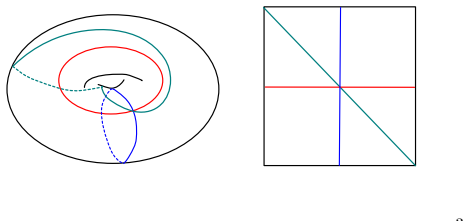


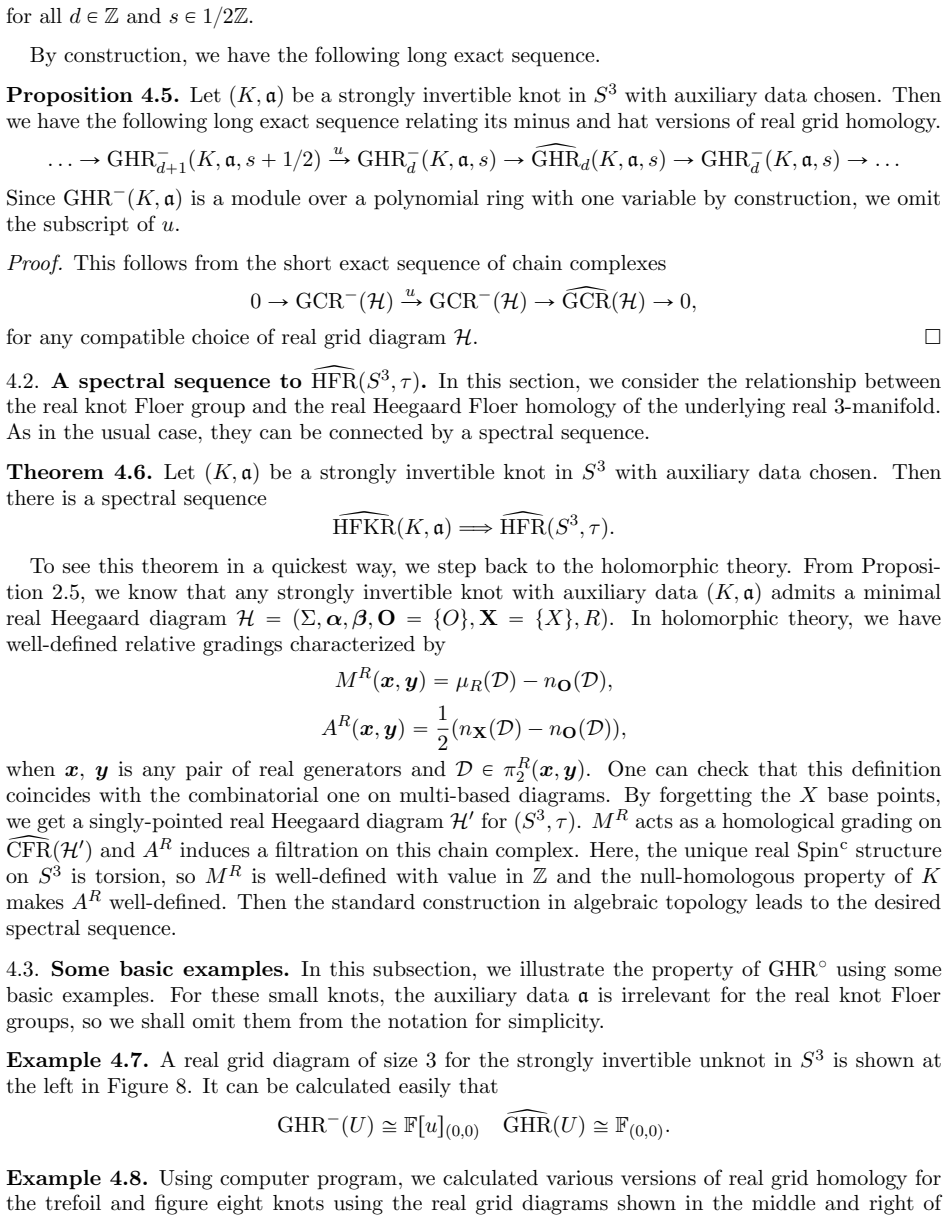


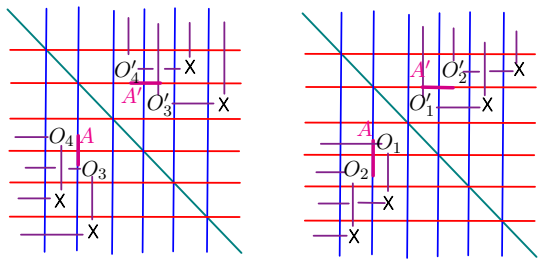


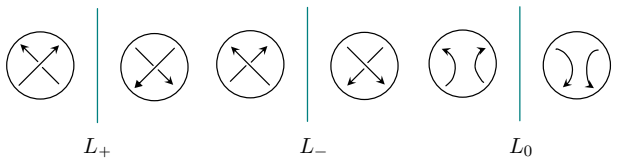




read the original abstract
In this paper, we define real link Floer homology for strongly invertible and doubly periodic links in closed real $3$-manifolds with connected fixed sets, which generalizes real Heegaard Floer homology and real sutured Heegaard Floer homology. We give a combinatorial description of the theory in $S^3$ via real grid diagrams and use it to investigate structural properties of the theory as well as properties of strongly invertible knots. A computer implementation was written by Zhenkun Li. An appendix including real grid homology for 50+ small knots is made jointly by Zhenkun Li and the author, from which we observe several interesting phenomenon.
Editorial analysis
A structured set of objections, weighed in public.
Referee Report
Summary. The paper defines real link Floer homology for strongly invertible and doubly periodic links in closed real 3-manifolds with connected fixed sets, generalizing real Heegaard Floer homology and real sutured Heegaard Floer homology. It supplies a combinatorial description in S^3 via real grid diagrams, uses this to investigate structural properties of the theory and of strongly invertible knots, includes a computer implementation, and provides an appendix with real grid homology computations for over 50 small knots.
Significance. If the invariance under diagram changes is established, the construction would furnish a new Floer-theoretic invariant adapted to real symmetries, extending existing real Heegaard Floer theories to links and enabling computational study of strongly invertible knots. The combinatorial grid-diagram approach together with the explicit computer implementation and tabulated examples constitute concrete strengths that would make the invariant immediately usable for further calculations and conjectures.
major comments (2)
- [Section describing the combinatorial chain complex and its invariance (the section immediately following the definition)] The central claim that the homology is a link invariant rests on the assertion that the chain complex defined from a real grid diagram is independent of the choice of diagram. The text does not supply the required case-by-case verification that every real analogue of a grid move (real stabilizations, real commutations, and real Reidemeister-type moves compatible with the strong inversion or double periodicity) induces a chain homotopy equivalence; without these explicit homotopy equivalences the homology remains diagram-dependent rather than an invariant of the link.
- [Introduction and the section on the definition of real link Floer homology] The generalization from real Heegaard Floer homology to the link setting is stated in the abstract and introduction, yet the manuscript supplies no derivation steps showing how the real link complex reduces to the known real Heegaard or sutured complexes when the link is a knot or when the diagram is a Heegaard diagram; this reduction is load-bearing for the claim that the new theory is a genuine generalization.
minor comments (2)
- Notation for the real generators and the differential counting real holomorphic disks (or their combinatorial analogues) should be introduced with a single consistent table or list of symbols to avoid ambiguity when the same symbols appear in both the geometric and combinatorial descriptions.
- [Appendix] The appendix computations are valuable; each table should include a brief statement of the diagram used and the grading conventions so that readers can reproduce the entries from the combinatorial definition.
Simulated Author's Rebuttal
We thank the referee for the careful reading and constructive comments on our manuscript. The two major points raised concern the explicit verification of invariance under real grid moves and the detailed reduction to the known real Heegaard and sutured theories. We address each below and will revise the manuscript to strengthen these aspects while retaining the combinatorial and computational contributions.
read point-by-point responses
-
Referee: [Section describing the combinatorial chain complex and its invariance (the section immediately following the definition)] The central claim that the homology is a link invariant rests on the assertion that the chain complex defined from a real grid diagram is independent of the choice of diagram. The text does not supply the required case-by-case verification that every real analogue of a grid move (real stabilizations, real commutations, and real Reidemeister-type moves compatible with the strong inversion or double periodicity) induces a chain homotopy equivalence; without these explicit homotopy equivalences the homology remains diagram-dependent rather than an invariant of the link.
Authors: We agree that explicit verification of invariance is necessary to establish the homology as a true link invariant. The manuscript defines the real grid moves and asserts invariance by analogy with the non-real grid homology literature, but we acknowledge that the full case-by-case construction of chain homotopy equivalences (for real stabilizations, commutations, and symmetry-compatible Reidemeister moves) is not written out in detail. In the revised version we will insert a new subsection immediately after the definition of the chain complex. This subsection will construct the required homotopy equivalences explicitly, adapting the standard arguments from Manolescu–Ozsváth–Sarkar and subsequent grid-homology papers to the real symmetric setting while preserving the real involution on the complex. These additions will make the invariance rigorous without changing the overall combinatorial framework. revision: yes
-
Referee: [Introduction and the section on the definition of real link Floer homology] The generalization from real Heegaard Floer homology to the link setting is stated in the abstract and introduction, yet the manuscript supplies no derivation steps showing how the real link complex reduces to the known real Heegaard or sutured complexes when the link is a knot or when the diagram is a Heegaard diagram; this reduction is load-bearing for the claim that the new theory is a genuine generalization.
Authors: We appreciate the referee’s emphasis on making the generalization explicit. By construction, a real grid diagram for a strongly invertible knot specializes to a real Heegaard diagram of the knot complement (or the closed manifold), with generators, differentials, and gradings matching those of real Heegaard Floer homology; the sutured case follows similarly when the diagram is viewed as a sutured Heegaard diagram. To render this reduction transparent, we will add a short paragraph in the introduction and a dedicated remark in the definition section that spells out the correspondence between the real link complex and the existing real Heegaard/sutured complexes in the knot and Heegaard-diagram special cases. This clarification will be purely expository and will not alter the definitions or results. revision: yes
Circularity Check
No circularity: definition via real grid diagrams is independent of inputs.
full rationale
The paper defines real link Floer homology directly from real grid diagrams for strongly invertible and doubly periodic links, generalizing prior real Heegaard Floer theories without self-referential equations or fitted parameters renamed as predictions. No load-bearing step reduces the homology to its own construction by definition, self-citation chain, or ansatz smuggling. Invariance under diagram moves is a standard proof obligation in such combinatorial Floer theories and does not constitute circularity per the enumerated patterns. The appendix computations provide external verification content rather than tautological support. This is a normal non-finding for a definitional generalization paper.
Axiom & Free-Parameter Ledger
axioms (1)
- domain assumption Real Heegaard Floer homology and real sutured Heegaard Floer homology are well-defined and invariant as previously constructed.
Reference graph
Works this paper leans on
-
[1]
Knot Floer homology and the unknotting number.Geometry & Topology, 24(5):2435–2469, December 2020
Akram Alishahi and Eaman Eftekhary. Knot Floer homology and the unknotting number.Geometry & Topology, 24(5):2435–2469, December 2020
2020
-
[2]
Baldwin and William D
John A. Baldwin and William D. Gillam. Computations of Heegaard-Floer knot homology.Journal of Knot Theory and Its Ramifications, 21(08):1250075, 2012
2012
-
[3]
Real sutured Heegaard Floer homology
Fraser Binns, Gary Guth, and Yonghan Xiao. Real sutured Heegaard Floer homology
-
[4]
Khovanov homology and equivariant surfaces.arXiv preprint arXiv:2507.13642, 2025
Maciej Borodzik, Irving Dai, Abhishek Mallick, and Matthew Stoffregen. Khovanov homology and equivariant surfaces.arXiv preprint arXiv:2507.13642, 2025
-
[5]
Reidemeister and movie moves for involutive links
Maciej Borodzik, Irving Dai, Abhishek Mallick, and Matthew Stoffregen. Reidemeister and movie moves for involutive links. In preparation
-
[6]
Equivariant unknotting numbers of strongly invertible knots
Keegan Boyle and Wenzhao Chen. Equivariant unknotting numbers of strongly invertible knots. 2025
2025
-
[7]
Involutions onS 4
Keegan Boyle, Wenzhao Chen, and Anthony Conway. Involutions onS 4. 2025
2025
-
[8]
Equivariant 4-genera of strongly invertible and periodic knots.Journal of Topol- ogy, 15(3):1635–1674, 2022
Keegan Boyle and Ahmad Issa. Equivariant 4-genera of strongly invertible and periodic knots.Journal of Topol- ogy, 15(3):1635–1674, 2022
2022
-
[9]
Simply slicing knots
Anthony Conway, Patrick Orson, and Mark Pencovitch. Simply slicing knots. 2025
2025
-
[10]
Equivariant knots and knot Floer homology.Journal of Topology, 16:1167–1236, 09 2023
Irving Dai, Abhishek Mallick, and Matthew Stoffregen. Equivariant knots and knot Floer homology.Journal of Topology, 16:1167–1236, 09 2023
2023
-
[11]
The equivariant concordance group is not abelian.Bulletin of the London Mathematical Society, 55(1):502–507, 2023
Alessio Di Prisa. The equivariant concordance group is not abelian.Bulletin of the London Mathematical Society, 55(1):502–507, 2023
2023
-
[12]
Equivariant algebraic concordance of strongly invertible knots.Journal of Topology, 17(4):e70006, 2024
Alessio Di Prisa. Equivariant algebraic concordance of strongly invertible knots.Journal of Topology, 17(4):e70006, 2024
2024
-
[13]
Edmonds and Charles Livingston
Allan L. Edmonds and Charles Livingston. Group actions on fibered three-manifolds.Commentarii Mathematici Helvetici, 58:529–542, 1983
1983
-
[14]
Real Heegaard Floer homology.arXiv preprint arXiv:2504.09034, 2025
Gary Guth and Ciprian Manolescu. Real Heegaard Floer homology.arXiv preprint arXiv:2504.09034, 2025
-
[15]
A note on real Heegaard Floer homology and localization.arXiv preprint arXiv:2508.03897, 2025
Kristen Hendricks. A note on real Heegaard Floer homology and localization.arXiv preprint arXiv:2508.03897, 2025
-
[16]
Involutive Heegaard Floer homology.Duke Mathematical Journal, 166(7):1211 – 1299, 2017
Kristen Hendricks and Ciprian Manolescu. Involutive Heegaard Floer homology.Duke Mathematical Journal, 166(7):1211 – 1299, 2017
2017
-
[17]
Mikami Hirasawa, Ryota Hiura, and Makoto Sakuma. The equivariant genera of marked strongly invertible knots associated with 2-bridge knots.arXiv preprint arXiv:2312.06156, 2023
-
[18]
Invariant Seifert surfaces for strongly invertible knots
Mikami Hirasawa, Ryota Hiura, and Makoto Sakuma. Invariant Seifert surfaces for strongly invertible knots. InEssays in geometry—dedicated to Norbert A’Campo, volume 34 ofIRMA Lect. Math. Theor. Phys., pages 325–349. EMS Press, Berlin, [2023]©2023
2023
-
[19]
Craig Hodgson and J. H. Rubinstein. Involutions and isotopies of lens spaces. In Dale Rolfsen, editor,Knot Theory and Manifolds, pages 60–96, Berlin, Heidelberg, 1985. Springer Berlin Heidelberg
1985
-
[20]
Monopole Floer homology and real structures, 2022
Jiakai Li. Monopole Floer homology and real structures, 2022
2022
-
[21]
Zhenkun Li.https://github.com/Zhenkun-Li/RealGridHomology
-
[22]
Robert Lipshitz and Peter Ozsv´ ath. Real bordered floer homology.arXiv preprint arXiv:2604.20565, 2026
work page internal anchor Pith review Pith/arXiv arXiv 2026
-
[23]
A refinement of Khovanov homology.Geometry & Topology, 25:1861–1917, 07 2021
Andrew Lobb and Liam Watson. A refinement of Khovanov homology.Geometry & Topology, 25:1861–1917, 07 2021
1917
-
[24]
A combinatorial description of knot Floer homology
Ciprian Manolescu, Peter Ozsv´ ath, and Sucharit Sarkar. A combinatorial description of knot Floer homology. Ann. of Math. (2), 169(2):633–660, 2009
2009
-
[25]
On combinatorial link Floer homology
Ciprian Manolescu, Peter Ozsv´ ath, Zolt´ an Szab´ o, and Dylan Thurston. On combinatorial link Floer homology. Geom. Topol., 11:2339–2412, 2007. 69
2007
-
[26]
Miller and Mark Powell
Allison N. Miller and Mark Powell. Strongly invertible knots, equivariant slice genera, and an equivariant alge- braic concordance group.Journal of the London Mathematical Society, 107(6):2025–2053, 2023
2025
-
[27]
Montesinos.Surgery on Links and Double branched covers ofS 3, pages 227–260
Jose M. Montesinos.Surgery on Links and Double branched covers ofS 3, pages 227–260. Princeton University Press, Princeton, 1975
1975
-
[28]
On periodic knots.Commentarii Mathematici Helvetici, 46:162–174, 1971
Kunio Murasugi. On periodic knots.Commentarii Mathematici Helvetici, 46:162–174, 1971
1971
-
[29]
Holomorphic disks and knot invariants.Advances in Mathematics, 186(1):58– 116, August 2004
Peter Ozsv´ ath and Zolt´ an Szab´ o. Holomorphic disks and knot invariants.Advances in Mathematics, 186(1):58– 116, August 2004
2004
-
[30]
Holomorphic disks and topological invariants for closed three-manifolds.Annals of Mathematics, pages 1027–1158, 2004
Peter Ozsv´ ath and Zolt´ an Szab´ o. Holomorphic disks and topological invariants for closed three-manifolds.Annals of Mathematics, pages 1027–1158, 2004
2004
-
[31]
Knot Floer homology and the four-ball genus.Geometry & Topology, 7:1364– 380, 02 2003
Peter Ozsvath and Zolt´ an Szab´ o. Knot Floer homology and the four-ball genus.Geometry & Topology, 7:1364– 380, 02 2003
2003
-
[32]
Ozsv´ ath, Andr´ as I
Peter S. Ozsv´ ath, Andr´ as I. Stipsicz, and Zolt´ an Szab´ o.Grid homology for knots and links, volume 208 of Mathematical Surveys and Monographs. American Mathematical Society, Providence, RI, 2015
2015
-
[33]
Floer homology and knot complements.arXiv:math/0306378, June 2003
Jacob Rasmussen. Floer homology and knot complements.arXiv:math/0306378, June 2003. arXiv: math/0306378
-
[34]
On strongly invertible knots.Algebraic and topological theories (Kinosaki, 1984), 01 1986
Makoto Sakuma. On strongly invertible knots.Algebraic and topological theories (Kinosaki, 1984), 01 1986
1984
-
[35]
Involutive Khovanov homology and equivariant knots.Algebraic & Geometric Topology, 25(8):5059–5111, November 2025
Taketo Sano. Involutive Khovanov homology and equivariant knots.Algebraic & Geometric Topology, 25(8):5059–5111, November 2025
2025
-
[36]
Grid diagrams and the Ozsv´ ath-Szab´ o tau-invariant.Math
Sucharit Sarkar. Grid diagrams and the Ozsv´ ath-Szab´ o tau-invariant.Math. Res. Lett., 18(6):1239–1257, 2011
2011
-
[37]
Moving basepoints and the induced automorphisms of link Floer homology.Algebraic & Geo- metric Topology, 15(5):2479–2515, November 2015
Sucharit Sarkar. Moving basepoints and the induced automorphisms of link Floer homology.Algebraic & Geo- metric Topology, 15(5):2479–2515, November 2015
2015
-
[38]
An algorithm for computing some Heegaard Floer homologies.Annals of Mathematics, 171(2):1213–1236, 2010
Sucharit Sarkar and Jiajun Wang. An algorithm for computing some Heegaard Floer homologies.Annals of Mathematics, 171(2):1213–1236, 2010
2010
-
[39]
Hale F. Trotter. Periodic automorphisms of groups and knots.Duke Mathematical Journal, 28:553–557, 1961
1961
-
[40]
Quasistabilization and basepoint moving maps in link Floer homology.Algebraic & Geometric Topol- ogy, 17(6):3461 – 3518, 2017
Ian Zemke. Quasistabilization and basepoint moving maps in link Floer homology.Algebraic & Geometric Topol- ogy, 17(6):3461 – 3518, 2017
2017
-
[41]
Link cobordisms and absolute gradings on link Floer homology.Quantum Topology, 10:207–323, 03 2019
Ian Zemke. Link cobordisms and absolute gradings on link Floer homology.Quantum Topology, 10:207–323, 03 2019
2019
-
[42]
Link cobordisms and functoriality in link Floer homology.Journal of Topology, 12(1):94–220, 2019
Ian Zemke. Link cobordisms and functoriality in link Floer homology.Journal of Topology, 12(1):94–220, 2019
2019
-
[43]
Real open books and real contact structures.Advances in Geometry, 15(4):415– 431, 2015
Ferit ¨Ozt¨ urk and Nermin Salepci. Real open books and real contact structures.Advances in Geometry, 15(4):415– 431, 2015. Department of Mathematics, School of Mathematical Sciences, Peking University Email address:judy xyh0530@stu.pku.edu.cn 70
2015
discussion (0)
Sign in with ORCID, Apple, or X to comment. Anyone can read and Pith papers without signing in.