Recognition: unknown
Bounding the density of spherical polygon packings
Pith reviewed 2026-05-08 13:00 UTC · model grok-4.3
The pith
Regular spherical polygons achieve maximum packing densities that can be bounded above using an extended Lovász theta number on rotation-group graphs.
A machine-rendered reading of the paper's core claim, the machinery that carries it, and where it could break.
Core claim
Putative optimal packings of regular spherical polygons are located by manifold optimization; maximality for several families is established by the Lovász theta number of the associated Cayley graph on SO(3). The key step is an algebraic criterion that exactly characterizes when two congruent regular spherical polygons have disjoint interiors, allowing every packing constraint to be written uniformly. Harmonic analysis reduces the resulting theta-number computation to a trigonometric sum-of-squares problem that is solved via semidefinite programming.
What carries the argument
Algebraic criterion for disjoint interiors of congruent regular spherical polygons, which unifies the packing constraints and permits the Lovász theta number to be defined on Cayley graphs over SO(3).
If this is right
- For the polygon types treated, the manifold-optimized arrangements attain the highest possible density.
- The method supplies explicit, computable upper bounds on packing density that can be checked numerically.
- The same algebraic criterion and reduction apply uniformly across different numbers of sides and spherical excesses.
- The resulting semidefinite programs can be re-solved for additional polygon families to generate further bounds.
Where Pith is reading between the lines
- The same extension of the theta number could be attempted for packings of non-regular spherical tiles or for objects on higher-dimensional spheres.
- The trigonometric sum-of-squares formulation might be tightened by adding further symmetry constraints or by using higher-order harmonics.
- Numerical comparison of the obtained bounds against known Euclidean or hyperbolic polygon packings could reveal cross-geometry patterns.
- The manifold-optimization stage could be replaced by a purely discrete search once the algebraic criterion is in hand.
Load-bearing premise
The algebraic criterion correctly identifies every pair of congruent regular spherical polygons whose interiors are disjoint.
What would settle it
A concrete pair of regular spherical polygons that the algebraic criterion declares non-overlapping yet whose interiors intersect, or a spherical packing whose measured density exceeds the SDP-computed theta bound for the same polygon type.
Figures

read the original abstract
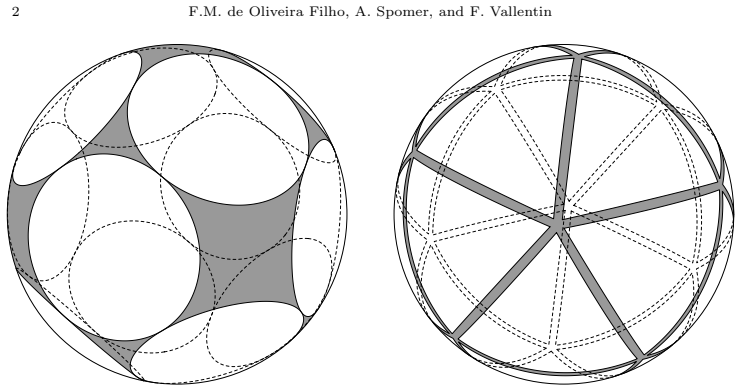
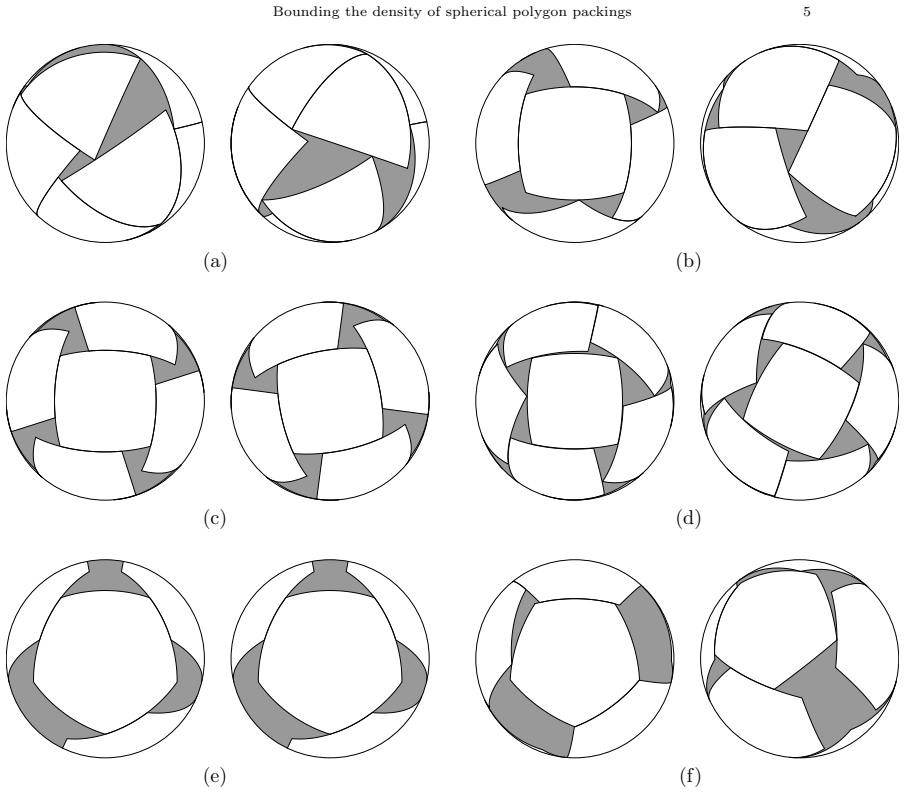
We determine putative optimal packings of regular spherical polygons via optimization on smooth manifolds. For several cases, we establish maximality by extending the Lov\'asz theta number to Cayley graphs on the special orthogonal group ${\rm SO}(3)$. To this end, we introduce an algebraic criterion characterizing when congruent regular spherical polygons have disjoint interiors, leading to a unified formulation of the packing constraints. Using harmonic analysis on ${\rm SO}(3)$, we reduce the theta number to a trigonometric sum-of-squares problem, which can be solved via semidefinite programming.
Editorial analysis
A structured set of objections, weighed in public.
Referee Report
Summary. The paper claims to determine putative optimal packings of regular spherical polygons via optimization on smooth manifolds. For several cases, maximality is established by extending the Lovász theta number to Cayley graphs on SO(3), using a new algebraic criterion that characterizes when congruent regular spherical polygons have disjoint interiors; this leads to a unified packing constraint that is reduced, via harmonic analysis on SO(3), to a trigonometric sum-of-squares problem solvable by semidefinite programming.
Significance. If the algebraic criterion is shown to be exact and the SDP relaxations are tight, the work supplies rigorous upper bounds on spherical polygon densities together with a general technique for applying Lovász theta numbers to continuous symmetry groups. The combination of manifold optimization, harmonic analysis, and SDP is a concrete methodological advance that could be reused for other packing problems on homogeneous spaces.
major comments (1)
- [Algebraic criterion for disjoint interiors (used to define the Cayley-graph edges)] The maximality claims rest on the algebraic criterion (introduced after the abstract and used to define the adjacency relation of the Cayley graph) being both necessary and sufficient for two congruent regular spherical polygons to have disjoint interiors. If any pair whose interiors intersect is not flagged by the criterion, the resulting graph is a proper subgraph of the true conflict graph; independent sets in the computed graph may therefore contain geometrically invalid configurations, and the theta value upper-bounds only a relaxation. The manuscript must supply a complete proof that the criterion detects every overlap, together with explicit verification against known intersecting configurations or a geometric argument showing completeness.
minor comments (2)
- [Reduction to SDP via harmonic analysis] The abstract states that the theta number is reduced to a trigonometric sum-of-squares SDP, but the precise change of variables, the choice of basis for the harmonic expansion, and the numerical tolerances used to certify tightness should be stated explicitly in the main text.
- A short table or paragraph comparing the new bounds with previously known spherical-packing densities (e.g., for spherical triangles or squares) would help readers assess the improvement.
Simulated Author's Rebuttal
We thank the referee for the careful reading of the manuscript and for the constructive feedback on the algebraic criterion. We address the major comment below and will incorporate the requested clarifications into the revised version.
read point-by-point responses
-
Referee: [Algebraic criterion for disjoint interiors (used to define the Cayley-graph edges)] The maximality claims rest on the algebraic criterion (introduced after the abstract and used to define the adjacency relation of the Cayley graph) being both necessary and sufficient for two congruent regular spherical polygons to have disjoint interiors. If any pair whose interiors intersect is not flagged by the criterion, the resulting graph is a proper subgraph of the true conflict graph; independent sets in the computed graph may therefore contain geometrically invalid configurations, and the theta value upper-bounds only a relaxation. The manuscript must supply a complete proof that the criterion detects every overlap, together with explicit verification against known intersecting configurations or a geometric argument showing completeness.
Authors: We agree that a self-contained proof of necessity and sufficiency is essential for the validity of the upper bounds. The criterion is obtained by expressing the condition for interior overlap in terms of the relative orientation g in SO(3) and reducing it, via the rotational symmetry of the regular polygon, to a finite set of algebraic inequalities on the entries of the rotation matrix (specifically, on the spherical distances between corresponding vertices after rotation). In the current draft this derivation is sketched but not expanded into a full if-and-only-if argument. In the revision we will add a dedicated subsection that (i) proves sufficiency by showing that satisfaction of the algebraic inequalities implies the minimal geodesic distance between any pair of points in the two polygons is positive, and (ii) proves necessity by exhibiting an explicit intersecting configuration whenever any inequality is violated. We will also include direct numerical verification on a collection of known overlapping and non-overlapping pairs (including the equatorial great-circle case and the standard spherical triangle overlaps) to confirm that the criterion flags precisely the intersecting instances. With these additions the Cayley graph coincides with the true conflict graph, so the SDP relaxation of the Lovász theta number yields a rigorous upper bound on the packing density. revision: yes
Circularity Check
No circularity: derivation uses external Lovász theta, harmonic analysis, and SDP on independently introduced algebraic criterion
full rationale
The paper introduces an algebraic criterion for disjoint interiors of spherical polygons, constructs the corresponding Cayley graph on SO(3), and computes its Lovász theta number via standard harmonic analysis reduced to a trigonometric sum-of-squares SDP. None of these steps define a quantity in terms of itself or rename a fitted parameter as a prediction; the theta bound is obtained from the graph defined by the criterion, which is external to the final density value. The approach relies on established tools (Lovász theta, representation theory of SO(3), semidefinite programming) whose validity does not presuppose the target packing densities. No self-citation chain or ansatz smuggling is load-bearing for the central claims.
Axiom & Free-Parameter Ledger
axioms (1)
- standard math Harmonic analysis on SO(3) reduces the theta number on the Cayley graph to a trigonometric sum-of-squares problem
Reference graph
Works this paper leans on
-
[1]
Addabbo,Il Libellus de impletione loci di Francesco Maurolico e la tassellazione dello spazio, PhD Thesis, Universit` a di Pisa, 2015, 299pp
C. Addabbo,Il Libellus de impletione loci di Francesco Maurolico e la tassellazione dello spazio, PhD Thesis, Universit` a di Pisa, 2015, 299pp
2015
-
[2]
Andrews, R
G.E. Andrews, R. Askey, and R. Roy,Special functions, Encyclopedia of Mathematics and its Applications 71, Cambridge University Press, Cambridge, 1999
1999
-
[3]
S.D. Axen, M. Baran, R. Bergmann, and K. Rzecki,Manifolds.jl: an extensible Julia frame- work for data analysis on manifolds,ACM Trans. Math. Software49 (2023) Art. 33, 23
2023
-
[4]
Bachoc, D
C. Bachoc, D. Gijswijt, A. Schrijver, and F. Vallentin, Invariant semidefinite programs, in: Handbook on semidefinite, conic and polynomial optimization, Internat. Ser. Oper. Res. Man- agement Sci. 166, Springer, New York, 2012, pp. 219–269
2012
-
[5]
Bachoc, G
C. Bachoc, G. Nebe, F.M. de Oliveira Filho, and F. Vallentin, Lower bounds for measurable chromatic numbers,Geom. Funct. Anal.19 (2009) 645–661
2009
-
[6]
Bachoc and F
C. Bachoc and F. Vallentin, New upper bounds for kissing numbers from semidefinite pro- gramming,J. Amer. Math. Soc.21 (2008) 909–924
2008
-
[7]
Bergmann, Manopt.jl: optimization on manifolds in Julia,Journal of Open Source Soft- ware7 (2022) 3866
R. Bergmann, Manopt.jl: optimization on manifolds in Julia,Journal of Open Source Soft- ware7 (2022) 3866
2022
-
[8]
Birgin and J.M
E.G. Birgin and J.M. Mart´ ınez,Practical augmented Lagrangian methods for constrained optimization, Fundamentals of Algorithms 10, Society for Industrial and Applied Mathematics (SIAM), Philadelphia, PA, 2014
2014
-
[9]
Birgin, J.M
E.G. Birgin, J.M. Mart´ ınez, W.F. Mascarenhas, and D.P. Ronconi, Method of sentinels for packing items within arbitrary convex regions,Journal of the Operational Research Society57 (2006) 735–746
2006
-
[10]
Bochner, Hilbert distances and positive definite functions,Ann
S. Bochner, Hilbert distances and positive definite functions,Ann. of Math. (2)42 (1941) 647–656
1941
-
[11]
Boumal,An introduction to optimization on smooth manifolds, Cambridge University Press, Cambridge, 2023
N. Boumal,An introduction to optimization on smooth manifolds, Cambridge University Press, Cambridge, 2023
2023
-
[12]
Br¨ ocker and T
T. Br¨ ocker and T. tom Dieck,Representations of compact Lie groups, Graduate Texts in Mathematics 98, Springer-Verlag, New York, 1985
1985
-
[13]
Casselman, The difficulties of kissing in three dimensions,Notices Amer
B. Casselman, The difficulties of kissing in three dimensions,Notices Amer. Math. Soc.51 (2004) 884–885
2004
-
[14]
Chirikjian and A.B
G.S. Chirikjian and A.B. Kyatkin,Engineering applications of noncommutative harmonic analysis(With emphasis on rotation and motion groups), CRC Press, Boca Raton, FL, 2001
2001
-
[15]
Cohn, Table of spherical codes,https://hdl.handle.net/1721.1/153543, DSpace@MIT, 2024
H. Cohn, Table of spherical codes,https://hdl.handle.net/1721.1/153543, DSpace@MIT, 2024
2024
-
[16]
Cohn and N
H. Cohn and N. Elkies, New upper bounds on sphere packings. I,Ann. of Math. (2)157 (2003) 689–714
2003
- [17]
-
[18]
Delsarte, J.M
P. Delsarte, J.M. Goethals, and J.J. Seidel, Spherical codes and designs,Geometriae Dedi- cata6 (1977) 363–388
1977
-
[19]
Dostert, C
M. Dostert, C. Guzm´ an, F.M. de Oliveira Filho, and F. Vallentin, New upper bounds for the density of translative packings of three-dimensional convex bodies with tetrahedral symmetry, Discrete Comput. Geom.58 (2017) 449–481
2017
-
[20]
Dumitrescu,Positive trigonometric polynomials and signal processing applications, Signals and Communication Technology, Springer, Cham, 2017
B. Dumitrescu,Positive trigonometric polynomials and signal processing applications, Signals and Communication Technology, Springer, Cham, 2017
2017
-
[21]
Folland,A Course in Abstract Harmonic Analysis, Studies in Advanced Mathematics, CRC Press, Boca Raton, FL, 1995
G.B. Folland,A Course in Abstract Harmonic Analysis, Studies in Advanced Mathematics, CRC Press, Boca Raton, FL, 1995
1995
-
[22]
Gatermann and P.A
K. Gatermann and P.A. Parrilo, Symmetry groups, semidefinite programs, and sums of squares,J. Pure Appl. Algebra192 (2004) 95–128
2004
-
[23]
Kabatiansky and V.I
G.A. Kabatiansky and V.I. Levenshtein, Bounds for packings on the sphere and in space, Problemy Peredaˇ ci Informacii14 (1978) 3–25
1978
-
[24]
de Laat, F.C
D. de Laat, F.C. Machado, F.M. de Oliveira Filho, and F. Vallentin,k-point semidefinite programming bounds for equiangular lines,Math. Program.194 (2022) 533–567
2022
-
[25]
de Laat, F.M
D. de Laat, F.M. de Oliveira Filho, and F. Vallentin, Upper bounds for packings of spheres of several radii,Forum Math. Sigma2 (2014) Paper No. e23, 42. 1https://www.tudelft.nl/dhpc 38 F.M. de Oliveira Filho, A. Spomer, and F. Vallentin
2014
-
[26]
de Laat and F
D. de Laat and F. Vallentin, A semidefinite programming hierarchy for packing problems in discrete geometry,Math. Program.151 (2015) 529–553
2015
-
[27]
Lagarias and C
J.C. Lagarias and C. Zong, Mysteries in packing regular tetrahedra,Notices Amer. Math. Soc.59 (2012) 1540–1549
2012
-
[28]
Leijenhorst and D
N.M. Leijenhorst and D. de Laat, Solving clustered low-rank semidefinite programs arising from polynomial optimization,Math. Program. Comput.16 (2024) 503–534
2024
-
[29]
Liu and N
C. Liu and N. Boumal, Simple algorithms for optimization on Riemannian manifolds with constraints,Appl. Math. Optim.82 (2020) 949–981
2020
-
[30]
Lov´ asz, On the Shannon capacity of a graph,IEEE Trans
L. Lov´ asz, On the Shannon capacity of a graph,IEEE Trans. Inform. Theory25 (1979) 1–7
1979
-
[31]
Mascarenhas and E.G
W.F. Mascarenhas and E.G. Birgin, Using sentinels to detect intersections of convex and nonconvex polygons,Comput. Appl. Math.29 (2010) 247–267
2010
-
[32]
McEliece, E.R
R.J. McEliece, E.R. Rodemich, and H.C. Rumsey, The Lov´ asz bound and some generaliza- tions,J. Combin. Inform. System Sci.3 (1978) 134–152
1978
-
[33]
Musin and A.S
O.R. Musin and A.S. Tarasov, The Tammes problem forN= 14,Exp. Math.24 (2015) 460–468
2015
-
[34]
Musin and A.S
O.R. Musin and A.S. Tarasov, The strong thirteen spheres problem,Discrete Comput. Geom.48 (2012) 128–141
2012
-
[35]
F.M. de Oliveira Filho, A. Spomer, and F. Vallentin, Data and code for: Bounding the density of spherical polygon packings,https://doi.org/10.7910/DVN/PNH45K, Harvard Dataverse, 2026, V1
-
[36]
de Oliveira Filho and F
F.M. de Oliveira Filho and F. Vallentin, Computing upper bounds for the packing density of congruent copies of a convex body, in:New trends in intuitive geometry, Bolyai Soc. Math. Stud. 27, J´ anos Bolyai Math. Soc., Budapest, 2018, pp. 155–188
2018
-
[37]
de Oliveira Filho and F
F.M. de Oliveira Filho and F. Vallentin, Fourier analysis, linear programming, and densities of distance avoiding sets inR n,J. Eur. Math. Soc. (JEMS)12 (2010) 1417–1428
2010
-
[38]
Schrijver, A comparison of the Delsarte and Lov´ asz bounds,IEEE Trans
A. Schrijver, A comparison of the Delsarte and Lov´ asz bounds,IEEE Trans. Inform. The- ory25 (1979) 425–429
1979
-
[39]
Schrijver,Combinatorial optimization
A. Schrijver,Combinatorial optimization. Polyhedra and efficiency. Vol. B(Matroids, trees, stable sets, Chapters 39–69), Algorithms and Combinatorics 24, Springer-Verlag, Berlin, 2003
2003
-
[40]
Sch¨ utte and B.L
K. Sch¨ utte and B.L. van der Waerden, Auf welcher Kugel haben 5, 6, 7, 8 oder 9 Punkte mit Mindestabstand Eins Platz?,Math. Ann.123 (1951) 96–124
1951
-
[41]
Sch¨ utte and B.L
K. Sch¨ utte and B.L. van der Waerden, Das Problem der dreizehn Kugeln,Math. Ann.125 (1953) 325–334
1953
-
[42]
Serre,Linear representations of finite groups(Translated from the second French edition by Leonard L
J. Serre,Linear representations of finite groups(Translated from the second French edition by Leonard L. Scott), Graduate Texts in Mathematics, Vol. 42, Springer-Verlag, New York- Heidelberg, 1977
1977
-
[43]
Spomer,Packing Regular Spherical Polygons(to appear), PhD Thesis, University of Cologne, 2026
A. Spomer,Packing Regular Spherical Polygons(to appear), PhD Thesis, University of Cologne, 2026
2026
-
[44]
Tarnai and Zs
T. Tarnai and Zs. G´ asp´ ar, Packing of equal regular pentagons on a sphere,R. Soc. Lond. Proc. Ser. A Math. Phys. Eng. Sci.457 (2001) 1043–1058. F.M. de Oliveira Filho, Delft Institute of Applied Mathematics, Delft University of Technology, Mekelweg 4, 2628 CD Delft, The Netherlands. Email address:F.M.deOliveiraFilho@tudelft.nl A. Spomer, Department Mat...
2001
discussion (0)
Sign in with ORCID, Apple, or X to comment. Anyone can read and Pith papers without signing in.