Recognition: unknown
Signatures of Very Massive Stars in the Epoch of Reionization
Pith reviewed 2026-05-09 21:07 UTC · model grok-4.3
The pith
Deep spectra of two high-redshift galaxies require very massive stars to explain their wind features.
A machine-rendered reading of the paper's core claim, the machinery that carries it, and where it could break.
Core claim
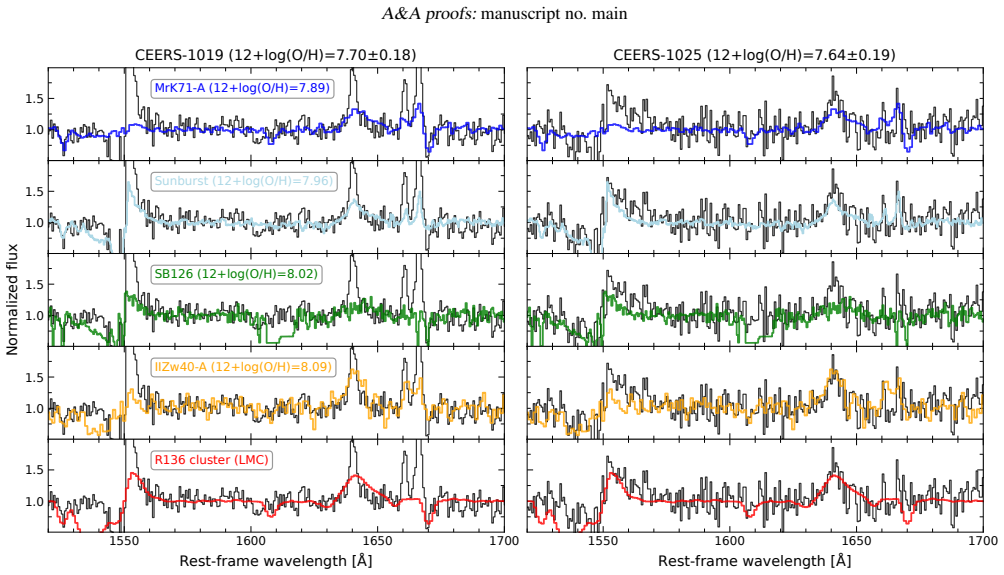
Ultra-deep NIRSpec/JWST spectra of CEERS-1019 and CEERS-1025 at z approximately 8.7 with nebular metallicity around 0.1 solar reveal strong wind features in NV and CIV plus broad HeII emission with equivalent widths of 2-4 angstroms. Synthetic stellar population models at similar metallicity that include very massive stars reproduce the observed line strengths far better than models without them, with improvements in AIC and BIC exceeding 70. The best-fit models imply stellar ages of 1.5-2 million years and ionizing efficiencies log xi_ion greater than or equal to 25.8, exceeding non-VMS inferences by 0.1-0.2 dex.
What carries the argument
The P-Cygni profiles in NV lambda 1240 and CIV lambda 1550 lines together with broad HeII lambda 1640 emission, interpreted through direct comparison of the data to stellar population synthesis models at 0.1 solar metallicity with and without very massive stars.
If this is right
- The stellar populations are extremely young at ages of 1.5 to 2 million years.
- Ionizing photon production efficiencies exceed those from non-VMS models by 0.1-0.2 dex.
- The initial mass function extends well beyond 100 solar masses.
- Very massive stars shape the rest-frame UV spectra, chemical enrichment, and ionizing output of early galaxies.
Where Pith is reading between the lines
- Very massive stars may have supplied a larger fraction of the ionizing photons that reionized the universe than previously estimated.
- The initial mass function in the early universe could have been top-heavy relative to local conditions.
- Repeated observations of additional high-redshift galaxies with similar spectral features would test whether very massive stars were widespread.
Load-bearing premise
The synthetic stellar population models correctly predict the detailed strengths of the wind features and helium lines at low metallicity, and no other process such as AGN activity produces equivalent profiles.
What would settle it
A spectrum or model fit showing that the observed line strengths are matched equally well by non-VMS models or by including AGN activity or different wind physics at the same metallicity.
Figures

read the original abstract
We present ultra-deep ($\simeq 20-30$ hours), rest-frame UV spectroscopy with NIRSpec/JWST of two UV-bright galaxies at $z\sim 8.7$, CEERS-1019 and CEERS-1025 ($Z_{\rm neb} \simeq 0.1 Z_{\odot}$). The spectra reveal exceptionally strong P-Cygni profiles in wind lines (NV $\lambda$1240 and CIV $\lambda$1550) and significant broad and strong HeII $\lambda$1640 emission ($\rm EW\simeq 2-4$ A). We compare the observations with synthetic stellar population models at $Z_{\star} \simeq 0.1 Z_{\odot}$, both including and excluding very massive stars (VMS). Models including VMS provide a markedly improved fit to the data relative to non-VMS models ($\Delta$AIC and $\Delta$BIC $> 70$), which fail to reproduce the observed strengths of the wind features. A comparison with empirical spectra of VMS-dominated systems in the local Universe further supports this interpretation. The best-fit VMS models imply extremely young ages of the stellar populations ($\simeq 1.5-2.0$Myr) and high ionizing photon production efficiencies ($\log \xi_{\rm ion} [\rm Hz erg^{-1}] \gtrsim 25.8$), exceeding those inferred from non-VMS models by $\sim 0.1-0.2$ dex. These results provide evidence for an overabundance of VMS at high-$z$ with an IMF extending well beyond $100 M_{\odot}$, and highlight their potential role in shaping the rest-frame UV spectra, chemical enrichment, and ionizing output of galaxies in the early Universe.
Editorial analysis
A structured set of objections, weighed in public.
Referee Report
Summary. The paper presents ultra-deep JWST/NIRSpec rest-frame UV spectroscopy of two z≈8.7 galaxies (CEERS-1019 and CEERS-1025) at Z_neb≈0.1 Z_⊙, revealing strong P-Cygni profiles in NV λ1240 and CIV λ1550 plus broad HeII λ1640 emission (EW≈2-4 Å). Synthetic stellar population models at Z_⋆≈0.1 Z_⊙ that include very massive stars (VMS) yield markedly better fits than non-VMS models (ΔAIC and ΔBIC >70), with best-fit ages of 1.5-2 Myr and log ξ_ion ≳25.8. Local empirical spectra of VMS-dominated systems are used for support, leading to the conclusion of VMS overabundance and an IMF extending beyond 100 M_⊙ at high redshift.
Significance. If the VMS model interpretation is robust, the work supplies direct observational evidence that very massive stars shape the UV spectra, ionizing output, and enrichment of galaxies during reionization. The large statistical improvement from including VMS, combined with the local empirical comparison, represents a concrete advance in using wind-line diagnostics at high-z. The reported high ξ_ion values and young ages are quantitatively tied to the model fits and could inform reionization calculations if the underlying stellar tracks hold.
major comments (3)
- [§3.2] §3.2 and Table 2: The reported ΔAIC/ΔBIC >70 favoring VMS models is statistically compelling, but the manuscript does not state the number of spectral pixels or independent data points entering the fit, nor does it tabulate the raw AIC/BIC values; without these, the effective degrees of freedom and robustness against overfitting cannot be verified independently.
- [§4.1] §4.1: The claim that non-VMS models fail to reproduce the observed NV, CIV, and HeII strengths assumes that the only difference between the two model grids is the presence of stars >100 M_⊙; if the VMS tracks incorporate distinct mass-loss rates, rotation, or binary physics not matched in the non-VMS runs, the statistical preference does not isolate VMS abundance as the sole cause.
- [§5.2] §5.2: Alternative physical explanations (AGN activity, different wind physics, or nebular contributions) are discussed qualitatively, but no quantitative upper limits or synthetic spectra for these scenarios are presented to demonstrate that they cannot produce P-Cygni profiles and HeII EW=2-4 Å at Z≈0.1 Z_⊙.
minor comments (2)
- [Abstract] Abstract: the units for log ξ_ion are written as [Hz erg^{-1}]; standard notation is erg^{-1} Hz, and this should be clarified for consistency with the literature.
- [Figure 3] Figure 3: the model spectra overlays would benefit from explicit residual panels to highlight where non-VMS models deviate from the data in the wind-line regions.
Simulated Author's Rebuttal
We thank the referee for their constructive and detailed comments on our manuscript. We address each major point below and will make the indicated revisions to improve clarity and robustness.
read point-by-point responses
-
Referee: [§3.2] §3.2 and Table 2: The reported ΔAIC/ΔBIC >70 favoring VMS models is statistically compelling, but the manuscript does not state the number of spectral pixels or independent data points entering the fit, nor does it tabulate the raw AIC/BIC values; without these, the effective degrees of freedom and robustness against overfitting cannot be verified independently.
Authors: We agree that reporting the number of data points and raw AIC/BIC values will allow independent verification. In the revised manuscript we will state the exact number of spectral pixels (approximately 250 independent points across the fitted 1200–1700 Å range after masking) and tabulate the raw AIC and BIC values for both model families in an expanded Table 2. This addition directly addresses the concern about degrees of freedom and overfitting. revision: yes
-
Referee: [§4.1] §4.1: The claim that non-VMS models fail to reproduce the observed NV, CIV, and HeII strengths assumes that the only difference between the two model grids is the presence of stars >100 M⊙; if the VMS tracks incorporate distinct mass-loss rates, rotation, or binary physics not matched in the non-VMS runs, the statistical preference does not isolate VMS abundance as the sole cause.
Authors: The VMS and non-VMS grids are constructed within the identical stellar population synthesis framework (same code, same mass-loss prescriptions, rotation, and binary physics for stars ≤100 M⊙). The sole structural difference is the IMF upper limit (300 M⊙ versus 100 M⊙) and the associated evolutionary tracks for the additional very massive stars. We will revise §4.1 to state these model consistencies explicitly so that the statistical improvement is clearly attributable to the inclusion of VMS. revision: yes
-
Referee: [§5.2] §5.2: Alternative physical explanations (AGN activity, different wind physics, or nebular contributions) are discussed qualitatively, but no quantitative upper limits or synthetic spectra for these scenarios are presented to demonstrate that they cannot produce P-Cygni profiles and HeII EW=2-4 Å at Z≈0.1 Z⊙.
Authors: We accept that quantitative limits would strengthen the section. In the revision we will expand §5.2 with (i) literature-based upper limits on AGN contribution derived from the observed line profiles and equivalent widths, (ii) estimates of nebular He II using photoionization models at the measured metallicity and ionization parameter, and (iii) a brief comparison to existing synthetic wind spectra for alternative mass-loss prescriptions. Full custom synthetic spectra for every scenario lie outside the present scope, but the added quantitative discussion will address the referee’s concern. revision: partial
Circularity Check
No significant circularity; model comparison is independent of derived outputs
full rationale
The paper's derivation proceeds from observed rest-UV spectra (P-Cygni NV/CIV profiles and HeII EW) to a direct statistical comparison against external synthetic SPS models at Z~0.1 Z_sun, with and without VMS. The ΔAIC/ΔBIC >70 preference is driven by the VMS models' ability to match the wind features that non-VMS models fail to reproduce; this is not equivalent to the input spectra by construction. The reported ages (~1.5-2 Myr) and log ξ_ion ≳25.8 are straightforward outputs of the best-fit VMS models, not inputs used to select the models or predictions of the same quantities. No self-citations, uniqueness theorems, or ansatzes are invoked in the abstract or described chain to justify the core result. The comparison uses pre-existing stellar population synthesis at the relevant metallicity and is tested against independent local empirical VMS spectra. The logic remains self-contained against the JWST observations.
Axiom & Free-Parameter Ledger
free parameters (2)
- stellar population age =
1.5-2.0 Myr
- log ξ_ion =
>=25.8
axioms (2)
- domain assumption Synthetic stellar population models at Z_star ~0.1 Z_sun correctly predict the UV wind lines and HeII emission for populations that include or exclude VMS
- domain assumption Empirical spectra of local VMS-dominated systems are appropriate templates for high-redshift conditions
Reference graph
Works this paper leans on
-
[1]
JWST Identification of Extremely Low C/N Galaxies with [N/O] 0.5 at z 6-10 Evidencing the Early CNO-cycle Enrichment and a Connection with Globular Cluster Formation. , keywords =. doi:10.3847/1538-4357/ad09be , archivePrefix =. 2307.00710 , primaryClass =
-
[2]
Extreme N-emitters at high redshift: Possible signatures of supermassive stars and globular cluster or black hole formation in action. , keywords =. doi:10.1051/0004-6361/202347411 , archivePrefix =. 2307.04234 , primaryClass =
-
[3]
2015, ApJL, 810, L12, doi: 10.1088/2041-8205/810/1/L12
Lyman Emission from a Luminous z = 8.68 Galaxy: Implications for Galaxies as Tracers of Cosmic Reionization. , keywords =. doi:10.1088/2041-8205/810/1/L12 , archivePrefix =. 1507.02679 , primaryClass =
-
[4]
A CEERS Discovery of an Accreting Supermassive Black Hole 570 Myr after the Big Bang: Identifying a Progenitor of Massive z > 6 Quasars. , keywords =. doi:10.3847/2041-8213/ace619 , archivePrefix =. 2303.08918 , primaryClass =
-
[5]
Searching for Islands of Reionization: A Potential Ionized Bubble Powered by a Spectroscopic Overdensity at z = 8.7. , keywords =. doi:10.3847/1538-4357/ac5dbd , archivePrefix =. 2203.08461 , primaryClass =
-
[6]
2025, arXiv e-prints, arXiv:2512.09022
GA-NIFS: Understanding the ionization nature of EGSY8p7/CEERS-1019. Evidence for a star formation-driven outflow at z = 8.6. arXiv e-prints , keywords =. doi:10.48550/arXiv.2512.09022 , archivePrefix =. 2512.09022 , primaryClass =
-
[7]
JWST/NIRSpec spectroscopy of z = 7-9 star-forming galaxies with CEERS: new insight into bright Ly emitters in ionized bubbles. , keywords =. doi:10.1093/mnras/stad2763 , archivePrefix =. 2301.07072 , primaryClass =
-
[8]
2023, ApJS, 269, 33, doi: 10.3847/1538-4365/acd556
JWST Census for the Mass-Metallicity Star Formation Relations at z = 4-10 with Self-consistent Flux Calibration and Proper Metallicity Calibrators. , keywords =. doi:10.3847/1538-4365/acd556 , archivePrefix =. 2301.12825 , primaryClass =
-
[9]
JWST/NIRSpec Observations of Lyman Emission in Star-forming Galaxies at 6.5 z 13. , keywords =. doi:10.3847/1538-4357/ad7eb7 , archivePrefix =. 2408.01507 , primaryClass =
-
[10]
Deep JWST spectroscopy of galaxies in a candidate ionized bubble at z = 8.7 : probing reionization at pMpc scales with Ly α emission. arXiv e-prints , keywords =. doi:10.48550/arXiv.2510.12019 , archivePrefix =. 2510.12019 , primaryClass =
work page internal anchor Pith review Pith/arXiv arXiv doi:10.48550/arxiv.2510.12019
-
[11]
2023, , 522, 6295, 10.1093/mnras/stad1283
The VANDELS survey: the ionizing properties of star-forming galaxies at 3 z 5 using deep rest-frame ultraviolet spectroscopy. , keywords =. doi:10.1093/mnras/stad1283 , archivePrefix =. 2211.01351 , primaryClass =
-
[12]
Lmfit: Non-Linear Least-Square Minimization and Curve-Fitting for Python
-
[13]
Spectroscopic Measurements of the Far-Ultraviolet Dust Attenuation Curve at z 3. , keywords =. doi:10.3847/0004-637X/828/2/107 , archivePrefix =. 1606.00434 , primaryClass =
-
[14]
Starburst99: Synthesis Models for Galaxies with Active Star Formation. , keywords =. doi:10.1086/313233 , archivePrefix =. astro-ph/9902334 , primaryClass =
-
[15]
Binary Population and Spectral Synthesis Version 2.1: Construction, Observational Verification, and New Results. , keywords =. doi:10.1017/pasa.2017.51 , archivePrefix =. 1710.02154 , primaryClass =
-
[16]
Very massive stars at low metallicity: Evolution, synthetic spectroscopy, and impact on the integrated light of starbursts. , keywords =. doi:10.1051/0004-6361/202554421 , archivePrefix =. 2505.02993 , primaryClass =
-
[17]
Evidence for very massive stars in extremely UV-bright star-forming galaxies at z 2.2-3.6. , keywords =. doi:10.1051/0004-6361/202449184 , archivePrefix =. 2401.16165 , primaryClass =
-
[18]
HST FUV Spectroscopy of Super Star Cluster A in the Green Pea Analog Mrk 71: Revealing the Presence of Very Massive Stars. , keywords =. doi:10.3847/1538-4357/ad00b4 , archivePrefix =. 2310.03413 , primaryClass =
-
[19]
Ultraviolet spectra of extreme nearby star-forming regions: Evidence for an overabundance of very massive stars. , keywords =. doi:10.1093/mnras/stab884 , archivePrefix =. 2008.09780 , primaryClass =
-
[20]
Physical Properties of II Zw 40's Super Star Cluster and Nebula: New Insights and Puzzles from UV Spectroscopy. , keywords =. doi:10.3847/1538-4357/aada84 , archivePrefix =. 1808.04332 , primaryClass =
-
[21]
Clues on the presence and segregation of very massive stars in the Sunburst Lyman-continuum cluster at z = 2.37. , keywords =. doi:10.1051/0004-6361/202345895 , archivePrefix =. 2301.04672 , primaryClass =
-
[22]
The Sunburst Arc with JWST. III. An Abundance of Direct Chemical Abundances. , keywords =. doi:10.3847/1538-4357/ada76c , archivePrefix =. 2405.06631 , primaryClass =
-
[23]
The R136 star cluster dissected with Hubble Space Telescope/STIS. I. Far-ultraviolet spectroscopic census and the origin of He II 1640 in young star clusters. , keywords =. doi:10.1093/mnras/stw273 , archivePrefix =. 1603.04994 , primaryClass =
-
[24]
Line luminosities of Galactic and Magellanic Cloud Wolf-Rayet stars. , keywords =. doi:10.1093/mnras/stad418 , archivePrefix =. 2301.11297 , primaryClass =
-
[25]
Observable and ionizing properties of star-forming galaxies with very massive stars and different initial mass functions. , keywords =. doi:10.1051/0004-6361/202451454 , archivePrefix =. 2407.12122 , primaryClass =
-
[26]
The R136 star cluster hosts several stars whose individual masses greatly exceed the accepted 150M _ solar stellar mass limit. , keywords =. doi:10.1111/j.1365-2966.2010.17167.x , archivePrefix =. 1007.3284 , primaryClass =
-
[27]
The most massive stars in the Arches cluster. , keywords =. doi:10.1051/0004-6361:20078469 , archivePrefix =. 0711.0657 , primaryClass =
-
[28]
Spectroscopic evolution of very massive stars at Z = 1/2.5 Z _ ☉. , keywords =. doi:10.1051/0004-6361/202243048 , archivePrefix =. 2202.13703 , primaryClass =
-
[29]
Highlights of Astronomy , keywords =
Very Massive Stars in the local Universe. Highlights of Astronomy , keywords =. doi:10.1017/S1743921314004657 , archivePrefix =. 1302.2021 , primaryClass =
-
[30]
Very massive stars and nitrogen-emitting galaxies. , keywords =. doi:10.1051/0004-6361/202347827 , archivePrefix =. 2310.10725 , primaryClass =
-
[31]
Extreme broad He II emission at high and low redshifts: the dominant role of VMS in NGC 3125-A1 and CDFS131717. , keywords =. doi:10.1093/mnras/stad1622 , archivePrefix =. 2305.14563 , primaryClass =
-
[32]
Inferring the presence of very massive stars in local star-forming regions. , keywords =. doi:10.1051/0004-6361/202346732 , archivePrefix =. 2308.14489 , primaryClass =
-
[33]
Ultraviolet spectra of extreme nearby star-forming regions - approaching a local reference sample for JWST. , keywords =. doi:10.1093/mnras/stx2059 , archivePrefix =. 1706.00881 , primaryClass =
-
[34]
PyNeb: a new tool for analyzing emission lines. I. Code description and validation of results. , keywords =. doi:10.1051/0004-6361/201323152 , archivePrefix =. 1410.6662 , primaryClass =
-
[35]
Driving classical Wolf-Rayet winds: a - and Z-dependent mass-loss. , keywords =. doi:10.1093/mnras/stz3064 , archivePrefix =. 1910.12886 , primaryClass =
-
[36]
The Sunburst Arc with JWST: I. Detection of Wolf-Rayet stars injecting nitrogen into a low-metallicity, z = 2.37 proto-globular cluster leaking ionizing photons. , keywords =. doi:10.1051/0004-6361/202450359 , archivePrefix =. 2404.08884 , primaryClass =
discussion (0)
Sign in with ORCID, Apple, or X to comment. Anyone can read and Pith papers without signing in.