Recognition: unknown
Generative Learning Enhanced Intelligent Resource Management for Cell-Free Delay Deterministic Communications
Pith reviewed 2026-05-08 13:43 UTC · model grok-4.3
The pith
A virtual constrained Markov decision process with evidence-aware Gaussian mixture modeling enables safer and more sample-efficient reinforcement learning for energy-efficient resource allocation in cell-free MIMO systems.
A machine-rendered reading of the paper's core claim, the machinery that carries it, and where it could break.
Core claim
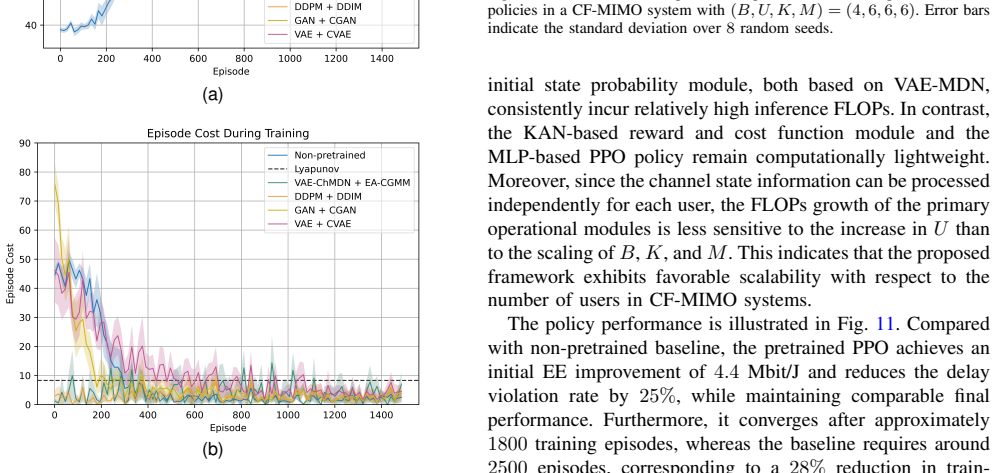
By modeling the cell-free MIMO resource allocation task as a virtual constrained Markov decision process and pretraining a proximal policy optimization agent offline, the framework lets the agent reach twice the initial energy efficiency, sustain only a 1 percent delay constraint violation rate, converge to a 4.7 percent higher final energy efficiency, and cut exploration steps by half relative to a non-pretrained baseline, all while matching diffusion-model performance at one-fourteenth the computational cost.
What carries the argument
The virtual constrained Markov decision process (CMDP) whose state-transition module is realized by an evidence-aware conditional Gaussian mixture model (EA-CGMM) to support safe offline pretraining of the primal-dual PPO policy.
If this is right
- The pretrained agent begins with twice the energy efficiency of the non-pretrained baseline.
- It maintains a delay violation rate of only 1 percent throughout learning.
- Final converged energy efficiency is 4.7 percent higher and requires 50 percent fewer exploration steps.
- The framework delivers performance comparable to diffusion-model pretraining at 14 times lower computational complexity.
Where Pith is reading between the lines
- The same virtual-CMDP construction could be applied to other constrained wireless problems such as power control or user scheduling in different network topologies.
- If the EA-CGMM successfully captures distribution drift, the method may reduce the volume of real-world interaction data needed for safe learning in time-varying channels.
- The observed reduction in exploration steps suggests the approach could scale to larger cell-free deployments where online trial-and-error would be prohibitively costly or disruptive.
- Hybrid offline-online training pipelines that begin with this style of virtual pretraining might become a practical route for deploying learning agents in live 6G-style networks.
Load-bearing premise
The virtual CMDP faithfully reproduces the dynamics of the real cell-free MIMO system so that performance gains observed in simulation transfer to actual deployments without large degradation.
What would settle it
Running the pretrained agent on a physical cell-free MIMO testbed and measuring whether its initial energy efficiency is at least twice that of the cold-start baseline while keeping delay violations at or below 1 percent; a clear shortfall in either metric would falsify the transfer claim.
Figures




read the original abstract
Cell-free multiple-input multiple-output (CF-MIMO) architecture significantly enhances wireless network performance, offering a promising solution for delay-sensitive applications. This paper investigates the resource allocation problem in CF-MIMO systems, aiming to maximize energy efficiency (EE) while satisfying delay violation rate constraint. We design a Proximal Policy Optimization (PPO) with a primal-dual method to solve it. To address the low sample efficiency and safety risks caused by cold-start of the designed safe deep reinforcement learning (DRL) method, we propose a novel offline pretraining framework based on virtual constrained Markov decision process (CMDP) modeling. The virtual CMDP consists of reward and cost prediction module, initial-state distribution module and state transition module. Notably, we propose an evidence-aware conditional Gaussian Mixture Model (EA-CGMM) inference approach to mitigate data sparsity and distribution drift issues in state transition modeling. Simulation results demonstrate the effectiveness of CMDP modeling and validate the safety and efficiency of the proposed pretraining framework. Specifically, compared with non-pretrained baseline, the agent pretrained through our proposed framework achieves twice the initial EE and maintains a low delay constraint violation rate of $1\%$, while ultimately converging to an EE that is $4.7\%$ higher with a $50\%$ reduction in exploration steps. Additionally, our proposed pretraining framework implementation exhibits comparable performance to the SOTA diffusion model-based implementation, while achieving a $14$-fold reduction in computational complexity.
Editorial analysis
A structured set of objections, weighed in public.
Referee Report
Summary. The paper addresses energy-efficient resource allocation in cell-free MIMO systems under delay violation constraints by formulating it as a constrained Markov decision process solved via PPO with a primal-dual method. To mitigate cold-start issues in safe DRL, it introduces an offline pretraining framework based on a virtual CMDP whose components include reward/cost predictors, initial-state distribution, and state transitions modeled by a proposed evidence-aware conditional Gaussian mixture model (EA-CGMM) to handle sparsity and drift. Simulations claim that the pretrained agent achieves 2× initial EE, 1% delay violation rate, 4.7% higher converged EE, and 50% fewer exploration steps versus a non-pretrained baseline, while matching SOTA diffusion-model performance at 14× lower complexity.
Significance. If the transfer claims are substantiated, the work offers a practical, lower-complexity generative pretraining approach for safe RL in delay-sensitive wireless systems, with concrete quantitative gains over baselines and a complexity advantage over diffusion methods. The explicit comparison to non-pretrained and SOTA methods, along with the CMDP decomposition, provides a clear benchmark for future generative-RL work in communications.
major comments (2)
- [Simulation results] Simulation results section: All reported gains (2× initial EE, 1% violation, +4.7% final EE, 50% step reduction) are obtained by training and evaluating the PPO agent inside the same virtual CMDP whose transition kernel is the EA-CGMM fitted to the pretraining data. No mismatch experiments (different mobility patterns, hardware impairments, or pilot contamination not captured by the CGMM) are described, so the safety and zero-shot transfer claims rest on an untested modeling assumption.
- [Virtual CMDP modeling] Virtual CMDP and EA-CGMM modeling sections: The paper asserts that the virtual CMDP accurately represents real CF-MIMO dynamics and that EA-CGMM mitigates distribution drift, yet provides no quantitative validation (e.g., prediction error on held-out real traces or sensitivity analysis) that would confirm these modules are load-bearing for the observed performance lift.
minor comments (2)
- [Abstract] The abstract and simulation description omit key experimental details such as number of Monte Carlo runs, statistical significance tests, exact baseline implementations, and hyperparameter settings for the PPO/primal-dual agent.
- [EA-CGMM inference] Notation for the EA-CGMM parameters (evidence weighting, mixture components) and the precise form of the reward/cost predictors could be clarified with explicit equations to aid reproducibility.
Simulated Author's Rebuttal
We thank the referee for the constructive feedback. We address each major comment below and will revise the manuscript accordingly to strengthen the validation of the virtual CMDP and transfer performance.
read point-by-point responses
-
Referee: [Simulation results] Simulation results section: All reported gains (2× initial EE, 1% violation, +4.7% final EE, 50% step reduction) are obtained by training and evaluating the PPO agent inside the same virtual CMDP whose transition kernel is the EA-CGMM fitted to the pretraining data. No mismatch experiments (different mobility patterns, hardware impairments, or pilot contamination not captured by the CGMM) are described, so the safety and zero-shot transfer claims rest on an untested modeling assumption.
Authors: We agree that the reported gains are demonstrated within the virtual CMDP environment. This is by design for offline pretraining, where the EA-CGMM is fitted to collected system data to approximate dynamics. To substantiate robustness and transfer, we will add new experiments in the revised manuscript evaluating the pretrained agent in online environments with altered mobility patterns, hardware impairments, and pilot contamination levels not fully represented in the pretraining data. revision: yes
-
Referee: [Virtual CMDP modeling] Virtual CMDP and EA-CGMM modeling sections: The paper asserts that the virtual CMDP accurately represents real CF-MIMO dynamics and that EA-CGMM mitigates distribution drift, yet provides no quantitative validation (e.g., prediction error on held-out real traces or sensitivity analysis) that would confirm these modules are load-bearing for the observed performance lift.
Authors: We will incorporate quantitative validation in the revised manuscript. This includes the mean squared error of EA-CGMM state transition predictions on held-out simulation traces and a sensitivity analysis varying the number of Gaussian components and evidence threshold to quantify their effect on pretraining gains and drift mitigation. revision: yes
Circularity Check
No significant circularity in derivation or claims.
full rationale
The paper defines a PPO primal-dual solver for the EE maximization under delay constraints, then introduces an offline pretraining stage that fits an EA-CGMM transition model to generate a virtual CMDP. Performance is reported via simulation comparisons against a non-pretrained baseline and a diffusion-model baseline, yielding concrete deltas (2× initial EE, 1 % violation, +4.7 % final EE, 50 % fewer steps). These metrics are obtained by running the trained policy inside the simulator and measuring against the same simulator's ground-truth trajectories; they do not reduce to a fitted parameter being relabeled as a prediction, nor does any load-bearing step rely on a self-citation whose content is itself unverified. The virtual-model assumption is stated explicitly as an approximation whose fidelity is tested only inside the synthetic environment, but that is a modeling limitation rather than a circular derivation. No equation or section equates the claimed gain to the fitting procedure by construction.
Axiom & Free-Parameter Ledger
invented entities (2)
-
virtual constrained Markov decision process (CMDP)
no independent evidence
-
evidence-aware conditional Gaussian Mixture Model (EA-CGMM)
no independent evidence
Reference graph
Works this paper leans on
-
[1]
The quick and the dead: The rise of deterministic networks,
B. Varga, J. Farkas, D. Fedyk, L. Berger, and D. Brungard, “The quick and the dead: The rise of deterministic networks,”ComSoc TECHNOLOGY NEWS(CTN), FEBRUARY, 2021
2021
-
[2]
Performance of integrated 3GPP 5G and IEEE TSN networks,
P. M. Rost and T. Kolding, “Performance of integrated 3GPP 5G and IEEE TSN networks,”IEEE Communications Standards Magazine, vol. 6, no. 2, pp. 51–56, 2022
2022
-
[3]
A comprehensive survey of wireless time-sensitive networking (TSN): Architecture, technologies, applications, and open issues,
K. Zanbouri, M. Noor-A-Rahim, J. John, C. J. Sreenan, H. V . Poor, and D. Pesch, “A comprehensive survey of wireless time-sensitive networking (TSN): Architecture, technologies, applications, and open issues,”IEEE Communications Surveys & Tutorials, 2024
2024
-
[4]
Toward deterministic communications in 6G networks: State of the art, open challenges and the way forward,
G. P. Sharma, D. Patel, J. Sachs, M. De Andrade, J. Farkas, J. Harmatos, B. Varga, H.-P. Bernhard, R. Muzaffar, M. Ahmedet al., “Toward deterministic communications in 6G networks: State of the art, open challenges and the way forward,”IEEE Access, vol. 11, pp. 106 898– 106 923, 2023
2023
-
[5]
Simple bounds on delay-constrained capacity and delay-violation probability of joint queue and channel- aware wireless transmissions,
L. Li, W. Chen, and K. B. Letaief, “Simple bounds on delay-constrained capacity and delay-violation probability of joint queue and channel- aware wireless transmissions,”IEEE Transactions on Wireless Commu- nications, vol. 22, no. 4, pp. 2744–2759, 2022
2022
-
[6]
Delay perfor- mance of wireless communications with imperfect CSI and finite-length coding,
S. Schiessl, H. Al-Zubaidy, M. Skoglund, and J. Gross, “Delay perfor- mance of wireless communications with imperfect CSI and finite-length coding,”IEEE Transactions on Communications, vol. 66, no. 12, pp. 6527–6541, 2018
2018
-
[7]
Joint power and blocklength optimization for URLLC in a factory automation scenario,
H. Ren, C. Pan, Y . Deng, M. Elkashlan, and A. Nallanathan, “Joint power and blocklength optimization for URLLC in a factory automation scenario,”IEEE Transactions on Wireless Communications, vol. 19, no. 3, pp. 1786–1801, 2020
2020
-
[8]
Joint uplink and downlink resource allocation toward energy-efficient transmission for URLLC,
K. Li, P. Zhu, Y . Wang, F.-C. Zheng, and X. You, “Joint uplink and downlink resource allocation toward energy-efficient transmission for URLLC,”IEEE Journal on Selected Areas in Communications, vol. 41, no. 7, pp. 2176–2192, 2023
2023
-
[9]
Delay deterministic cell-free mimo transmission via safety reinforcement learning,
F. Meng, C. Zhang, Y . Huang, and X. You, “Delay deterministic cell-free mimo transmission via safety reinforcement learning,”IEEE Transactions on Wireless Communications, 2025
2025
-
[10]
Study on scenarios and requirements for next generation access technologies,
3GPP, “Study on scenarios and requirements for next generation access technologies,” 3rd Generation Partnership Project (3GPP), Tech. Rep. TS 38.913, 2024
2024
-
[11]
Performance of multidevice downlink cell-free system under finite blocklength for URLLC with hard deadlines,
Z. Zhang, X. You, D. Wang, X. Xia, P. Zhu, Y . Jiang, C. Liang, and J. Wang, “Performance of multidevice downlink cell-free system under finite blocklength for URLLC with hard deadlines,”IEEE Journal on Selected Areas in Communications, vol. 41, no. 7, pp. 2090–2106, 2023
2090
-
[12]
Diversity enabled low-latency wireless communications with hard delay constraints,
C. Li, W. Chen, and H. V . Poor, “Diversity enabled low-latency wireless communications with hard delay constraints,”IEEE Journal on Selected Areas in Communications, vol. 41, no. 7, pp. 2107–2122, 2023
2023
-
[13]
Radio resource management for ultra-reliable and low-latency communications,
C. She, C. Yang, and T. Q. S. Quek, “Radio resource management for ultra-reliable and low-latency communications,”IEEE Communications Magazine, vol. 55, no. 6, pp. 72–78, 2017
2017
-
[14]
Evaluating the impact of delay constraints in network services for intelligent network slicing based on SKM model,
A. El-mekkawi, X. Hesselbach, and J. R. Piney, “Evaluating the impact of delay constraints in network services for intelligent network slicing based on SKM model,”Journal of Communications and Networks, vol. 23, no. 4, pp. 281–298, 2021
2021
-
[15]
Achieving energy- efficient uplink urllc with mimo-aided grant-free access,
L. Zhao, S. Yang, X. Chi, W. Chen, and S. Ma, “Achieving energy- efficient uplink urllc with mimo-aided grant-free access,”IEEE Trans- actions on Wireless Communications, vol. 21, no. 2, pp. 1407–1420, 2022
2022
-
[16]
Through- put analysis of low-latency iot systems with qos constraints and finite blocklength codes,
Y . Hu, Y . Li, M. C. Gursoy, S. Velipasalar, and A. Schmeink, “Through- put analysis of low-latency iot systems with qos constraints and finite blocklength codes,”IEEE Transactions on Vehicular Technology, vol. 69, no. 3, pp. 3093–3104, 2020
2020
-
[17]
Cross-layer optimization for statistical QoS provision in C-RAN with finite-length coding,
C. Wu, H. Lu, Y . Chen, and L. Qin, “Cross-layer optimization for statistical QoS provision in C-RAN with finite-length coding,”IEEE Transactions on Communications, vol. 72, no. 6, pp. 3393–3407, 2024. JOURNAL OF LATEX CLASS FILES, VOL. 14, NO. 8, AUGUST 2021 16
2024
-
[18]
Joint URLLC traffic scheduling and resource allocation for semantic communication systems,
G. Ding, S. Liu, J. Yuan, and G. Yu, “Joint URLLC traffic scheduling and resource allocation for semantic communication systems,”IEEE Transactions on Wireless Communications, vol. 23, no. 7, pp. 7278– 7290, 2023
2023
-
[19]
Achievable rate region for URLLC interference channel with finite blocklength transmission,
W. Huang, S. Xiao, L. Wu, C. Kai, S. He, and C. Li, “Achievable rate region for URLLC interference channel with finite blocklength transmission,”IEEE Transactions on Vehicular Technology, vol. 72, no. 7, pp. 8857–8868, 2023
2023
-
[20]
Machine learning for large-scale optimization in 6G wireless networks,
Y . Shi, L. Lian, Y . Shi, Z. Wang, Y . Zhou, L. Fu, L. Bai, J. Zhang, and W. Zhang, “Machine learning for large-scale optimization in 6G wireless networks,”IEEE Communications Surveys & Tutorials, vol. 25, no. 4, pp. 2088–2132, 2023
2088
-
[21]
A recursive DRL-based resource allocation method for multibeam satellite communication systems,
H. Meng, N. Xin, H. Qin, and D. Zhao, “A recursive DRL-based resource allocation method for multibeam satellite communication systems,” Chinese Journal of Electronics, vol. 33, no. 5, pp. 1286–1295, 2024
2024
-
[22]
Wireless network digital twin for 6G: Generative AI as a key enabler,
Z. Tao, W. Xu, Y . Huang, X. Wang, and X. You, “Wireless network digital twin for 6G: Generative AI as a key enabler,”IEEE Wireless Communications, vol. 31, no. 4, pp. 24–31, 2024
2024
-
[23]
Achieving maximum energy- efficiency in multi-relay ofdma cellular networks: A fractional program- ming approach,
K. T. K. Cheung, S. Yang, and L. Hanzo, “Achieving maximum energy- efficiency in multi-relay ofdma cellular networks: A fractional program- ming approach,”IEEE Transactions on Communications, vol. 61, no. 7, pp. 2746–2757, 2013
2013
-
[24]
Spectral and energy spectral efficiency optimization of joint trans- mit and receive beamforming based multi-relay mimo-ofdma cellular networks,
——, “Spectral and energy spectral efficiency optimization of joint trans- mit and receive beamforming based multi-relay mimo-ofdma cellular networks,”IEEE Transactions on Wireless Communications, vol. 13, no. 11, pp. 6147–6165, 2014
2014
-
[25]
Flexible resource allocation for joint optimization of energy and spectral efficiency in ofdma multi- cell networks,
W. Jing, Z. Lu, X. Wen, Z. Hu, and S. Yang, “Flexible resource allocation for joint optimization of energy and spectral efficiency in ofdma multi- cell networks,”IEEE Communications Letters, vol. 19, no. 3, pp. 451– 454, 2015
2015
-
[26]
Distributed energy spectral efficiency optimization for partial/full interference alignment in multi- user multi-relay multi-cell mimo systems,
K. T. K. Cheung, S. Yang, and L. Hanzo, “Distributed energy spectral efficiency optimization for partial/full interference alignment in multi- user multi-relay multi-cell mimo systems,”IEEE Transactions on Signal Processing, vol. 64, no. 4, pp. 882–896, 2015
2015
-
[27]
Power allocation optimization for energy- efficient massive mimo aided multi-pair decode-and-forward relay sys- tems,
F. Tan, T. Lv, and S. Yang, “Power allocation optimization for energy- efficient massive mimo aided multi-pair decode-and-forward relay sys- tems,”IEEE Transactions on Communications, vol. 65, no. 6, pp. 2368– 2381, 2017
2017
-
[28]
On the energy efficiency of interference alignment in thek-user interference channel,
X. Miao, S. Yang, C. Wang, S. Wang, and L. Hanzo, “On the energy efficiency of interference alignment in thek-user interference channel,” IEEE Access, vol. 7, pp. 97 253–97 263, 2019
2019
-
[29]
Energy efficient ofdma networks maintaining statistical qos guarantees for delay-sensitive traffic,
T. Abr ˜ao, L. D. H. Sampaio, S. Yang, K. T. K. Cheung, P. J. E. Jeszensky, and L. Hanzo, “Energy efficient ofdma networks maintaining statistical qos guarantees for delay-sensitive traffic,”IEEE Access, vol. 4, pp. 774– 791, 2016
2016
-
[30]
Achieving maximum effective capacity in ofdma networks operating under statistical delay guarantee,
T. Abr ˜ao, S. Yang, L. D. H. Sampaio, P. J. E. Jeszensky, and L. Hanzo, “Achieving maximum effective capacity in ofdma networks operating under statistical delay guarantee,”IEEE Access, vol. 5, pp. 14 333– 14 346, 2017
2017
-
[31]
User scheduling and task offloading in multi-tier computing 6G vehicular network,
H. Zhang, L. Feng, X. Liu, K. Long, and G. K. Karagiannidis, “User scheduling and task offloading in multi-tier computing 6G vehicular network,”IEEE Journal on Selected Areas in Communications, vol. 41, no. 2, pp. 446–456, 2022
2022
-
[32]
Accuracy-guaranteed collaborative DNN inference in industrial IoT via deep reinforcement learning,
W. Wu, P. Yang, W. Zhang, C. Zhou, and X. Shen, “Accuracy-guaranteed collaborative DNN inference in industrial IoT via deep reinforcement learning,”IEEE Transactions on Industrial Informatics, vol. 17, no. 7, pp. 4988–4998, 2020
2020
-
[33]
Digital twin for UA V- RIS assisted vehicular communication systems,
M. Wu, Y . Xiao, Y . Gao, and M. Xiao, “Digital twin for UA V- RIS assisted vehicular communication systems,”IEEE Transactions on Wireless Communications, vol. 23, no. 7, pp. 7638–7651, 2024
2024
-
[34]
Resource allocation for integrated sensing and communication in digital twin enabled internet of vehicles,
Y . Gong, Y . Wei, Z. Feng, F. R. Yu, and Y . Zhang, “Resource allocation for integrated sensing and communication in digital twin enabled internet of vehicles,”IEEE Transactions on Vehicular Technology, vol. 72, no. 4, pp. 4510–4524, 2023
2023
-
[35]
RIS-empowered MEC for URLLC systems with digital-twin-driven architecture,
S. Kurma, M. Katwe, K. Singh, C. Pan, S. Mumtaz, and C.-P. Li, “RIS-empowered MEC for URLLC systems with digital-twin-driven architecture,”IEEE Transactions on Communications, vol. 72, no. 4, pp. 1983–1997, 2024
1983
-
[36]
Digital twin-enhanced deep reinforcement learning for resource management in networks slicing,
Z. Zhang, Y . Huang, C. Zhang, Q. Zheng, L. Yang, and X. You, “Digital twin-enhanced deep reinforcement learning for resource management in networks slicing,”IEEE Transactions on Communications, vol. 72, no. 10, pp. 6209–6224, 2024
2024
-
[37]
Toward a fully-observable markov decision process with generative models for integrated 6G- non-terrestrial networks,
A. Machumilane, P. Cassara, and A. Gotta, “Toward a fully-observable markov decision process with generative models for integrated 6G- non-terrestrial networks,”IEEE Open Journal of the Communications Society, vol. 4, pp. 1913–1930, 2023
1913
-
[38]
Time- sensitive networking-driven deterministic low-latency communication for real-time telemedicine and e-health services,
Y . Lu, G. Zhao, C. Chakraborty, C. Xu, L. Yang, and K. Yu, “Time- sensitive networking-driven deterministic low-latency communication for real-time telemedicine and e-health services,”IEEE Transactions on Consumer Electronics, vol. 69, no. 4, pp. 734–744, 2023
2023
-
[39]
Enhancing radio resource management in ran slicing by diffusion model and digital twin,
S. Xiong, Y . Huang, S. He, and C. Zhang, “Enhancing radio resource management in ran slicing by diffusion model and digital twin,”IEEE Transactions on Communications, 2025
2025
-
[40]
Generative AI-driven digital twin for mobile networks,
H. Chai, H. Wang, T. Li, and Z. Wang, “Generative AI-driven digital twin for mobile networks,”IEEE Network, 2024
2024
-
[41]
Denoising diffusion probabilistic models,
J. Ho, A. Jain, and P. Abbeel, “Denoising diffusion probabilistic models,” Advances in neural information processing systems, vol. 33, pp. 6840– 6851, 2020
2020
-
[42]
Bert: Pre-training of deep bidirectional transformers for language understanding,
J. Devlin, M.-W. Chang, K. Lee, and K. Toutanova, “Bert: Pre-training of deep bidirectional transformers for language understanding,” inPro- ceedings of the 2019 conference of the North American chapter of the association for computational linguistics: human language technologies, volume 1 (long and short papers), 2019, pp. 4171–4186
2019
-
[43]
Theme transformer: Symbolic music generation with theme-conditioned trans- former,
Y .-J. Shih, S.-L. Wu, F. Zalkow, M. M ¨uller, and Y .-H. Yang, “Theme transformer: Symbolic music generation with theme-conditioned trans- former,”IEEE Transactions on Multimedia, vol. 25, pp. 3495–3508, 2023
2023
-
[44]
Proximal Policy Optimization Algorithms
J. Schulman, F. Wolski, P. Dhariwal, A. Radford, and O. Klimov, “Proximal policy optimization algorithms,” 2017. [Online]. Available: https://arxiv.org/abs/1707.06347
work page internal anchor Pith review arXiv 2017
-
[45]
KAN: Kolmogorov-Arnold Networks
Z. Liu, Y . Wang, S. Vaidya, F. Ruehle, J. Halverson, M. Solja ˇci´c, T. Y . Hou, and M. Tegmark, “KAN: Kolmogorov-Arnold networks,” 2025. [Online]. Available: https://arxiv.org/abs/2404.19756
work page internal anchor Pith review arXiv 2025
-
[46]
A novel interpretable short- term load forecasting method based on Kolmogorov-Arnold networks,
B. Jiang, Y . Wang, Q. Wang, and H. Geng, “A novel interpretable short- term load forecasting method based on Kolmogorov-Arnold networks,” IEEE Transactions on Power Systems, vol. 40, no. 1, pp. 1180–1183, 2025
2025
-
[47]
Kolmogorov-Arnold networks for semi-supervised impedance inversion,
M. Liu, F. Bossmann, and J. Ma, “Kolmogorov-Arnold networks for semi-supervised impedance inversion,”IEEE Geoscience and Remote Sensing Letters, vol. 22, pp. 1–5, 2025
2025
-
[48]
On a constructive proof of Kolmogorov’s superposition theorem,
J. Braun and M. Griebel, “On a constructive proof of Kolmogorov’s superposition theorem,”Constructive approximation, vol. 30, pp. 653– 675, 2009
2009
-
[49]
Generative learning-powered probing beam optimization for Cell-Free hybrid beamforming,
C. Zhang, S. Xiong, M. He, L. Wei, Y . Huang, and W. Zhang, “Generative learning-powered probing beam optimization for Cell-Free hybrid beamforming,”IEEE Wireless Communications Letters, vol. 13, no. 12, pp. 3380–3384, 2024
2024
-
[50]
Technical report: Training mixture density networks with full covariance matrices,
J. Kruse, “Technical report: Training mixture density networks with full covariance matrices,”arXiv preprint arXiv:2003.05739, 2020
-
[51]
DeepMIMO: A generic deep learning dataset for mil- limeter wave and massive MIMO applications,
A. Alkhateeb, “DeepMIMO: A generic deep learning dataset for mil- limeter wave and massive MIMO applications,” inProc. of Information Theory and Applications Workshop (ITA), San Diego, CA, Feb 2019, pp. 1–8
2019
-
[52]
Wireless InSite,
Remcom, “Wireless InSite,” http://www.remcom.com/wireless-insite
-
[53]
Denoising Diffusion Implicit Models
J. Song, C. Meng, and S. Ermon, “Denoising diffusion implicit models,” arXiv preprint arXiv:2010.02502, 2020
work page internal anchor Pith review arXiv 2010
-
[54]
Classifier-Free Diffusion Guidance
J. Ho and T. Salimans, “Classifier-free diffusion guidance,”arXiv preprint arXiv:2207.12598, 2022
work page internal anchor Pith review arXiv 2022
-
[55]
A kernel two-sample test,
A. Gretton, K. M. Borgwardt, M. J. Rasch, B. Sch ¨olkopf, and A. Smola, “A kernel two-sample test,”J. Mach. Learn. Res., vol. 13, no. null, p. 723–773, Mar. 2012
2012
-
[56]
U-Net: Convolutional net- works for biomedical image segmentation,
O. Ronneberger, P. Fischer, and T. Brox, “U-Net: Convolutional net- works for biomedical image segmentation,” inMedical image computing and computer-assisted intervention–MICCAI 2015: 18th international conference, Munich, Germany, October 5-9, 2015, proceedings, part III
2015
-
[57]
Springer, 2015, pp. 234–241
2015
-
[58]
Neely,Stochastic network optimization with application to commu- nication and queueing systems
M. Neely,Stochastic network optimization with application to commu- nication and queueing systems. Morgan & Claypool Publishers, 2010
2010
discussion (0)
Sign in with ORCID, Apple, or X to comment. Anyone can read and Pith papers without signing in.