Recognition: unknown
You Don't Need Public Tests to Generate Correct Code
Pith reviewed 2026-05-09 20:54 UTC · model grok-4.3
The pith
Large language models can generate correct code by creating and simulating their own test cases without any public tests.
A machine-rendered reading of the paper's core claim, the machinery that carries it, and where it could break.
Core claim
DryRUN removes the need for ground-truth test data by letting the LLM iteratively plan, synthesize its own test inputs, and run simulated executions for self-correction, achieving performance comparable to test-dependent baselines on LiveCodeBench v6 while reducing token usage and avoiding overfitting to public examples.
What carries the argument
The DryRUN framework, which replaces external test cases with the model's own generation of inputs and internal simulation of execution flows to enable self-correction during code production.
If this is right
- Code generation systems can function in open-ended settings where no pre-written tests exist.
- The process avoids overfitting to limited public examples and handles hidden cases more reliably.
- Fewer output tokens are needed, which reduces the compute cost of producing each solution.
- Multi-agent coding setups can proceed without waiting for or depending on external execution signals.
Where Pith is reading between the lines
- The same self-simulation loop could apply to generating scripts or small programs outside competitive programming problems.
- Deeper integration of internal simulation into model reasoning might further decrease the need for any form of external validation.
- Applying the method to domains with different correctness criteria, such as data processing or API usage, would test its broader reach.
Load-bearing premise
Large language models can construct accurate test inputs and simulate program runs well enough to correct code without introducing new errors that reduce final correctness.
What would settle it
Evaluating the method on a benchmark with held-out tests and observing that the generated code passes fewer hidden cases than test-using baselines, or that many self-generated inputs are invalid, would indicate the approach fails to deliver claimed correctness.
Figures



read the original abstract
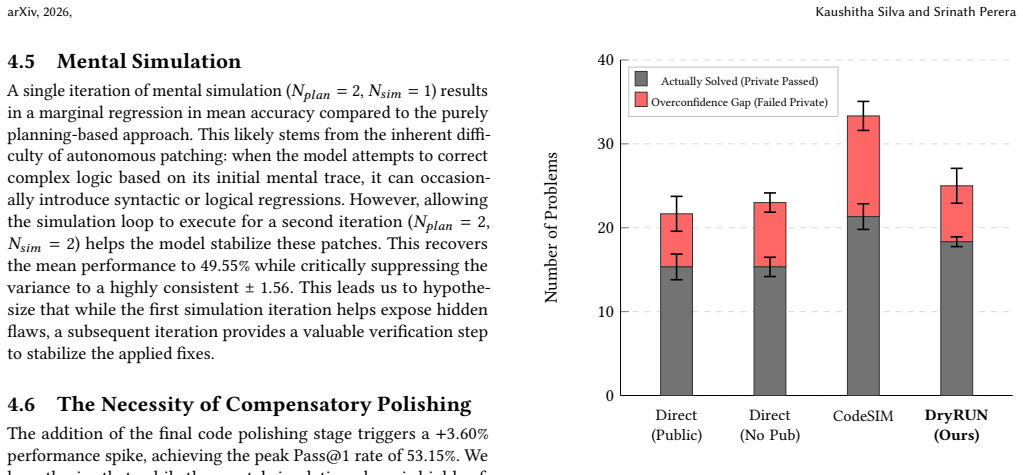
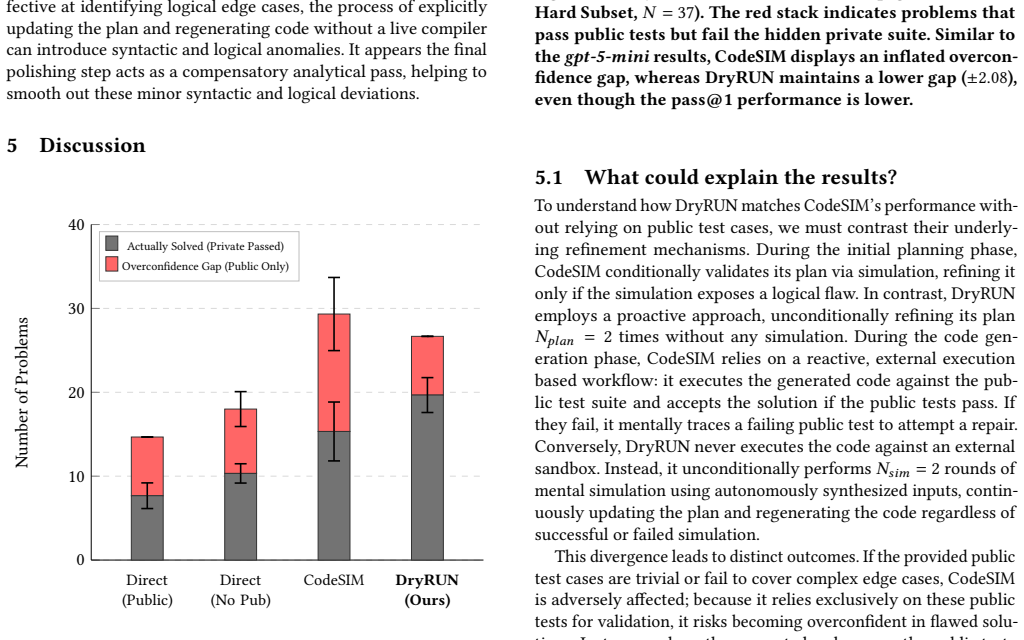
Multi-agent systems are frequently employed for autonomous code generation, demonstrating strong utility in complex algorithmic problem-solving. Recent studies tackle the difficulty of producing functionally correct programs by leveraging simulation-guided planning and debugging, wherein language models step through execution traces to validate logic. Nevertheless, these methods rely heavily on human-authored public test cases to anchor the simulation and debugging cycles. Hand-crafting exhaustive input-output pairs creates a significant, labor-intensive bottleneck within the software development lifecycle. Since ground-truth examples are seldom accessible before actual implementation in real-world scenarios, this reliance limits existing approaches primarily to curated competitive programming datasets. Additionally, we demonstrate that depending on these public tests creates an "overconfidence gap," leading frameworks to overfit to basic examples and underperform on hidden test suites. Conversely, we note that external input samples are not an absolute requirement for successful code generation. We show that large language models possess the capability to autonomously construct valid inputs and simulate execution flows for self-correction. Building on this, we introduce DryRUN, a framework that removes the necessity for ground-truth data by enabling the LLM to iteratively plan, synthesize its own test inputs, and run simulated executions, thereby mitigating algorithmic overconfidence. Assessments using the LiveCodeBench v6 dataset (post-March 2025) reveal that DryRUN achieves comparable performance to CodeSIM, a state-of-the-art, test-dependent baseline. Notably, it does so entirely without public tests or external execution signals, all while decreasing overall output token usage.
Editorial analysis
A structured set of objections, weighed in public.
Referee Report
Summary. The paper introduces DryRUN, a framework for autonomous code generation in which LLMs iteratively plan, synthesize their own test inputs, and simulate execution traces for self-correction and debugging. It argues that reliance on human-authored public tests creates an overconfidence gap that causes overfitting to simple cases and poor generalization to hidden tests; DryRUN removes this dependency by enabling fully internal simulation. On the LiveCodeBench v6 dataset (post-March 2025), the method is reported to reach performance comparable to the test-dependent CodeSIM baseline while reducing output token usage.
Significance. If the empirical claims hold under rigorous controls, the result would be significant for autonomous code generation: it would demonstrate that LLMs can reliably self-simulate valid inputs and execution flows, thereby eliminating a major practical bottleneck (the need for pre-existing public tests) and extending simulation-guided techniques beyond curated competitive-programming settings. The reported token savings would also be a useful engineering contribution.
major comments (3)
- [Abstract] Abstract: the central claim that autonomous input synthesis and simulated execution enable reliable self-correction (and thus parity with CodeSIM) rests on the unverified assumption that LLM-generated traces match real interpreter behavior closely enough to avoid propagating errors. No measurement of simulation fidelity (e.g., mismatch rates between predicted and actual outputs on self-generated inputs) is described, which is load-bearing for attributing success to the DryRUN mechanism rather than base-model strength or dataset properties.
- [Abstract] Abstract: the reported performance comparability to CodeSIM is stated at a high level without reference to experimental controls, statistical tests, ablation studies isolating the simulation component, or the number of problems and exact metrics on LiveCodeBench v6. This absence prevents assessment of whether the result is robust or reproducible.
- [Abstract] Abstract: the demonstration of the 'overconfidence gap' in test-dependent methods appears to rely on internal analysis whose independence from the proposed DryRUN framework is not established, risking circularity in the argument that removing public tests improves generalization.
minor comments (1)
- [Abstract] The abstract introduces the LiveCodeBench v6 dataset (post-March 2025) without indicating whether it is publicly released or how hidden tests were accessed, which affects reproducibility claims.
Simulated Author's Rebuttal
We thank the referee for the detailed and constructive comments. We address each major point below, clarifying aspects of the manuscript and indicating planned revisions to strengthen the presentation of our claims.
read point-by-point responses
-
Referee: [Abstract] Abstract: the central claim that autonomous input synthesis and simulated execution enable reliable self-correction (and thus parity with CodeSIM) rests on the unverified assumption that LLM-generated traces match real interpreter behavior closely enough to avoid propagating errors. No measurement of simulation fidelity (e.g., mismatch rates between predicted and actual outputs on self-generated inputs) is described, which is load-bearing for attributing success to the DryRUN mechanism rather than base-model strength or dataset properties.
Authors: We agree that explicit quantification of simulation fidelity would strengthen attribution of results to the DryRUN mechanism. The current manuscript provides illustrative examples of the planning, input synthesis, and trace simulation steps along with end-to-end performance, but does not report mismatch rates between LLM-predicted outputs and actual interpreter results on self-generated inputs. In the revision we will add a dedicated analysis (new subsection in Experiments or an appendix) that measures fidelity on a representative sample of problems by executing the self-generated inputs in a real interpreter and reporting agreement rates. This will allow readers to assess how closely the internal simulations track ground-truth behavior. revision: yes
-
Referee: [Abstract] Abstract: the reported performance comparability to CodeSIM is stated at a high level without reference to experimental controls, statistical tests, ablation studies isolating the simulation component, or the number of problems and exact metrics on LiveCodeBench v6. This absence prevents assessment of whether the result is robust or reproducible.
Authors: The abstract summarizes the key outcome due to length limits, but the full manuscript details the LiveCodeBench v6 evaluation (post-March 2025 split), the exact number of problems, the primary metric (pass rate), and direct numerical comparison to CodeSIM. Ablation studies isolating the contribution of autonomous input synthesis and trace simulation are also present. We did not include formal statistical significance tests in the original version. In the revision we will (1) expand the abstract to include the problem count and headline metric values and (2) add a brief statistical comparison (e.g., paired t-test or bootstrap confidence intervals) in the Experiments section. revision: partial
-
Referee: [Abstract] Abstract: the demonstration of the 'overconfidence gap' in test-dependent methods appears to rely on internal analysis whose independence from the proposed DryRUN framework is not established, risking circularity in the argument that removing public tests improves generalization.
Authors: The overconfidence-gap analysis is performed on existing test-dependent baselines (including CodeSIM) by comparing their behavior on public tests versus held-out hidden tests; it does not invoke any DryRUN components or self-simulation. This section is presented as motivation before DryRUN is introduced. To eliminate any ambiguity we will revise the manuscript to explicitly label the analysis as an independent evaluation of prior methods and to restate the logical separation between the gap demonstration and the subsequent DryRUN experiments. revision: yes
Circularity Check
No significant circularity; empirical claims rest on external benchmarks
full rationale
The paper's core result is an empirical performance comparison of DryRUN against the external baseline CodeSIM on the external LiveCodeBench v6 dataset (post-March 2025 hidden tests). No equations, fitted parameters renamed as predictions, or self-citations are present in the provided text. The claim that LLMs can autonomously synthesize inputs and simulate executions is tested via end-to-end correctness on held-out tests rather than being true by construction or reduced to internal analysis alone. The overconfidence gap demonstration is described as an observation from public-test reliance, not a definitional loop. This matches the default expectation of a self-contained empirical paper against external benchmarks.
Axiom & Free-Parameter Ledger
axioms (1)
- domain assumption Large language models can autonomously construct valid inputs and simulate execution flows with sufficient accuracy for effective self-correction.
invented entities (1)
-
DryRUN framework
no independent evidence
Reference graph
Works this paper leans on
-
[1]
Bei Chen, Fengji Zhang, Anh Nguyen, Daoguang Zan, Zeqi Lin, Jian-Guang Lou, and Weizhu Chen. 2022. CodeT: Code Generation with Generated Tests. doi:10.48550/arXiv.2207.10397 arXiv:2207.10397 [cs]
-
[2]
Jizheng Chen, Kounianhua Du, Xinyi Dai, Weiming Zhang, Xihuai Wang, Yasheng Wang, Ruiming Tang, Weinan Zhang, and Yong Yu. 2025. DebateCoder: Towards Collective Intelligence of LLMs via Test Case Driven LLM Debate for Code Genera- tion. InProceedings of the 63rd Annual Meeting of the Association for Computational Linguistics (Volume 1: Long Papers), Wanxi...
-
[3]
Mark Chen, Jerry Tworek, Heewoo Jun, Qiming Yuan, Henrique Ponde de Oliveira Pinto, Jared Kaplan, Harri Edwards, Yuri Burda, Nicholas Joseph, Greg Brockman, Alex Ray, Raul Puri, Gretchen Krueger, Michael Petrov, Heidy Khlaaf, Girish Sastry, Pamela Mishkin, Brooke Chan, Scott Gray, Nick Ryder, Mikhail Pavlov, Alethea Power, Lukasz Kaiser, Mohammad Bavarian...
work page internal anchor Pith review Pith/arXiv arXiv doi:10.48550/arxiv.2107.03374 2021
-
[4]
Aditya Desai, Sumit Gulwani, Vineet Hingorani, Nidhi Jain, Amey Karkare, Mark Marron, Sailesh R, and Subhajit Roy. 2015. Program Synthesis using Natural Language. doi:10.48550/arXiv.1509.00413 arXiv:1509.00413 [cs]
- [5]
-
[6]
AgentCoder: Multi-Agent-based Code Generation with Iterative Testing and Optimisation
Dong Huang, Jie M. Zhang, Michael Luck, Qingwen Bu, Yuhao Qing, and Heming Cui. 2024. AgentCoder: Multi-Agent-based Code Generation with Iterative Testing and Optimisation. doi:10.48550/arXiv.2312.13010 arXiv:2312.13010 [cs]
work page internal anchor Pith review doi:10.48550/arxiv.2312.13010 2024
-
[7]
Md Ashraful Islam, Mohammed Eunus Ali, and Md Rizwan Parvez. 2024. MapCoder: Multi-Agent Code Generation for Competitive Problem Solving. doi:10.48550/arXiv.2405.11403 arXiv:2405.11403 [cs]
-
[8]
Md Ashraful Islam, Mohammed Eunus Ali, and Md Rizwan Parvez. 2025. CODESIM: Multi-Agent Code Generation and Problem Solving through Simulation-Driven Planning and Debugging. doi:10.48550/arXiv.2502.05664 arXiv:2502.05664 [cs]
work page internal anchor Pith review Pith/arXiv arXiv doi:10.48550/arxiv.2502.05664 2025
-
[9]
Naman Jain, King Han, Alex Gu, Wen-Ding Li, Fanjia Yan, Tianjun Zhang, Sida Wang, Armando Solar-Lezama, Koushik Sen, and Ion Stoica. 2024. Live- CodeBench: Holistic and Contamination Free Evaluation of Large Language Models for Code. doi:10.48550/arXiv.2403.07974 arXiv:2403.07974 [cs]
work page internal anchor Pith review doi:10.48550/arxiv.2403.07974 2024
-
[10]
Xue Jiang, Yihong Dong, Lecheng Wang, Zheng Fang, Qiwei Shang, Ge Li, Zhi Jin, and Wenpin Jiao. 2024. Self-planning Code Generation with Large Language Models. doi:10.48550/arXiv.2303.06689 arXiv:2303.06689 [cs]
-
[11]
SWE-bench: Can Language Models Resolve Real-World GitHub Issues?
Carlos E. Jimenez, John Yang, Alexander Wettig, Shunyu Yao, Kexin Pei, Ofir Press, and Karthik Narasimhan. 2024. SWE-bench: Can Language Models Resolve Real-World GitHub Issues? doi:10.48550/arXiv.2310.06770 arXiv:2310.06770 [cs]
work page internal anchor Pith review doi:10.48550/arxiv.2310.06770 2024
-
[12]
Dacheng Li, Shiyi Cao, Chengkun Cao, Xiuyu Li, Shangyin Tan, Kurt Keutzer, Jiarong Xing, Joseph E. Gonzalez, and Ion Stoica. 2025. S*: Test Time Scaling for Code Generation. doi:10.48550/arXiv.2502.14382 arXiv:2502.14382 [cs]
-
[13]
Jia Li, Ge Li, Yongmin Li, and Zhi Jin. 2023. Structured Chain-of-Thought Prompt- ing for Code Generation. doi:10.48550/arXiv.2305.06599 arXiv:2305.06599 [cs]
-
[14]
Jiawei Liu, Chunqiu Steven Xia, Yuyao Wang, and Lingming Zhang. 2023. Is Your Code Generated by ChatGPT Really Correct? Rigorous Evaluation of Large Language Models for Code Generation. doi:10.48550/arXiv.2305.01210 arXiv:2305.01210 [cs]
work page internal anchor Pith review doi:10.48550/arxiv.2305.01210 2023
-
[15]
Yifei Liu, Li Lyna Zhang, Yi Zhu, Bingcheng Dong, Xudong Zhou, Ning Shang, Fan Yang, and Mao Yang. 2025. rStar-Coder: Scaling Competitive Code Reasoning with a Large-Scale Verified Dataset. doi:10.48550/arXiv.2505.21297 arXiv:2505.21297 [cs]
-
[16]
Ruwei Pan, Hongyu Zhang, and Chao Liu. 2025. CodeCoR: An LLM-Based Self- Reflective Multi-Agent Framework for Code Generation. doi:10.48550/arXiv.2501. 07811 arXiv:2501.07811 [cs]
- [17]
-
[18]
Noah Shinn, Federico Cassano, Edward Berman, Ashwin Gopinath, Karthik Narasimhan, and Shunyu Yao. 2023. Reflexion: Language Agents with Verbal Reinforcement Learning. doi:10.48550/arXiv.2303.11366 arXiv:2303.11366 [cs]
work page internal anchor Pith review doi:10.48550/arxiv.2303.11366 2023
- [19]
-
[20]
Jason Wei, Xuezhi Wang, Dale Schuurmans, Maarten Bosma, Brian Ichter, Fei Xia, Ed Chi, Quoc Le, and Denny Zhou. 2023. Chain-of-Thought Prompting Elicits Reasoning in Large Language Models. doi:10.48550/arXiv.2201.11903 arXiv:2201.11903 [cs]
work page internal anchor Pith review doi:10.48550/arxiv.2201.11903 2023
-
[21]
Colin White, Samuel Dooley, Manley Roberts, Arka Pal, Ben Feuer, Siddhartha Jain, Ravid Shwartz-Ziv, Neel Jain, Khalid Saifullah, Sreemanti Dey, Shubh- Agrawal, Sandeep Singh Sandha, Siddartha Naidu, Chinmay Hegde, Yann LeCun, Tom Goldstein, Willie Neiswanger, and Micah Goldblum. 2025. LiveBench: A Chal- lenging, Contamination-Limited LLM Benchmark. doi:1...
work page internal anchor Pith review doi:10.48550/arxiv.2406.19314 2025
-
[22]
Linghao Zhang, Shilin He, Chaoyun Zhang, Yu Kang, Bowen Li, Chengxing Xie, Junhao Wang, Maoquan Wang, Yufan Huang, Shengyu Fu, Elsie Nallipogu, Qingwei Lin, Yingnong Dang, Saravan Rajmohan, and Dongmei Zhang. 2025. SWE-bench Goes Live! doi:10.48550/arXiv.2505.23419 arXiv:2505.23419 [cs]
-
[23]
Xiaoqing Zhang, Yuhan Liu, Flood Sung, Xiuying Chen, Shuo Shang, and Rui Yan
-
[24]
doi:10.48550/arXiv.2502.17442 arXiv:2502.17442 [cs]
Thinking Before Running! Efficient Code Generation with Thorough Explo- ration and Optimal Refinement. doi:10.48550/arXiv.2502.17442 arXiv:2502.17442 [cs]
discussion (0)
Sign in with ORCID, Apple, or X to comment. Anyone can read and Pith papers without signing in.