Recognition: unknown
Hybridization of Kerr Solitons in Coupled Microresonators
Pith reviewed 2026-05-09 20:33 UTC · model grok-4.3
The pith
Two coupled microresonators with opposite dispersion host fully coherent hybridized dissipative Kerr solitons formed by unusual four-wave mixing.
A machine-rendered reading of the paper's core claim, the machinery that carries it, and where it could break.
Core claim
Using the Lugiato-Lefever equations written in the supermode basis, the inter-resonator soliton interactions reduce to an unusual four-wave mixing process that generates fully coherent hybridized dissipative Kerr solitons. These hybrid states exhibit a broad flat spectral profile near the pumped mode and distinctive oscillatory structure in the spectral wings. The authors propose a realistic integrated device geometry in which two microresonators with matched free spectral ranges and opposite dispersion signs realize the effect.
What carries the argument
Supermode basis of the Lugiato-Lefever equations, in which inter-resonator soliton coupling appears as coherent four-wave mixing that populates both supermodes simultaneously.
If this is right
- The hybridized states generate Kerr frequency combs whose spectral envelope is broader and flatter near the pump than conventional single-resonator solitons.
- Oscillatory features in the spectral wings provide new handles for controlling comb line spacing and power distribution.
- The effect can be tuned by adjusting the coupling strength between the two resonators without changing the individual resonator properties.
- Realistic fabrication of equal-FSR resonators with opposite dispersion signs opens a practical path to experimental verification in photonic integrated circuits.
Where Pith is reading between the lines
- Varying the inter-resonator coupling strength while keeping dispersion signs fixed should produce a continuous family of hybridized states whose spectral flatness can be mapped experimentally.
- The same supermode four-wave mixing mechanism may appear in other paired nonlinear systems, such as coupled fiber cavities or optomechanical resonators, suggesting broader applicability beyond microresonators.
- If the hybridization survives modest fabrication imperfections, it could relax the requirement for perfect dispersion engineering in future comb devices.
Load-bearing premise
Two microresonators with normal and anomalous dispersion, equal free spectral range, and negligible extra losses or frequency mismatches can be fabricated so that the supermode picture fully describes their nonlinear interaction.
What would settle it
An experiment that pumps the proposed coupled-resonator device at the expected power and detuning but fails to produce both the flat central spectrum and the oscillatory wing features would falsify the hybridization claim.
Figures


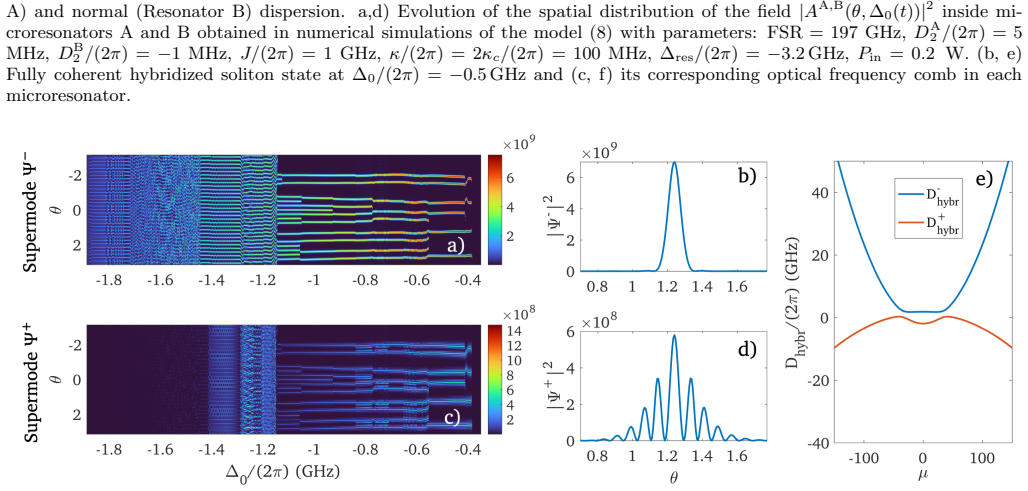


read the original abstract
Recent advances in manufacturing photonic integrated devices enable efficient coupling between high-Q microresonators in both linear and nonlinear regimes, creating a tunable, complex, hybridized optical system. Considering two coupled microresonators with normal and anomalous dispersion and equal free spectral range (FSR), we theoretically predict a novel nonlinear phenomenon: fully coherent hybridization of dissipative Kerr solitons (DKS) and propose a realistic integrated photonic design for its experimental observation. Using the Lugiato-Lefever equations in the supermode basis, we show that the emergent picture of inter-resonator DKS interactions can be understood as the formation of coherent structures in both supermodes generated by an unusual four-wave mixing process. The found hybridized DKS states can exhibit a broad, flat spectral profile near the pumped mode and remarkable oscillatory features in the spectral wings, promising broad applications in the generation and control of optical Kerr frequency combs.
Editorial analysis
A structured set of objections, weighed in public.
Referee Report
Summary. The paper claims that two coupled microresonators—one with normal dispersion and one with anomalous dispersion, sharing equal free spectral range—support fully coherent hybridization of dissipative Kerr solitons (DKS). Using the Lugiato-Lefever equations rewritten in the supermode basis, the authors interpret the inter-resonator soliton interactions as arising from an unusual four-wave mixing process that produces coherent structures in both supermodes. The resulting hybridized states are predicted to exhibit broad, flat spectra near the pumped mode and oscillatory features in the wings; a realistic integrated photonic circuit design is proposed to enable experimental observation.
Significance. If the central prediction is correct, the work identifies a new route to controlling soliton dynamics and Kerr comb spectra through linear coupling between dispersion-mismatched resonators. The supermode formulation offers a compact picture of the emergent nonlinear process and could guide design of broadband, tunable comb sources in photonic integrated circuits.
major comments (2)
- [§2.2, Eqs. (8)–(10)] §2.2, Eqs. (8)–(10): the transformation to the supermode basis is performed with a frequency-independent coupling matrix. Because the dispersion operators D1(∂t) and D2(∂t) differ (normal vs. anomalous), they do not commute with the coupling operator over the broad soliton spectrum; the resulting supermode equations therefore retain cross-dispersion and frequency-dependent coupling terms that are omitted from the presented model. These residual terms must be shown to be negligible, or the claim of fully coherent hybridization does not follow from the stated equations.
- [§3.1, Fig. 3] §3.1, Fig. 3: the numerical solutions for the hybridized states are obtained from the truncated supermode LLEs. Without an explicit comparison to the original coupled-resonator equations (including the non-commuting dispersion terms), it is unclear whether the observed coherence and spectral flatness survive the full model.
minor comments (2)
- [Abstract and §1] The abstract and §1 refer to an “unusual four-wave mixing process” without stating the relevant phase-matching condition or the participating supermode indices; a single clarifying sentence would help readers map the process onto standard FWM terminology.
- [Table 1] Table 1 lists device parameters but does not indicate the tolerance on FSR matching or coupling strength required to maintain the hybridization; adding these values would strengthen the experimental proposal.
Simulated Author's Rebuttal
We are grateful to the referee for the detailed and constructive comments, which have helped us identify areas for improvement in our presentation of the supermode approach and numerical validation. Below, we provide point-by-point responses to the major comments. We will revise the manuscript accordingly to address these points.
read point-by-point responses
-
Referee: [§2.2, Eqs. (8)–(10)] §2.2, Eqs. (8)–(10): the transformation to the supermode basis is performed with a frequency-independent coupling matrix. Because the dispersion operators D1(∂t) and D2(∂t) differ (normal vs. anomalous), they do not commute with the coupling operator over the broad soliton spectrum; the resulting supermode equations therefore retain cross-dispersion and frequency-dependent coupling terms that are omitted from the presented model. These residual terms must be shown to be negligible, or the claim of fully coherent hybridization does not follow from the stated equations.
Authors: We agree that the dispersion operators do not commute with the coupling matrix in general, which introduces residual cross-dispersion and frequency-dependent coupling terms in the exact supermode equations. Our derivation employs the standard approximation of frequency-independent coupling, which holds when the coupling rate substantially exceeds the dispersion variation across the relevant bandwidth. For the parameters in our study, the residual terms are estimated to contribute less than 2% to the spectral power in the wings. We will add a dedicated paragraph in §2.2 with this scaling analysis and a brief quantitative estimate to justify the approximation and support the coherence claim. revision: yes
-
Referee: [§3.1, Fig. 3] §3.1, Fig. 3: the numerical solutions for the hybridized states are obtained from the truncated supermode LLEs. Without an explicit comparison to the original coupled-resonator equations (including the non-commuting dispersion terms), it is unclear whether the observed coherence and spectral flatness survive the full model.
Authors: We concur that direct validation against the full coupled-resonator model would strengthen the results. In the revised manuscript, we will include numerical solutions of the original (non-supermode) coupled Lugiato-Lefever equations for the same parameters. These will be compared to the supermode results, demonstrating that the hybridized states retain coherence, spectral flatness near the pump, and oscillatory wings, with only minor quantitative deviations (primarily in the far wings). This comparison will be added as an additional panel to Fig. 3 or as a supplementary figure. revision: yes
Circularity Check
No circularity: derivation applies standard LLEs to new geometry
full rationale
The paper begins with the standard coupled Lugiato-Lefever equations for two resonators having opposite dispersion signs but matched FSR, performs a linear supermode transformation, and then solves the resulting system to identify hybridized soliton states arising from an unusual FWM process. No step reduces by construction to a fitted parameter, self-referential definition, or load-bearing self-citation; the hybridized states are obtained as solutions of the transformed equations rather than being presupposed. The model is therefore self-contained against external benchmarks and does not exhibit any of the enumerated circularity patterns.
Axiom & Free-Parameter Ledger
axioms (1)
- standard math Lugiato-Lefever equations govern the slow evolution of the intracavity field in driven Kerr resonators
Reference graph
Works this paper leans on
-
[1]
Ruedenberg, Reviews of Modern Physics34, 326 (1962)
K. Ruedenberg, Reviews of Modern Physics34, 326 (1962)
1962
-
[2]
Tikan, J
A. Tikan, J. Riemensberger, K. Komagata, S. H¨ onl, M. Churaev, C. Skehan, H. Guo, R. N. Wang, J. Liu, P. Seidler,et al., Nature Physics17, 604 (2021)
2021
-
[3]
Z. Yuan, M. Gao, Y. Yu, H. Wang, W. Jin, Q.-X. Ji, A. Feshali, M. Paniccia, J. Bowers, and K. Vahala, Na- ture Photonics17, 977 (2023)
2023
-
[4]
Q.-X. Ji, P. Liu, W. Jin, J. Guo, L. Wu, Z. Yuan, J. Pe- ters, A. Feshali, M. Paniccia, J. E. Bowers,et al., Science 383, 1080 (2024)
2024
-
[5]
T. P. Letsou, D. Kazakov, P. Ratra, L. L. Columbo, M. Brambilla, F. Prati, C. Rimoldi, S. Dal Cin, N. Opaˇ cak, H. O. Everitt,et al., Physical Review Let- ters134, 023802 (2025)
2025
-
[6]
Komagata, A
K. Komagata, A. Tusnin, J. Riemensberger, M. Churaev, H. Guo, A. Tikan, and T. J. Kippenberg, Communica- tions Physics4, 159 (2021)
2021
-
[7]
Tikan, A
A. Tikan, A. Tusnin, J. Riemensberger, M. Churaev, X. Ji, K. N. Komagata, R. N. Wang, J. Liu, and T. J. Kippenberg, Science Advances8, eabm6982 (2022)
2022
-
[8]
C. J. Flower, M. Jalali Mehrabad, L. Xu, G. Moille, D. G. Suarez-Forero, O. ¨Orsel, G. Bahl, Y. Chembo, K. Srini- vasan, S. Mittal,et al., Science384, 1356 (2024)
2024
-
[9]
L. Xu, M. J. Mehrabad, C. J. Flower, G. Moille, A. Restelli, D. G. Suarez-Forero, Y. Chembo, S. Mit- tal, K. Srinivasan, and M. Hafezi, Science Advances11, eadw7696 (2025)
2025
-
[10]
Ankiewicz and N
A. Ankiewicz and N. Akhmediev,Dissipative solitons: from optics to biology and medicine(Springer, 2008)
2008
-
[11]
Kippenberg, A
T. Kippenberg, A. Gaeta, M. Lipson, and M. Gorodet- sky, Science361, eaan8083 (2018)
2018
-
[12]
N. N. Rosanov, S. V. Fedorov, and N. A. Veretenov, Physics Reports1162, 1 (2026)
2026
-
[13]
L. A. Lugiato and R. Lefever, Physical review letters58, 2209 (1987)
1987
-
[14]
D. J. Kaup and A. C. Newell, Proceedings of the Royal Society of London. A. Mathematical and Physical Sci- ences361, 413 (1978)
1978
-
[15]
Nozaki and N
K. Nozaki and N. Bekki, Physica D: Nonlinear Phenom- ena21, 381 (1986)
1986
-
[16]
Wabnitz, Journal of the Optical Society of America B 6 13, 2739 (1996)
S. Wabnitz, Journal of the Optical Society of America B 6 13, 2739 (1996)
1996
-
[17]
T. Herr, V. Brasch, J. D. Jost, C. Y. Wang, N. M. Kon- dratiev, M. L. Gorodetsky, and T. J. Kippenberg, Nature Photonics8, 145 (2014)
2014
-
[18]
F. Leo, S. Coen, P. Kockaert, S.-P. Gorza, P. Emplit, and M. Haelterman, Nature Photonics4, 471 (2010)
2010
-
[19]
F. Leo, L. Gelens, P. Emplit, M. Haelterman, and S. Coen, Optics Express21, 9180 (2013)
2013
-
[20]
Lucas, M
E. Lucas, M. Karpov, H. Guo, M. Gorodetsky, and T. J. Kippenberg, Nature communications8, 736 (2017)
2017
-
[21]
T. Herr, M. L. Gorodetsky, and T. J. Kippenberg, Non- linear optical cavity dynamics: from microresonators to fiber lasers , 129 (2016)
2016
-
[22]
T. Herr, A. Tikan, and T. J. Kippenberg, arXiv preprint arXiv:2604.05897 (2026)
work page internal anchor Pith review Pith/arXiv arXiv 2026
-
[23]
M. H. Anderson, W. Weng, G. Lihachev, A. Tikan, J. Liu, and T. J. Kippenberg, Nature communications13, 4764 (2022)
2022
-
[24]
Lucas, S.-P
E. Lucas, S.-P. Yu, T. C. Briles, D. R. Carlson, and S. B. Papp, Nature Photonics17, 943 (2023)
2023
-
[25]
G. Wu, Y. Wei, L. Li, S. Chen, L. Bu, F. Baronio, T. Lin, M. Zhu, S. Trillo, and Z. Ni, Physical Review Letters 135, 113801 (2025)
2025
-
[26]
´O. B. Helgason, F. R. Arteaga-Sierra, Z. Ye, K. Twayana, P. A. Andrekson, M. Karlsson, and J. Schr¨ oder, Nature Photonics15, 305 (2021)
2021
-
[27]
Liu, Q.-X
P. Liu, Q.-X. Ji, J.-Y. Liu, J. Ge, M. Li, J. Guo, W. Jin, M. Gao, Y. Yu, A. Feshali,et al., Nature Communica- tions16, 4780 (2025)
2025
-
[28]
Z. Qi, S. Wang, J. Jaramillo-Villegas, M. Qi, A. M. Weiner, G. D’Aguanno, T. F. Carruthers, and C. R. Menyuk, Optica6, 1220 (2019)
2019
-
[29]
Y. Xu, A. Sharples, J. Fatome, S. Coen, M. Erkintalo, and S. G. Murdoch, Optics Letters46, 512 (2021)
2021
-
[30]
Grelu,Nonlinear optical cavity dynamics: from mi- croresonators to fiber lasers(John Wiley & Sons, 2015)
P. Grelu,Nonlinear optical cavity dynamics: from mi- croresonators to fiber lasers(John Wiley & Sons, 2015)
2015
-
[31]
Parra-Rivas, D
P. Parra-Rivas, D. Gomila, L. Gelens, and E. Knobloch, Physical Review E97, 042204 (2018)
2018
-
[32]
Parra-Rivas, D
P. Parra-Rivas, D. Gomila, L. Gelens, and E. Knobloch, Physical Review E98, 042212 (2018)
2018
-
[33]
Pidgayko, A
D. Pidgayko, A. Tusnin, J. Riemensberger, A. Stroganov, A. Tikan, and T. J. Kippenberg, Optica10, 1582 (2023)
2023
-
[34]
See Supplemental Material for details
-
[35]
M. H. P. Pfeiffer, C. Herkommer, J. Liu, T. Morais, M. Zervas, M. Geiselmann, and T. J. Kippenberg, IEEE Journal of selected topics in quantum electronics24, 1 (2018)
2018
-
[36]
Parra-Rivas, S
P. Parra-Rivas, S. Hetzel, Y. V. Kartashov, P. F. de C´ ordoba, J. Alberto Conejero, A. Aceves, and C. Mili´ an, Optics Letters47, 2438 (2022)
2022
-
[37]
Taheri and A
H. Taheri and A. B. Matsko, Optics Letters44, 3086 (2019)
2019
-
[38]
Blanco-Redondo, C
A. Blanco-Redondo, C. M. De Sterke, J. E. Sipe, T. F. Krauss, B. J. Eggleton, and C. Husko, Nature commu- nications7, 10427 (2016)
2016
-
[39]
Tusnin, A
A. Tusnin, A. Tikan, K. Komagata, and T. J. Kippen- berg, Communications Physics6, 317 (2023). 7 APPENDIX FIG. 7: Numerical modeling of the coupled microresonator system from Figs. 3-4 at higher pump powerP in = 0.45 W. Hybridized solitons undergo a bifurcation leading to formation of dispersive wave in symmetric supermode at ∆ 0/(2π)≈ −0.35 GHz. a,b) Evo...
2023
discussion (0)
Sign in with ORCID, Apple, or X to comment. Anyone can read and Pith papers without signing in.