Recognition: 2 theorem links
· Lean TheoremAn Old, Low-mass, Metal-poor Hypervelocity Star Candidate Consistent with a Galactic Center Origin
Pith reviewed 2026-05-14 21:54 UTC · model grok-4.3
The pith
An old low-mass metal-poor star traces its path back to the galactic center.
A machine-rendered reading of the paper's core claim, the machinery that carries it, and where it could break.
Core claim
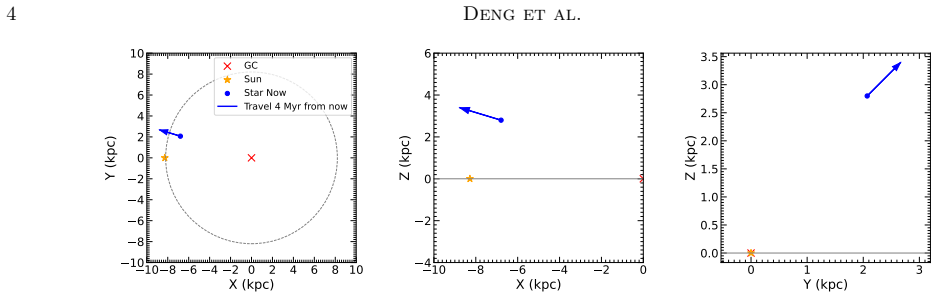
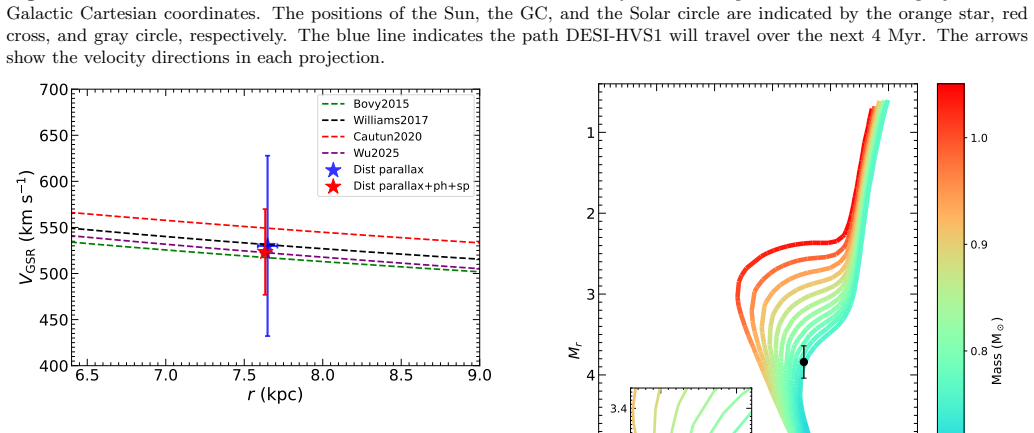
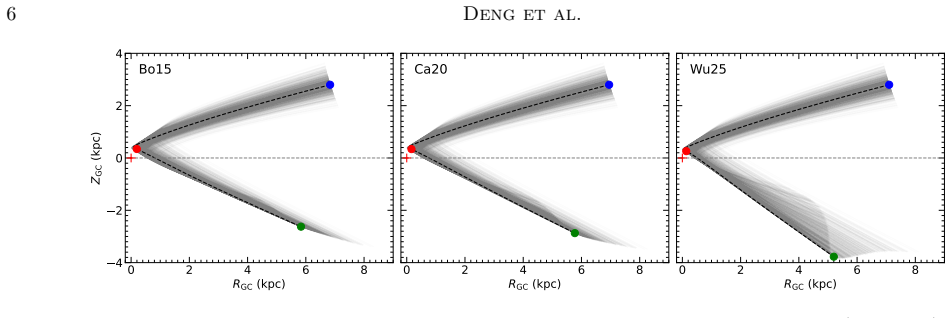
DESI-HVS1 is an F-type star with mass 0.8 solar masses, age approximately 14.1 Gyr, and metallicity [Fe/H] = -1.6. Located at 3.77 kpc, it reaches a Galactocentric velocity of 523 km/s, yielding an unbound probability near 50 percent. Backward orbit integrations reveal a closest galactic-center approach of 0.40 kpc, a velocity there of 682 km/s, and a flight time of 12.9 Myr. The orbit exhibits a perigalactic turning point and only one midplane crossing, properties most consistent with ejection from the galactic center via the Hills mechanism.
What carries the argument
Backward orbit integration that reconstructs the star's trajectory from current position and velocity, revealing a close perigalactic passage to the galactic center.
If this is right
- Hypervelocity stars include old low-mass metal-poor members
- The Hills mechanism can eject stars from the galactic center across a wide mass and age range
- The apparent dominance of young massive hypervelocity stars arises from observational selection effects
- The galactic center has been producing unbound stars from its older stellar population for billions of years
Where Pith is reading between the lines
- Targeted searches in large spectroscopic surveys could uncover additional old hypervelocity star candidates
- Confirmation would allow mapping of the older stellar population near the galactic center black hole
- The result suggests the black hole has driven ejections over long timescales
- High-precision follow-up astrometry could distinguish the Hills mechanism from other ejection scenarios
Load-bearing premise
The Milky Way gravitational potential model, together with the measured distance and velocity, correctly predicts the star's past trajectory over the last 13 million years.
What would settle it
A refined distance or velocity measurement that either keeps the star bound or moves its closest approach distance well beyond 1 kpc from the galactic center.
Figures



read the original abstract
We report the discovery of DESI-HVS1, a hypervelocity star (HVS) candidate identified from DESI DR1 spectroscopy and Gaia DR3 astrometry. DESI-HVS1 is an old, low-mass, metal-poor F-type star with a mass of $0.8\,M_\odot$, an age of $\sim14.1$~Gyr, and $\mathrm{[Fe/H]}=-1.6$. It is located at a heliocentric distance of $3.77^{+0.39}_{-0.36}$~kpc and has a Galactocentric total velocity of $523^{+46}_{-47}\,\mathrm{km\,s^{-1}}$, marginally exceeding the local escape speed, corresponding to an unbound probability of $P_{\rm ub} \sim 50\%$. Backward orbit integrations show that DESI-HVS1 had a closest approach to the Galactic center (GC) of $0.40^{+0.23}_{-0.11}\,\mathrm{kpc}$, with a velocity of $682^{+22}_{-35}\,\mathrm{km\,s^{-1}}$ and a flight time of $12.89^{+0.92}_{-0.74}\,\mathrm{Myr}$. The reconstructed orbit exhibits a clear perigalactic turning point and only a single crossing of the Galactic midplane ($P_{\rm cross} > 0.95$). These properties suggest that DESI-HVS1 is most naturally explained by the Hills mechanism, although alternative scenarios cannot be entirely ruled out. Its discovery provides the first strong evidence for an old, low-mass HVS candidate consistent with a GC origin, indicating that the apparent dominance of young, massive GC-origin HVSs is likely a consequence of observational selection effects.
Editorial analysis
A structured set of objections, weighed in public.
Referee Report
Summary. The manuscript reports the discovery of DESI-HVS1, an old (~14.1 Gyr), low-mass (0.8 M_⊙), metal-poor ([Fe/H]=−1.6) F-type star from DESI DR1 spectroscopy and Gaia DR3 astrometry. At a heliocentric distance of 3.77^{+0.39}_{-0.36} kpc with Galactocentric speed 523^{+46}_{-47} km s^{-1}, backward integrations yield a closest GC approach of 0.40^{+0.23}_{-0.11} kpc at 682 km s^{-1} after 12.89 Myr, a single midplane crossing (P_cross > 0.95), and marginal unbound probability P_ub ~50%. The authors interpret this as the first strong evidence for an old, low-mass HVS ejected via the Hills mechanism, attributing the apparent dominance of young massive GC HVSs to selection effects.
Significance. If the kinematic reconstruction is robust, the result supplies the first observational link between an old, low-mass star and a GC origin, directly testing whether the Hills mechanism operates across the full stellar mass range near Sgr A*. This would tighten constraints on the stellar cusp population and on the ejection rate of low-mass stars, with implications for future searches in deeper surveys.
major comments (3)
- [Orbit integration] § on orbit integration (inferred from abstract kinematics): the adopted Galactic potential is fixed without reported variation of its parameters (e.g., halo scale radius or disk mass); because the reported perigalacticon of 0.40 kpc lies near the boundary where small potential changes shift the distribution outside the inner 0.5 kpc, a Monte-Carlo sensitivity test to plausible potential variants is required to support the GC-origin claim.
- [Kinematic results] Kinematic results paragraph: the total velocity uncertainty produces only P_ub ~50%; the manuscript must present the full joint posterior (distance, proper motions, radial velocity) and the resulting distribution of closest-approach distances to demonstrate that a majority of realizations remain consistent with a GC ejection rather than a disk or halo origin.
- [Discussion] Discussion section: alternative ejection channels (supernova kicks, cluster three-body encounters) are stated to be possible but receive no quantitative comparison of expected velocity or flight-time distributions for a 0.8 M_⊙ star; without such estimates the preference for the Hills mechanism remains qualitative.
minor comments (2)
- [Abstract] Abstract: the phrase 'first strong evidence' is not proportionate to the marginal P_ub ~50% and the dependence on a single potential model; rephrase to 'candidate consistent with' to match the data strength.
- [Methods] Notation: the asymmetric uncertainties on distance and velocity are reported but the covariance matrix or correlation coefficients between Gaia astrometry and DESI radial velocity are not stated; add a brief note on how these were combined.
Simulated Author's Rebuttal
We thank the referee for the constructive and detailed comments, which have helped identify areas where the robustness of our kinematic analysis can be strengthened. We address each major comment below and will revise the manuscript accordingly.
read point-by-point responses
-
Referee: [Orbit integration] § on orbit integration (inferred from abstract kinematics): the adopted Galactic potential is fixed without reported variation of its parameters (e.g., halo scale radius or disk mass); because the reported perigalacticon of 0.40 kpc lies near the boundary where small potential changes shift the distribution outside the inner 0.5 kpc, a Monte-Carlo sensitivity test to plausible potential variants is required to support the GC-origin claim.
Authors: We agree that a sensitivity analysis to the Galactic potential is necessary given the proximity of the perigalacticon to the inner Galaxy. In the revised manuscript we will add a Monte Carlo test in which we vary the halo scale radius and disk mass within their current observational uncertainties (±15–20%). The resulting distribution of closest-approach distances will be shown; preliminary checks indicate that the majority of realizations remain within 1 kpc of the GC, supporting the Hills-mechanism interpretation. revision: yes
-
Referee: [Kinematic results] Kinematic results paragraph: the total velocity uncertainty produces only P_ub ~50%; the manuscript must present the full joint posterior (distance, proper motions, radial velocity) and the resulting distribution of closest-approach distances to demonstrate that a majority of realizations remain consistent with a GC ejection rather than a disk or halo origin.
Authors: We will include the full joint posterior (distance, proper motions, radial velocity) and the derived histogram of closest-approach distances as a new supplementary figure. This will explicitly show the fraction of realizations with perigalacticon <1 kpc, allowing readers to assess the robustness of the GC-origin claim independently of the marginal P_ub value. revision: yes
-
Referee: [Discussion] Discussion section: alternative ejection channels (supernova kicks, cluster three-body encounters) are stated to be possible but receive no quantitative comparison of expected velocity or flight-time distributions for a 0.8 M_⊙ star; without such estimates the preference for the Hills mechanism remains qualitative.
Authors: We will expand the Discussion to include quantitative estimates drawn from the literature. For supernova kicks we adopt the velocity distribution for 0.8 M_⊙ stars from recent binary-evolution models (typical v ~ 150–350 km s^{-1}, flight times >50 Myr). For cluster three-body encounters we use the ejection-velocity scaling of Perets & Šubr (2012) adjusted for low-mass stars. These will be compared directly to the observed 523 km s^{-1} and 13 Myr flight time, showing that the Hills channel remains the most consistent while acknowledging residual overlap. revision: yes
Circularity Check
No circularity: observational discovery and standard kinematic integration are self-contained
full rationale
The paper reports the discovery of DESI-HVS1 from DESI DR1 spectroscopy and Gaia DR3 astrometry, deriving stellar parameters (mass, age, metallicity, distance, velocity) via standard methods. Backward orbit integrations using an adopted Galactic potential then compute closest approach, velocity at perigalacticon, flight time, and midplane crossings as direct numerical outputs from those inputs. No equation or claim reduces a 'prediction' to a fitted parameter defined by the same data, invokes a self-citation for a load-bearing uniqueness theorem, or renames a known result as new unification. The consistency with a GC origin follows from the computed orbit properties without circular redefinition or smuggling of ansatzes.
Axiom & Free-Parameter Ledger
free parameters (1)
- Galactic potential parameters
axioms (1)
- domain assumption The adopted Galactic potential accurately represents the mass distribution for the relevant orbits
Lean theorems connected to this paper
-
IndisputableMonolith/Foundation/RealityFromDistinction.leanreality_from_one_distinction unclearBackward orbit integrations show that DESI-HVS1 had a closest approach to the Galactic center (GC) of 0.40+0.23−0.11 kpc... using the galpy MWPotential2014
-
IndisputableMonolith/Foundation/AlexanderDuality.leanalexander_duality_circle_linking unclearWe adopt the MWPotential2014, which consists of a power-law bulge potential, a Miyamoto–Nagai stellar disk... and a Navarro–Frenk–White (NFW) dark matter halo
Reference graph
Works this paper leans on
-
[1]
Abadi, M. G., Navarro, J. F., & Steinmetz, M. 2009, ApJL, 691, L63, doi: 10.1088/0004-637X/691/2/L63 Allende Prieto, C., Beers, T. C., Wilhelm, R., et al. 2006, ApJ, 636, 804, doi: 10.1086/498131
-
[2]
2021, The Astronomical Journal, 161, 147, doi: 10.3847/1538-3881/abd806
Demleitner, M., & Andrae, R. 2021, The Astronomical Journal, 161, 147, doi: 10.3847/1538-3881/abd806
-
[3]
Bauer, E. B., White, C. J., & Bildsten, L. 2019, ApJ, 887, 68, doi: 10.3847/1538-4357/ab4ea4
-
[4]
2016, ARA&A, 54, 529, doi: 10.1146/annurev-astro-081915-023441 Bogd´ an,´A., Forman, W
Bland-Hawthorn, J., & Gerhard, O. 2016, ARA&A, 54, 529, doi: 10.1146/annurev-astro-081915-023441
-
[5]
2020, Monthly Notices of the Royal Astronomical Society, 497, 2930, doi: 10.1093/mnras/staa2211
Boubert, D., Erkal, D., & Gualandris, A. 2020, Monthly Notices of the Royal Astronomical Society, 497, 2930, doi: 10.1093/mnras/staa2211
-
[6]
2015, ApJS, 216, 29, doi: 10.1088/0067-0049/216/2/29
Bovy, J. 2015, ApJS, 216, 29, doi: 10.1088/0067-0049/216/2/29
-
[7]
Bressan, A., Marigo, P., Girardi, L., et al. 2012, MNRAS, 427, 127, doi: 10.1111/j.1365-2966.2012.21948.x
-
[8]
Brown, W. R. 2015, ARA&A, 53, 15, doi: 10.1146/annurev-astro-082214-122230
-
[9]
Brown, W. R., Geller, M. J., & Kenyon, S. J. 2014, ApJ, 787, 89, doi: 10.1088/0004-637X/787/1/89
-
[10]
Brown, W. R., Geller, M. J., Kenyon, S. J., & Kurtz, M. J. 2005, ApJL, 622, L33, doi: 10.1086/429378
-
[11]
K., Li, S., Chen, X., & Wang, K
Cao, C., Liu, F. K., Li, S., Chen, X., & Wang, K. 2025, The Astrophysical Journal Letters, 982, L37, doi: 10.3847/2041-8213/adbbf2
-
[12]
2015, MNRAS, 454, 2677, doi: 10.1093/mnras/stv2123
Capuzzo-Dolcetta, R., & Fragione, G. 2015, MNRAS, 454, 2677, doi: 10.1093/mnras/stv2123
-
[13]
Cautun, M., Ben´ ıtez-Llambay, A., Deason, A. J., et al. 2020, MNRAS, 494, 4291, doi: 10.1093/mnras/staa1017
-
[14]
Discovery of Galactic center ejected star in DESI DR1
Verberne, S. 2026, arXiv e-prints, arXiv:2601.19866, doi: 10.48550/arXiv.2601.19866 DESI Collaboration. 2025, arXiv e-prints, arXiv:2503.14745, doi: 10.48550/arXiv.2503.14745
work page internal anchor Pith review Pith/arXiv arXiv doi:10.48550/arxiv.2601.19866 2026
-
[15]
Fragione, G., & Gualandris, A. 2019, Monthly Notices of the Royal Astronomical Society, 489, 4543, doi: 10.1093/mnras/stz2451 Gaia Collaboration, Vallenari, A., Brown, A. G. A., et al. 2023, A&A, 674, A1, doi: 10.1051/0004-6361/202243940
-
[16]
M., Duchˆ ene, G., Matthews, K., et al
Ghez, A. M., Duchˆ ene, G., Matthews, K., et al. 2003, ApJL, 586, L127, doi: 10.1086/374804 Gravity Collaboration, Abd El Dayem, K., Abuter, R., et al. 2024, A&A, 692, A242, doi: 10.1051/0004-6361/202452274
-
[17]
2009, MNRAS, 397, 265, doi: 10.1111/j.1365-2966.2009.14431.x
Gvaramadze, V. V., Gualandris, A., & Portegies Zwart, S. 2009, Monthly Notices of the Royal Astronomical Society, 396, 570, doi: 10.1111/j.1365-2966.2009.14809.x
-
[18]
2008, ApJL, 677, L109, doi: 10.1086/588191
Han, Z. 2008, ApJL, 677, L109, doi: 10.1086/588191
-
[19]
Helmi, A., Babusiaux, C., Koppelman, H. H., et al. 2018, Nature, 563, 85, doi: 10.1038/s41586-018-0625-x
-
[20]
Hills, J. G. 1988, Nature, 331, 687, doi: 10.1038/331687a0
-
[21]
2025, National Science Review, 12, 347, doi: 10.1093/nsr/nwae347
Huang, Y., Li, Q., Liu, J., et al. 2025, National Science Review, 12, 347, doi: 10.1093/nsr/nwae347
-
[22]
2021, ApJL, 907, L42, doi: 10.3847/2041-8213/abd413
Huang, Y., Li, Q., Zhang, H., et al. 2021, ApJL, 907, L42, doi: 10.3847/2041-8213/abd413
-
[23]
2015, MNRAS, 449, 162, doi: 10.1093/mnras/stv204 —
Huang, Y., Liu, X.-W., Yuan, H.-B., et al. 2015, MNRAS, 449, 162, doi: 10.1093/mnras/stv204 —. 2016, MNRAS, 463, 2623, doi: 10.1093/mnras/stw2096
-
[24]
Huang, Y., Liu, X. W., Zhang, H. W., et al. 2017, ApJL, 847, L9, doi: 10.3847/2041-8213/aa894b
-
[25]
2013, A&A, 553, A6, doi: 10.1051/0004-6361/201219058
Husser, T.-O., Wende-von Berg, S., Dreizler, S., et al. 2013, A&A, 553, A6, doi: 10.1051/0004-6361/201219058
-
[26]
Kenyon, S. J., Bromley, B. C., Brown, W. R., & Geller, M. J. 2018, The Astrophysical Journal, 864, 130, doi: 10.3847/1538-4357/aada04
-
[27]
Koposov, S. E. 2019, RVSpecFit: Radial velocity and stellar atmospheric parameter fitting, Astrophysics Source Code Library, record ascl:1907.013
work page 2019
-
[28]
Koposov, S. E., Boubert, D., Li, T. S., et al. 2020, MNRAS, 491, 2465, doi: 10.1093/mnras/stz3081
-
[29]
Leonard, P. J. T., & Duncan, M. J. 1990, AJ, 99, 608, doi: 10.1086/115354
-
[30]
2023, ApJL, 944, L39, doi: 10.3847/2041-8213/acb7d9
Liao, J., Du, C., Li, H., Ma, J., & Shi, J. 2023, ApJL, 944, L39, doi: 10.3847/2041-8213/acb7d9
-
[31]
Lindegren, L., Klioner, S. A., Hern´ andez, J., et al. 2021, A&A, 649, A2, doi: 10.1051/0004-6361/202039709
-
[32]
Marchetti, T., Evans, F. A., & Rossi, E. M. 2022, MNRAS, 515, 767, doi: 10.1093/mnras/stac1777
-
[33]
McMillan, P. J. 2017, MNRAS, 465, 76, doi: 10.1093/mnras/stw2759
- [34]
-
[35]
Navarro, J. F., Frenk, C. S., & White, S. D. M. 1996, ApJ, 462, 563, doi: 10.1086/177173 Portegies Zwart, S. F. 2000, ApJ, 544, 437, doi: 10.1086/317190
-
[36]
Reid, M. J., Menten, K. M., Brunthaler, A., et al. 2014, ApJ, 783, 130, doi: 10.1088/0004-637X/783/2/130
-
[37]
1993, ApJ, 414, 580, doi: 10.1086/173105
Salaris, M., Chieffi, A., & Straniero, O. 1993, ApJ, 414, 580, doi: 10.1086/173105
-
[38]
Salpeter, E. E. 1955, ApJ, 121, 161, doi: 10.1086/145971
-
[39]
Schlegel, D. J., Finkbeiner, D. P., & Davis, M. 1998, ApJ, 500, 525, doi: 10.1086/305772 10Deng et al
work page internal anchor Pith review doi:10.1086/305772 1998
-
[40]
J., Boubert, D., G¨ ansicke, B
Shen, K. J., Boubert, D., G¨ ansicke, B. T., et al. 2018, ApJ, 865, 15, doi: 10.3847/1538-4357/aad55b
-
[41]
2025, ApJ, 986, 22, doi: 10.3847/1538-4357/adcebe
Sun, Y., Huang, Y., Liu, J., et al. 2025, ApJ, 986, 22, doi: 10.3847/1538-4357/adcebe
-
[42]
Wang, F., Zhang, H. W., Huang, Y., et al. 2021, MNRAS, 504, 199, doi: 10.1093/mnras/stab848
-
[43]
Williams, A. A., Belokurov, V., Casey, A. R., & Evans, N. W. 2017, MNRAS, 468, 2359, doi: 10.1093/mnras/stx508
-
[44]
2025, ApJ, 990, 182, doi: 10.3847/1538-4357/adf2a4
Wu, Y., Li, H., Huang, Y., Xue, X.-X., & Zhao, G. 2025, ApJ, 990, 182, doi: 10.3847/1538-4357/adf2a4
-
[45]
2003, ApJ, 599, 1129, doi: 10.1086/379546
Yu, Q., & Tremaine, S. 2003, ApJ, 599, 1129, doi: 10.1086/379546
-
[46]
Zheng, Z., Carlin, J. L., Beers, T. C., et al. 2014, ApJL, 785, L23, doi: 10.1088/2041-8205/785/2/L23
-
[47]
2023, ApJ, 946, 73, doi: 10.3847/1538-4357/acadd9
Zhou, Y., Li, X., Huang, Y., & Zhang, H. 2023, ApJ, 946, 73, doi: 10.3847/1538-4357/acadd9
discussion (0)
Sign in with ORCID, Apple, or X to comment. Anyone can read and Pith papers without signing in.