Spectral Perspectives on FAT Graph Colorings
Pith reviewed 2026-05-09 21:13 UTC · model grok-4.3
The pith
The FAT chromatic number is exactly determined for every complete multipartite graph.
A machine-rendered reading of the paper's core claim, the machinery that carries it, and where it could break.
Core claim
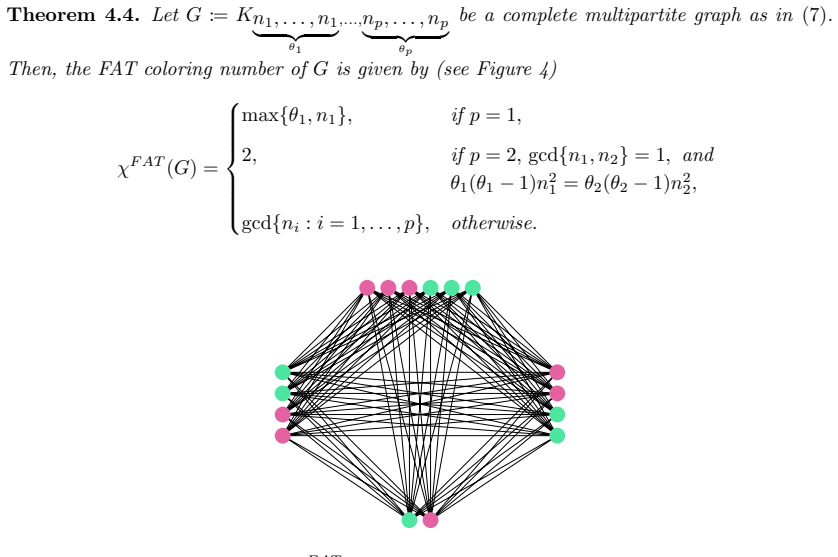
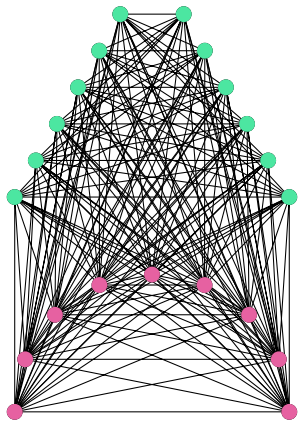
We determine the FAT chromatic number for all complete multipartite graphs. Spectral methods form the primary focus, with several combinatorial arguments included to complement the results. We also analyze the behavior of FAT colorings under several graph operations.
What carries the argument
The FAT coloring condition, requiring each vertex to share its color with a fixed fraction of neighbors and balance the rest evenly across other classes, whose minimum color count is computed via spectral bounds from the adjacency matrix.
If this is right
- The minimum number of colors needed for any complete multipartite graph under the FAT rules is now known explicitly.
- FAT colorings of disjoint unions and joins can be built directly from the colorings of the component graphs.
- Spectral techniques supply matching upper and lower bounds that coincide exactly for complete multipartite graphs.
- Combinatorial constructions verify the spectral results in special cases.
Where Pith is reading between the lines
- The exact values supply a benchmark for testing whether spectral methods work on FAT colorings of graph families outside the multipartite case.
- The analysis of operations suggests that the FAT property remains controllable when graphs are built from multipartite pieces.
- The link between eigenvalue bounds and the even-distribution requirement may carry over to other equitable or balanced coloring problems.
Load-bearing premise
The FAT coloring definition applies uniformly and spectral methods produce the exact chromatic number for these graphs without further unstated restrictions.
What would settle it
A specific complete multipartite graph for which the number of colors given by the spectral formula fails to produce an assignment meeting the share-fraction and even-distribution rules for every vertex.
Figures




read the original abstract
We investigate Fair and Tolerant (FAT) graph colorings, a coloring framework in which each vertex is allowed to share its color with a prescribed fraction of its neighbors, while the remaining neighbors are required to be distributed evenly among the other coloring classes. In particular, we determine the FAT chromatic number for all complete multipartite graphs, and we analyze the behavior of FAT colorings under several graph operations. Although spectral methods form the primary focus, several combinatorial arguments are included to complement the results.
Editorial analysis
A structured set of objections, weighed in public.
Referee Report
Summary. The paper introduces Fair and Tolerant (FAT) graph colorings, allowing each vertex to share its color with a prescribed fraction of neighbors while requiring even distribution of the remaining neighbors among other color classes. It determines the exact FAT chromatic number for all complete multipartite graphs by applying the known spectrum of their adjacency matrices, supported by explicit combinatorial constructions that achieve the bound for arbitrary part sizes and tolerance values. The work also analyzes the behavior of FAT colorings under several standard graph operations.
Significance. If the derivations hold, the exact formula for the FAT chromatic number on complete multipartite graphs is a useful contribution to relaxed coloring theory. The primary reliance on spectral methods is well-suited to the regular structure of these graphs, and the explicit combinatorial constructions provide constructive verification of the spectral bounds. This combination of spectral derivations and matching constructions is a strength that could support extensions to other graph families or tolerance parameters.
minor comments (2)
- The introduction would benefit from a brief illustrative example of a FAT coloring on a small complete multipartite graph (e.g., K_{2,2,2}) to clarify the interaction between the fraction parameter and the even-distribution requirement.
- Notation for the tolerance parameters (fraction of same-color neighbors and even distribution) is introduced clearly but could be cross-referenced more explicitly when the main formula is stated in the spectral section.
Simulated Author's Rebuttal
We thank the referee for the positive summary, significance assessment, and recommendation of minor revision. The report correctly identifies the core contribution: an exact determination of the FAT chromatic number for all complete multipartite graphs via the known spectrum of their adjacency matrices, together with matching explicit combinatorial constructions. We are pleased that the combination of spectral and constructive arguments is viewed as a strength.
Circularity Check
Derivation is self-contained using known spectra and independent constructions
full rationale
The paper explicitly defines FAT colorings with parameters for allowed same-color neighbor fractions and even distribution across classes. It computes the FAT chromatic number for complete multipartite graphs by invoking the standard, externally known spectrum of their adjacency matrices and then verifies the bound via direct combinatorial constructions that work for arbitrary part sizes and tolerance parameters. No step reduces a claimed prediction or uniqueness result to a fitted parameter, self-citation chain, or definitional tautology; the spectral input is a standard fact independent of this work, and the constructions are explicit and non-circular.
Axiom & Free-Parameter Ledger
axioms (1)
- standard math Standard axioms of graph theory and linear algebra for spectral methods
Reference graph
Works this paper leans on
-
[1]
L. Beers and R. Mulas. At the end of the spectrum: Chromatic bounds for the largest eigenvalue of the normalized Laplacian.Journal of Physics: Complexity, 6(2), 2024
work page 2024
-
[2]
L. Beers and R. Mulas. Fair and Tolerant (FAT) Graph Colorings.arXiv:2510.18494, 2025
- [3]
-
[4]
A.E. Brouwer and W.H. Haemers.Spectra of graphs. Universitext. Springer, New York, 2012
work page 2012
-
[5]
S. Butler. Algebraic aspects of the normalized Laplacian. InRecent Trends in Combina- torics, pages 295–315. Springer, 2016. 24
work page 2016
-
[6]
F. Chung.Spectral graph theory. American Mathematical Soc., 1997
work page 1997
-
[7]
J. Jost, R. Mulas, and D. Zhang.Spectra of Discrete Structures.Cambridge University Press, Cambridge Studies in Advanced Mathematics, Forthcoming, 2026
work page 2026
- [8]
- [9]
-
[10]
S. Sun and K.C. Das. Normalized Laplacian spectrum of complete multipartite graphs. Discrete Appl. Math., 284:234–245, 2020
work page 2020
-
[11]
B. Zelinka. On domatic numbers of graphs.Mathematica Slovaca, 31(1):91–95, 1981. 25
work page 1981
discussion (0)
Sign in with ORCID, Apple, or X to comment. Anyone can read and Pith papers without signing in.