Recognition: unknown
Flexible Piezoresistive Yarn Sensor for Human Physiological Signal Measurement
Pith reviewed 2026-05-08 13:05 UTC · model grok-4.3
The pith
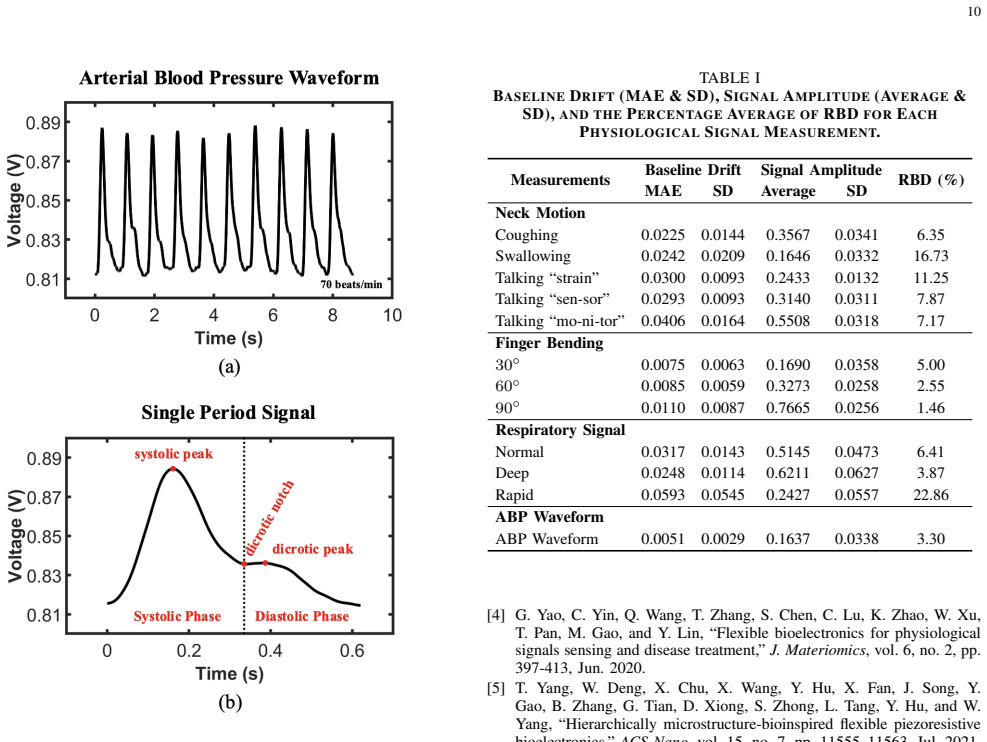
A flexible piezoresistive yarn sensor measures arterial blood pressure waveforms with a baseline drift mean absolute error of 0.0051.
A machine-rendered reading of the paper's core claim, the machinery that carries it, and where it could break.
Core claim
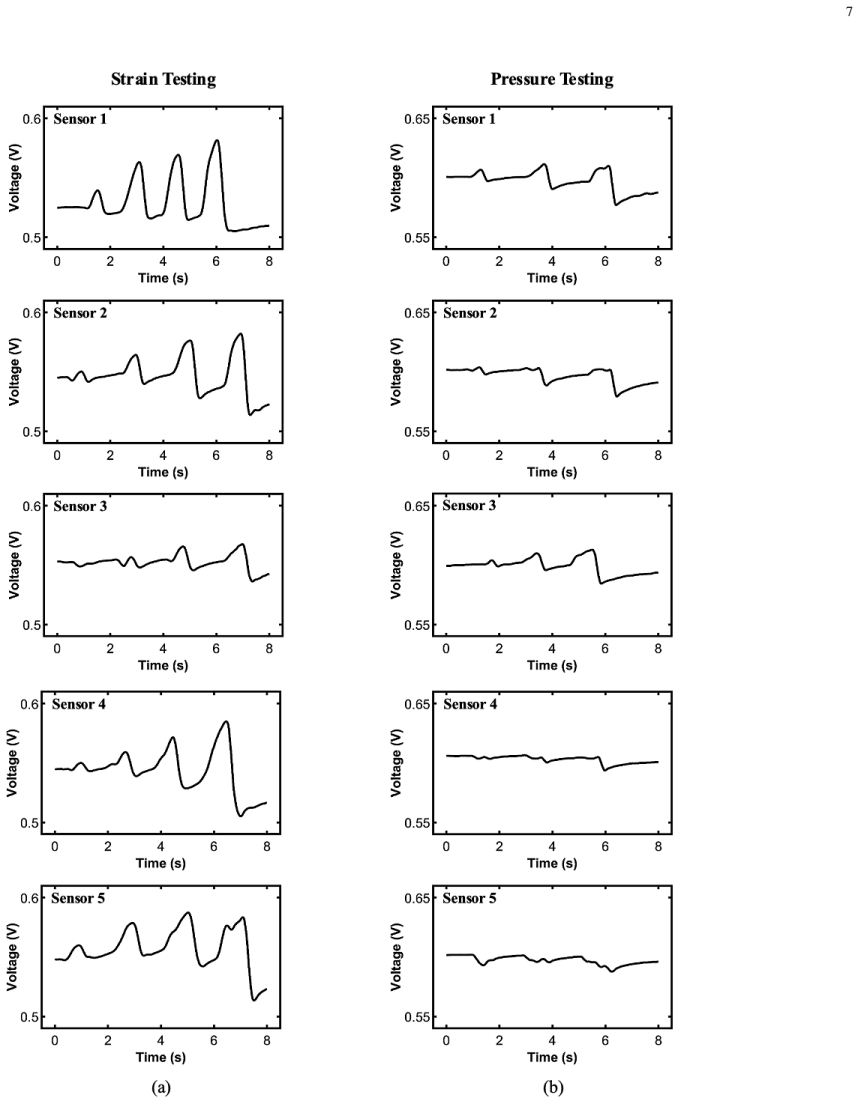
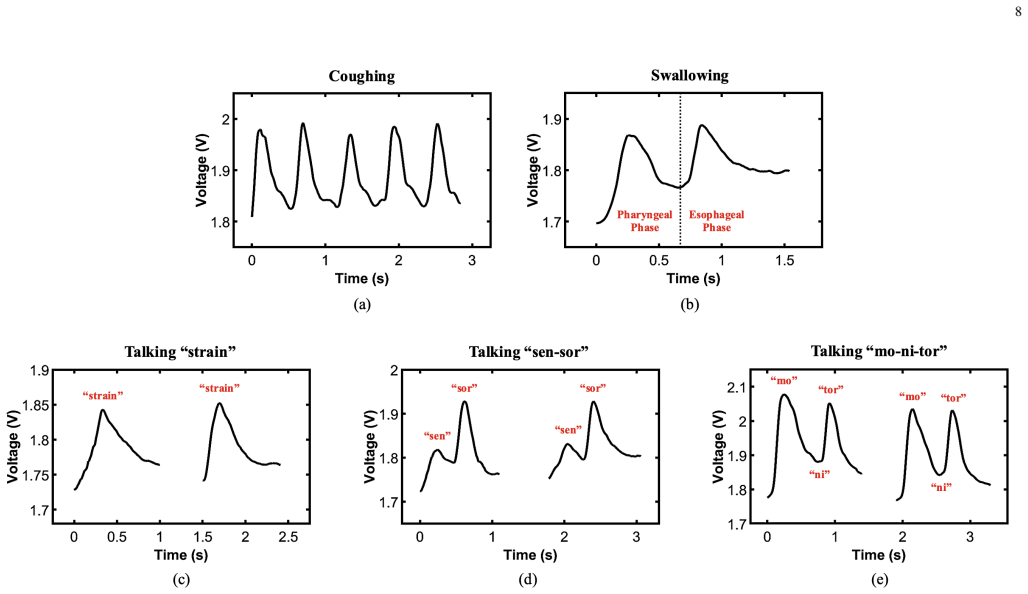
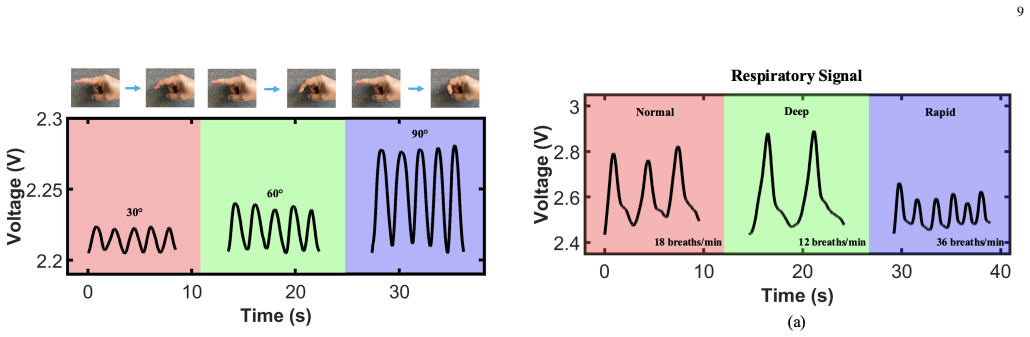
The representative sensor design was constructed by applying an FPY bonding pattern, utilizing tightly arranged triangular patterns and using minimal FPY. The prototype operates in strain and pressure modes and was evaluated on neck motion, finger bending, respiratory signals, and ABP waveforms. Qualitative comparison shows high morphological similarity to related studies, while baseline drift analysis finds the ABP measurement most stable with a mean absolute error of 0.0051 ± 0.0029 using normalized values from 0 to 1. The results support the sensor as an innovative solution for physiological signal monitoring.
What carries the argument
The FPY bonding pattern of tightly arranged triangular shapes using minimal yarn, which enables dual strain and pressure sensing across body sites.
If this is right
- The sensor captures neck motion, finger bending, respiratory signals, and arterial blood pressure waveforms in strain or pressure mode.
- ABP waveforms exhibit the lowest baseline drift among tested signals.
- The design supports extension to personalized healthcare and sports monitoring applications.
- Minimal material usage in the triangular pattern keeps the sensor flexible and comfortable for extended wear.
Where Pith is reading between the lines
- Embedding the yarn directly into clothing fabrics could enable unobtrusive, all-day vital sign collection without separate attachments.
- Large-scale trials across many subjects with direct comparisons to gold-standard devices would test whether the reported stability holds in varied conditions.
- The same triangular pattern could be adapted for multi-limb or torso coverage to track combined motion and pressure changes during exercise.
Load-bearing premise
Qualitative morphological similarity to other studies plus one baseline drift metric suffices to establish high sensitivity, accuracy, and suitability for physiological monitoring.
What would settle it
Simultaneous ABP recording against a validated clinical monitor that shows substantially higher error or drift than 0.0051 would disprove the stability claim.
Figures



read the original abstract
Continuous monitoring of physiological signals is essential for the early detection of health problems. A measurement system that ensures high sensitivity, accuracy, and user comfort is needed. In this study, we designed and optimized a flexible piezoresistive yarn (FPY) sensor to achieve a high sensitivity and wide working range for detecting physiological signals. The representative sensor design was constructed by applying an FPY bonding pattern, utilizing tightly arranged triangular patterns and using minimal FPY. The prototype sensor operates in two measurement modes, strain and pressure, and was evaluated for measuring neck motion, finger bending, respiratory signals, and arterial blood pressure (ABP) waveforms. A qualitative evaluation, performed by comparing the characteristics of the measurement results of each physiological signal with those from related studies, indicates a high similarity in its morphological characteristics. Then, a quantitative evaluation through baseline drift analysis demonstrates that the FPY sensor displays high measurement stability. The ABP waveform measurement shows the most stable baseline, with a mean absolute error (MAE) of $0.0051 \pm 0.0029$ in terms of baseline drift, using normalized values from 0 to 1. Based on our results, the prototype sensor can be used as an innovative solution for physiological signal monitoring and can be further enhanced for personalized healthcare and sports applications.
Editorial analysis
A structured set of objections, weighed in public.
Referee Report
Summary. The manuscript presents the design, optimization, and prototype evaluation of a flexible piezoresistive yarn (FPY) sensor for continuous monitoring of human physiological signals. The sensor uses a triangular bonding pattern with minimal FPY and operates in strain and pressure modes. It is tested on neck motion, finger bending, respiration, and arterial blood pressure (ABP) waveforms. Evaluation consists of qualitative morphological comparison to related studies (claiming high similarity) plus a single quantitative metric: baseline drift MAE of 0.0051 ± 0.0029 (normalized [0,1]) for ABP, which is reported as the most stable. The authors conclude the prototype offers an innovative solution for physiological monitoring suitable for personalized healthcare and sports applications.
Significance. Wearable, flexible sensors for unobtrusive physiological monitoring address an important need in preventive healthcare and sports science. If the performance claims were supported by rigorous validation against reference instruments, the dual-mode capability and minimal-material design could represent a practical advance over rigid or less comfortable alternatives. However, the current evidence base limits the assessed significance.
major comments (3)
- [Abstract] Abstract: The central claim that the FPY sensor provides 'high sensitivity, accuracy' and 'can be used as an innovative solution for physiological signal monitoring' rests on qualitative morphological similarity plus one baseline-drift MAE value. Baseline stability alone does not establish faithful reproduction of signal amplitude, peak timing, or diagnostic features (e.g., systolic pressure or respiratory rate). No simultaneous gold-standard recordings (commercial cuff, Finapres, or spirometer) or correlation/Bland-Altman analyses are reported.
- [Abstract] Abstract and evaluation description: No information is given on sample size (number of subjects or trials), statistical methods, reproducibility of fabrication parameters, or error bars/confidence intervals for metrics beyond the single ABP baseline-drift value. This omission prevents assessment of whether the reported stability generalizes or is statistically significant.
- [Abstract] Abstract: The quantitative evaluation is limited to baseline drift on normalized ABP signals; no quantitative metrics (e.g., amplitude error, frequency response, or feature-specific accuracy) are provided for the other tested signals (neck motion, finger bending, respiration), weakening the broad claim of suitability across physiological monitoring applications.
minor comments (2)
- [Abstract] Abstract: Clarify how the normalized [0,1] values were obtained for the MAE calculation and whether the same normalization was applied consistently across signals.
- The description of 'post-hoc design choices' for the representative sensor (triangular pattern, minimal FPY) would benefit from explicit criteria or optimization data used to select this configuration over alternatives.
Simulated Author's Rebuttal
We thank the referee for the constructive and detailed feedback on our manuscript describing the flexible piezoresistive yarn sensor prototype. We address each major comment point by point below, agreeing where the evaluation scope is limited and committing to revisions that accurately reflect the prototype nature of the work without overstating the results.
read point-by-point responses
-
Referee: [Abstract] The central claim that the FPY sensor provides 'high sensitivity, accuracy' and 'can be used as an innovative solution for physiological signal monitoring' rests on qualitative morphological similarity plus one baseline-drift MAE value. Baseline stability alone does not establish faithful reproduction of signal amplitude, peak timing, or diagnostic features (e.g., systolic pressure or respiratory rate). No simultaneous gold-standard recordings (commercial cuff, Finapres, or spirometer) or correlation/Bland-Altman analyses are reported.
Authors: We agree that the evaluation is preliminary and relies on morphological comparison to prior studies plus baseline-drift stability for ABP. This does not constitute rigorous validation of amplitude fidelity, timing accuracy, or diagnostic features. We will revise the abstract and conclusions to moderate language, removing unqualified claims of 'high sensitivity, accuracy' and 'innovative solution' and instead describing the results as demonstrating feasibility through waveform similarity and stability. A limitations paragraph will be added noting the lack of gold-standard comparisons. revision: yes
-
Referee: [Abstract] Abstract and evaluation description: No information is given on sample size (number of subjects or trials), statistical methods, reproducibility of fabrication parameters, or error bars/confidence intervals for metrics beyond the single ABP baseline-drift value. This omission prevents assessment of whether the reported stability generalizes or is statistically significant.
Authors: We acknowledge the missing protocol details. The full manuscript describes the prototype testing but lacks explicit reporting of subject/trial counts and statistical procedures. We will expand the methods and results sections to report the number of subjects and repeated trials for each signal, detail the fabrication parameters for reproducibility, and clarify that the reported MAE includes standard deviation across measurements. Additional error bars or intervals will be included for the existing metric. revision: yes
-
Referee: [Abstract] Abstract: The quantitative evaluation is limited to baseline drift on normalized ABP signals; no quantitative metrics (e.g., amplitude error, frequency response, or feature-specific accuracy) are provided for the other tested signals (neck motion, finger bending, respiration), weakening the broad claim of suitability across physiological monitoring applications.
Authors: The baseline-drift metric was prioritized for ABP because continuous pressure monitoring particularly benefits from stability. Other signals were assessed qualitatively via morphology because they primarily use the strain mode and involve transient movements. We will revise the abstract to explicitly limit the quantitative claims to ABP baseline stability and qualify the suitability statement. If derivable from existing recordings, supplementary quantitative descriptors (e.g., SNR) will be added; otherwise the scope will be clarified. revision: partial
- We cannot add simultaneous gold-standard recordings (e.g., with commercial cuffs, Finapres, or spirometers) or new correlation/Bland-Altman analyses, as these require fresh experiments not performed in the original prototype study. Revisions will be confined to textual moderation of claims and addition of limitations based on existing data.
Circularity Check
No circularity: purely experimental claims with no derivations or self-referential fits
full rationale
The paper reports fabrication of an FPY sensor, its testing on neck motion, finger bending, respiration, and ABP waveforms, followed by qualitative morphological comparison to unrelated prior studies and one quantitative baseline-drift MAE (0.0051 ± 0.0029 on normalized [0,1] data). No equations, fitted parameters, predictions, ansatzes, or uniqueness theorems appear. Claims rest on direct experimental outputs rather than any reduction to inputs by construction. Self-citations, if present, are not load-bearing for the central assertions. This is a standard experimental report whose logic chain is self-contained and externally falsifiable via replication against reference instruments.
Axiom & Free-Parameter Ledger
Reference graph
Works this paper leans on
-
[1]
Flexible pressure sensors in human-machine interface applications,
C. Xu, J. Chen, Z. Zhu, M. Liu, R. Lan, X. Chen, W. Tang, Y . Zhang, and H. Li, “Flexible pressure sensors in human-machine interface applications,”Small, vol. 20, no. 15, Apr. 2024
2024
-
[2]
High-performance graphene flexible sensors for pulse monitoring and human-machine interaction,
W. Xiao, X. Cai, A. Jadoon, Y . Zhou, Q. Gou, J. Tang, X. Ma, W. Wang, and J. Cai, “High-performance graphene flexible sensors for pulse monitoring and human-machine interaction,”ACS Appl. Mater . Interfaces, vol. 16, no. 25, pp. 32445–32455, Jun. 2024
2024
-
[3]
Wide linear range and highly sensitive flexible pressure sensor based on multistage sensing process for health monitoring and human-machine interfaces,
M. Zhong, L. Zhang, X. Liu, Y . Zhou, M. Zhang, Y . Wang, L. Yang, and D. Wei, “Wide linear range and highly sensitive flexible pressure sensor based on multistage sensing process for health monitoring and human-machine interfaces,”Chem. Eng. J., vol. 412, May 2021. TABLE I BASELINEDRIFT(MAE & SD), SIGNALAMPLITUDE(AVERAGE& SD),AND THEPERCENTAGEAVERAGE OFR...
2021
-
[4]
Flexible bioelectronics for physiological signals sensing and disease treatment,
G. Yao, C. Yin, Q. Wang, T. Zhang, S. Chen, C. Lu, K. Zhao, W. Xu, T. Pan, M. Gao, and Y . Lin, “Flexible bioelectronics for physiological signals sensing and disease treatment,”J. Materiomics, vol. 6, no. 2, pp. 397-413, Jun. 2020
2020
-
[5]
Hierarchically microstructure-bioinspired flexible piezoresistive bioelectronics,
T. Yang, W. Deng, X. Chu, X. Wang, Y . Hu, X. Fan, J. Song, Y . Gao, B. Zhang, G. Tian, D. Xiong, S. Zhong, L. Tang, Y . Hu, and W. Yang, “Hierarchically microstructure-bioinspired flexible piezoresistive bioelectronics,”ACS Nano, vol. 15, no. 7, pp. 11555–11563, Jul. 2021
2021
-
[6]
Flexible and stretchable bioelectronics,
C. Chitrakar, E. Hedrick, L. Adegoke, and M. Ecker, “Flexible and stretchable bioelectronics,”Materials, vol. 15, no. 5, p.1664, Feb. 2022
2022
-
[7]
On-skin ultrathin and stretchable multifunctional sensor for smart healthcare wearables,
S. Zhang, A. Chhetry, M.A. Zahed, S. Sharma, C. Park, S. Yoon, and J.Y . Park, “On-skin ultrathin and stretchable multifunctional sensor for smart healthcare wearables,”npj Flex. Electron., vol. 6, no. 1, p. 11, Feb. 2022
2022
-
[8]
Implantable flexible sensors for health monitoring,
A. Yu, M. Zhu, C. Chen, Y . Li, H. Cui, S. Liu, and Q. Zhao, “Implantable flexible sensors for health monitoring,”Adv. Healthcare Mater ., vol. 13, no. 2, Jan. 2024
2024
-
[9]
An early breast cancer detection by using wearable flexible sensors and artificial intelligent,
D.N. Elsheakh, O.M. Fahmy, M. Farouk, K. Ezzat, and A.R. Eldamak, “An early breast cancer detection by using wearable flexible sensors and artificial intelligent,”IEEE Access, vol. 12, pp. 48511-48529, Apr. 2024
2024
-
[10]
Skin bioelectronics towards long-term, continuous health monitoring,
Y . Wang, H. Haick, S. Guo, C. Wang, S. Lee, T. Yokota, and T. Someya, “Skin bioelectronics towards long-term, continuous health monitoring,” Chem. Soc. Rev., vol. 51, no. 9, pp. 3759-3793, May 2022
2022
-
[11]
Wearable pressure sensors for pulse wave monitoring,
K. Meng, X. Xiao, W. Wei, G. Chen, A. Nashalian, S. Shen, X. Xiao, and J. Chen, “Wearable pressure sensors for pulse wave monitoring,” Adv. Mater ., vol. 34, no. 21, May 2022
2022
-
[12]
Recent progress in flexible pressure sensors based electronic skin,
U.P. Claver and G. Zhao, “Recent progress in flexible pressure sensors based electronic skin,”Adv. Eng. Mater ., vol. 23, no. 5, p. 2001187, May 2021
2021
-
[13]
Progress of flexible strain sensors for physiological signal monitoring,
Z. Shen, F. Liu, S. Huang, H. Wang, C. Yang, T. Hang, J. Tao, W. Xia, and X. Xie, “Progress of flexible strain sensors for physiological signal monitoring,”Biosens. Bioelectron., vol. 211, Sep. 2022
2022
-
[14]
Aluminum nitride thin film piezoelectric pressure sensor for respiratory rate detection,
M.A. Signore, G. Rescio, L. Francioso, F. Casino, and A. Leone, “Aluminum nitride thin film piezoelectric pressure sensor for respiratory rate detection,”Sensors, vol. 24, no. 7, p. 2071, Mar. 2024
2071
-
[15]
Piezoelectric strain sensor with high sensitivity and high stretchability based on kirigami design cutting,
Y .G. Kim, J.H. Song, S. Hong, and S.H. Ahn, “Piezoelectric strain sensor with high sensitivity and high stretchability based on kirigami design cutting,”npj Flex. Electron., vol. 6, Jun. 2022
2022
-
[16]
Monitoring the degree of comfort of shoes in-motion using triboelectric pressure sensors with an ultrawide detection range,
P. Yang, Y . Shi, S. Li, X. Tao, Z. Liu, X. Wang, Z.L. Wang, and X. Chen, “Monitoring the degree of comfort of shoes in-motion using triboelectric pressure sensors with an ultrawide detection range,”ACS Nano, vol. 16, no. 3, pp. 4654-4665, Mar. 2022
2022
-
[17]
A triboelectric nanogenerator powered piezoresistive strain sensing technique insensitive to output variations,
G. Li, S. Wu, Z. Sha, L. Zhao, D. Chu, C.H. Wang, and S. Peng, “A triboelectric nanogenerator powered piezoresistive strain sensing technique insensitive to output variations,”Nano Energy, vol. 108, p. 108185, Apr. 2023. 11
2023
-
[18]
Lithography-based fabricated capacitive pressure sensitive touch sensors for multimode intelligent HMIs,
M.Q. Mehmood, M.H. Zulfiqar, A.K. Goyal, M.S. Malik, W.T. Khan, M.A. Khan, M. Zubair, and Y . Massoud, “Lithography-based fabricated capacitive pressure sensitive touch sensors for multimode intelligent HMIs,”IEEE Access, vol. 11, pp. 127411-127421, Nov. 2023
2023
-
[19]
An ultra- stretchable, highly sensitive and biocompatible capacitive strain sensor from an ionic nanocomposite for on-skin monitoring,
H. Xu, Y . Lv, D. Qiu, Y . Zhou, H. Zeng, and Y . Chu, “An ultra- stretchable, highly sensitive and biocompatible capacitive strain sensor from an ionic nanocomposite for on-skin monitoring,”Nanoscale, vol. 11, no. 4, pp. 1570-1578, Jan. 2019
2019
-
[20]
Wearable piezoresistive pressure sensors based on 3d graphene,
M. Cao, J. Su, S. Fan, H. Qiu, D. Su, and L. Li, “Wearable piezoresistive pressure sensors based on 3d graphene,”Chem. Eng. J., vol. 406, p. 126777, Feb. 2021
2021
-
[21]
Flexible piezoresistive strain sensor based on CNTs–polymer composites: a brief review,
Y . Yi, B. Wang, X. Liu, and C. Li, “Flexible piezoresistive strain sensor based on CNTs–polymer composites: a brief review,”Carbon Lett., vol. 32, pp. 713-726, Feb. 2022
2022
-
[22]
Knotted fiber-based strain sensors with tunable sensitivity and a sensing region for monitoring wearable physiological signals and human motion,
W. Zhong, W. Liu, Y . Ke, K. Jia, X. Ming, M. Li, D. Wang, Y . Chen, and H. Jiang, “Knotted fiber-based strain sensors with tunable sensitivity and a sensing region for monitoring wearable physiological signals and human motion,”J. Mater . Chem. C, vol. 11, no. 42, pp. 14796-14804, Oct. 2023
2023
-
[23]
Research progress of flexible piezoresistive sensors based on polymer porous materials,
S. Han, S. Li, X. Fu, S. Han, H. Chen, L. Zhang, J. Wang, and G. Sun, “Research progress of flexible piezoresistive sensors based on polymer porous materials,”ACS Sens., vol. 9, no. 8, pp. 3848-3863, Aug. 2024
2024
-
[24]
A flexible three- dimensional force sensor based on PI piezoresistive film,
Y . Zhu, S. Jiang, Y . Xiao, J. Yu, L. Sun, and W. Zhang, “A flexible three- dimensional force sensor based on PI piezoresistive film,”J. Mater . Sci: Mater . Electron., vol. 29, pp. 19830-19839, Sep. 2018
2018
-
[25]
Piezoresistive pressure sensor using nanocrystalline silicon thin film on flexible substrate,
V . Pandey, A. Mandal, S. Sisle, M.P. Gururajan, and R.O. Dusane, “Piezoresistive pressure sensor using nanocrystalline silicon thin film on flexible substrate,”Sens. Actuators A: Phys., vol. 316, p. 112372, Dec. 2020
2020
-
[26]
De- sign, development and characterization of textile stitch-based piezore- sistive sensors for wearable monitoring,
N.A. Choudhry, A. Rasheed, S. Ahmad, L. Arnold, and L. Wang, “De- sign, development and characterization of textile stitch-based piezore- sistive sensors for wearable monitoring,”IEEE Sens. J., vol. 20, no. 18, pp. 10485-10494, Sep. 2020
2020
-
[27]
Fiber/yarn and textile-based piezoresistive pressure sensors,
Y . Yang, Y . Liu, and R. Yin, “Fiber/yarn and textile-based piezoresistive pressure sensors,”Adv. Fiber Mater ., vol. 7, pp. 34-71, Feb. 2025
2025
-
[28]
Easily scalable and highly flexible machine knitted resistive pressure sensor for smart textile applications,
M.M. Hosen, A. Ferdous, and S. Ahmed, “Easily scalable and highly flexible machine knitted resistive pressure sensor for smart textile applications,”J. Ind. Text., vol. 54, Aug. 2024
2024
-
[29]
Washable smart threads for strain sensing fabrics,
A. Sadeqi, H.R. Nejad, F. Alaimo, H. Yun, M. Punjiya, and S.R. Sonkusale, “Washable smart threads for strain sensing fabrics,”IEEE Sens. J., vol. 18, no. 22, pp. 9137-9144, Nov. 2018
2018
-
[30]
Wide-range sensitive all-textile piezoresistive sensors assembled with biomimetic core-shell yarn via facile embroidery integration,
Y . Ke, K. Jia, W. Zhong, X. Ming, H. Jiang, J. Chen, X. Ding, M. Li, Z. Lu, and D. Wang, “Wide-range sensitive all-textile piezoresistive sensors assembled with biomimetic core-shell yarn via facile embroidery integration,”Chem. Eng. J., vol. 435, p. 135003, May 2022
2022
-
[31]
Highly sensitive resistance-type flexible pressure sensor for cuffless blood-pressure monitoring by using neural network techniques,
Q. Zhang, L. Shen, P. Liu, P. Xia, J. Li, H. Feng, C. Liu, K. Xing, A. Song, M. Li, X. Yang, and Y . Huang, “Highly sensitive resistance-type flexible pressure sensor for cuffless blood-pressure monitoring by using neural network techniques,”Compos. B: Eng., vol. 226, Dec. 2021
2021
-
[32]
A novel non-invasive blood pressure waveform measuring system compared to millar applanation tonometry,
S. F ¨oldi, T. Horv ´ath, F. Zieger, P. S ´otonyi, and G. Cserey, “A novel non-invasive blood pressure waveform measuring system compared to millar applanation tonometry,”J. Clin. Monit. Comput., vol. 32, pp. 717- 727, Aug. 2018
2018
-
[33]
Stretchable and washable strain sensor based on cracking structure for human motion monitoring,
J. Tolvanen, J. Hannu, and H. Jantunen, “Stretchable and washable strain sensor based on cracking structure for human motion monitoring,”Sci. Rep., vol. 8, Sep. 2018
2018
-
[34]
A novel automatic cough frequency monitoring system combining a triaxial accelerometer and a stretchable strain sensor,
T. Otoshi, T. Nagano, S. Izumi, D. Hazama, N. Katsurada, M. Ya- mamoto, M. Tachihara, K. Kobayashi, and Y . Nishimura, “A novel automatic cough frequency monitoring system combining a triaxial accelerometer and a stretchable strain sensor,”Sci. Rep., vol. 11, p. 9973, May 2021
2021
-
[35]
Metallic nanoislands on graphene for monitoring swallowing activity in head and neck cancer patients,
J. Ram ´ırez, D. Rodriquez, F. Qiao, J. Warchall, J. Rye, E. Aklile, A.S.C. Chiang, B.C. Marin, P.P. Mercier, C.K. Cheng, K.A. Hutcheson, E.H. Shinn, and D.J. Lipomi, “Metallic nanoislands on graphene for monitoring swallowing activity in head and neck cancer patients,”ACS Nano, vol. 12, no. 6, pp. 5913-5922, Jun. 2018
2018
-
[36]
External measurement of swallowed volume during exercise enabled by stretchable derivatives of PEDOT:PSS, graphene, metallic nanoparticles, and machine learn- ing,
B. Polat, T. Rafeedi, L. Becerra, A.X. Chen, K. Chiang, V . Kaipu, R. Blau, P.P. Mercier, C.K. Cheng, and D.J. Lipomi, “External measurement of swallowed volume during exercise enabled by stretchable derivatives of PEDOT:PSS, graphene, metallic nanoparticles, and machine learn- ing,”Adv. Sensor Res., vol. 2, no. 4, p. 2200060, Apr. 2023
2023
-
[37]
Superhydrophobic conductive suede fabrics based on carboxylated multiwalled carbon nanotubes and polydopamine for wearable pressure sensors,
X. Sun, Q. Wang, J. Zhan, T. Yang, Y . Zhao, C.K. Sun, M. Aisha, M. Guo, S. Tang, H. Zhao, L. Wang, and J. Liu, “Superhydrophobic conductive suede fabrics based on carboxylated multiwalled carbon nanotubes and polydopamine for wearable pressure sensors,”ACS Appl. Nano Mater ., vol. 6, no. 12, pp. 10746–10757, Jun. 2023
2023
-
[38]
Liquid metal and carbon nanofiber- based strain sensor for monitoring gesture, voice, and physiological signals,
J. Wang, S. Ren, X. Jia, and Y . Jia, “Liquid metal and carbon nanofiber- based strain sensor for monitoring gesture, voice, and physiological signals,”ACS Appl. Nano Mater ., vol. 7, no. 2, pp. 1664–1673, Jan. 2024
2024
-
[39]
Self-powered wearable pres- sure sensors with enhanced piezoelectric properties of aligned P(VDF- TrFE)/MWCNT composites for monitoring human physiological and muscle motion signs,
A. Wang, M. Hu, L. Zhou, and X. Qiang, “Self-powered wearable pres- sure sensors with enhanced piezoelectric properties of aligned P(VDF- TrFE)/MWCNT composites for monitoring human physiological and muscle motion signs,”Nanomaterials, vol. 8, no. 12, p. 1021, Dec. 2018
2018
-
[40]
Flexible pressure and temperature dual-mode sensor based on buckling carbon nanofibers for respiration pattern recognition,
Z. Pang, Y . Zhao, N. Luo, D. Chen, and M. Chen, “Flexible pressure and temperature dual-mode sensor based on buckling carbon nanofibers for respiration pattern recognition,”Sci. Rep., vol. 12, p. 17434, Oct. 2022
2022
-
[41]
Noninvasive clean room free printed piezoresistive breath sensor for point of care application,
P.R. Priya, S.K. Dubey, and S. Goel, “Noninvasive clean room free printed piezoresistive breath sensor for point of care application,”IEEE Sens. J., vol. 23, no. 12, pp. 13621-13628, Jun. 2023
2023
-
[42]
3D printing of polyvinylidene fluoride-based piezoelectric sensors for noninvasive continuous blood pressure monitoring,
A. Mandal, A. Morali, M. Skorobogatiy, and S. Bodkhe, “3D printing of polyvinylidene fluoride-based piezoelectric sensors for noninvasive continuous blood pressure monitoring,”Adv. Eng. Mater ., vol. 26, no. 1, p. 2301292, Jan. 2024
2024
-
[43]
Theoretical study and structural optimization of a flexible piezoelectret-based pressure sensor,
N. Wu, S. Chen, S. Lin, W. Li, Z. Xu, F. Yuan, L. Huang, B. Hu, and J. Zhou, “Theoretical study and structural optimization of a flexible piezoelectret-based pressure sensor,”J. Mater . Chem. A., vol. 6, no. 12, pp. 5065-5070, Feb. 2018
2018
-
[44]
Physiology of swallowing,
J. Walton and P. Silva, “Physiology of swallowing,”Surgery (Oxf)., vol. 42, no. 9, pp. 638-643, Sep. 2024
2024
-
[45]
Effects of diaphragmatic breathing on health: a narrative review,
H. Hamasaki, “Effects of diaphragmatic breathing on health: a narrative review,”Medicines, vol. 7, no. 10, p. 65, Oct. 2020
2020
-
[46]
Synthetic photoplethys- mogram generation using two gaussian functions,
Q. Tang, Z. Chen, R. Ward, and M. Elgendi, “Synthetic photoplethys- mogram generation using two gaussian functions,”Sci. Rep., vol. 10, p. 13883, Aug. 2020. Rizal Maulanareceived the M.S. degree in electrical engineering from the National Central University, Taoyuan, Taiwan, and Brawijaya University, Malang, Indonesia (Double Degree Program), in 2014. He ...
2020
discussion (0)
Sign in with ORCID, Apple, or X to comment. Anyone can read and Pith papers without signing in.