Recognition: unknown
Neuromorphic Computing Based on Parametrically-Driven Oscillators and Frequency Combs
Pith reviewed 2026-05-08 12:54 UTC · model grok-4.3
The pith
A parametrically driven two-mode oscillator achieves best reservoir computing performance inside the parametric resonance regime.
A machine-rendered reading of the paper's core claim, the machinery that carries it, and where it could break.
Core claim
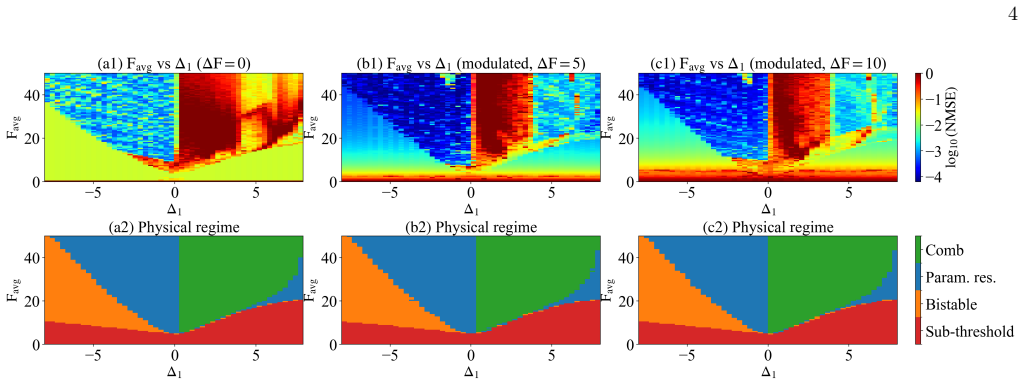
In a two-mode system exhibiting 2:1 parametric resonance, encoding input signals into the drive amplitude and sampling the resulting temporal and spectral responses yields effective one-step-ahead prediction of chaotic benchmark systems, with optimal performance occurring inside the parametric resonance regime where nonlinear interactions activate while temporal coherence is preserved; prediction error maps directly onto the underlying bifurcation structure.
What carries the argument
Two-mode parametrically driven oscillator used as reservoir computer, with input encoded in drive amplitude and readout taken from temporal and spectral responses.
If this is right
- Input modulation, frequency detuning, damping ratio, and data rate each select the accessible dynamical regime and thereby control prediction accuracy.
- Frequency-comb states increase spectral dimensionality but do not deliver consistently lower error, especially once the comb enters the chaotic regime and phase coherence is lost.
- Computational capability aligns directly with the bifurcation diagram, so low-error regions sit near the parametric resonance boundary.
- Parametric resonance supplies a robust, tunable operating point for oscillator-based neuromorphic hardware.
Where Pith is reading between the lines
- Hardware versions could deliberately bias the drive parameters to sit just inside the resonance boundary to gain nonlinearity while staying tolerant to small fabrication spreads.
- The same bifurcation-performance link may appear in other oscillator platforms such as MEMS or optomechanical devices, offering a design rule that does not require full system simulation.
- Scaling to networks of coupled oscillator pairs could extend the approach from single-step forecasting to longer-horizon or multi-variable tasks without adding digital layers.
- Experimental tests that deliberately add controlled noise or detuning jitter would directly test how sharply the performance cliff follows the theoretical resonance edge.
Load-bearing premise
The idealized noise-free two-mode oscillator equations accurately represent the computational capacity of a physical device once fabrication imperfections, thermal noise, and readout limits are present.
What would settle it
Fabricate a physical two-mode oscillator, sweep drive amplitude and detuning while injecting realistic thermal noise, and measure whether the one-step prediction error for Lorenz or Rössler time series reproduces the low-error band aligned with the simulated parametric resonance boundary.
Figures



read the original abstract
Parametrically driven oscillators provide a natural platform for neuromorphic computation, where nonlinear mode coupling and intrinsic dynamics enable both memory and high-dimensional transformation. Here, we investigate a two-mode system exhibiting 2:1 parametric resonance and demonstrate its operation as a reservoir computer across distinct dynamical regimes, including sub-threshold, parametric resonance, and frequency-comb states. By encoding input signals into the drive amplitude and sampling the resulting temporal and spectral responses, we perform one step-ahead prediction of benchmark chaotic systems, including Mackey-Glass, Rossler, and Lorenz dynamics. We find that optimal computational performance is achieved within the parametric resonance regime, where nonlinear interactions are activated while temporal coherence is preserved. In contrast, although frequency-comb states introduce increased spectral dimensionality, their performance is not consistently good across their existence band and also degrades in the chaotic comb regime due to loss of phase coherence. Mapping prediction error over parameter space reveals a direct correspondence between computational capability and the underlying bifurcation structure, with low-error regions aligned with the parametric resonance boundary. We further show that the input modulation, the detuning from the frequency matching condition, damping ratio, and input data rate systematically control the accessible dynamical regimes and thereby the computational performance. These results establish parametric resonance as a robust operating regime for oscillator-based reservoir computing and provide design principles for tuning physical systems toward optimal neuromorphic functionality.
Editorial analysis
A structured set of objections, weighed in public.
Referee Report
Summary. The paper investigates a two-mode parametrically driven oscillator exhibiting 2:1 parametric resonance as a platform for reservoir computing. Input signals are encoded into the drive amplitude, and the system's temporal and spectral responses are sampled to perform one-step-ahead prediction on chaotic time series benchmarks including Mackey-Glass, Rössler, and Lorenz systems. The authors explore sub-threshold, parametric resonance, and frequency-comb regimes, finding that optimal performance occurs in the parametric resonance regime where nonlinear mode coupling is active yet temporal coherence is preserved. They map the prediction error over parameter space, showing alignment with the bifurcation structure, and identify how parameters like modulation depth, detuning, damping, and data rate control the regimes and performance.
Significance. If validated, this establishes parametric resonance as a robust regime for oscillator-based neuromorphic computing, offering design principles for tuning physical systems. The systematic parameter sweeps and direct correspondence between performance and bifurcation structure provide a strong foundation for hardware implementations, with credit due for using standard benchmarks that enable cross-comparison.
major comments (1)
- [Simulation Setup and Model Equations] The performance maps and optimality claims are based on noise-free numerical integration of the idealized two-mode equations. As highlighted in the stress-test, thermal noise, shot noise, or drive jitter in a physical device could erode phase coherence within the resonance tongue more rapidly than in sub-threshold regimes, potentially eliminating the reported performance advantage. A robustness analysis adding stochastic terms and re-evaluating the error maps is necessary to support the claim that parametric resonance is robust.
minor comments (2)
- [Results on Performance Mapping] The error maps should explicitly overlay the analytically computed bifurcation boundaries to make the claimed direct correspondence visually immediate and quantitative.
- The manuscript should specify the exact sampling protocol for the parameter sweeps, including the number of runs, initial conditions, and whether error bars or variance are reported for the prediction errors.
Simulated Author's Rebuttal
We thank the referee for the constructive review and for recognizing the value of our systematic parameter sweeps and the correspondence between performance and bifurcation structure. We address the single major comment below.
read point-by-point responses
-
Referee: The performance maps and optimality claims are based on noise-free numerical integration of the idealized two-mode equations. As highlighted in the stress-test, thermal noise, shot noise, or drive jitter in a physical device could erode phase coherence within the resonance tongue more rapidly than in sub-threshold regimes, potentially eliminating the reported performance advantage. A robustness analysis adding stochastic terms and re-evaluating the error maps is necessary to support the claim that parametric resonance is robust.
Authors: We agree that the absence of stochastic terms limits the strength of claims about robustness in physical hardware. The present study deliberately employs deterministic integration to isolate the effects of the underlying dynamical regimes and bifurcation structure on reservoir performance. To directly address the concern, we will augment the two-mode equations with additive white noise terms calibrated to representative thermal and drive-jitter levels, recompute the full prediction-error maps across the same parameter space, and include the resulting comparison in a revised manuscript. This addition will clarify whether the performance advantage observed in the parametric-resonance regime survives realistic noise. revision: yes
Circularity Check
No significant circularity; performance evaluated on independent external benchmarks
full rationale
The paper numerically integrates the two-mode oscillator equations across parameter space, encodes external benchmark inputs (Mackey-Glass, Lorenz, Rössler) into drive amplitude, and computes one-step prediction error on those same independent chaotic systems. The reported alignment between low-error regions and the parametric resonance boundary is an empirical observation from these simulations rather than a quantity defined by construction from the oscillator equations or from any self-citation. No load-bearing step reduces the central claim to a fit, renaming, or self-referential definition; the bifurcation diagram and the prediction metric are computed separately and the benchmarks lie outside the model's fitted parameters.
Axiom & Free-Parameter Ledger
free parameters (4)
- drive amplitude modulation depth
- frequency detuning
- damping ratio
- input data rate
axioms (2)
- standard math The two-mode system obeys the standard Mathieu-type parametric resonance equations
- domain assumption One-step-ahead normalized mean-square error on Mackey-Glass, Rössler, and Lorenz attractors is a valid proxy for reservoir computing quality
Reference graph
Works this paper leans on
-
[1]
The computa- tional performance observed in Fig
[32]. The computa- tional performance observed in Fig. 2(a) within this re- gion corresponds to the parametric branch, as the reser- voir is initialized in this state. However, the trivial branch remains stable throughout this region, and the realized state depends on the initial conditions. Consequently, the apparent low NMSE in the bistable region refle...
-
[2]
F. C. Hoppensteadt and E. M. Izhikevich, Oscillatory neurocomputers with dynamic connectivity, Physical Re- view Letters82, 2983 (1999-04-05). 7
1999
-
[3]
Hoppensteadt and E
F. Hoppensteadt and E. Izhikevich, Synchronization of MEMS resonators and mechanical neurocomputing, IEEE Transactions on Circuits and Systems I: Funda- mental Theory and Applications48, 133 (2001-02)
2001
-
[4]
Izhikevich, Computing with oscillators (2000-03)
E. Izhikevich, Computing with oscillators (2000-03)
2000
-
[5]
Torrejon, M
J. Torrejon, M. Riou, F. A. Araujo, S. Tsunegi, G. Khalsa, D. Querlioz, P. Bortolotti, V. Cros, K. Yakushiji, A. Fukushima, H. Kubota, S. Yuasa, M. D. Stiles, and J. Grollier, Neuromorphic computing with nanoscale spintronic oscillators, Nature547, 428 (2017- 07)
2017
-
[6]
Grollier, D
J. Grollier, D. Querlioz, K. Y. Camsari, K. Everschor- Sitte, S. Fukami, and M. D. Stiles, Neuromorphic spin- tronics, Nature electronics3, 360 (2020)
2020
-
[7]
Maher, M
O. Maher, M. Jim´ enez, C. Delacour, N. Harnack, J. N´ u˜ nez, M. J. Avedillo, B. Linares-Barranco, A. Todri- Sanial, G. Indiveri, and S. Karg, A cmos-compatible oscillation-based vo2 ising machine solver, Nature Com- munications15, 3334 (2024)
2024
-
[8]
R. Guo, W. Lin, X. Yan, T. Venkatesan, and J. Chen, Ferroic tunnel junctions and their application in neuro- morphic networks, Applied physics reviews7(2020)
2020
-
[9]
J. M. Parrilla-Gutierrez, A. Sharma, S. Tsuda, G. J. Cooper, G. Aragon-Camarasa, K. Donkers, and L. Cronin, A programmable chemical computer with memory and pattern recognition, Nature communica- tions11, 1442 (2020)
2020
-
[10]
Chalkiadakis and J
D. Chalkiadakis and J. Hizanidis, Dynamical properties of neuromorphic josephson junctions, Physical Review E 106, 044206 (2022)
2022
-
[11]
Baxevanis and J
G. Baxevanis and J. Hizanidis, Inductively coupled josephson junctions: A platform for rich neuromorphic dynamics, Physical Review E111, 044214 (2025)
2025
-
[12]
M. A. Azam, D. Bhattacharya, D. Querlioz, and J. At- ulasimha, Resonate and fire neuron with fixed magnetic skyrmions, Journal of Applied Physics124(2018)
2018
-
[13]
Lee and C
C. Lee and C. Shin, Fbfet (feedback field-effect transistor)-based oscillator for neuromorphic comput- ing, Semiconductor Science and Technology36, 035013 (2021)
2021
-
[14]
Lashkare, P
S. Lashkare, P. Kumbhare, V. Saraswat, and U. Ganguly, Transient joule heating-based oscillator neuron for neu- romorphic computing, IEEE Electron Device Letters39, 1437 (2018)
2018
-
[15]
Kumar and P
A. Kumar and P. Mohanty, Autoassociative memory and pattern recognition in micromechanical oscillator net- work, Scientific Reports7, 411 (2017-03-24)
2017
-
[16]
W. Wustmann and V. Shumeiko, Parametric resonance in tunable superconducting cavities, Physical Review B 10.1103/PhysRevB.87.184501 (2013), 1302.3484
-
[17]
Y.-J. Chen, H. K. Lee, R. Verba, J. A. Katine, I. Barsukov, V. Tiberkevich, J. Q. Wang, A. N. Slavin, and I. N. Krivorotov, Parametric resonance of magnetization excited by electric field, Nano Letters 10.1021/acs.nanolett.6b04725 (2017)
-
[18]
S. Magaz` u and M. T. Caccamo, Parametric resonance in a brain model, Scientific Reports 10.1038/s41598-024- 76610-8 (2024)
-
[19]
Savchenkov, A
A. Savchenkov, A. Matsko, M. Mohageg, D. Strekalov, and L. Maleki, Parametric oscillations in a whispering gallery resonator, Optics letters32, 157 (2006)
2006
-
[20]
F¨ urst, D
J. F¨ urst, D. Strekalov, D. Elser, A. Aiello, U. L. Ander- sen, C. Marquardt, and G. Leuchs, Low-threshold optical parametric oscillations in a whispering gallery mode res- onator, Physical review letters105, 263904 (2010)
2010
-
[21]
Salandrino, Plasmonic parametric resonance, Physical Review B97, 081401 (2018)
A. Salandrino, Plasmonic parametric resonance, Physical Review B97, 081401 (2018)
2018
-
[22]
K. L. Turner, S. A. Miller, P. G. Hartwell, N. C. MacDon- ald, S. H. Strogatz, and S. G. Adams, Five parametric resonances in a microelectromechanical system, Nature 396, 149 (1998-11)
1998
-
[23]
Ganesan, C
A. Ganesan, C. Do, and A. Seshia, Observation of three- mode parametric instability in a micromechanical res- onator, Applied Physics Letters109(2016)
2016
-
[24]
Ganesan, C
A. Ganesan, C. Do, and A. Seshia, Excitation of multiple 2-mode parametric resonances by a single driven mode, Europhysics Letters119, 10002 (2017)
2017
-
[25]
Berges and J
J. Berges and J. Serreau, Parametric resonance in quan- tum field theory, Physical Review Letters91, 111601 (2003)
2003
-
[26]
D. G. Figueroa and F. Torrenti, Parametric resonance in the early Universe—a fitting analysis, Journal of Cosmol- ogy and Astroparticle Physics
-
[27]
J. A. Dror, K. Harigaya, and V. Narayan, Parametric resonance production of ultralight vector dark matter, Physical Review D 10.1103/PhysRevD.99.035036 (2019)
-
[28]
Q. Y. Liu, S. P. Mikheyev, and A. Y. Smirnov, Para- metric resonance in oscillations of atmospheric neutri- nos?, Physics Letters B 10.1016/S0370-2693(98)01102-2 (1998)
-
[29]
Magaz` u and M
S. Magaz` u and M. T. Caccamo, Parametric resonance brain model, Scientific Reports14, 24657 (2024)
2024
- [30]
-
[31]
N. S. Shishavan, E. Manuylovich, M. Kamalian-Kopae, and A. M. Perego, Optical neuromorphic computing based on chaotic frequency combs in nonlinear microres- onators, Physical Review Research7, L042008 (2025-10- 06)
2025
-
[32]
Ganesan, C
A. Ganesan, C. Do, and A. Seshia, Phononic frequency comb via intrinsic three-wave mixing, Physical Review Letters118, 033903 (2017-01-17)
2017
-
[33]
Z. Qi, C. R. Menyuk, J. J. Gorman, and A. Ganesan, Ex- istence conditions for phononic frequency combs, Applied Physics Letters117, 183503 (2020-11-02)
2020
-
[34]
Ganesan, C
A. Ganesan, C. Do, and A. Seshia, Excitation of cou- pled phononic frequency combs via two-mode parametric three-wave mixing, Physical Review B97, 014302 (2018- 01-03)
2018
-
[35]
J. Sun, W. Yang, T. Zheng, X. Xiong, Y. Liu, Z. Wang, Z. Li, and X. Zou, Novel nondelay-based reservoir com- puting with a single micromechanical nonlinear resonator for high-efficiency information processing, Microsystems & Nanoengineering7, 83 (2021-10-20)
2021
-
[36]
X. Guo, W. Yang, X. Xiong, Z. Wang, and X. Zou, MEMS reservoir computing system with stiffness mod- ulation for multi-scene data processing at the edge, Mi- crosystems & Nanoengineering10, 84 (2024-06-24)
2024
-
[37]
Lukoˇ seviˇ cius and H
M. Lukoˇ seviˇ cius and H. Jaeger, Reservoir computing ap- proaches to recurrent neural network training, Computer Science Review3, 127 (2009-08)
2009
-
[38]
Jaeger and H
H. Jaeger and H. Haas, Harnessing nonlinearity: Predict- ing chaotic systems and saving energy in wireless com- munication, Science304, 78 (2004-04-02)
2004
discussion (0)
Sign in with ORCID, Apple, or X to comment. Anyone can read and Pith papers without signing in.