Recognition: unknown
Wave physics as a choreographic notation for partner dance
Pith reviewed 2026-05-08 12:56 UTC · model grok-4.3
The pith
Wave physics provides an analytical notation for partner dance by modeling movements as oscillatory systems with interference and harmonics.
A machine-rendered reading of the paper's core claim, the machinery that carries it, and where it could break.
Core claim
The authors show that expressive motion in partner dance can be comprehensively characterized using wave-physics and oscillatory models. Sequences from dance couples exhibit multiple wave phenomena, from time-dependent interference to the generation-like emergence of harmonics. Within this perspective, the formalism functions as a choreographic motion notation, with harmonic components mappable to audible frequencies forming musical dyads under boundary conditions, and modal responses tunable to support fluid motion adapting to musical timescales and patterns.
What carries the argument
Wave-physics formalism treating dance movements as oscillatory systems that display interference patterns and harmonic generation.
Load-bearing premise
That the observed dance sequences genuinely exhibit the described wave phenomena and that body morphology does not rigidly constrain the modal responses allowing flexible tuning.
What would settle it
Reanalyzing the dance sequences to find no measurable time-dependent interference or harmonic emergence consistent with wave predictions would show the model does not characterize the motions.
Figures


read the original abstract
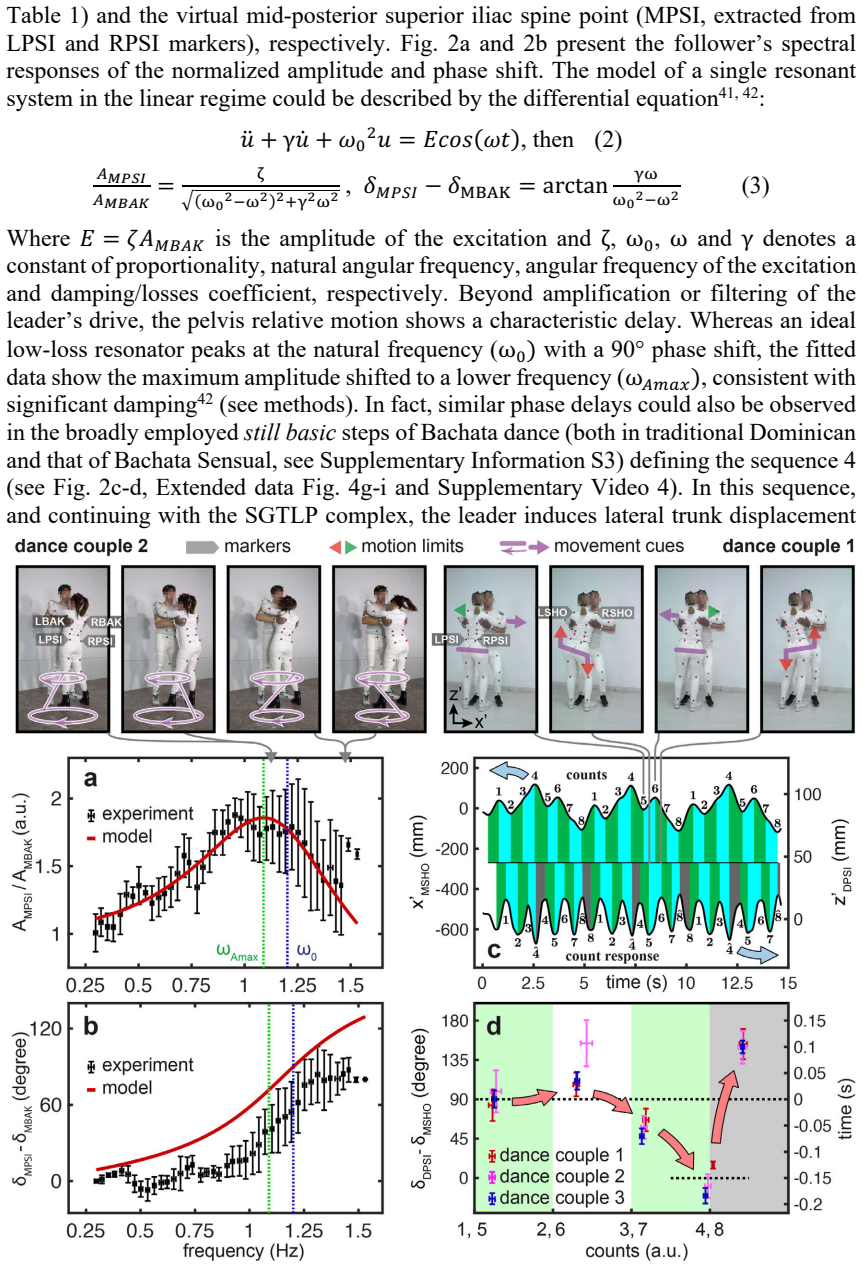
The wave is considered a paradigm in dance and connects bodily expression with nature. Although wave concepts such as propagation and phase have proven to be powerful tools for dance analysis, many aspects of bodily expression, including partner dance, have been investigated using numerical approaches and neural networks. Complementarily, compact analytical models have been especially successful for describing human motion, particularly gait. Here, we leverage wave-physics concepts to provide a comprehensive wave-based and oscillatory analytical characterization of expressive motion in partner dance. We apply this framework to Bachata Sensual, a dance style in which the wave is the leitmotif. We analyse three dance couples (Phase I) performing five movement sequences and one composite. The sequences exhibit multiple wave phenomena, from time-dependent interference to the generation-like emergence of harmonics. Within this wave-physics perspective, the formalism can be viewed as a choreographic motion notation. As an illustrative acoustic analogy, harmonic components extracted under boundary conditions can be mapped to audible frequencies, forming musical dyads. Within certain limits and not rigidly constrained by body morphology, modal response can be tuned to underpin fluid motion, adapting across musical timescales and movement patterns. Overall, this wave-physics notation highlights connections between partner-dance expressivity and harmonic nature.
Editorial analysis
A structured set of objections, weighed in public.
Referee Report
Summary. The manuscript proposes a wave-physics framework to analytically characterize expressive motion in partner dance, with a focus on Bachata Sensual. It applies concepts such as propagation, phase, interference, and harmonic generation to kinematic data from three dance couples performing five movement sequences plus one composite. The authors claim these sequences exhibit time-dependent interference and generation-like emergence of harmonics, positioning the resulting formalism as a choreographic motion notation. An acoustic analogy is drawn in which extracted harmonic components under boundary conditions map to audible frequencies forming musical dyads, with modal responses tunable within limits not rigidly fixed by body morphology.
Significance. If the wave interpretation can be shown to provide a compact, falsifiable description that outperforms simpler oscillatory or rigid-body models on the same trajectories, the work would offer a novel analytical bridge between physics and dance studies. The explicit framing as notation, the acoustic mapping, and the emphasis on adaptability across musical timescales are potentially generative for both fields, especially if accompanied by reproducible code or parameter-free derivations.
major comments (3)
- Abstract and any Results section: the central claim that the five sequences 'exhibit' time-dependent interference and generation-like emergence of harmonics is load-bearing for the notation proposal, yet no quantitative measures (e.g., phase plots, Fourier spectra, wave-equation residuals, or comparison to null models) are referenced. Without these, it is impossible to determine whether the wave phenomena are observed or imposed post-hoc.
- The acoustic analogy (harmonic components mapped to musical dyads) is presented as illustrative, but the mapping rules, frequency scaling, and preservation of temporal structure are not specified. This leaves the claimed connection between dance expressivity and harmonic nature under-constrained.
- The statement that modal response 'can be tuned' and is 'not rigidly constrained by body morphology' is central to the generality of the notation. No supporting analysis (e.g., variation across couples, sensitivity to morphological parameters, or boundary-condition robustness) is indicated, weakening the claim that the framework functions as a general choreographic tool.
minor comments (2)
- The abstract refers to 'Phase I' without defining subsequent phases or the overall experimental design.
- Notation for wave quantities (phase, boundary conditions, harmonics) should be introduced explicitly with symbols and units when first used.
Simulated Author's Rebuttal
We thank the referee for their constructive and detailed comments, which help clarify how the manuscript can better support its central claims. We respond to each major comment below and commit to revisions that strengthen the quantitative grounding and specificity of the work without altering its core framing.
read point-by-point responses
-
Referee: Abstract and any Results section: the central claim that the five sequences 'exhibit' time-dependent interference and generation-like emergence of harmonics is load-bearing for the notation proposal, yet no quantitative measures (e.g., phase plots, Fourier spectra, wave-equation residuals, or comparison to null models) are referenced. Without these, it is impossible to determine whether the wave phenomena are observed or imposed post-hoc.
Authors: We agree that the abstract does not explicitly cite quantitative metrics, which leaves the evidential basis for the wave phenomena under-specified. The full results section contains kinematic trajectory analysis and visual demonstrations of interference patterns and harmonic emergence from the recorded data of the three couples. To resolve this, we will revise the abstract to reference the supporting quantitative elements (phase relationships, Fourier decomposition of the extracted modes, and residuals against the wave model) and add an explicit null-model comparison subsection in the results to show that the observed features exceed those expected from simpler oscillatory or rigid-body descriptions of the same trajectories. revision: yes
-
Referee: The acoustic analogy (harmonic components mapped to musical dyads) is presented as illustrative, but the mapping rules, frequency scaling, and preservation of temporal structure are not specified. This leaves the claimed connection between dance expressivity and harmonic nature under-constrained.
Authors: The analogy is deliberately illustrative and not presented as a one-to-one physical equivalence. We will expand the relevant paragraph to state the explicit mapping procedure: harmonic frequencies extracted from the dance kinematics are linearly scaled into the audible range (with a chosen reference frequency tied to the musical tempo), and the time-dependent amplitude envelopes are retained to preserve the original temporal structure of each sequence. This addition will make the rules transparent while retaining the illustrative intent. revision: yes
-
Referee: The statement that modal response 'can be tuned' and is 'not rigidly constrained by body morphology' is central to the generality of the notation. No supporting analysis (e.g., variation across couples, sensitivity to morphological parameters, or boundary-condition robustness) is indicated, weakening the claim that the framework functions as a general choreographic tool.
Authors: The dataset already includes three couples with differing body morphologies, and the results note consistent modal patterns across them. However, we did not include a dedicated sensitivity study. We will add a short analysis subsection that quantifies variation in extracted modal frequencies and amplitudes across the couples, tests sensitivity to small changes in assumed body-segment lengths (as boundary conditions), and reports the range of tunability observed. This will directly support the generality claim. revision: yes
Circularity Check
No circularity: wave concepts applied descriptively to dance kinematics
full rationale
The paper applies established wave-physics ideas (propagation, phase, interference, boundary conditions, harmonics) to observed partner-dance trajectories as an analytical overlay and notation. No derivation chain is presented that reduces a claimed result to its own inputs by construction, no parameters are fitted to a subset and then relabeled as predictions, and no self-citation or uniqueness theorem is invoked to justify the core framework. The abstract states that the five sequences exhibit the listed wave phenomena as empirical observations; the notation claim follows directly from re-expressing those kinematics in wave terms rather than from any self-referential loop. The framework remains self-contained against external wave-physics benchmarks.
Axiom & Free-Parameter Ledger
axioms (1)
- domain assumption Dance movements can be modeled as waves exhibiting propagation, phase, interference, and harmonic generation.
Reference graph
Works this paper leans on
-
[1]
& Lopes, D
Gaut, B. & Lopes, D. M. The Rouledge Companion to Asthetics (Routlege, London, 2001)
2001
-
[2]
Art and visual perception
Arnheim, R. Art and visual perception. A Psychology of the Creative Eye (University of California Press, Berkeley, 1974)
1974
-
[3]
The Fine Arts Reduced to a Single Principle (Oxford University Press, Oxford, 2015)
Batteux C. The Fine Arts Reduced to a Single Principle (Oxford University Press, Oxford, 2015)
2015
-
[4]
Appreciation and the Natural Environment
Carlson A. Appreciation and the Natural Environment. J. Aesthet. Art. Critic. 37, 267-275 (1979)
1979
-
[5]
Essays on the Nature and Principles of Taste (Archibald Constable & Co
Alison A. Essays on the Nature and Principles of Taste (Archibald Constable & Co. Edinburg, 1810)
-
[6]
& Schaffer, K
Belcastro, S.M. & Schaffer, K. Dancing Mathematics and the Mathematics of Dance. Math Horiz. 18, 16-20 (2011)
2011
-
[7]
Las formas matemáticas de la danza, El País, 2017
Sardón C. Las formas matemáticas de la danza, El País, 2017. Accessed: Dec. 17,
2017
-
[8]
Available: https://elpais.com/elpais/2017/11/27/ciencia/1511798957_277080.html
[Online]. Available: https://elpais.com/elpais/2017/11/27/ciencia/1511798957_277080.html
-
[9]
Visualizations: The Nature Book of Art and Science (Oxford University Press, Oxford, 2000)
Kemp, M. Visualizations: The Nature Book of Art and Science (Oxford University Press, Oxford, 2000)
2000
-
[10]
From science in art to the art of science, Nature 434, 308-309 (2005)
Kemp M. From science in art to the art of science, Nature 434, 308-309 (2005)
2005
-
[11]
& Loots E
Birsel Z., Marques L. & Loots E. Daring to disentangle: towards a framework for art-science-technology collaborations. Interdiscip. Sci. Rev. 48, 109-128 (2023)
2023
-
[12]
& Schiavone G
Laws K., Sugano A., Swope M. & Schiavone G. Physics and the Art of Dance - Understanding Movement (Oxford University Press, Oxford, 2008)
2008
-
[13]
Imura, A & Yeadon, M.R., Mechanics of the Fouetté turn, Hum. Mov. Sci. 29, 947- 955 (2010)
2010
-
[14]
& Kosuge K
Wang H. & Kosuge K. Control of a Robot Dancer for Enhancing Haptic Human- Robot Interaction in Waltz, IEEE Trans. Haptics 5, 264-273 (2012)
2012
-
[15]
& Kuno-Mizumura, M
Kawano, Y. & Kuno-Mizumura, M. Intra- and Inter-individual Movement Variability of Upper Limb Movements of Ballet Dancers, Med. Probl. Perform. Art. 34, 132-140 (2019)
2019
-
[16]
& Reverter, F
Torrents C., Castañer, M., Jofre, T., Morey, G. & Reverter, F. Kinematic parameters that influence the aesthetic perception of beauty in contemporary dance. Perception 42, 447-458 (2013)
2013
-
[17]
An Analysis of Turns in Dance
Laws K. An Analysis of Turns in Dance. Dance Res. J. 11, 12-19 (1978)
1978
-
[18]
Dias, M. A. et al. The behaviour of the centre of mass in a ballerina while performing a Grand Jeté. Phys. Educ. 52, 025009 (2018)
2018
-
[19]
Biomechanical analysis of the basic classical dance jump-the grand jeté
Kalichová, M. Biomechanical analysis of the basic classical dance jump-the grand jeté. Int J. Sport. Health Sci. 5, 1363-1367 (2011)
2011
-
[20]
Cuban Motion
Centrone A., Viglialoro, R.M. Di Pietro A. & Di Puccio F. Biomechanical Analysis of the “Cuban Motion”. J. of Sci. Sport Exerc. 1-10 (2024)
2024
-
[21]
Alborno, P. et al. Analysis of intrapersonal synchronization in full-body movements displaying different expressive qualities. In Proceedings of the International Working Conference on Advanced Visual Interfaces,136-143 (AVI '16, 2016). 16
2016
-
[22]
& Hertzmann A
Brand M. & Hertzmann A. Style machines. In Proceedings of the 27th annual conference on Computer graphics and interactive techniques, 183-192 (SIGGRAPH00, 2000)
2000
-
[23]
& Moreno-Noguer F
Guo W., Bie X., Alameda-Pineda X. & Moreno-Noguer F. Multi-Person Extreme Motion Prediction, IEEE/CVF Conference on Computer Vision and Pattern Recognition, 13043-13054 (CVPR, 2022)
2022
- [24]
-
[25]
& Himona S.L
Aristidou A., Stavrakis E., Charalambous P., Chrysanthou Y. & Himona S.L. Folk Dance Evaluation Using Laban Movement Analysis, J. Comput. Cult. Herit. 8, 20 (2015)
2015
-
[26]
Ahn H., Kim J., Kim K. & Oh S. Generative Autoregressive Networks for 3D Dancing Move Synthesis From Music. IEEE robot. autom. lett. 5, 3501-3508 (2020)
2020
-
[27]
A., Aristidou A
Senecal, S., Nijdam N. A., Aristidou A. & Magnenat-Thalmann N. Salsa dance learning evaluation and motion analysis in gamified virtual reality environment. Multimed. Tools Appl. 79, 24621-24643 (2020)
2020
-
[28]
Christensenm J. F. & Calvo-Merino B. Dance as a subject for empirical aesthetics. Psychol. Aesthet. Creat. Arts. 7, 76-88 (2013)
2013
-
[29]
& Grafton S
Tipper, C., Signorini G. & Grafton S. Body language in the brain: constructing meaning from expressive movement, Front. Hum. Neurosci. 9, 450 (2015)
2015
-
[30]
E., Grèzes J., Passingham R
Calvo-Merino B., Glaser D. E., Grèzes J., Passingham R. & E., Haggard, P. Action observation and acquired motor skills: An fMRI study with expert dancers. Cereb. Cortex 15, 1243-1249 (2005)
2005
-
[31]
& Goldman A
Gallese V. & Goldman A. Mirror neurons and the simulation theory of mind- reading. Trends. Cogn. Sci. 2, 493-501 (1998)
1998
-
[32]
F., Neuroscience meets dance/movement therapy: Mirror neurons, the therapeutic process and empathy, ART 33, Issue 4, 302-315 (2006)
Berrol, C. F., Neuroscience meets dance/movement therapy: Mirror neurons, the therapeutic process and empathy, ART 33, Issue 4, 302-315 (2006)
2006
-
[33]
& Milner T
Nugent M.M. & Milner T. E., Segmental specificity in belly dance mimics primal trunk locomotor patterns, J. Neurophysiol. 117 1100-1111 (2017)
2017
-
[34]
& Ikegami Y
Sato N., Nunome H. & Ikegami Y. Key Features of Hip Hop Dance Motions Affect Evaluation by Judges. J. Appl. Biomech. 30, 439-445 (2014)
2014
-
[35]
Passive dynamic walking
McGeer, T. Passive dynamic walking. Int. J. Rob. Res. 9, 62-82 (1990)
1990
-
[36]
& Rand R.H
Cohen A.H., Holmes P.J. & Rand R.H. The nature of the coupling between segmental oscillators of the lamprey spinal generator for locomotion: A mathematical model. J. Math. Biology 13, 345-369 (1982)
1982
-
[37]
& Berg R
Lindén, H., Petersen, P.C., Vestergaard, M. & Berg R. W. Movement is governed by rotational neural dynamics in spinal motor networks. Nature 610, 526-531 (2022)
2022
-
[38]
The geometry of interpersonal synchrony in human dance, Curr
Bigand F., Bianco R., Abalde S.F.& Novembre G. The geometry of interpersonal synchrony in human dance, Curr. Biol. 34, 3011-3019.e4 (2024)
2024
-
[39]
Isadora Duncan and the Distinction of Dance, Am
Daly, A. Isadora Duncan and the Distinction of Dance, Am. Stud. 35, 5-23 (1994) 17 39 Proske U. & Gandevia S.C. The proprioceptive senses: their roles in signaling body shape, body position and movement, and muscle force. Physiol. Rev. 92,1651-1697 (2012)
1994
-
[40]
Decision of the Intergovernmental Committee: 14.COM 10.b.10
Unesco. Decision of the Intergovernmental Committee: 14.COM 10.b.10. (2019) https://ich.unesco.org/en/Decisions/14.COM/10.b.10
2019
-
[41]
French, A. P. Vibrations and Waves, The M.I.T. Introductory Physics Series (W. W. Norton & Company, NEW YORK, 1971)
1971
-
[42]
Smith, W. F. Waves and Oscillations. A Prelude to Quantum Mechanics (Oxford University Press, Oxford, 2010)
2010
-
[43]
Biasi, S., Ramiro-Manzano F. et al. Hermitian and non-hermitian mode coupling in a microdisk resonator due to stochastic surface roughness scattering. IEEE Photonics J. 11, 6101114 (2019)
2019
-
[44]
& Stanzial D
Masina, I., Lo Presti G. & Stanzial D. Dyad’s consonance and dissonance: combining the compactness and roughness approaches. Eur. Phys. J. Plus 137, 1254 (2022). 45 Franklin D. W. & Wolpert D. M., Computational mechanisms of sensorimotor control, Neuron 72, 425-442 (2011)
2022
-
[45]
Brillouin L., Wave Propagation and Group Velocity (Academic Press, 1960)
1960
-
[46]
J., Harrison A
Aubusson P. J., Harrison A. G. & Ritchie S. M., Metaphor and Analogy in Science Education (Springer, Dordrecht, 2006)
2006
-
[47]
& Ward, J., Somatosensory activations during the observation of touch and a case of vision-touch synaesthesia
Blakemore, S.J., Bristow, D., Bird, G., Frith C. & Ward, J., Somatosensory activations during the observation of touch and a case of vision-touch synaesthesia. Brain 128, 1571-1583 (2005)
2005
-
[48]
characterized by a sensual hip movement
Schönemann, P. H., A generalized solution of the orthogonal Procrustes problem. Psychometrika 31, 1-10 (1966). 18 Extended Data Table 1. Marker descriptions, placements, virtual markers and analysis sets. Name View Description Placement region Mid/ diff. SGTLP SGCH WB- NUL TFHD1 Anterior Top Front Head High frontal region, midline TFHD - X X TBHD1 Posteri...
discussion (0)
Sign in with ORCID, Apple, or X to comment. Anyone can read and Pith papers without signing in.