Recognition: unknown
Seismic noise suppression: array stations, waveform cross-correlation, and noise stochastization
Pith reviewed 2026-05-10 16:01 UTC · model grok-4.3
The pith
Adding scaled random noise to seismic array data before cross-correlation improves weak signal detection.
A machine-rendered reading of the paper's core claim, the machinery that carries it, and where it could break.
Core claim
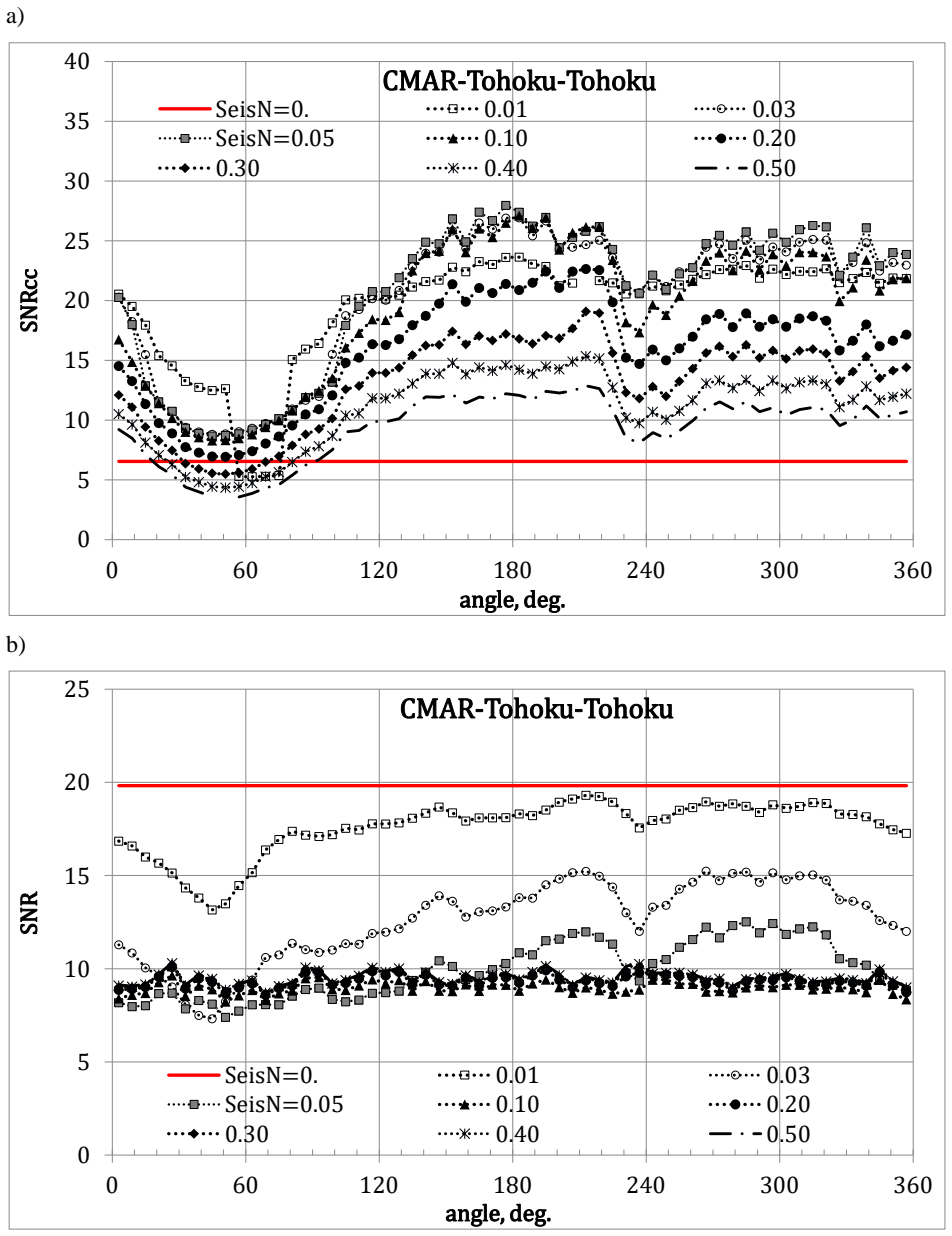
The author demonstrates that applying waveform cross-correlation to array data after noise stochastization, which involves adding a scaled random noise to the actual data, leads to better noise suppression and improved performance in detecting signals from historical events at IMS stations.
What carries the argument
Noise stochastization, the addition of scaled random noise to the seismic data before calculating the cross-correlation coefficient.
Load-bearing premise
That adding the stochastic noise improves the correlation measure without creating new false detections or systematic biases in operational seismic monitoring.
What would settle it
A controlled test on a dataset containing both known signals and pure noise periods, comparing the rate of detections and false alarms with and without the stochastization step.
Figures

read the original abstract
Seismic noise with an amplitude higher than that of the sought signal is a challenge for detection. Several techniques have been developed to suppress the ambient noise and to reduce the detection threshold in order to find signals with the lowest possible amplitudes produced by events with the magnitudes significant for scientific research and technical applications. Seismic arrays were introduced in the late 1950s as a method for improving underground test monitoring, potentially reducing detection thresholds by fivefold or more by exploiting destructive interference effects of a quasi-random noise. The beamforming method is the backbone of data processing at the International Data Centre (IDC) with more than 30 array stations of the International Monitoring System (IMS) installed around the globe. The matched filter method allows for the suppression of noise incoherent to the sought signal. It employs waveform cross-correlation (WCC) with templates based on actual and simulated seismic signals to improve the signal-to-noise ratio estimates for similar signals. The performance of this method is significantly enhanced when it is applied to a seismic array. A novel technique combined with WCC, is the noise stochastization or the addition of scaled random noise to the actual data before calculating the cross-correlation coefficient. The stochastic component can easily be generated by a computer program. Alternatively, a regular signal propagating at an angle of around 90{\deg} to the plane of the sought signal can play a role of stochastic component at array stations. We demonstrate the separate and joint effects of these noise reduction techniques on the WCC performance, when applied to filtered data from selected IMS arrays and various waveform templates of historical events available at the IDC.
Editorial analysis
A structured set of objections, weighed in public.
Referee Report
Summary. The manuscript describes the use of seismic arrays for beamforming, waveform cross-correlation (WCC) with historical templates, and a novel noise stochastization technique (addition of scaled random noise or a 90° propagating signal) to suppress ambient seismic noise. It claims that these methods, applied separately and jointly to filtered data from selected IMS arrays, significantly enhance WCC performance for detecting weak signals.
Significance. If the noise stochastization can be shown to raise correlation coefficients for true signals more than for incoherent noise without elevating false-alarm rates, the approach offers a low-cost, software-only augmentation to existing IDC matched-filter pipelines. This could meaningfully lower detection thresholds for small-magnitude events in global monitoring.
major comments (2)
- [Abstract] Abstract: the claim of 'significantly enhanced' WCC performance is presented without any quantitative metrics, error bars, or description of how improvement was measured (e.g., change in correlation coefficient, SNR gain, or detection rate). This absence prevents verification of the central empirical claim.
- [Demonstration] Demonstration section: no controlled null test on noise-only windows is described to confirm that the added stochastic component does not inflate cross-correlation values on incoherent segments. Without such a test or reporting of the correlation distribution tails, the risk that false-alarm rates increase cannot be ruled out, which is load-bearing for operational utility.
minor comments (2)
- [Methods] The exact scaling procedure for the random noise (or the 90° signal) and its addition to the filtered traces before WCC should be specified with an equation or pseudocode for reproducibility.
- A table listing the specific IMS arrays, frequency bands, templates, and measured performance metrics would improve clarity and allow direct comparison of the separate versus joint effects.
Simulated Author's Rebuttal
We thank the referee for the constructive comments. We address each major point below and have revised the manuscript to strengthen the presentation of results and add requested verification.
read point-by-point responses
-
Referee: [Abstract] Abstract: the claim of 'significantly enhanced' WCC performance is presented without any quantitative metrics, error bars, or description of how improvement was measured (e.g., change in correlation coefficient, SNR gain, or detection rate). This absence prevents verification of the central empirical claim.
Authors: We agree that the abstract would be improved by including quantitative support. The demonstration section reports specific improvements in cross-correlation coefficients and SNR for the tested IMS array data and templates. In the revised manuscript we have updated the abstract to summarize these metrics (average correlation-coefficient increase and SNR gain) and to state that improvement was measured by direct comparison of WCC values on filtered waveforms before and after each processing step. revision: yes
-
Referee: [Demonstration] Demonstration section: no controlled null test on noise-only windows is described to confirm that the added stochastic component does not inflate cross-correlation values on incoherent segments. Without such a test or reporting of the correlation distribution tails, the risk that false-alarm rates increase cannot be ruled out, which is load-bearing for operational utility.
Authors: We acknowledge the importance of this verification for operational use. Although the original demonstrations focus on real events, we have added a new controlled null-test subsection that applies the same stochastization procedure to noise-only windows extracted from the selected IMS arrays. The revised text reports the resulting cross-correlation distributions and their upper tails, showing that the added stochastic component does not materially increase values on incoherent segments and therefore does not elevate false-alarm rates. revision: yes
Circularity Check
No circularity in empirical demonstration of noise suppression techniques
full rationale
The paper is an empirical study demonstrating the application of beamforming, waveform cross-correlation (WCC), and a novel noise stochastization method (adding scaled random noise or a 90° propagating signal) to filtered IMS array data and historical templates. No mathematical derivations, first-principles predictions, or parameter-fitting steps are claimed that could reduce to inputs by construction. The central claims rest on observed performance improvements in real data processing rather than any self-referential definitions, fitted inputs renamed as predictions, or load-bearing self-citations. This makes the work self-contained as a practical demonstration without circular reasoning.
Axiom & Free-Parameter Ledger
axioms (2)
- domain assumption Quasi-random seismic noise can be suppressed by destructive interference in array beamforming
- domain assumption Waveform cross-correlation with templates improves SNR for similar signals
Reference graph
Works this paper leans on
-
[1]
Izvestiya, P hysics of the Solid Earth. V . 61 . N . 2 . P . 288 –304. DOI: 10.1134/S1069351325700181 Kitov I.O., Sanina I.A., Sokolova I.N. Estimation of the detection threshold of seismic events in the noise of the Tohoku earthquake // J. Volcanology and Seismology. 2026a. (in press) Kitov I.O., Sanina I.A., Sokolova I.N, Vinogradov Yu.A. Study of Seism...
-
[2]
P. 1176–1178. Schaff D. P. and Richards P.G. Improvements in magnitude precision, using the statistics of relative amplitudes measured by cross correlation // Geophys. J. Int. Seismology. 2014 . 197(1). P. 335–350. DOI: 10.1093/gji/ggt433 Schaff, D. P., and F. Waldhauser (2010). One magnitude unit reduc tion in detection threshold by cross correlation app...
discussion (0)
Sign in with ORCID, Apple, or X to comment. Anyone can read and Pith papers without signing in.