Recognition: unknown
Branched Bending in Finite-Volume Hyperbolic Manifolds
Pith reviewed 2026-05-08 13:13 UTC · model grok-4.3
The pith
Branched bending deformations supported on piecewise geodesic complexes give a lower bound on the dimension of infinitesimal deformations of finite-volume hyperbolic manifolds.
A machine-rendered reading of the paper's core claim, the machinery that carries it, and where it could break.
Core claim
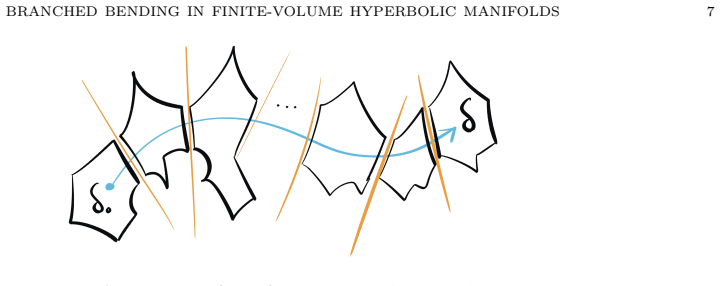
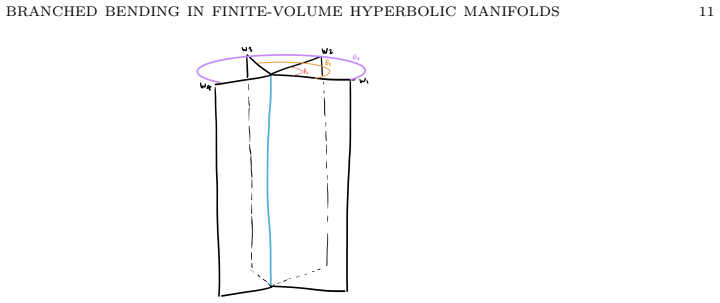
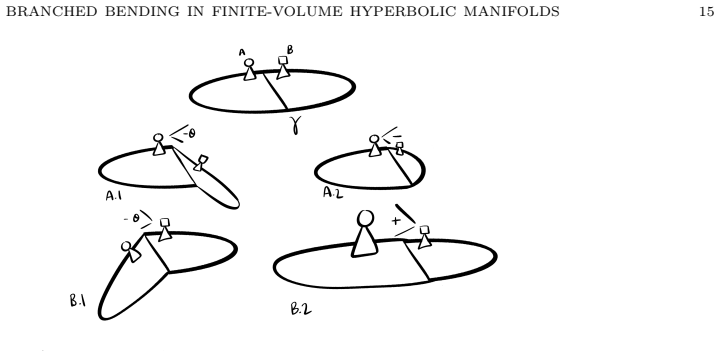
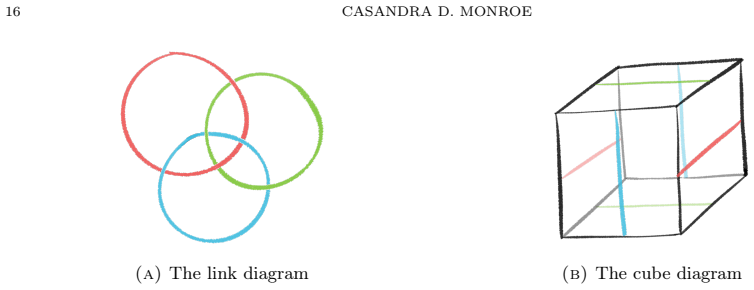
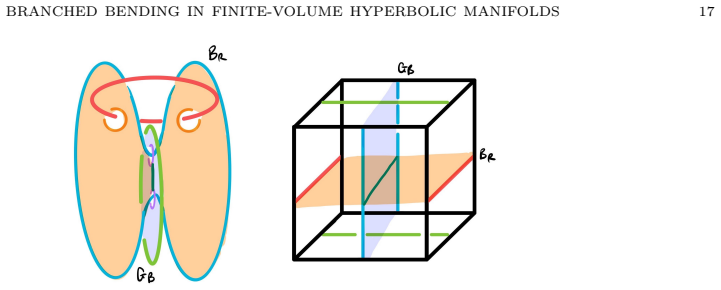
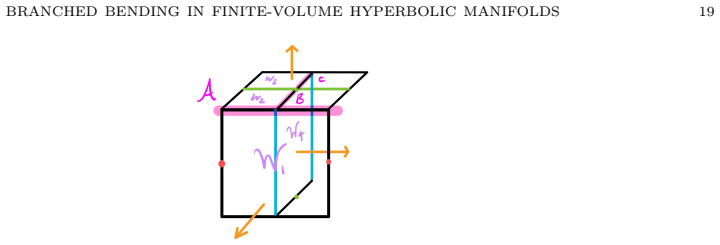
Branched bending deformations are defined as those supported on a piecewise totally geodesic complex of (n-1)-dimensional faces meeting along (n-2)-dimensional branching loci inside a finite-volume hyperbolic manifold. These generalize ordinary bending deformations. A lower bound is established on the dimension of the infinitesimal deformation space supported on any such complex, generalizing the result of Bart and Scannell. Explicit equations are derived for the deformations when the ambient geometry is changed to higher hyperbolic or real projective geometry. As a concrete case the method produces infinitesimal deformations of the Borromean rings link complement.
What carries the argument
The branched bending complex, a piecewise totally geodesic (n-1)-dimensional complex whose (n-2)-dimensional loci serve as the branching set that carries the infinitesimal deformations.
If this is right
- The dimension of the supported deformation space is at least the value predicted by the formula that counts the branching data.
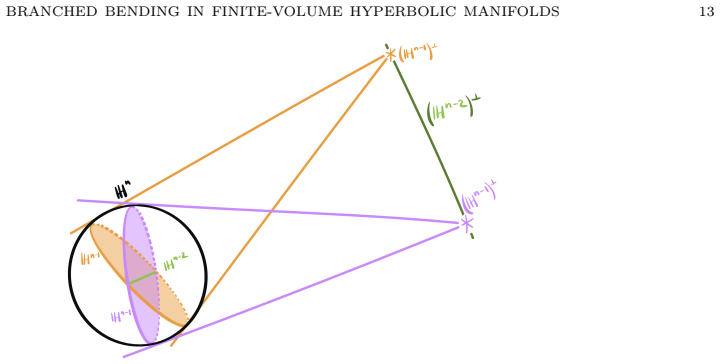
- Deformations can be written down explicitly via the supplied equations when the target is a higher-dimensional hyperbolic or real-projective structure.
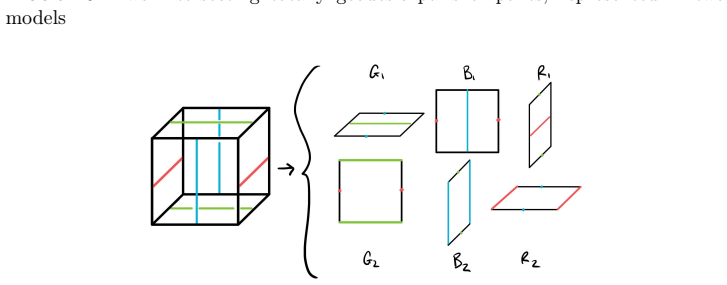
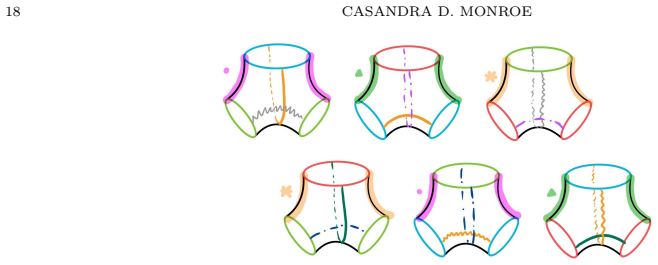
- The Borromean rings link complement admits nontrivial infinitesimal deformations constructed this way.
- Any finite-volume hyperbolic manifold that contains a suitable branched bending complex inherits the same dimension lower bound.
Where Pith is reading between the lines
- The same lower-bound technique might be tested on other hyperbolic link complements to locate additional flexible examples.
- The equations for real-projective deformations could be used to construct new projective structures on 3-manifolds that are not obviously hyperbolic.
- If the branching loci can be chosen with varying combinatorial types, the method may produce families of deformations parametrized by the topology of the complex.
Load-bearing premise
The complex must be assembled from (n-1)-dimensional totally geodesic faces that meet cleanly along (n-2)-dimensional loci inside a finite-volume hyperbolic manifold so that the deformations can be defined and the dimension count performed.
What would settle it
An explicit computation of the infinitesimal deformation space for the Borromean rings link complement that yields dimension strictly smaller than the lower bound given by the branched-bending formula would falsify the claim.
Figures
read the original abstract
We define branched bending deformations as deformations supported on a piecewise totally geodesic complex of $(n-1)$-dimensional faces meeting along $(n-2)$-dimensional branching loci. These are a generalization of bending deformations, as introduced by Johnson and Millson. We give a lower bound on the dimension of the (infinitesimal) deformation space supported on a branched bending complex, and in doing so generalize a result of Bart and Scannell. We give equations describing these deformations in the setting of deforming to higher hyperbolic geometry and real projective geometry. As a special example of branched bending, we construct infinitesimal deformations supported on the link complement of the Borromean Rings (also known as the link $6^3_2$), recovering a special case of a theorem due to Menasco and Reid.
Editorial analysis
A structured set of objections, weighed in public.
Referee Report
Summary. The paper defines branched bending deformations in finite-volume hyperbolic n-manifolds as deformations supported on a piecewise totally geodesic (n-1)-complex with (n-2)-dimensional branching loci. It establishes a lower bound on the dimension of the associated infinitesimal deformation space, generalizing a result of Bart and Scannell. Explicit equations are derived for deformations into higher hyperbolic and real projective structures. As a special case, infinitesimal deformations are constructed on the Borromean rings link complement (6^3_2), recovering a theorem of Menasco and Reid.
Significance. If the dimension lower bound and deformation equations hold, the work meaningfully extends Johnson-Millson bending to branched complexes, supplying a concrete framework for deformation spaces in higher-dimensional hyperbolic and projective geometry. The explicit recovery of the Menasco-Reid deformations on the Borromean rings complement provides a useful sanity check and demonstrates applicability in the cusped setting.
minor comments (4)
- §2 (definition of branched bending complex): the local model near the (n-2)-branching locus is described only in coordinates; a short diagram or explicit coordinate chart would clarify how the totally geodesic condition is imposed across the locus.
- Theorem 3.1 (dimension lower bound): the proof sketch invokes a count of independent infinitesimal isometries on each face minus the branching constraints; stating the precise linear-algebra rank calculation (or referencing the matrix whose kernel dimension is bounded) would make the argument self-contained.
- §4.2 (equations to real projective structures): the transition functions across branching loci are given in matrix form, but the compatibility condition with the developing map is not written explicitly; adding one displayed equation for the cocycle condition would improve readability.
- The Borromean rings example in §5 recovers the Menasco-Reid deformations but does not compare the obtained dimension bound numerically with the known dimension of the deformation space; a one-sentence remark on this numerical match would strengthen the validation.
Simulated Author's Rebuttal
We thank the referee for their careful reading and positive evaluation of the manuscript. The summary and significance assessment accurately reflect the paper's contributions in generalizing bending deformations to branched complexes and recovering the Menasco-Reid result on the Borromean rings complement. We will make the minor revisions recommended.
Circularity Check
No significant circularity detected
full rationale
The paper introduces branched bending deformations via an original definition as a generalization of Johnson-Millson bending, supported on an explicitly constructed piecewise totally geodesic (n-1)-complex with (n-2) branching loci. The lower bound on infinitesimal deformation dimension is derived from this construction and generalizes Bart-Scannell via independent equations for deformations into higher hyperbolic and real projective structures. The Borromean rings example recovers Menasco-Reid deformations through the new framework without reducing any prediction or bound to a fitted input or self-citation chain. All load-bearing steps rely on the paper's own definitions and explicit deformation equations rather than self-referential inputs or unverified uniqueness theorems.
Axiom & Free-Parameter Ledger
axioms (2)
- domain assumption Hyperbolic manifolds admit piecewise totally geodesic complexes
- standard math Standard results from differential geometry on infinitesimal deformations
invented entities (1)
-
branched bending complex
no independent evidence
Reference graph
Works this paper leans on
-
[1]
C. C. Adams. Thrice-punctured spheres in hyperbolic 3-manifolds.Trans. Am. Math. Soc., 287 (2):645, Feb. 1985
1985
-
[2]
Apanasov
B. Apanasov. Bending and stamping deformations of hyperbolic manifolds.Ann. Glob. Anal. Geom., 8(1):3–12, Jan. 1990
1990
-
[3]
Apanasov and A
B. Apanasov and A. Tetenov. Deformations of hyperbolic structures along surfaces with bound- ary and pleated surfaces.Proceedings of Low-Dimensional Topology, 1992
1992
-
[4]
S. A. Ballas.Flexibility and Rigidity of Three-Dimensional Convex Projective Structures. PhD thesis, The University of Texas at Austin, 2013
2013
-
[5]
S. A. Ballas and L. Marquis. Properly convex bending of hyperbolic manifolds.Groups Geom. Dyn., 14(2):653–688, June 2020
2020
-
[6]
S. A. Ballas, J. Danciger, and G.-S. Lee. Convex projective structures on nonhyperbolic three- manifolds.Geometry & Topology, 22(3):1593 – 1646, 2018. doi: 10.2140/gt.2018.22.1593. URL https://doi.org/10.2140/gt.2018.22.1593
-
[7]
S. A. Ballas, D. Cooper, and A. Leitner. Generalized cusps in real projective manifolds: classi- fication.J. Topol., 13(4):1455–1496, Dec. 2020
2020
-
[8]
Bart and K
A. Bart and K. P. Scannell. The generalized cuspidal cohomology problem.Canad. J. Math., 58(04):673–690, Aug. 2006
2006
-
[9]
Bart and K
A. Bart and K. P. Scannell. A note on stamping.Geom. Dedicata, 126(1):283–291, July 2007
2007
-
[10]
B. Basilio, C. Lee, and J. Malionek. Totally Geodesic Surfaces in Hyperbolic 3-Manifolds: Algo- rithms and Examples. In W. Mulzer and J. M. Phillips, editors,40th International Symposium on Computational Geometry (SoCG 2024), volume 293 ofLeibniz International Proceedings in Informatics (LIPIcs), pages 14:1–14:19, Dagstuhl, Germany, 2024. Schloss Dagstuhl...
-
[11]
Y. Benoist. Convexes divisibles i, algebraic groups and arithmetic (2004), 339–390, tata inst. Fund. Res., Mumbai, 2004
2004
-
[12]
M. D. Bobb. Convex projective manifolds with a cusp of any non-diagonalizable type.J. Lond. Math. Soc. (2), 100(1):183–202, Aug. 2019
2019
-
[13]
E. Calabi. On compact, riemannian manifolds with constant curvature i.Proc. Sympos. Pure Math., Amer. Math. Soc., Providence, RI, 1961, pages 155–180, 1961. 30 CASANDRA D. MONROE
1961
-
[14]
Totallygeodesichyperbolic3-manifoldsinhyperboliclinkcomplements of tori in S4.Pacific J
M.ChuandA.W.Reid. Totallygeodesichyperbolic3-manifoldsinhyperboliclinkcomplements of tori in S4.Pacific J. Math., 325(2):191–207, Nov. 2023
2023
-
[15]
Cooper, D
D. Cooper, D. Long, and M. Thistlethwaite. Computing varieties of representations of hyper- bolic 3-manifolds into sl (4, r).Experimental Mathematics, 15(3):291–305, 2006
2006
-
[16]
Cooper, D
D. Cooper, D. Long, and M. Thistlethwaite. Flexing closed hyperbolic manifolds.Geom. Topol., 11(4):2413–2440, Dec. 2007
2007
-
[17]
Danciger, F
J. Danciger, F. Guéritaud, and F. Kassel. Margulis spacetimes via the arc complex.Invent. Math., 204(1):133–193, Apr. 2016
2016
-
[18]
J. Deblois, A. Gharagozlou, and N. R. Hoffman. Knot complements decomposing into prisms. arXiv preprint arXiv:2507.01263, 2025
-
[19]
R. H. Fox. Free differential calculus. i: Derivation in the free group ring.Ann. Math., 57(3): 547, May 1953
1953
-
[20]
A. García and J. Porti. Projective deformations of hyperbolic 3-orbifolds with turnover ends. arXiv preprint arXiv:2503.20395, 2025
-
[21]
Garland and M
H. Garland and M. S. Raghunathan. Fundamental domains for lattices in (r-)rank 1 semisimple lie groups.Ann. Math., 92(2):279, Sept. 1970
1970
-
[22]
W. Goldman. Parallelism on lie groups and fox’s free differential calculus, 2020
2020
-
[23]
Guruprasad, J
K. Guruprasad, J. Huebschmann, L. C. Jeffrey, and A. D. Weinstein. Group systems, groupoids, and moduli spaces of parabolic bundles.Duke Mathematical Journal, 89:377–412, 1995. URL https://api.semanticscholar.org/CorpusID:14107196
1995
-
[24]
C. D. Hodgson.Degeneration and Regeneration of Geometric Structures on Three-Manifolds. PhD thesis, Princeton University, 1986
1986
-
[25]
Huebschmann
J. Huebschmann. Singularities and poisson geometry of certain representation spaces. InQuan- tization of Singular Symplectic Quotients, pages 119–135. Birkhäuser Basel, Basel, 2001
2001
-
[26]
Johnson and J
D. Johnson and J. J. Millson. Deformation spaces associated to compact hyperbolic mani- folds. InDiscrete Groups in Geometry and Analysis, Progress in mathematics, pages 48–106. Birkhäuser Boston, Boston, MA, 1987
1987
-
[27]
Kapovich
M. Kapovich. Deformations of representations of discrete subgroups of so (3, 1).Mathematische Annalen, 299:341–354, 1994
1994
-
[28]
Kapovich
M. Kapovich. Convex projective structures on Gromov–Thurston manifolds.Geom. Topol., 11 (3):1777–1830, Sept. 2007
2007
-
[29]
Kapovich and J
M. Kapovich and J. J. Millson. Bending deformations of representations of fundamental groups of complexes of groups.Preprint, 1996
1996
-
[30]
H. C. Kim. The symplectic global coordinates on the moduli space of real projective structures. Journal of Differential Geometry, 53:359–401, 1999
1999
-
[31]
J.-L. Koszul. Déformations de connexions localement plates.Ann. Inst. Fourier (Grenoble), 18 (1):103–114, 1968
1968
-
[32]
S. Lawton. Poisson geometry of slc(3,c)-character varieties relative to a surface with boundary. Trans. Am. Math. Soc., 361(5):2397–2429, Dec. 2008
2008
-
[33]
C. J. Leininger. Small curvature surfaces in hyperbolic 3-manifolds.Journal of Knot Theory and Its Ramifications, 15(03):379–411, 2006
2006
-
[34]
M. T. Lozano and J. H. Przytycki. Incompressible surfaces in the exterior of a closed 3-braid: I. surfaces with horizontal boundary components. InMathematical Proceedings of the Cambridge Philosophical Society, volume 98, pages 275–299. Cambridge University Press, 1985
1985
-
[35]
Lubotzky and A
A. Lubotzky and A. R. Magid.Varieties of representations of finitely generated groups. Memoirs of the American Mathematical Society. American Mathematical Society, Providence, RI, Dec. 1985
1985
-
[36]
D. Luna. Sur certaines operations differentiables des groupes de lie.Amer. J. Math., 97(1):172, 1975
1975
-
[37]
L. Marquis. Exemples de variétés projectives strictement convexes de volume fini en dimension quelconque.Enseign. Math., 58(1):3–47, June 2012. BRANCHED BENDING IN FINITE-VOLUME HYPERBOLIC MANIFOLDS 31
2012
-
[38]
Mathematisches Forschungsinstitut Oberwolfach. 8537. Technical report, Mathematisches Forschungsinstitut Oberwolfach, 1985
1985
-
[39]
Variationsd’entropiesetdéformationsdestructuresconformesplatessurlesvariétés hyperboliques compactes.Ergodic Theory Dynam
J.Maubon. Variationsd’entropiesetdéformationsdestructuresconformesplatessurlesvariétés hyperboliques compactes.Ergodic Theory Dynam. Systems, 20(6):1735–1748, Dec. 2000
2000
-
[40]
Menasco and A
W. Menasco and A. W. Reid. Totally geodesic surfaces in hyperbolic link complements.Topol- ogy, 90:215–226, 1992
1992
-
[41]
J. Porti. Local and infinitesimal rigidity of representations of hyperbolic. three manifolds (repre- sentation spaces, twisted topological invariants and geometric structures of 3-manifolds).RIMS Kôkyûroku, 1836:154–177, 2013
2013
-
[42]
Rolfsen.Knots and links
D. Rolfsen.Knots and links. Number 346 in AMS Chelsea Publishing Series. American Math- ematical Soc., 2003
2003
-
[43]
K. P. Scannell. Local rigidity of hyperbolic 3-manifolds after dehn surgery.Duke Math. J., 114 (1):1–14, July 2002
2002
-
[44]
S. P. Tan. Deformations of flat conformal structures on a hyperbolic 3-manifold.Journal of Differential Geometry, 37(1):161–176, 1993
1993
- [45]
-
[46]
A. Weil. On discrete subgroups of lie groups.Ann. Math., 72(2):369, Sept. 1960
1960
-
[47]
A. Weil. Remarks on the cohomology of groups.Ann. Math., 80(1):149, July 1964. Department of Mathematics, University of Michigan, Ann Arbor, MI Email address:cdmonroe@umich.edu
1964
discussion (0)
Sign in with ORCID, Apple, or X to comment. Anyone can read and Pith papers without signing in.