Recognition: 2 theorem links
· Lean TheoremInvariants of Legendrian knots in thickened convex surfaces
Pith reviewed 2026-05-14 21:36 UTC · model grok-4.3
The pith
A differential graded algebra built from Reeb chords and immersed polygons bounded by the dividing set gives an isotopy invariant for Legendrian knots in thickened convex surfaces.
A machine-rendered reading of the paper's core claim, the machinery that carries it, and where it could break.
Core claim
A differential graded algebra is associated to a Legendrian knot Λ in Σ×ℝ. It is generated by the Reeb chords of Λ, and its differential counts immersed polygons in the projection π(Σ×ℝ)→Σ with boundary on π(Λ)∪Γ. The differential squares to zero, and the stable tame isomorphism class of the algebra is invariant under Legendrian isotopy of Λ.
What carries the argument
The DGA generated by Reeb chords whose differential counts immersed polygons with boundary on the projected Legendrian union the dividing set Γ.
If this is right
- The algebra supplies a computable invariant that refines the classical numerical invariants for Legendrian knots in these manifolds.
- Examples computed in the paper show concrete pairs of knots that become distinguishable once the new algebra is evaluated.
- The construction adapts the polygon-counting method of the Chekanov-Eliashberg DGA to surfaces equipped with dividing sets.
- The invariance under isotopy implies that the algebra descends to a well-defined object on the isotopy class of the Legendrian knot.
Where Pith is reading between the lines
- The same polygon-counting technique might extend to Legendrian knots in other contact 3-manifolds that admit convex surfaces.
- The immersed polygons counted here could be interpreted as boundaries of holomorphic disks in a suitable symplectic filling of the thickened surface.
- If the algebra can be computed algorithmically for surfaces of higher genus, it would give a practical tool for classifying Legendrian knots beyond the standard numerical invariants.
Load-bearing premise
The count of immersed polygons is finite, independent of choices, and only transverse polygons contribute.
What would settle it
An explicit Legendrian isotopy between two knots whose associated DGAs are not stably tame isomorphic would contradict the invariance claim.
Figures









read the original abstract
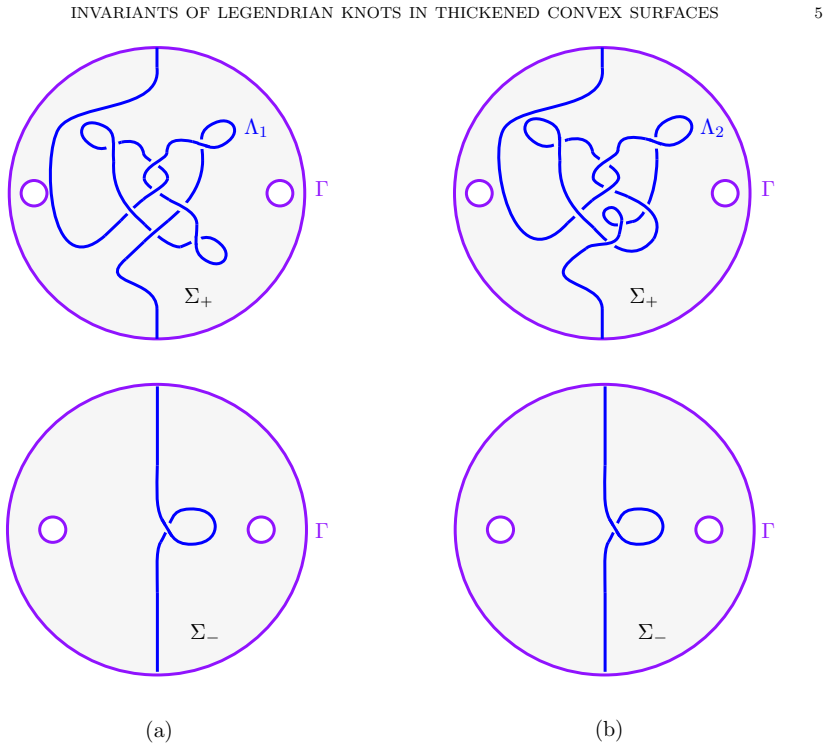
We define a differential graded algebra associated to Legendrian knots in thickened convex surfaces $\Sigma\times \mathbb{R}$. The algebra is defined in the same spirit as the Chekanov-Eliashberg DGA for Legendrians in $\mathbb{R}^3$, but makes use of the data of the dividing set $\Gamma$ of $\Sigma$. The algebra is generated by countably many Reeb chords of the Legendrian $\Lambda$, and its differential counts certain immersed polygons in the projection $\pi:\Sigma\times \mathbb{R}\to \Sigma\times \{0\}$ with boundary on $\pi(\Lambda)\cup \Gamma$. We show that the differential squares to zero and that the stable tame isomorphism type of the DGA is invariant under Legendrian isotopy. Finally, we compute several examples and use the invariant to distinguish Legendrian knots in thickened convex surfaces that cannot be distinguished by the classical invariants.
Editorial analysis
A structured set of objections, weighed in public.
Referee Report
Summary. The paper defines a differential graded algebra for Legendrian knots Λ in thickened convex surfaces Σ × ℝ, generated by Reeb chords of Λ with differential counting immersed polygons in the projection to Σ whose boundary lies on π(Λ) ∪ Γ (the dividing set). It proves that this differential squares to zero, that the stable tame isomorphism type of the DGA is invariant under Legendrian isotopy, and computes examples showing the invariant distinguishes Legendrian knots not separated by classical invariants.
Significance. If the central claims hold, the construction supplies a new contact-invariant for Legendrians in a setting that includes many contact 3-manifolds with convex surfaces, extending the Chekanov-Eliashberg DGA in a geometrically natural way. The explicit examples and the invariance statement are concrete strengths that would make the invariant usable for classification questions.
major comments (2)
- [§3, Theorem 3.1] §3, Theorem 3.1: the proof that d² = 0 proceeds by analyzing the boundary of the moduli space of immersed polygons; the contribution from broken configurations involving arcs on Γ is asserted to cancel, but the text does not supply an explicit sign or orientation argument for the two ways a polygon can break along a chord ending on Γ, leaving the cancellation claim unverified in the current write-up.
- [§4.2, Definition 4.5] §4.2, Definition 4.5: the stable tame isomorphism type is shown invariant under isotopy by a sequence of elementary moves, yet the argument for the move that crosses a dividing curve does not include a direct count of the new Reeb chords created or destroyed; without an explicit local model or diagram, it is unclear whether the resulting DGAs are indeed stably tame isomorphic.
minor comments (2)
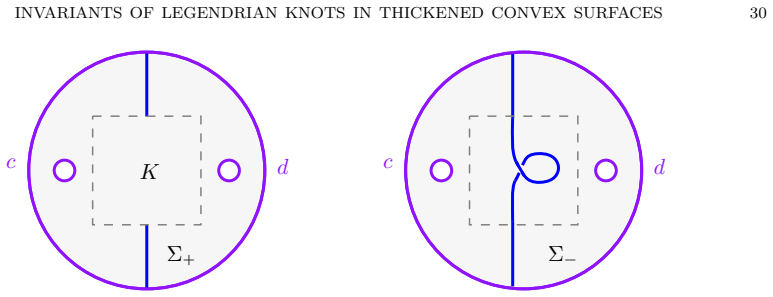
- [§2] The notation for the projection π and the dividing set Γ is introduced without a preliminary diagram; a single figure showing Σ, Γ, and a sample Legendrian projection would clarify the geometric setup for readers.
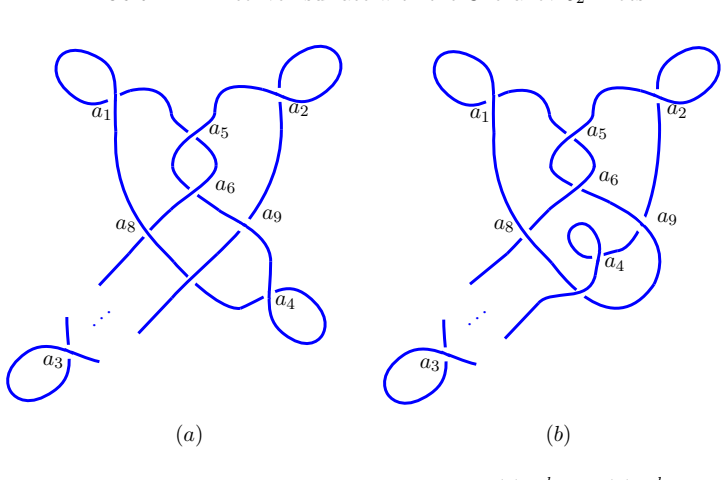
- [§5] Several Reeb chord generators are labeled a_i, b_j without an accompanying table listing their degrees or actions; adding such a table in the example computations would improve readability.
Simulated Author's Rebuttal
We thank the referee for the careful reading and positive recommendation. We address the two major comments below and will incorporate the requested clarifications into the revised manuscript.
read point-by-point responses
-
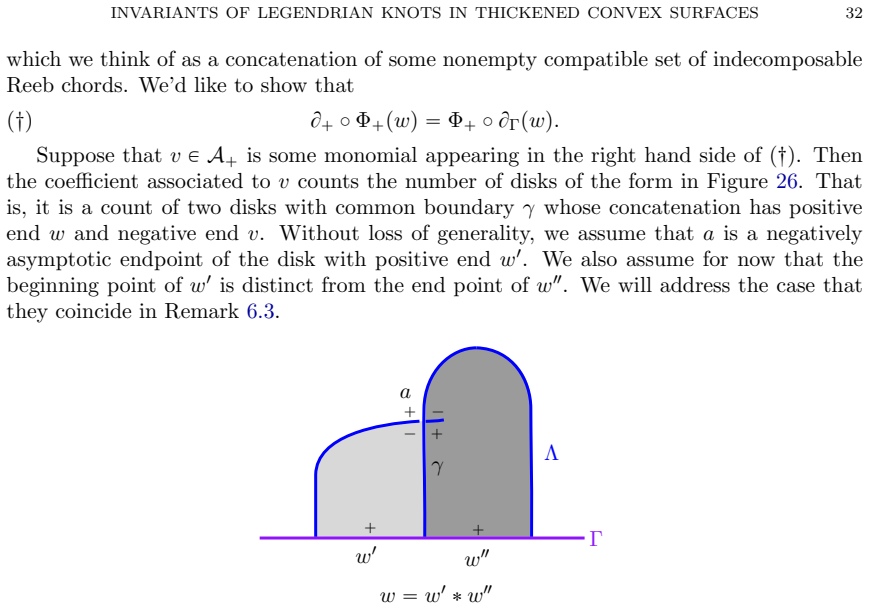
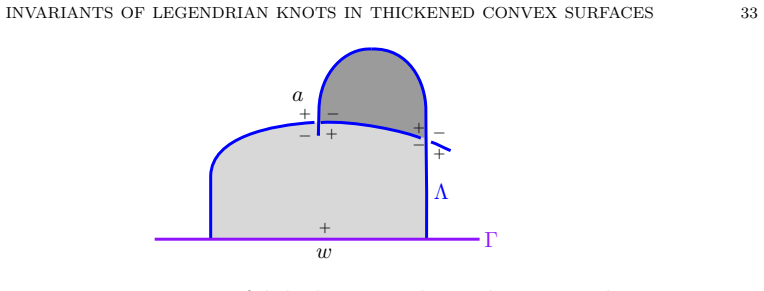
Referee: [§3, Theorem 3.1] the proof that d² = 0 proceeds by analyzing the boundary of the moduli space of immersed polygons; the contribution from broken configurations involving arcs on Γ is asserted to cancel, but the text does not supply an explicit sign or orientation argument for the two ways a polygon can break along a chord ending on Γ, leaving the cancellation claim unverified in the current write-up.
Authors: We agree that an explicit sign computation is needed for the broken configurations along Γ. In the revision we will add a dedicated paragraph (new Lemma 3.3) that fixes orientations on the moduli spaces using the standard coherent orientation conventions for holomorphic polygons and the transverse orientation of Γ; this shows that the two breaking directions contribute with opposite signs and cancel. revision: yes
-
Referee: [§4.2, Definition 4.5] the stable tame isomorphism type is shown invariant under isotopy by a sequence of elementary moves, yet the argument for the move that crosses a dividing curve does not include a direct count of the new Reeb chords created or destroyed; without an explicit local model or diagram, it is unclear whether the resulting DGAs are indeed stably tame isomorphic.
Authors: We will insert a new local model (Figure 4.3 and accompanying calculation) for the crossing move. The model explicitly lists the Reeb chords that appear or disappear, shows that the change is realized by a single stabilization followed by a tame isomorphism, and verifies that the stable tame isomorphism type is preserved. revision: yes
Circularity Check
No significant circularity
full rationale
The paper defines the DGA directly from geometric data consisting of Reeb chords of the Legendrian and counts of immersed polygons in the projection with boundary on π(Λ) ∪ Γ. The claims that d² = 0 and that the stable tame isomorphism type is invariant under Legendrian isotopy are established by direct verification using standard transversality, compactness, and algebraic arguments for such DGAs, without any reduction of the output to fitted parameters, self-referential equations, or load-bearing self-citations that presuppose the result. The construction is self-contained against external benchmarks in contact geometry and introduces no ansatz or renaming that collapses the derivation to its inputs.
Axiom & Free-Parameter Ledger
axioms (2)
- standard math Standard properties of Reeb vector fields and contact structures on thickened surfaces
- domain assumption Existence and combinatorial properties of dividing sets on convex surfaces
invented entities (1)
-
The new differential graded algebra
no independent evidence
Reference graph
Works this paper leans on
-
[1]
Legendrian contact homology in the product of a punctured Riemann surface and the real line
arXiv: 2307.09068 [math.SG].url:https://arxiv.org/abs/2307.09068. [Bj¨ o16] Johan Bj¨ orklund. “Legendrian contact homology in the product of a punctured Riemann surface and the real line”. In:J. Lond. Math. Soc. (2)94.3 (2016), pp. 970–992.issn: 0024-6107,1469-7750.doi:10 . 1112 / jlms / jdw066.url: https://doi-org.libproxy2.usc.edu/10.1112/jlms/jdw066. ...
-
[2]
Differential algebra of Legendrian links
[Che02] Yuri Chekanov. “Differential algebra of Legendrian links”. In:Invent. Math. 150.3 (2002), pp. 441–483.issn: 0020-9910,1432-1297.doi:10.1007/s002220200212. url:https://doi.org/10.1007/s002220200212. [Col+11] Vincent Colin et al. “Sutures and contact homology I”. In:Geom. Topol.15.3 (2011), pp. 1749–1842.issn: 1465-3060,1364-0380.doi:10.2140/gt.2011...
-
[3]
The contact homology of Legendrian submanifolds inR 2n`1
[EES05] Tobias Ekholm, John Etnyre, and Michael Sullivan. “The contact homology of Legendrian submanifolds inR 2n`1”. In:J. Differential Geom.71.2 (2005), pp. 177–305.issn: 0022-040X,1945-743X.url:http://projecteuclid.org/ euclid.jdg/1143651770. [EES07] Tobias Ekholm, John Etnyre, and Michael Sullivan. “Legendrian contact ho- mology inPˆR”. In:Trans. Amer...
-
[4]
Invariants of Leg- endrian knots and coherent orientations
Surv. Differ. Geom. Int. Press, Boston, MA, [2022]©2022, pp. 103–161.isbn: 978-1-57146-419-4. [ENS02] John B. Etnyre, Lenhard L. Ng, and Joshua M. Sabloff. “Invariants of Leg- endrian knots and coherent orientations”. In:J. Symplectic Geom.1.2 (2002), pp. 321–367.issn: 1527-5256,1540-2347.doi:10.4310/jsg.2001.v1.n2.a5. url:https://doi-org.libproxy2.usc.ed...
-
[5]
Proc. Sympos. Pure Math. Amer. Math. Soc., Providence, RI, 2003, pp. 81–107.isbn: 0-8218-3507-6.doi: 10.1090/pspum/071/2024631.url:https://doi.org/10.1090/pspum/071/ 2024631. [Gei06] Hansj¨ org Geiges. “Contact geometry”. In:Handbook of differential geometry. Vol. II. Elsevier/North-Holland, Amsterdam, 2006, pp. 315–382.isbn: 978-0- 444-52052-4; 0-444-520...
work page doi:10.1090/pspum/071/2024631.url:https://doi.org/10.1090/pspum/071/ 2003
-
[6]
Convexit´ e en topologie de contact
[Gir91] Emmanuel Giroux. “Convexit´ e en topologie de contact”. In:Comment. Math. Helv.66.4 (1991), pp. 637–677.issn: 0010-2571,1420-8946.doi:10 . 1007 / BF02566670.url:https://doi.org/10.1007/BF02566670. REFERENCES 56 [K´ al05] Tam´ as K´ alm´ an. “Contact homology and one parameter families of Legendrian knots”. In:Geom. Topol.9 (2005), pp. 2013–2078.is...
-
[7]
Invariants for Legendrian knots in lens spaces
[Lic11] Joan E. Licata. “Invariants for Legendrian knots in lens spaces”. In:Commun. Contemp. Math.13.1 (2011), pp. 91–121.issn: 0219-1997,1793-6683.doi:10. 1142/S0219199711004178.url:https://doi-org.libproxy1.usc.edu/10. 1142/S0219199711004178. [LS13] Joan E. Licata and Joshua M. Sabloff. “Legendrian contact homology in Seifert fibered spaces”. In:Quantu...
work page doi:10.4171/qt/40.url:https://doi.org/10.4171/qt/40 2011
discussion (0)
Sign in with ORCID, Apple, or X to comment. Anyone can read and Pith papers without signing in.