Recognition: unknown
Learning Coverage- and Power-Optimal Transmitter Placement from Building Maps: A Comparative Study of Direct and Indirect Neural Approaches
Pith reviewed 2026-05-09 22:07 UTC · model grok-4.3
The pith
Dual score-map models match the exhaustive balanced optimum for transmitter placement at 14-22 times speedup.
A machine-rendered reading of the paper's core claim, the machinery that carries it, and where it could break.
Core claim
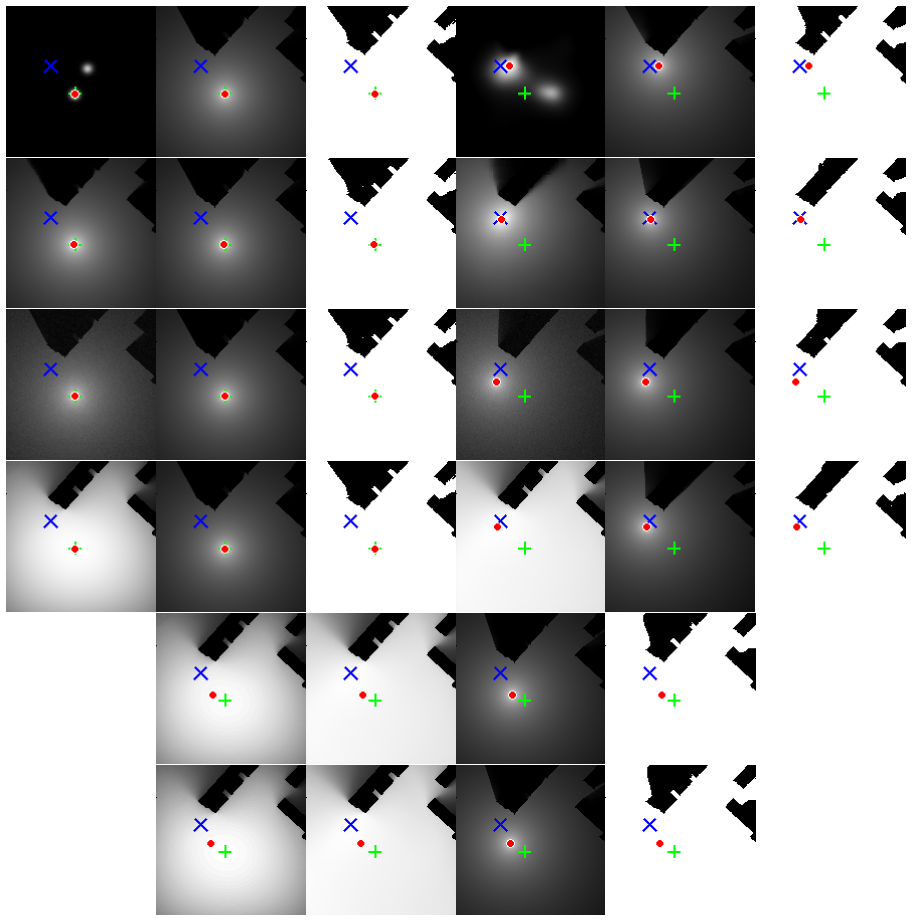
In the single-transmitter setting, dual score-map strategies that combine power and coverage score maps match the exhaustive balanced optimum at an average distance of 2.60 from the ideal point of 100 percent coverage and 100 percent power. These models remain close to that optimum across smaller candidate budgets and deliver 14 to 22 times speedup including the cost of evaluating the shortlisted candidates. Indirect heatmap models achieve one-shot predictions 1350 to 2400 times faster than exhaustive search, while diffusion-based heatmap models improve single-objective results through multi-sample inference and can recover strong balanced placements by reusing samples under a balanced score
What carries the argument
Dual score-map models that directly predict the objective landscape over feasible transmitter locations for both coverage and received-power criteria.
If this is right
- Coverage-optimal placement sacrifices 13.86 percent of received power while power-optimal placement sacrifices only 5.50 percent of coverage.
- Discriminative heatmap models deliver one-shot predictions 1350 to 2400 times faster than exhaustive search.
- Diffusion models support multi-sample inference that improves single-objective performance and recovers balanced placements without explicit multi-objective training.
- Performance stays close to the balanced optimum even when only smaller candidate budgets are evaluated after shortlisting.
Where Pith is reading between the lines
- The direct score-map approach could be extended to multi-transmitter problems by predicting joint objective landscapes instead of single-location scores.
- The observed asymmetry in the coverage-power trade-off implies that power-focused placement may be preferable in many practical network designs.
- Replacing the learned propagation model with measured data would test whether the speedups and accuracy hold outside simulated environments.
Load-bearing premise
The fixed learned propagation model generates sufficiently accurate ground-truth labels for coverage and power objectives across all urban scenarios.
What would settle it
Testing whether the dual score-map models still achieve an average distance of 2.60 from the ideal point when evaluated against real field measurements of coverage and power instead of labels from the learned propagation model.
Figures




read the original abstract
Optimal wireless transmitter placement is a central task in radio-network planning, yet exhaustive search becomes prohibitively expensive at scale. This paper studies the single-transmitter setting under a fixed learned propagation model, enabling exhaustive per-pixel assessment at dataset scale in a regime where measurement-based exhaustive labeling is infeasible and ray-tracing-based exhaustive labeling is computationally out of reach. We introduce a dataset of 167{,}525 urban scenarios (\emph{RadioMapSeer-Deployment}) with dual ground-truth labels for coverage-optimal and power-optimal transmitter locations. Benchmark analysis reveals an asymmetric coverage-power trade-off: coverage-optimal placement sacrifices $13.86\%$ of received power, whereas power-optimal placement sacrifices only $5.50\%$ of coverage; the best achievable balanced placement lies at $\bar{d}=2.60$ from the ideal point $(100\%,100\%)$. We evaluate two learning formulations: indirect heatmap-based models predicting received-power radio maps, and direct score-map models predicting the objective landscape over feasible transmitter locations. Within the heatmap family, discriminative models deliver one-shot predictions $1350$-$2400\times$ faster than exhaustive search, while diffusion models additionally support multi-sample inference that improves single-objective performance and, by reusing the same sample pool under a balanced criterion, recovers strong balanced placements without explicit multi-objective training. Dual score-map strategies that combine power and coverage score maps match the exhaustive balanced optimum ($\bar{d}=2.60$) and remain close to it across smaller candidate budgets, at $14$-$22\times$ speedups including the cost of evaluating shortlisted candidates.
Editorial analysis
A structured set of objections, weighed in public.
Referee Report
Summary. The manuscript introduces the RadioMapSeer-Deployment dataset of 167,525 urban scenarios with dual ground-truth labels for coverage-optimal and power-optimal single-transmitter locations, generated under a fixed learned propagation model. It compares indirect (heatmap-based) and direct (score-map) neural approaches, reports an asymmetric coverage-power trade-off (13.86% vs. 5.50%), identifies a balanced optimum at d=2.60, and shows that dual score-map strategies recover this optimum with 14-22x speedups (including candidate evaluation) while heatmap models achieve 1350-2400x one-shot speedups.
Significance. If the underlying propagation model is reliable, the work offers a scalable, data-driven alternative to exhaustive search for transmitter placement in radio-network planning, where real measurements and ray-tracing are impractical at this scale. The concrete quantitative benchmarks, the large dataset, and the demonstration that diffusion-based multi-sample reuse can support balanced objectives without multi-objective training are strengths that could influence practical deployment pipelines.
major comments (2)
- [Dataset construction and experimental setup] The central empirical claims (asymmetric trade-off percentages, balanced d=2.60, and all speedup factors) rest on ground-truth labels produced by a single fixed learned propagation model. No training details, validation metrics, error analysis against measurements or ray-tracing, or sensitivity study appear in the dataset-construction or experimental sections; systematic biases in urban propagation modeling would render both the 'exhaustive' reference and the reported performance deltas artifacts of the simulator rather than physically grounded targets.
- [Experimental setup and results] The manuscript provides no information on training/validation splits, hyperparameter selection, or overfitting diagnostics for the placement-prediction networks themselves. This absence undermines confidence in the reported one-shot and multi-sample performance numbers, especially given the large number of scenarios and the claim that discriminative models generalize across held-out scenarios.
minor comments (2)
- The abstract uses the non-standard notation '167{,}525'; standard comma formatting would improve readability.
- [Method description] Clarify the precise procedure for combining power and coverage score maps (e.g., how the balanced criterion is computed from the two maps) and whether any additional normalization is applied.
Simulated Author's Rebuttal
We thank the referee for the constructive feedback. The two major comments identify important omissions in experimental details that we will address through targeted revisions to improve reproducibility and clarify the scope of our claims. We respond point by point below.
read point-by-point responses
-
Referee: [Dataset construction and experimental setup] The central empirical claims (asymmetric trade-off percentages, balanced d=2.60, and all speedup factors) rest on ground-truth labels produced by a single fixed learned propagation model. No training details, validation metrics, error analysis against measurements or ray-tracing, or sensitivity study appear in the dataset-construction or experimental sections; systematic biases in urban propagation modeling would render both the 'exhaustive' reference and the reported performance deltas artifacts of the simulator rather than physically grounded targets.
Authors: We acknowledge the absence of these details in the current manuscript. The propagation model is a fixed model trained in our prior radio-map work; we will add a dedicated paragraph in the dataset-construction section describing its architecture, training dataset, validation RMSE on held-out urban maps, and a sensitivity analysis that perturbs propagation parameters and recomputes the coverage-power trade-off. We note that exhaustive real measurements or ray-tracing at the scale of 167k scenarios are infeasible, so the learned model serves as the common reference for all methods. Because every comparison (exhaustive search, heatmap models, score-map models) uses identical labels, the reported relative speedups and the asymmetric trade-off (13.86% vs. 5.50%) remain internally valid; we will explicitly state this modeling scope and limitation in the revised introduction and discussion. revision: yes
-
Referee: [Experimental setup and results] The manuscript provides no information on training/validation splits, hyperparameter selection, or overfitting diagnostics for the placement-prediction networks themselves. This absence undermines confidence in the reported one-shot and multi-sample performance numbers, especially given the large number of scenarios and the claim that discriminative models generalize across held-out scenarios.
Authors: We agree these details are required. In the revised manuscript we will insert a new subsection 'Network Training and Evaluation Protocol' that specifies: (i) random 70/15/15 train/validation/test splits over the 167,525 scenarios with no building-map overlap between splits, (ii) hyperparameter selection via grid search on the validation set (learning rate, batch size, network depth), and (iii) overfitting diagnostics consisting of training/validation loss curves plus final test-set metrics for both discriminative and diffusion models. These additions will directly support the generalization claims and allow readers to assess the reliability of the 1350-2400x and 14-22x speedup figures. revision: yes
Circularity Check
No significant circularity; results are empirical comparisons on held-out data
full rationale
The paper's central claims rest on training neural models (direct score-map and indirect heatmap predictors) and evaluating them against exhaustive-search ground-truth optima computed on a held-out subset of the RadioMapSeer-Deployment dataset. These ground-truth labels are generated once by a fixed learned propagation model and then treated as external reference; the reported speed-ups, d-bar distances, and trade-off percentages are direct empirical measurements that do not reduce by any equation or self-citation to quantities defined solely in terms of the fitted parameters. No self-definitional loops, fitted-input-as-prediction artifacts, or load-bearing self-citations appear in the derivation chain.
Axiom & Free-Parameter Ledger
free parameters (1)
- neural network weights and hyperparameters
axioms (1)
- domain assumption The fixed learned propagation model produces reliable ground-truth coverage and power labels for every scenario
Reference graph
Works this paper leans on
-
[1]
Planning of large-scale WLAN infrastructures,
J. Stosic, Z. Hadzi-Velkov, and L. Gavrilovska, “Planning of large-scale WLAN infrastructures,” in International Symposium on Wireless Personal Multimedia Communications (IWS / WPMC), 01 2005
2005
-
[2]
Ray-tracing based large indoor office base station deployment optimization at millimeter wave bands,
D. Chen, S. Yang, Y. Wang, J. Huang, C.-X. Wang, and Q. Zhu, “Ray-tracing based large indoor office base station deployment optimization at millimeter wave bands,” in2023 IEEE/CIC International Conference on Communications in China (ICCC), 2023, pp. 1–6
2023
-
[3]
Automation of millimeter wave network planning for outdoor coverage in dense urban areas using wall-mounted base stations,
N. Palizban, S. Szyszkowicz, and H. Yanikomeroglu, “Automation of millimeter wave network planning for outdoor coverage in dense urban areas using wall-mounted base stations,”IEEE Wireless Commu- nications Letters, vol. 6, no. 2, pp. 206–209, 2017
2017
-
[4]
Optimization of 5G base station deployment based on quantum genetic algorithm in outdoor 3D map,
J. Li, J. Pang, B. Jiang, Q. Xu, and E. Zhang, “Optimization of 5G base station deployment based on quantum genetic algorithm in outdoor 3D map,”Computer Networks, vol. 269, p. 111431, 2025
2025
-
[5]
Optimal Transmitter Placement in Realistic Urban Environments
L. Taus, R. Tsai, and J. G. Andrews, “Optimal transmitter placement in realistic urban environments,” arXiv preprint arXiv:2604.28153, 2026. 30
work page internal anchor Pith review Pith/arXiv arXiv 2026
-
[6]
Accurate base station placement in 4G LTE networks using multiobjective genetic algorithm optimiza- tion,
J. Isabona, A. L. Imoize, S. Ojo, P. Venkatareddy, S. K. Hinga, M. Sánchez-Chero, and S. M. Ancca, “Accurate base station placement in 4G LTE networks using multiobjective genetic algorithm optimiza- tion,”Wireless Communications and Mobile Computing, vol. 2023, no. 1, p. 7476736, 2023
2023
-
[7]
RadioUNet: Fast radio map estimation with convolu- tional neural networks,
R. Levie, Ç. Yapar, G. Kutyniok, and G. Caire, “RadioUNet: Fast radio map estimation with convolu- tional neural networks,”IEEE Transactions on Wireless Communications, vol. 20, no. 6, pp. 4001–4015, 2021
2021
-
[8]
Dataset of pathloss and ToA radio maps with localization application,
Ç. Yapar, R. Levie, G. Kutyniok, and G. Caire, “Dataset of pathloss and ToA radio maps with localization application,”arXiv preprint:2212.11777, 2022. [Online]. Available: https: //arxiv.org/abs/2212.11777
-
[9]
Dominant path prediction model for urban scenarios,
R. Wahl, G. Wölfle, P. Wertz, P. Wildbolz, and F. Landstorfer, “Dominant path prediction model for urban scenarios,” in14th IST Mobile and Wireless Communications Summit, 2005, pp. 1–5
2005
-
[10]
Fast 3-D ray tracing for the planning of microcells by intelli- gent preprocessing of the data base,
R. Hoppe, G. Wölfle, and F. Landstorfer, “Fast 3-D ray tracing for the planning of microcells by intelli- gent preprocessing of the data base,” in3rd European Personal and Mobile Communications Conference (EPMCC), 1999, pp. 149–154
1999
-
[11]
Wave propagation and radio network planning software WinProp addedtotheelectromagneticsolverpackageFEKO,
R. Hoppe, G. Wölfle, and U. Jakobus, “Wave propagation and radio network planning software WinProp addedtotheelectromagneticsolverpackageFEKO,” inProc. Int. Appl. Computational Electromagnetics Society Symp. - Italy (ACES), Florence, Italy, March 2017
2017
-
[12]
Cellular network radio propagation mod- eling with deep convolutional neural networks,
X. Zhang, X. Shu, B. Zhang, J. Ren, L. Zhou, and X. Chen, “Cellular network radio propagation mod- eling with deep convolutional neural networks,” inProceedings of the 26th ACM SIGKDD International Conference on Knowledge Discovery & Data Mining, ser. KDD ’20. New York, NY, USA: Association for Computing Machinery, 2020, p. 2378–2386
2020
-
[13]
FadeNet: Deep learning-based mm-wave large-scale channel fading prediction and its applications,
V. V. Ratnam, H. Chen, S. Pawar, B. Zhang, C. J. Zhang, Y.-J. Kim, S. Lee, M. Cho, and S.-R. Yoon, “FadeNet: Deep learning-based mm-wave large-scale channel fading prediction and its applications,” IEEE Access, vol. 9, pp. 3278–3290, 2021
2021
-
[14]
EM DeepRay: An expedient, generalizable, and realistic data-driven indoor propagation model,
S. Bakirtzis, J. Chen, K. Qiu, J. Zhang, and I. Wassell, “EM DeepRay: An expedient, generalizable, and realistic data-driven indoor propagation model,”IEEE Transactions on Antennas and Propagation, vol. 70, no. 6, pp. 4140–4154, 2022
2022
-
[15]
Beam index map prediction in unseen environments from geospatial data,
F. Jaensch, G. Caire, and B. Demir, “Beam index map prediction in unseen environments from geospatial data,”IEEE Wireless Communications Letters, vol. 15, pp. 1519–1523, 2026
2026
-
[16]
Radio map estimation: A data-driven approach to spectrum cartography,
D. Romero and S.-J. Kim, “Radio map estimation: A data-driven approach to spectrum cartography,” IEEE Signal Processing Magazine, vol. 39, no. 6, pp. 53–72, 2022
2022
-
[17]
A tutorial on environment-aware communications via channel knowledge map for 6G,
Y. Zeng, J. Chen, J. Xu, D. Wu, X. Xu, S. Jin, X. Gao, D. Gesbert, S. Cui, and R. Zhang, “A tutorial on environment-aware communications via channel knowledge map for 6G,”IEEE Communications Surveys & Tutorials, vol. 26, no. 3, pp. 1478–1519, 2024
2024
-
[18]
Overview of the first pathloss radio map prediction challenge,
Ç. Yapar, F. Jaensch, R. Levie, G. Kutyniok, and G. Caire, “Overview of the first pathloss radio map prediction challenge,”IEEE Open Journal of Signal Processing, vol. 5, pp. 948–963, 2024
2024
-
[19]
A recent survey on radio map estimation methods for wireless networks,
B. Feng, M. Zheng, W. Liang, and L. Zhang, “A recent survey on radio map estimation methods for wireless networks,”Electronics, vol. 14, no. 8, 2025. [Online]. Available: https: //www.mdpi.com/2079-9292/14/8/1564
2025
-
[20]
Empowering wireless network applications with deep learning-based radio propagation models,
S. Bakirtzis, Ç. Yapar, M. Fiore, J. Zhang, and I. Wassell, “Empowering wireless network applications with deep learning-based radio propagation models,”IEEE Wireless Communications, vol. 32, no. 4, pp. 124–131, 2025
2025
-
[21]
A Tutorial on Learning-Based Radio Map Construction: Data, Paradigms, and Physics-Awareness
X. Wang, Y. Pan, and N. Cheng, “A tutorial on learning-based radio map construction: Data, paradigms, and physics-awarenes,” 2026. [Online]. Available: https://arxiv.org/abs/2603.17499 31
work page internal anchor Pith review Pith/arXiv arXiv 2026
-
[22]
Radio propagation modelling: To differentiate or to deep learn, that is the question,
S. Bakirtzis, P. Almasan, J. Suárez-Varela, G. O. Ferreira, M. Kalntis, A. F. Zanella, I. Wassell, and A. Lutu, “Radio propagation modelling: To differentiate or to deep learn, that is the question,” 2025. [Online]. Available: https://arxiv.org/abs/2509.19337
-
[23]
Sionna RT: Differentiable ray tracing for radio propagation modeling,
J. Hoydis, F. A. Aoudia, S. Cammerer, M. Nimier-David, N. Binder, G. Marcus, and A. Keller, “Sionna RT: Differentiable ray tracing for radio propagation modeling,” in2023 IEEE Globecom Workshops (GC Wkshps), 2023, pp. 317–321
2023
-
[24]
On the limitations of ray-tracing for learning-based rf tasks in urban environments,
A. Manukyan, H. Khachatrian, E. Ghukasyan, and T. P. Raptis, “On the limitations of ray-tracing for learning-based RF tasks in urban environments,”arXiv preprint arXiv:2507.19653, 2025
-
[25]
Bridgingthesim-to-real gap in RF localization with large-scale synthetic pretraining,
A.Manukyan, R.Mkrtchyan, A.Saribekyan, T.P.Raptis, andH.Khachatrian, “Bridgingthesim-to-real gap in RF localization with large-scale synthetic pretraining,”Information Fusion, 2025
2025
-
[26]
Radio map prediction from noisy environment information and sparse observations,
F. Jaensch, Ç. Yapar, G. Caire, and B. Demir, “Radio map prediction from noisy environment informa- tion and sparse observations,”arXiv preprint arXiv:2602.11950, 2026
-
[27]
The first pathloss radio map prediction challenge,
Ç. Yapar, F. Jaensch, R. Levie, G. Kutyniok, and G. Caire, “The first pathloss radio map prediction challenge,” inICASSP 2023 - 2023 IEEE International Conference on Acoustics, Speech and Signal Processing (ICASSP), 2023, pp. 1–2
2023
-
[28]
The first indoor pathloss radio map prediction challenge,
S. Bakirtzis, Ç. Yapar, K. Qiu, I. Wassell, and J. Zhang, “The first indoor pathloss radio map prediction challenge,” inICASSP 2025 - 2025 IEEE International Conference on Acoustics, Speech and Signal Processing (ICASSP), 2025, pp. 1–2
2025
-
[29]
The sampling-assisted pathloss radio map prediction competition,
Ç. Yapar, S. Bakirtzis, A. Lutu, I. Wassell, J. Zhang, and G. Caire, “The sampling-assisted pathloss radio map prediction competition,” in2025 IEEE 35th International Workshop on Machine Learning for Signal Processing (MLSP), 2025, pp. 1–6
2025
-
[30]
S. Bakirtzis, Ç. Yapar, K. Qui, I. Wassell, and J. Zhang, “Indoor radio map dataset,”IEEE Dataport, 2024, https://dx.doi.org/10.21227/c0ec-cw74. [Online]. Available: https://dx.doi.org/10. 21227/c0ec-cw74
-
[31]
PMNet: Robust pathloss map prediction via supervised learning,
J.-H. Lee, O. G. Serbetci, D. P. Selvam, and A. F. Molisch, “PMNet: Robust pathloss map prediction via supervised learning,” inGLOBECOM 2023 - 2023 IEEE Global Communications Conference, 2023, pp. 4601–4606
2023
-
[32]
REM-U-Net: Deep learning based agile rem prediction with energy-efficient cell-free use case,
H. Sallouha, S. Sarkar, E. Krijestorac, and D. Cabric, “REM-U-Net: Deep learning based agile rem prediction with energy-efficient cell-free use case,”IEEE Open Journal of Signal Processing, vol. 5, pp. 750–765, 2024
2024
-
[33]
Deep learning-based path loss prediction for outdoor wireless communication systems,
K. Qiu, S. Bakirtzis, H. Song, I. Wassell, and J. Zhang, “Deep learning-based path loss prediction for outdoor wireless communication systems,” inICASSP 2023 - 2023 IEEE International Conference on Acoustics, Speech and Signal Processing (ICASSP), 2023, pp. 1–2
2023
-
[34]
IPP-NET: A generalizable deep neural network model for indoor pathloss radio map prediction,
B. Feng, M. Zhen, W. Liang, and L. Zhang, “IPP-NET: A generalizable deep neural network model for indoor pathloss radio map prediction,” inProc. IEEE Int. Conf. on Acoustics, Speech and Signal Processing (ICASSP), April 2025
2025
-
[35]
Enhancing convolutional models for indoor radio mapping via ray marching,
M. Wu, M. Skocaj, and M. Boban, “Enhancing convolutional models for indoor radio mapping via ray marching,” inProc. IEEE Int. Conf. Acoust., Speech Signal Process. (ICASSP), April 2025
2025
-
[36]
TransPathNet: A novel two-stage framework for indoor radio map prediction,
X. Li, R. Liu, S. Xu, S. Gulam Razul, and C. Yuen, “TransPathNet: A novel two-stage framework for indoor radio map prediction,” inProc. IEEE Int. Conf. Acoust., Speech Signal Process. (ICASSP), April 2025
2025
-
[37]
Generalizableindoorpathlossprediction,
C.T.Cisse, O.Baala, V.Guillet, F.Spies, andA.Caminada, “Generalizableindoorpathlossprediction,” inProc. IEEE Int. Conf. Acoust., Speech Signal Process. (ICASSP), April 2025. 32
2025
-
[38]
SAIPP-Net: A sampling-assisted indoor pathloss pre- diction method for wireless communication systems,
B. Feng, M. Zheng, W. Liang, and L. Zhang, “SAIPP-Net: A sampling-assisted indoor pathloss pre- diction method for wireless communication systems,” in2025 IEEE 35th International Workshop on Machine Learning for Signal Processing (MLSP), 2025
2025
-
[39]
U-Net based indoor radio map prediction under sparse sampling,
T. Xing, L. Zou, T. Bharadwaj, R. Balaji, and D. Cabric, “U-Net based indoor radio map prediction under sparse sampling,” in2025 IEEE 35th International Workshop on Machine Learning for Signal Processing (MLSP), Istanbul, Turkiye, 2025
2025
-
[40]
Efficient indoor radio map prediction with improved Transform- ers and active sampling strategies,
Z. Zheng, L. Xiao, M. Zhao, and Y. Li, “Efficient indoor radio map prediction with improved Transform- ers and active sampling strategies,” in2025 IEEE 35th International Workshop on Machine Learning for Signal Processing (MLSP), Istanbul, Turkiye, 2025
2025
-
[41]
IRM-Net: An enhanced attention networks for indoor radio map estimation,
Q. Chen, H. Tan, M. Yang, Jingjing Huang, and B. Chen, “IRM-Net: An enhanced attention networks for indoor radio map estimation,” in2025 IEEE 35th International Workshop on Machine Learning for Signal Processing (MLSP), Istanbul, Turkiye, 2025
2025
-
[42]
U-Net for indoor pathloss prediction from sparse measurements with physics-informed features,
K. Petrosyan, H. Khachatrian, R. Mkrtchyan, and T. Raptis, “U-Net for indoor pathloss prediction from sparse measurements with physics-informed features,” in2025 IEEE 35th International Workshop on Machine Learning for Signal Processing (MLSP), Istanbul, Turkiye, 2025
2025
-
[43]
Radio map prediction via neural networks with ground truth shortcuts and selective sampling,
M. Wu, M. Skocaj, and M. Boban, “Radio map prediction via neural networks with ground truth shortcuts and selective sampling,” in2025 IEEE 35th International Workshop on Machine Learning for Signal Processing (MLSP), Istanbul, Turkiye, 2025
2025
-
[44]
Sparse-guided RadioUNet with adaptive sampling for the MLSP 2025 sampling-assisted pathloss radio map prediction data competition,
R. Kojima, S. Ito, T. Nagao, and M. Taya, “Sparse-guided RadioUNet with adaptive sampling for the MLSP 2025 sampling-assisted pathloss radio map prediction data competition,” in2025 IEEE 35th International Workshop on Machine Learning for Signal Processing (MLSP), Istanbul, Turkiye, 2025
2025
-
[45]
Vision transformers for efficient indoor pathloss radio map prediction,
R. Mkrtchyan, E. Ghukasyan, K. Petrosyan, H. Khachatrian, and T. P. Raptis, “Vision transformers for efficient indoor pathloss radio map prediction,”Electronics, vol. 14, no. 10, p. 1905, 2025
1905
-
[46]
U6G XL-MIMO radiomap prediction: Multi-config dataset and beam map approach,
X. Li, Y. Han, Z. Lu, S. Jin, and C.-K. Wen, “U6G XL-MIMO radiomap prediction: Multi-config dataset and beam map approach,”arXiv preprint arXiv:2603.06401, 2026
-
[47]
Deep learning with synthetic data for wireless NLOS positioning with a single base station,
H. Khachatrian, R. Mkrtchyan, and T. P. Raptis, “Deep learning with synthetic data for wireless NLOS positioning with a single base station,”Ad Hoc Networks, vol. 167, p. 103696, 2025
2025
-
[48]
Fastselectionofindoorwirelesstransmitterlocationswithgeneralizable neural network propagation models,
A.Seretis, C.Xu, andC.Sarris, “Fastselectionofindoorwirelesstransmitterlocationswithgeneralizable neural network propagation models,”IEEE Transactions on Antennas and Propagation, vol. 72, no. 10, pp. 7927–7940, 2024
2024
-
[49]
AI-assisted indoor wireless network planning with data-driven propagation models,
S. Bakirtzis, I. Wassell, M. Fiore, and J. Zhang, “AI-assisted indoor wireless network planning with data-driven propagation models,”IEEE Network, vol. 38, no. 6, pp. 451–458, 2024
2024
-
[50]
Deep learning-driven combinatorial optimization for indoor radio planning,
C. T. Cissé, O. Baala, V. Guillet, F. Spies, and A. Caminada, “Deep learning-driven combinatorial optimization for indoor radio planning,”Available at SSRN 4976575
-
[51]
EMF aware reinforcement learning for base station deployment using conditional GANs,
M. Mallik and G. Villemaud, “EMF aware reinforcement learning for base station deployment using conditional GANs,”IEEE Access, vol. 14, pp. 3806–3820, 2026
2026
-
[52]
Radio map-assisted transmitter deployment in complex indoor scenarios via deep reinforcement learning,
B. Feng, M. Zheng, W. Liang, L. Zhang, and L. Chen, “Radio map-assisted transmitter deployment in complex indoor scenarios via deep reinforcement learning,”IEEE Wireless Communications Letters, vol. 15, pp. 2508–2512, 2026
2026
-
[53]
AutoBS: Autonomous base station deployment with reinforcement learning and digital network twins,
J.-H. Lee and A. F. Molisch, “AutoBS: Autonomous base station deployment with reinforcement learning and digital network twins,” 2025. [Online]. Available: https://arxiv.org/abs/2502.19647
-
[54]
Automatic network planning with digital radio twin,
X. Li, Y. Zhang, Q. Liu, M. C. Vuran, N. Huynh, L. Zhao, M. Rahman, and E. E. Ozguven, “Automatic network planning with digital radio twin,” 2026. [Online]. Available: https://arxiv.org/abs/2509.12441 33
-
[55]
Radio map prediction from aerial images and application to coverage optimization,
F. Jaensch, G. Caire, and B. Demir, “Radio map prediction from aerial images and application to coverage optimization,”IEEE Transactions on Wireless Communications, vol. 25, pp. 308–320, 2026
2026
-
[56]
Aerial base station placement leveraging radio tomographic maps,
D. Romero, P. Q. Viet, and G. Leus, “Aerial base station placement leveraging radio tomographic maps,” inICASSP 2022 - 2022 IEEE International Conference on Acoustics, Speech and Signal Processing (ICASSP), 2022, pp. 5358–5362
2022
-
[57]
DA-cGAN: A framework for indoor radio design using a dimension- aware conditional generative adversarial network,
C.-H. Liu, H. Chang, and T. Park, “DA-cGAN: A framework for indoor radio design using a dimension- aware conditional generative adversarial network,” in2020 IEEE/CVF Conference on Computer Vision and Pattern Recognition Workshops (CVPRW), 2020, pp. 2089–2098
2020
-
[58]
A transformer-based network for unifying radio map estimation and optimized site selection,
Y. Zheng, C. Liao, J. Wang, and S. Liu, “A transformer-based network for unifying radio map estimation and optimized site selection,” in2024 IEEE International Conference on Acoustics, Speech, and Signal Processing Workshops (ICASSPW), 2024, pp. 610–614
2024
-
[59]
BSCSM-GAN: End-to-end generative prediction of base station coverage strength maps for 6G-aware urban deployment,
J. He and Y. Zheng, “BSCSM-GAN: End-to-end generative prediction of base station coverage strength maps for 6G-aware urban deployment,” in2025 IEEE/CIC International Conference on Communica- tions in China (ICCC Workshops), 2025, pp. 1–5
2025
-
[60]
Planning with language and generative models: Toward general reward-guided wireless network design,
C. Yuan and X. Cheng, “Planning with language and generative models: Toward general reward-guided wireless network design,” 2026. [Online]. Available: https://arxiv.org/abs/2602.00357
-
[61]
GDSG: Graph diffusion-based solution generator for optimization problems in MEC networks,
R. Liang, B. Yang, P. Chen, X. Cao, Z. Yu, M. Debbah, D. Niyato, H. V. Poor, and C. Yuen, “GDSG: Graph diffusion-based solution generator for optimization problems in MEC networks,”IEEE Transac- tions on Mobile Computing, vol. 24, no. 10, pp. 10264–10277, 2025
2025
-
[62]
DiffSG: A generative solver for network optimization with diffusion model,
R. Liang, B. Yang, Z. Yu, B. Guo, X. Cao, M. Debbah, H. V. Poor, and C. Yuen, “DiffSG: A generative solver for network optimization with diffusion model,”IEEE Communications Magazine, vol. 63, no. 6, pp. 16–24, 2025
2025
-
[63]
GDPlan: Generative network planning via graph diffusion model,
N. Kan, S. Yan, J. Zou, W. Dai, X. Gao, C. Li, and H. Xiong, “GDPlan: Generative network planning via graph diffusion model,”IEEE Transactions on Networking, vol. 33, no. 4, pp. 1422–1437, 2025
2025
-
[64]
Optimization for massive 3D-RIS deployment: A generative diffusion model-based approach,
K. Wang, B. Yang, Z. Yu, X. Cao, M. Debbah, and C. Yuen, “Optimization for massive 3D-RIS deployment: A generative diffusion model-based approach,” 2025. [Online]. Available: https://arxiv.org/abs/2509.11969
-
[65]
Generative diffusion models for resource allocation in wireless networks,
Y. B. Uslu, S. Hadou, S. S. Bidokhti, and A. Ribeiro, “Generative diffusion models for resource allocation in wireless networks,” in2025 IEEE 10th International Workshop on Computational Advances in Multi- Sensor Adaptive Processing (CAMSAP), 2025, pp. 201–205
2025
-
[66]
Diffusion models as network optimizers: Explorations and analysis,
R. Liang, B. Yang, P. Chen, X. Li, Y. Xue, Z. Yu, X. Cao, Y. Zhang, M. Debbah, H. Vincent Poor, and C. Yuen, “Diffusion models as network optimizers: Explorations and analysis,”IEEE Internet of Things Journal, vol. 12, no. 10, pp. 13183–13193, 2025
2025
-
[67]
Planet dump retrieved from https://planet.osm.org,
OpenStreetMap contributors, “Planet dump retrieved from https://planet.osm.org,” https://www. openstreetmap.org, 2017
2017
-
[68]
Goldsmith,Wireless communications
A. Goldsmith,Wireless communications. Cambridge university press, 2005
2005
-
[69]
Dataset of optimal radio maps and deployments,
Ç. Yapar, “Dataset of optimal radio maps and deployments,”IEEE Dataport, 2026. [Online]. Available: https://dx.doi.org/10.21227/wjwa-th03
-
[70]
Miettinen,Nonlinear multiobjective optimization
K. Miettinen,Nonlinear multiobjective optimization. Springer Science & Business Media, 1999, vol. 12
1999
-
[71]
Denoising diffusion probabilistic models,
J. Ho, A. Jain, and P. Abbeel, “Denoising diffusion probabilistic models,” inAdvances in Neural Infor- mation Processing Systems, vol. 33, 2020, pp. 6840–6851
2020
-
[72]
Denoising Diffusion Implicit Models
J. Song, C. Meng, and S. Ermon, “Denoising diffusion implicit models,” in9th International Conference on Learning Representations, ICLR 2021, 2021. [Online]. Available: https://arxiv.org/abs/2010.02502 34
work page internal anchor Pith review Pith/arXiv arXiv 2021
-
[73]
U-net: Convolutional networks for biomedical image segmen- tation,
O. Ronneberger, P. Fischer, and T. Brox, “U-net: Convolutional networks for biomedical image segmen- tation,” inMedical Image Computing and Computer-Assisted Intervention – MICCAI 2015, N. Navab, J. Hornegger, W. M. Wells, and A. F. Frangi, Eds. Cham: Springer International Publishing, 2015, pp. 234–241
2015
-
[74]
Deep residual learning for image recognition,
K. He, X. Zhang, S. Ren, and J. Sun, “Deep residual learning for image recognition,” inProceedings of the IEEE Conference on Computer Vision and Pattern Recognition (CVPR), June 2016
2016
-
[75]
Encoder-decoder with atrous separable convolution for semantic image segmentation,
L.-C. Chen, Y. Zhu, G. Papandreou, F. Schroff, and H. Adam, “Encoder-decoder with atrous separable convolution for semantic image segmentation,” inProceedings of the European Conference on Computer Vision (ECCV), September 2018
2018
-
[76]
DC-Net: A distant-range content interaction network for radio map construction,
Q. Chen, M. Huang, and J. Yang, “DC-Net: A distant-range content interaction network for radio map construction,”ICT Express, vol. 10, no. 5, pp. 1145–1150, 2024. [Online]. Available: https://www.sciencedirect.com/science/article/pii/S2405959524001024
2024
-
[77]
Aggregated contextual transformations for high-resolution image inpainting,
Y. Zeng, J. Fu, H. Chao, and B. Guo, “Aggregated contextual transformations for high-resolution image inpainting,”IEEE Transactions on Visualization and Computer Graphics, vol. 29, no. 7, pp. 3266–3280, 2023
2023
-
[78]
SIP2Net: Situational-aware indoor pathloss-map prediction network for radio map generation,
W. Lu, Z. Lu, J. Yan, and S. Gao, “SIP2Net: Situational-aware indoor pathloss-map prediction network for radio map generation,” inICASSP 2025 - 2025 IEEE International Conference on Acoustics, Speech and Signal Processing (ICASSP), 2025, pp. 1–2
2025
-
[79]
ACNet: Strengthening the kernel skeletons for powerful CNN via asymmetric convolution blocks,
X. Ding, Y. Guo, G. Ding, and J. Han, “ACNet: Strengthening the kernel skeletons for powerful CNN via asymmetric convolution blocks,” inProceedings of the IEEE/CVF International Conference on Computer Vision (ICCV), October 2019
2019
-
[80]
Image quality assessment: from error visibility to structural similarity,
Z. Wang, A. C. Bovik, H. R. Sheikh, and E. P. Simoncelli, “Image quality assessment: from error visibility to structural similarity,”IEEE Transactions on Image Processing, vol. 13, no. 4, pp. 600–612, 2004
2004
discussion (0)
Sign in with ORCID, Apple, or X to comment. Anyone can read and Pith papers without signing in.