Recognition: unknown
Optimal Transmitter Placement in Realistic Urban Environments
Pith reviewed 2026-05-08 02:57 UTC · model grok-4.3
The pith
Placing a fixed number of transmitters according to real city maps and ray tracing can double average wireless data rates and multiply the worst-case rates by two to eight times over today's tower locations.
A machine-rendered reading of the paper's core claim, the machinery that carries it, and where it could break.
Core claim
We propose a mathematically rigorous framework for optimal transmitter placement that explicitly integrates detailed site-specific maps, spatial material properties, and realistic signal attenuation. We introduce a novel aggregated network quality functional which captures the essential trade-off between maximizing network coverage and minimizing cost, and establish the problem's sub-modularity under certain practical conditions. To solve the resulting resource-constrained optimization problem for sparse, discrete transmitter configurations, we propose the Interference-Aware Submodular Placement Algorithm (IA-SPA) and prove theoretical performance guarantees on its gap from optimality. IA-SP
What carries the argument
The Interference-Aware Submodular Placement Algorithm (IA-SPA), which exploits the submodularity of the aggregated network quality functional to select optimal discrete transmitter locations while allowing for existing sites and prohibited areas.
If this is right
- Mean user data rates increase by a factor of about two for the same number of transmitters.
- The lowest data rates increase by factors between two and eight.
- The algorithm applies equally to clean-slate network designs and to incremental upgrades that must respect existing towers and forbidden zones.
- Performance guarantees hold whenever the quality functional satisfies the submodularity property used in the proof.
Where Pith is reading between the lines
- Cities could reach comparable performance levels with fewer transmitters if locations are chosen with this method.
- The same submodular placement approach might apply to other infrastructure such as Wi-Fi access points or private networks in dense areas.
- High-fidelity ray-tracing models become practical for routine network planning once paired with a submodular optimizer.
Load-bearing premise
The aggregated network quality functional is submodular under certain practical conditions.
What would settle it
A direct comparison of data rates achieved by IA-SPA placements versus actual operator tower locations in the same cities using the same ray-tracing simulator.
Figures






read the original abstract
In a wireless network, the spatial location of the transmitters has a large impact on the achievable rate at each user location. The optimal placement of -- for example -- cellular base stations is a difficult non-convex problem, and is usually addressed with simplified propagation models and simplified heuristics that may account for specifics such as the site topology, building locations, and user density. We propose a mathematically rigorous framework for optimal transmitter placement that explicitly integrates detailed site-specific maps, spatial material properties, and realistic signal attenuation. We introduce a novel aggregated network quality functional which captures the essential trade-off between maximizing network coverage and minimizing cost, and establish the problem's sub-modularity under certain practical conditions. To solve the resulting resource-constrained optimization problem for sparse, discrete transmitter configurations, we propose the Interference-Aware Submodular Placement Algorithm (IA-SPA) and prove theoretical performance guarantees on its gap from optimality. IA-SPA is general and can incorporate existing BS locations and prohibited areas (e.g. a lake), making it useful for either clean-slate or incremental deployments. We show the utility of our approach using a ray tracing-based simulation framework applied to 3D maps of San Francisco and Florence, where we compare to known base station deployments by AT&T, T-Mobile and Iliad. We demonstrate that our proposed placement strategy achieves significant increases in mean data rate (about 2x) and edge rate ($2-8$x) compared to existing tower deployments, using the same number of transmitters.
Editorial analysis
A structured set of objections, weighed in public.
Referee Report
Summary. The paper proposes a rigorous optimization framework for transmitter placement in wireless networks that incorporates detailed 3D urban maps, material properties, and ray-tracing propagation. It defines an aggregated network quality functional, proves its submodularity under practical conditions, introduces the Interference-Aware Submodular Placement Algorithm (IA-SPA) with approximation guarantees, and validates the approach via simulations on San Francisco and Florence maps. The method handles existing base stations and prohibited areas, and the simulations report approximately 2x gains in mean data rate and 2-8x gains in edge rate versus real AT&T, T-Mobile, and Iliad deployments at equal transmitter count.
Significance. If the central claims hold, the work is significant for providing a theoretically grounded method that directly uses site-specific realistic propagation models rather than simplified heuristics. The submodularity result and IA-SPA guarantees, together with the empirical comparisons against actual operator deployments on real city maps, offer both algorithmic novelty and practical utility for clean-slate or incremental network planning. The generality to incorporate constraints is a clear strength.
minor comments (3)
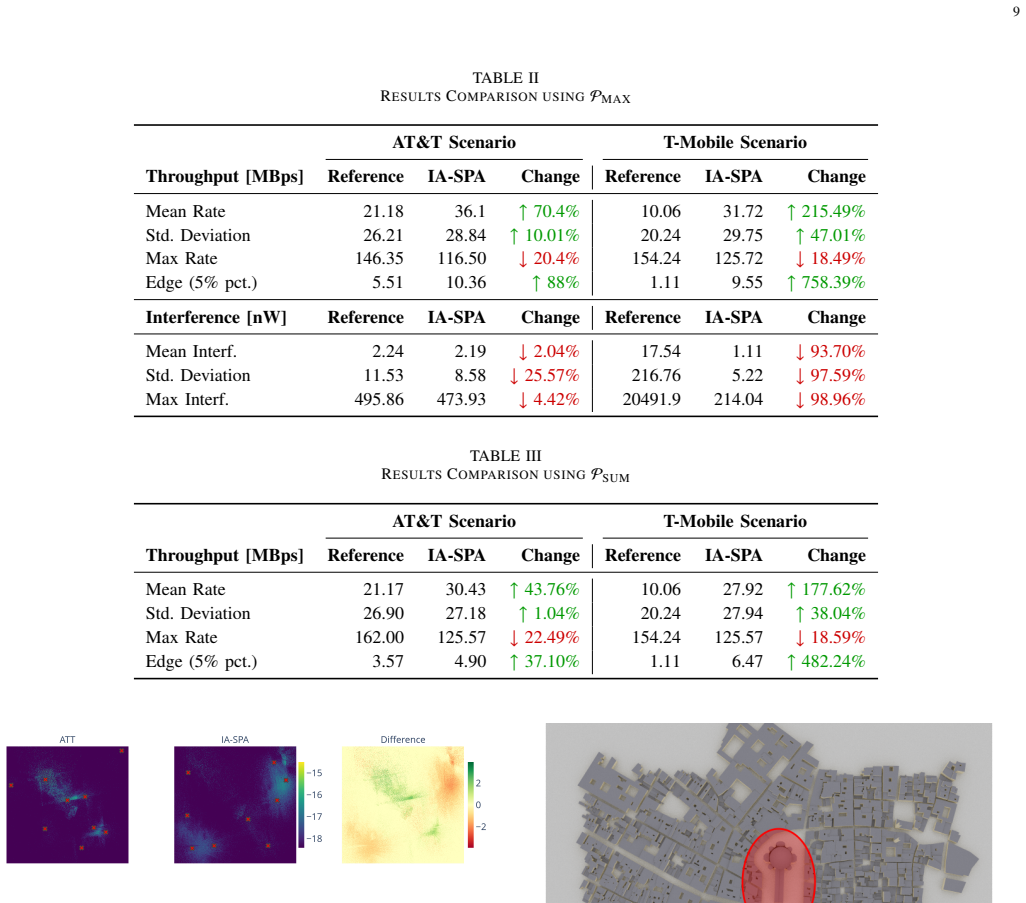
- The abstract and results sections report specific rate improvements (2x mean, 2-8x edge) from ray-tracing simulations but do not mention error bars, number of Monte Carlo runs, or data exclusion criteria; adding these would strengthen the empirical claims.
- The submodularity of the aggregated quality functional is stated to hold 'under certain practical conditions'; a concise statement or reference to the precise conditions (e.g., in the modeling section) would improve clarity and reproducibility.
- Figure captions and simulation setup descriptions could explicitly note the ray-tracing parameters (frequency, material properties, receiver height) used for the San Francisco and Florence scenarios to allow direct replication.
Simulated Author's Rebuttal
We thank the referee for the positive summary, recognition of the work's significance, and recommendation for minor revision. We appreciate the assessment that the submodularity result, IA-SPA guarantees, and comparisons to real operator deployments on city maps provide both algorithmic novelty and practical utility.
Circularity Check
No significant circularity detected
full rationale
The paper introduces a submodular aggregated network quality functional, establishes its submodularity under stated practical conditions, proposes the IA-SPA algorithm, and proves approximation guarantees. Performance claims (2x mean rate, 2-8x edge rate) are obtained from ray-tracing simulations on external 3D city maps compared against real operator deployments at fixed transmitter count. No derivation step reduces a claimed result to its own inputs by construction, no fitted parameter is relabeled as a prediction, and no load-bearing premise rests on self-citation chains. The modeling choices and empirical outputs remain independent.
Axiom & Free-Parameter Ledger
axioms (1)
- domain assumption The aggregated network quality functional is submodular under certain practical conditions
Forward citations
Cited by 1 Pith paper
-
Learning Coverage- and Power-Optimal Transmitter Placement from Building Maps: A Comparative Study of Direct and Indirect Neural Approaches
Neural models predict coverage- and power-optimal transmitter locations from building maps, matching exhaustive search performance at 14-2400x speedups while quantifying an asymmetric coverage-power trade-off.
Reference graph
Works this paper leans on
-
[1]
6G takes shape,
J. G. Andrews, T. Humphreys, and T. Ji, “6G takes shape,”IEEE BITS the Information Theory Magazine, 2025
2025
-
[2]
Digital twin-based ray tracing analysis for antenna orienta- tion optimization in wireless networks,
O. Yildiz, “Digital twin-based ray tracing analysis for antenna orienta- tion optimization in wireless networks,”Electronics, vol. 14, no. 15, p. 3023, 2025
2025
-
[3]
Learnable wireless digital twins: Reconstructing electromagnetic field with neural representations,
S. Jiang, Q. Qu, X. Pan, A. K. Agrawal, R. Newcombe, and A. Alkha- teeb, “Learnable wireless digital twins: Reconstructing electromagnetic field with neural representations,”IEEE Open Journal of the Communi- cations Society, vol. 6, pp. 1568–1590, 2025
2025
-
[4]
O’Rourke,Art Gallery Theorems and Algorithms
J. O’Rourke,Art Gallery Theorems and Algorithms. Oxford, UK: Oxford University Press, 1987. 12
1987
-
[5]
An efficient algorithm for guard placement in polygons with holes,
I. Bjorling-Sachs and D. L. Souvaine, “An efficient algorithm for guard placement in polygons with holes,”Discrete & Computational Geometry, vol. 13, pp. 77–109, 1995. [Online]. Available: https: //api.semanticscholar.org/CorpusID:37188717
1995
-
[6]
Online algorithms with discrete visibility - exploring unknown polygonal envi- ronments,
S. K. Ghosh, J. W. Burdick, A. Bhattacharya, and S. Sarkar, “Online algorithms with discrete visibility - exploring unknown polygonal envi- ronments,”IEEE Robotics & Automation Magazine, vol. 15, no. 2, pp. 67–76, 2008
2008
-
[7]
Optimal placement of aerial base station utilizing topographic features,
Y . Cho, J. Won, D.-Y . Kim, and J.-W. Lee, “Optimal placement of aerial base station utilizing topographic features,”IEEE Internet of Things Journal, vol. 12, no. 12, p. 19882, 2025
2025
-
[8]
D. T. Lee and F. P. Preparata,Computational Geometry: A Survey. IEEE Computer Society Press, 1986, reprinted in IEEE Transactions on Computers, vol. C–33, no. 12, pp. 1072-1101, 1984
1986
-
[9]
Submodular function maximization,
A. Krause and D. Golovin, “Submodular function maximization,” in Tractability: Practical Approaches to Hard Problems. Cambridge University Press, 2011, pp. 71–104
2011
-
[10]
Planning UMTS base station location: Optimization models with power control and algorithms,
E. Amaldi, A. Capone, and F. Malucelli, “Planning UMTS base station location: Optimization models with power control and algorithms,”IEEE Transactions on Wireless Communications, vol. 2, no. 5, pp. 939–952, 2003
2003
-
[11]
Re- ceding horizon path planning for 3D exploration and surface inspection,
A. Bircher, M. Kamel, K. Alexis, H. Oleynikova, and R. Siegwart, “Re- ceding horizon path planning for 3D exploration and surface inspection,” Autonomous Robots, vol. 42, pp. 291–306, 2018
2018
-
[12]
Navigation strategies for exploring indoor environments,
H. H. Gonzalez-Ba ˜nos and J.-C. Latombe, “Navigation strategies for exploring indoor environments,” inIntl. Symposium on Experimental Robotics (ISER). Springer, 2002, pp. 749–758
2002
-
[13]
Autonomous exploration, reconstruction, and surveillance of 3d environments aided by deep learning,
L. Ly and Y .-H. R. Tsai, “Autonomous exploration, reconstruction, and surveillance of 3d environments aided by deep learning,” in2019 International Conference on Robotics and Automation (ICRA), 2019, pp. 5467–5473
2019
-
[14]
V olumetric occupancy mapping with probabilistic depth completion for robotic navigation,
M. Popovic, F. Thomas, S. Papatheodorou, N. Funk, T. Vidal-Calleja, and S. Leutenegger, “V olumetric occupancy mapping with probabilistic depth completion for robotic navigation,”IEEE Robotics and Automation Letters, vol. 6, pp. 5072–5079, 2021
2021
-
[15]
Optimizing sensor network design for multiple coverage,
L. Taus and Y .-H. R. Tsai, “Optimizing sensor network design for multiple coverage,” arXiv preprint arXiv:2309.08545, 2024
-
[16]
Sionna: An Open-Source Library for Next-Generation Physical Layer Research,
J. Hoydis, S. Cammerer, F. A. Aoudia, A. Vem, N. Binder, G. Marcus, and A. Keller, “Sionna: An open-source library for next-generation physical layer research,”arXiv preprint arXiv:2203.11854, 2022
-
[17]
Site-specific outdoor propagation assessment and ray-tracing analysis for wireless digital twins,
M. G. Aram, H. Guo, M. Yin, and T. Svensson, “Site-specific outdoor propagation assessment and ray-tracing analysis for wireless digital twins,” 2024. [Online]. Available: https://arxiv.org/abs/2410.14620
-
[18]
A comprehensive survey on millimeter wave communications for fifth-generation wireless networks: Feasibility and challenges,
A. Uwaechia and N. Mahyuddin, “A comprehensive survey on millimeter wave communications for fifth-generation wireless networks: Feasibility and challenges,”IEEE Access, vol. 8, pp. 62 367–62 414, 2020
2020
-
[19]
Smart radio environments empowered by reconfigurable intelligent surfaces: How it works, state of research, and road ahead,
M. D. Renzo, A. Zappone, M. Debbah, M.-S. Alouini, C. Yuen, J. de Rosny, and S. Tretyakov, “Smart radio environments empowered by reconfigurable intelligent surfaces: How it works, state of research, and road ahead,”IEEE Journal on Selected Areas in Communications, 2020
2020
-
[20]
Coverage and capacity optimization in STAR-RISs assisted networks: A machine learning approach,
X. Gao, W. Yi, A. Agapitos, H. Wang, and Y . Liu, “Coverage and capacity optimization in STAR-RISs assisted networks: A machine learning approach,” inIEEE Wireless Communications and Networking Conference (WCNC), 2023, pp. 1–6
2023
-
[21]
Data-driven deployment of reconfigurable intelligent surfaces in cel- lular networks,
S. Beyraghi, J. Shabanpour, G. Geraci, P. Almasan, and A. Lozano, “Data-driven deployment of reconfigurable intelligent surfaces in cel- lular networks,”IEEE Journal on Selected Areas in Communications, vol. 44, pp. 2938–2951, 2026
2026
-
[22]
Better together: Leveraging multiple digital twins for deployment optimization of airborne base stations,
M. Belgiovine, C. Dick, and K. Chowdhury, “Better together: Leveraging multiple digital twins for deployment optimization of airborne base stations,”IEEE Transactions on Mobile Computing, vol. 25, no. 3, pp. 3920–3935, 2026
2026
-
[23]
MAPEL: Achieving global optimality for a non-convex wireless power control problem,
L. Qian, Y . J. Zhang, and J. Huang, “MAPEL: Achieving global optimality for a non-convex wireless power control problem,” 2008. [Online]. Available: https://arxiv.org/abs/0805.2675
-
[24]
Power control by geometric programming,
M. Chiang, C. W. Tan, D. P. Palomar, D. O’neill, and D. Julian, “Power control by geometric programming,”IEEE Transactions on Wireless Communications, vol. 6, no. 7, pp. 2640–2651, 2007
2007
-
[25]
Distributed interference com- pensation for wireless networks,
J. Huang, R. Berry, and M. Honig, “Distributed interference com- pensation for wireless networks,”IEEE Journal on Selected Areas in Communications, vol. 24, no. 5, pp. 1074–1084, 2006
2006
-
[26]
QoS and fairness constrained convex optimization of resource allocation for wireless cellular and ad hoc networks,
D. Julian, M. Chiang, D. O’Neill, and S. Boyd, “QoS and fairness constrained convex optimization of resource allocation for wireless cellular and ad hoc networks,” inIEEE INFOCOM, vol. 2, 2002, pp. 477–486
2002
-
[27]
Distributed uplink power control for optimal SIR assignment in cellular data networks,
P. Hande, S. Rangan, M. Chiang, and X. Wu, “Distributed uplink power control for optimal SIR assignment in cellular data networks,” IEEE/ACM Transactions on Networking, vol. 16, no. 6, pp. 1420–1433, 2008
2008
-
[28]
FaSTrack: A modular framework for real-time motion planning and guaranteed safe tracking,
M. Chen, S. L. Herbert, H. Hu, Y . Pu, J. F. Fisac, S. Bansal, S. Han, and C. J. Tomlin, “FaSTrack: A modular framework for real-time motion planning and guaranteed safe tracking,”IEEE Transactions on Automatic Control, vol. 66, no. 12, pp. 5861–5876, 2021
2021
-
[29]
F. Khoramnejad and E. Hossain, “Generative AI for the optimization of next-generation wireless networks: Basics, state-of-the-art, and open challenges,” 2024. [Online]. Available: https://arxiv.org/abs/2405.17454
-
[30]
Optimized base station deployment and assignment for smart factory millimeter wave networks,
A. Pasqual, S. Edirisinghe, C. A. Chan, and A. Nirmalathas, “Optimized base station deployment and assignment for smart factory millimeter wave networks,” inIEEE Annual Conference of the Industrial Electron- ics Society (IECON). IEEE, 2024
2024
-
[31]
Placement optimization of aerial base stations with deep reinforcement learning,
J. Qiu, J. Lyu, and L. Fu, “Placement optimization of aerial base stations with deep reinforcement learning,” inIEEE International Conference on Communications (ICC), 2020, pp. 1–6
2020
-
[32]
Energy-aware optimization of UA V base stations placement via decentralized multi-agent Q-learning,
B. Omoniwa, B. Galkin, and I. Dusparic, “Energy-aware optimization of UA V base stations placement via decentralized multi-agent Q-learning,” inIEEE Consumer Communications & Networking Conference (CCNC), 2022, pp. 216–222
2022
-
[33]
Reconfigurable intelligent surface-assisted aerial nonterrestrial networks: An intelligent synergy with deep reinforcement learning,
M. Umer, M. A. Mohsin, A. Kaushik, Q.-U.-A. Nadeem, A. A. Nasir, and S. A. Hassan, “Reconfigurable intelligent surface-assisted aerial nonterrestrial networks: An intelligent synergy with deep reinforcement learning,”IEEE Vehicular Technology Magazine, vol. 20, no. 1, pp. 55– 64, 2025
2025
-
[34]
Bayesian optimization framework for channel simulation-based base station placement and transmission power design,
K. Sato and K. Suto, “Bayesian optimization framework for channel simulation-based base station placement and transmission power design,” IEEE Networking Letters, vol. 6, no. 4, pp. 217–221, 2024
2024
-
[35]
E. Nwelih, J. Isabona, and A. L. Imoize, “Optimization of base station placement in 4G LTE broadband networks using adaptive variable length genetic algorithm,”SN Comput. Sci., vol. 4, no. 2, Dec. 2022. [Online]. Available: https://doi.org/10.1007/s42979-022-01533-y
-
[36]
Outdoor mmWave base station placement: A multi-armed bandit learning approach,
F. Erden, C. K. Anjinappa, E. Ozturk, and I. Guvenc, “Outdoor mmWave base station placement: A multi-armed bandit learning approach,” 2020. [Online]. Available: https://arxiv.org/abs/2003.03494
-
[37]
SKYSCALE: A radio tomographic ap- proach towards scaling UA V network deployments,
S. Das and A. Chakraborty, “SKYSCALE: A radio tomographic ap- proach towards scaling UA V network deployments,” inACM Intl. Symposium on Mobile Ad Hoc Networking and Computing (MobiHoc). ACM, 2024
2024
-
[38]
Aerial base station placement leveraging radio tomographic maps,
D. Romero, P. Q. Viet, and G. Leus, “Aerial base station placement leveraging radio tomographic maps,” inIEEE Intl. Conference on Acoustics, Speech and Signal Processing (ICASSP), 2022, pp. 5358– 5362
2022
-
[39]
Aerial base station placement via propagation radio maps,
D. Romero, P. Q. Viet, and R. Shrestha, “Aerial base station placement via propagation radio maps,”IEEE Transactions on Communications, vol. 72, no. 9, pp. 5349–5364, 2024
2024
-
[40]
Fast online movement optimization of aerial base stations based on global connectivity map,
Y . Wang, J. Lyu, and L. Fu, “Fast online movement optimization of aerial base stations based on global connectivity map,” inIEEE Vehicular Technology Conference (VTC2025-Fall), 2025, pp. 1–6
2025
-
[41]
Spatial deep learning for site- specific movement optimization of aerial base stations,
J. Lyu, X. Chen, J. Zhang, and L. Fu, “Spatial deep learning for site- specific movement optimization of aerial base stations,”IEEE Trans- actions on Wireless Communications, vol. 23, no. 7, pp. 7712–7727, 2024
2024
-
[42]
Joint uplink– downlink capacity and coverage optimization via site-specific learning of antenna settings,
E. Tekgul, T. Novlan, S. Akoum, and J. G. Andrews, “Joint uplink– downlink capacity and coverage optimization via site-specific learning of antenna settings,”IEEE Transactions on Wireless Communications, vol. 23, no. 5, pp. 4032–4048, 2024
2024
-
[43]
Base station deployment under EMF constraints by deep reinforcement learning,
M. Mallik and G. Villemaud, “Base station deployment under EMF constraints by deep reinforcement learning,” 2025. [Online]. Available: https://arxiv.org/abs/2601.02385
-
[44]
Vertical heterogeneous networks beyond 5G: CoMP coverage enhancement and optimization,
T. Shi, W. Wen, P. Wu, and M. Xia, “Vertical heterogeneous networks beyond 5G: CoMP coverage enhancement and optimization,”IEEE Transactions on Wireless Communications, vol. 25, pp. 9391–9405, 2026
2026
-
[45]
Existing Commercial Wireless Telecommunication Service Facilities,
City and County of San Francisco, “Existing Commercial Wireless Telecommunication Service Facilities,” SF Open Data, 2025, available: https://data.sfgov.org/Geographic-Locations-and-Boundaries/ Existing-Commercial-Wireless-Telecommunication-Ser/aa26-h926/ about data
2025
-
[46]
OpenCellID: The world’s largest open database of cell towers,
Unwired Labs, “OpenCellID: The world’s largest open database of cell towers,” https://opencellid.org/, 2026, accessed: Jan 14, 2026
2026
discussion (0)
Sign in with ORCID, Apple, or X to comment. Anyone can read and Pith papers without signing in.