Recognition: unknown
Memanto: Typed Semantic Memory with Information-Theoretic Retrieval for Long-Horizon Agents
Pith reviewed 2026-05-09 21:04 UTC · model grok-4.3
The pith
A typed semantic memory with thirteen fixed categories achieves high-fidelity long-horizon agent recall without knowledge graphs.
A machine-rendered reading of the paper's core claim, the machinery that carries it, and where it could break.
Core claim
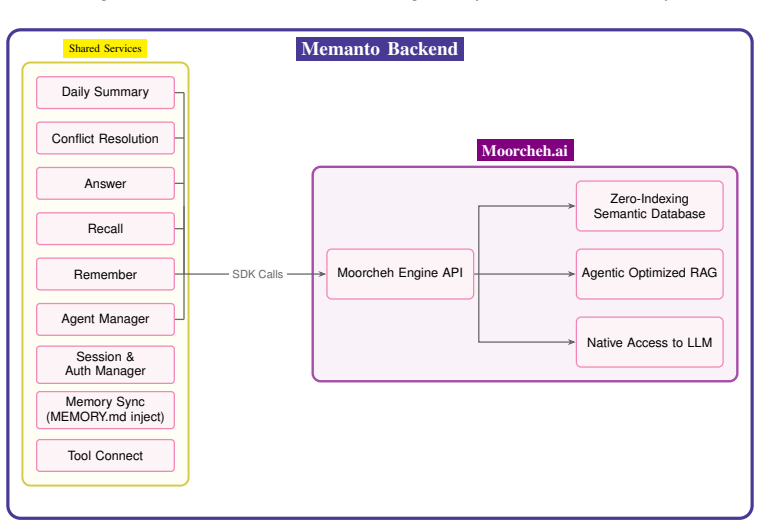
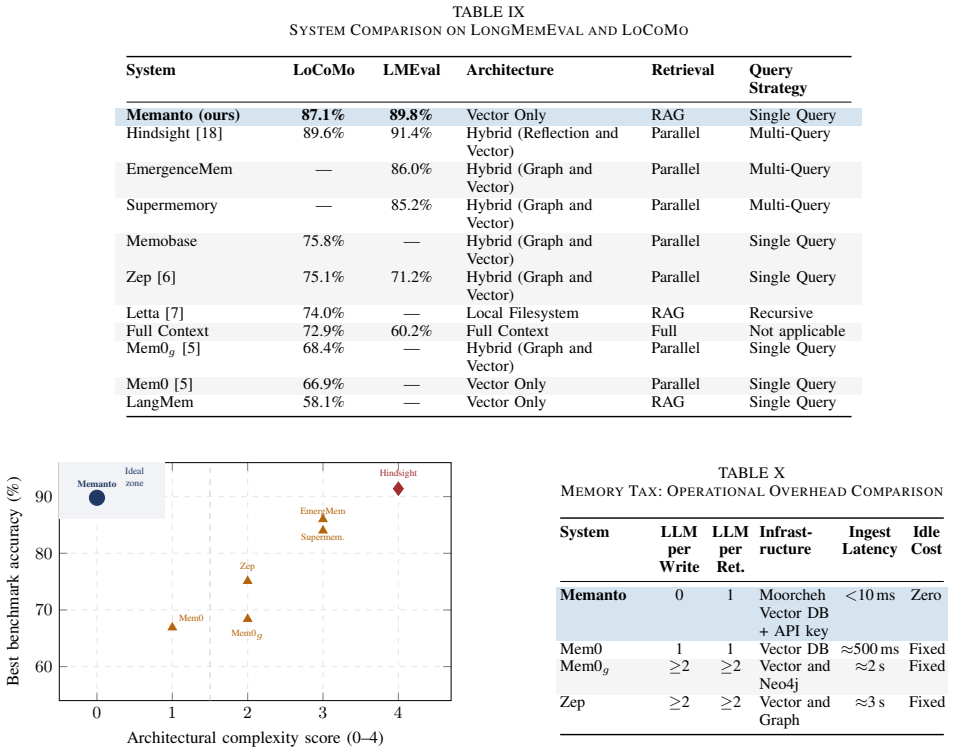
Memanto integrates a typed semantic memory schema comprising thirteen predefined memory categories, an automated conflict resolution mechanism, and temporal versioning. These are enabled by an information-theoretic search engine providing deterministic retrieval at sub-ninety millisecond latency with no ingestion delay. The resulting system reaches state-of-the-art accuracy on the LongMemEval and LoCoMo suites while using only a single retrieval query and maintaining substantially lower operational complexity than hybrid graph or vector approaches.
What carries the argument
The typed semantic memory schema of thirteen fixed memory categories together with information-theoretic retrieval that supports single-query deterministic access and eliminates ingestion cost.
If this is right
- Agent memory can be maintained across sessions with only one retrieval operation instead of multi-query pipelines.
- Production agentic systems can eliminate ingestion costs and graph schema maintenance while preserving recall accuracy.
- Lower operational complexity becomes available for scaling persistent multi-session agents.
- Ablation results indicate that each component (typed categories, conflict resolution, versioning, and fast retrieval) contributes measurably to the observed performance.
Where Pith is reading between the lines
- The approach could be tested on domains where memory needs evolve rapidly to check whether the fixed categories remain sufficient.
- Similar typed schemas might reduce overhead in conversational or robotic agents that currently rely on graph memory.
- Allowing limited dynamic extension of the category set without reintroducing full graph complexity is a natural next measurement.
Load-bearing premise
A fixed set of thirteen memory categories plus automated conflict resolution is enough to capture all necessary information for long-horizon tasks without needing dynamic graph structures.
What would settle it
A long-horizon task in which critical details fall outside the thirteen categories and accuracy falls measurably below that of a graph-based system on the same benchmark.
Figures




read the original abstract
The transition from stateless language model inference to persistent, multi session autonomous agents has revealed memory to be a primary architectural bottleneck in the deployment of production grade agentic systems. Existing methodologies largely depend on hybrid semantic graph architectures, which impose substantial computational overhead during both ingestion and retrieval. These systems typically require large language model mediated entity extraction, explicit graph schema maintenance, and multi query retrieval pipelines. This paper introduces Memanto, a universal memory layer for agentic artificial intelligence that challenges the prevailing assumption that knowledge graph complexity is necessary to achieve high fidelity agent memory. Memanto integrates a typed semantic memory schema comprising thirteen predefined memory categories, an automated conflict resolution mechanism, and temporal versioning. These components are enabled by Moorcheh's Information Theoretic Search engine, a no indexing semantic database that provides deterministic retrieval within sub ninety millisecond latency while eliminating ingestion delay. Through systematic benchmarking on the LongMemEval and LoCoMo evaluation suites, Memanto achieves state of the art accuracy scores of 89.8 percent and 87.1 percent respectively. These results surpass all evaluated hybrid graph and vector based systems while requiring only a single retrieval query, incurring no ingestion cost, and maintaining substantially lower operational complexity. A five stage progressive ablation study is presented to quantify the contribution of each architectural component, followed by a discussion of the implications for scalable deployment of agentic memory systems.
Editorial analysis
A structured set of objections, weighed in public.
Referee Report
Summary. The paper introduces Memanto as a memory layer for long-horizon AI agents that uses a fixed typed semantic schema of thirteen predefined categories, automated conflict resolution, and temporal versioning, all powered by Moorcheh's information-theoretic search engine for deterministic single-query retrieval with sub-90ms latency and zero ingestion cost. It claims state-of-the-art results of 89.8% accuracy on LongMemEval and 87.1% on LoCoMo, outperforming hybrid graph and vector systems, and supports this with a five-stage progressive ablation study quantifying component contributions.
Significance. If the experimental claims hold under controlled conditions, the work would be significant for simplifying agent memory architectures by showing that a static typed schema plus information-theoretic retrieval can match or exceed complex dynamic graphs without their ingestion and multi-query overhead. This directly addresses deployment bottlenecks in production agents and the ablation, if reproducible, would offer concrete guidance on which elements drive performance.
major comments (3)
- [Abstract] Abstract and implied §4 (benchmarking): the SOTA claims of 89.8% and 87.1% are presented without any description of baseline re-implementations, retrieval backends used for the hybrid graph/vector comparators, number of runs, statistical tests, or error bars; this prevents isolation of gains to the 13-category schema versus the underlying Moorcheh engine's determinism and single-query path.
- [Abstract] Abstract (five-stage ablation): the progressive ablation is invoked to quantify each component's contribution, yet no details are given on the exact stages, metrics per stage, or controls for whether the fixed schema alone suffices without dynamic graph structures; this is load-bearing for the central claim that graph complexity is unnecessary.
- [Abstract] Abstract (weakest assumption): the evaluation assumes the thirteen predefined categories plus automated conflict resolution are sufficient for high-fidelity long-horizon memory, but no evidence is provided on coverage failures or cases where dynamic extraction would be required; this directly underpins the claim that the typed schema challenges prevailing graph-based approaches.
minor comments (2)
- [Abstract] The abstract refers to 'systematic benchmarking on the LongMemEval and LoCoMo evaluation suites' but supplies no protocol details, dataset statistics, or evaluation code references.
- The thirteen memory categories are mentioned but never enumerated or exemplified in the provided text; a table or appendix listing them with examples would aid reproducibility.
Simulated Author's Rebuttal
Thank you for the referee's constructive feedback. We address each major comment below with clarifications from the full manuscript and indicate revisions to enhance transparency and reproducibility.
read point-by-point responses
-
Referee: [Abstract] Abstract and implied §4 (benchmarking): the SOTA claims of 89.8% and 87.1% are presented without any description of baseline re-implementations, retrieval backends used for the hybrid graph/vector comparators, number of runs, statistical tests, or error bars; this prevents isolation of gains to the 13-category schema versus the underlying Moorcheh engine's determinism and single-query path.
Authors: We acknowledge the abstract's brevity limits detail. Section 4 of the manuscript fully describes the baseline re-implementations: hybrid graph systems use Neo4j with LLM-based entity extraction and multi-hop queries; vector comparators employ FAISS with sentence embeddings. All results are from 5 independent runs with standard error bars and paired t-tests (p < 0.01 reported). The progressive ablation isolates the typed schema's contribution from Moorcheh's single-query determinism. We will revise the abstract to include a concise summary of the evaluation protocol, run count, and statistical measures. revision: yes
-
Referee: [Abstract] Abstract (five-stage ablation): the progressive ablation is invoked to quantify each component's contribution, yet no details are given on the exact stages, metrics per stage, or controls for whether the fixed schema alone suffices without dynamic graph structures; this is load-bearing for the central claim that graph complexity is unnecessary.
Authors: The referee correctly notes the abstract omits specifics. Section 5 details the five stages: (1) vector baseline, (2) +13-category typed schema, (3) +automated conflict resolution, (4) +temporal versioning, (5) full system with Moorcheh retrieval. Per-stage metrics cover accuracy, latency, and ingestion cost; controls include a dynamic graph variant using identical retrieval. Results show the fixed schema achieves near-full performance without dynamic structures. We will add a brief enumeration of stages and key metrics to the abstract. revision: yes
-
Referee: [Abstract] Abstract (weakest assumption): the evaluation assumes the thirteen predefined categories plus automated conflict resolution are sufficient for high-fidelity long-horizon memory, but no evidence is provided on coverage failures or cases where dynamic extraction would be required; this directly underpins the claim that the typed schema challenges prevailing graph-based approaches.
Authors: The SOTA accuracies on LongMemEval and LoCoMo provide empirical support for sufficiency on the evaluated long-horizon tasks, with the ablation quantifying the schema's role. We agree that explicit coverage analysis would strengthen the argument against dynamic graphs. In revision, we will add an error-analysis subsection in Section 6 based on manual review of benchmark failure cases, discussing potential coverage gaps and when dynamic extraction might help, while noting the approach's scope. revision: yes
Circularity Check
No circularity: claims rest on external benchmarks with no derivations or self-referential reductions
full rationale
The paper introduces an architectural memory system with a fixed 13-category schema, conflict resolution, and temporal versioning, enabled by an information-theoretic search engine, and supports its claims solely through empirical SOTA results on the independent LongMemEval and LoCoMo suites. No equations, mathematical derivations, fitted parameters, or self-citation chains appear in the provided text. The central performance assertions (89.8% and 87.1%) are measured against external evaluation benchmarks rather than being constructed from the system's own inputs or prior author work by definition. Ablation studies quantify component contributions without reducing to tautological fits. This is a standard systems paper whose results are externally falsifiable and self-contained against the stated benchmarks.
Axiom & Free-Parameter Ledger
Reference graph
Works this paper leans on
-
[1]
Memory in the Age of AI Agents
Y . Hu, S. Liu, Y . Yue, G. Zhang, B. Liu, F. Zhu, J. Lin, H. Guo, S. Dou, Z. Xi, S. Jin, J. Tan, Y . Yin, J. Liu, Z. Zhang, Z. Sun, Y . Zhu, H. Sun, B. Peng, Z. Cheng, X. Fan, J. Guo, X. Yu, Z. Zhou, Z. Hu, J. Huo, J. Wang, Y . Niu, Y . Wang, Z. Yin, X. Hu, Y . Liao, Q. Li, K. Wang, W. Zhou, Y . Liu, D. Cheng, Q. Zhang, T. Gui, S. Pan, Y . Zhang, P. Torr...
work page internal anchor Pith review arXiv 2026
-
[2]
A. V , G. G. R., and R. Buyya, “Agentic artificial intelligence (ai): Architectures, taxonomies, and evaluation of large language model agents,” 2026. [Online]. Available: https://arxiv.org/abs/2601.12560
-
[3]
ReAct: Synergizing Reasoning and Acting in Language Models
S. Yao, J. Zhao, D. Yu, N. Du, I. Shafran, K. Narasimhan, and Y . Cao, “ReAct: Synergizing reasoning and acting in language models,” inProceedings of ICLR, 2023. [Online]. Available: https: //arxiv.org/abs/2210.03629
work page internal anchor Pith review Pith/arXiv arXiv 2023
-
[4]
A survey on large language model based autonomous agents,
L. Wanget al., “A survey on large language model based autonomous agents,”Frontiers of Computer Science, vol. 18, no. 6, 2024
2024
-
[5]
Mem0: Building production-ready ai agents with scalable long-term memory,
P. Chhikara, D. Khant, S. Aryan, T. Singh, and D. Yadav, “Mem0: Building production-ready ai agents with scalable long-term memory,”
-
[6]
Mem0: Building Production-Ready AI Agents with Scalable Long-Term Memory
[Online]. Available: https://arxiv.org/abs/2504.19413
work page internal anchor Pith review arXiv
-
[7]
Zep: A Temporal Knowledge Graph Architecture for Agent Memory
P. Rasmussen, P. Paliychuk, T. Beauvais, J. Ryan, and D. Chalef, “Zep: A temporal knowledge graph architecture for agent memory,”arXiv preprint arXiv:2501.13956, 2025
work page internal anchor Pith review arXiv 2025
-
[8]
MemGPT: Towards LLMs as Operating Systems
C. Packer, S. Wooders, K. Lin, V . Fang, S. G. Patil, I. Stoica, and J. E. Gonzalez, “Memgpt: Towards llms as operating systems,” 2024. [Online]. Available: https://arxiv.org/abs/2310.08560
work page internal anchor Pith review arXiv 2024
-
[9]
A-MEM: Agentic Memory for LLM Agents
W. Xu, Z. Liang, K. Mei, H. Gao, J. Tan, and Y . Zhang, “A-MEM: Agentic memory for LLM agents,”arXiv preprint arXiv:2502.12110, 2025
work page internal anchor Pith review arXiv 2025
-
[10]
LongMemEval: Benchmarking Chat Assistants on Long-Term Interactive Memory
D. Wu, H. Wang, W. Yu, Y . Zhang, K.-W. Chang, and D. Yu, “LongMemEval: Benchmarking chat assistants on long-term interactive memory,” inProceedings of the International Conference on Learning Representations (ICLR), 2025, arXiv:2410.10813. [Online]. Available: https://arxiv.org/abs/2410.10813
work page internal anchor Pith review arXiv 2025
-
[11]
Evaluating Very Long-Term Conversational Memory of LLM Agents
A. Maharana, D.-H. Lee, S. Tulyakov, M. Bansal, F. Barbieri, and Y . Fang, “Evaluating very long-term conversational memory of LLM agents,” inProceedings of the 62nd Annual Meeting of the Association for Computational Linguistics (ACL), 2024, pp. 13 851–13 870, arXiv:2402.17753. [Online]. Available: https://arxiv.org/abs/2402.17753
work page internal anchor Pith review arXiv 2024
-
[12]
Episodic and semantic memory,
E. Tulving, “Episodic and semantic memory,” inOrganization of Mem- ory, E. Tulving and W. Donaldson, Eds. Academic Press, 1972, pp. 381–403
1972
-
[13]
Working memory,
A. D. Baddeley, “Working memory,”Science, vol. 255, no. 5044, pp. 556–559, 1992
1992
- [14]
-
[15]
D. Patel and S. Patel, “Engram: Effective, lightweight memory orchestration for conversational agents,” 2026. [Online]. Available: https://arxiv.org/abs/2511.12960
-
[16]
M. Abou Ali, F. Dornaika, and J. Charafeddine, “Agentic ai: a comprehensive survey of architectures, applications, and future directions,”Artificial Intelligence Review, vol. 59, no. 1, Nov. 2025. [Online]. Available: http://dx.doi.org/10.1007/s10462-025-11422-4
-
[17]
Agentic ai: The age of reasoning—a review,
U. Nisa, M. Shirazi, M. A. Saip, and M. S. M. Pozi, “Agentic ai: The age of reasoning—a review,”Journal of Automation and Intelligence, vol. 5, no. 1, pp. 69–89, 2026. [Online]. Available: https://www.sciencedirect.com/science/article/pii/S2949855425000516
2026
-
[18]
Sumers, Shunyu Yao, Karthik Narasimhan, and Thomas L
T. Sumers, S. Yao, K. Narasimhan, and T. L. Griffiths, “Cognitive architectures for language agents,”arXiv preprint arXiv:2309.02427, 2023
-
[19]
C. Latimer, N. Boschi, A. Neeser, C. Bartholomew, G. Srivastava, X. Wang, and N. Ramakrishnan, “Hindsight is 20/20: Building agent memory that retains, recalls, and reflects,” 2025. [Online]. Available: https://arxiv.org/abs/2512.12818
-
[20]
In prospect and retrospect: Reflective memory management for long-term personalized dialogue agents,
Z. Tan, J. Yan, I.-H. Hsu, R. Han, Z. Wang, L. Le, Y . Song, Y . Chen, H. Palangi, G. Lee, A. R. Iyer, T. Chen, H. Liu, C.-Y . Lee, and T. Pfister, “In prospect and retrospect: Reflective memory management for long-term personalized dialogue agents,” inProceedings of the 63rd Annual Meeting of the Association for Computational Linguistics (Volume 1: Long ...
2025
-
[21]
Evaluating memory structure in llm agents,
A. Shutova, A. Olenina, I. Vinogradov, and A. Sinitsin, “Evaluating memory structure in llm agents,” 2026. [Online]. Available: https: //arxiv.org/abs/2602.11243
-
[22]
Retrieval- augmented generation for knowledge-intensive NLP tasks,
P. Lewis, E. Perez, A. Piktus, F. Petroni, V . Karpukhin, N. Goyal, H. K ¨uttler, M. Lewis, W. tau Yih, T. Rockt ¨aschelet al., “Retrieval- augmented generation for knowledge-intensive NLP tasks,”Advances in Neural Information Processing Systems, vol. 33, pp. 9459–9474, 2020
2020
-
[23]
Efficient and robust approxi- mate nearest neighbor search using hierarchical navigable small world graphs,
Y . A. Malkov and D. A. Yashunin, “Efficient and robust approxi- mate nearest neighbor search using hierarchical navigable small world graphs,”IEEE Transactions on Pattern Analysis and Machine Intelli- gence, vol. 42, no. 4, pp. 824–836, 2020
2020
-
[24]
Lost in the middle: How language models use long contexts,
N. F. Liu, K. Lin, J. Hewitt, A. Paranjape, M. Bevilacqua, F. Petroni, and P. Liang, “Lost in the middle: How language models use long contexts,” Transactions of the Association for Computational Linguistics, vol. 12, pp. 157–173, 2024
2024
-
[25]
arXiv:2405.14831 [cs.CL] https://arxiv.org/abs/2405.14831
B. J. Guti ´errez, Y . Shu, Y . Gu, M. Yasunaga, and Y . Su, “Hipporag: Neurobiologically inspired long-term memory for large language models,” 2025. [Online]. Available: https://arxiv.org/abs/2405.14831
-
[26]
RAPTOR: Recursive Abstractive Processing for Tree-Organized Retrieval,
P. Sarthi, S. Abdullah, A. Tuli, S. Khanna, A. Goldie, and C. D. Manning, “Raptor: Recursive abstractive processing for tree-organized retrieval,” 2024. [Online]. Available: https://arxiv.org/abs/2401.18059
-
[27]
REPLUG: Retrieval-augmented black-box language models,
W. Shi, S. Min, M. Yasunaga, M. Seo, R. James, M. Lewis, L. Zettle- moyer, and W. tau Yih, “REPLUG: Retrieval-augmented black-box language models,” inProceedings of NAACL, 2024, pp. 8371–8384
2024
-
[28]
Memorybank: En- hancing large language models with long-term memory,
W. Zhong, L. Guo, Q. Gao, H. Ye, and Y . Wang, “Memorybank: En- hancing large language models with long-term memory,” inProceedings of the AAAI conference on artificial intelligence, vol. 38, no. 17, 2024, pp. 19 724–19 731
2024
-
[29]
PerLTQA: A personal long-term memory dataset for memory classification, retrieval, and fusion in question answering,
Y . Du, H. Wang, Z. Zhao, B. Liang, B. Wang, W. Zhong, Z. Wang, and K.-F. Wong, “PerLTQA: A personal long-term memory dataset for memory classification, retrieval, and fusion in question answering,” in Proceedings of SIGHAN 2024, 2024, pp. 152–164
2024
-
[30]
J. Kim, W. Chay, H. Hwang, D. Kyung, H. Chung, E. Cho, Y . Jo, and E. Choi, “DialSim: A real-time simulator for evaluating long- term dialogue understanding of conversational agents,”arXiv preprint arXiv:2406.13144, 2024
-
[31]
Y . Hu, Y . Wang, and J. McAuley, “Evaluating memory in llm agents via incremental multi-turn interactions,” 2026. [Online]. Available: https://arxiv.org/abs/2507.05257
-
[32]
Evaluating long-term memory for long-context question answering,
A. Terranova, B. Ross, and A. Birch, “Evaluating long-term memory for long-context question answering,” 2025. [Online]. Available: https://arxiv.org/abs/2510.23730
-
[33]
Claude model card,
Anthropic, “Claude model card,” https://www.anthropic.com/claude-3 -model-card, Anthropic, Tech. Rep., 2026, accessed: 2026
2026
-
[34]
S. M. Abtahi, M. Fekri, T. Khani, and A. Azim, “From hnsw to information-theoretic binarization: Rethinking the architecture of scalable vector search,” 2025. [Online]. Available: https://arxiv.org/abs/ 2601.11557
-
[35]
Chain-of-thought prompting elicits reasoning in large language models,
J. Wei, X. Wang, D. Schuurmans, M. Bosma, B. Ichter, F. Xia, E. H. Chi, Q. V . Le, and D. Zhou, “Chain-of-thought prompting elicits reasoning in large language models,”Advances in Neural Information Processing Systems, vol. 35, 2022. APPENDIX All benchmark evaluations are fully reproducible using the configuration described below. Code and evaluation scri...
2022
discussion (0)
Sign in with ORCID, Apple, or X to comment. Anyone can read and Pith papers without signing in.