Recognition: unknown
A Hybrid Reinforcement and Self-Supervised Learning Aided Benders Decomposition Algorithm
Pith reviewed 2026-05-09 20:26 UTC · model grok-4.3
The pith
A graph-based reinforcement learning agent and KKT-informed neural network accelerate generalized Benders decomposition.
A machine-rendered reading of the paper's core claim, the machinery that carries it, and where it could break.
Core claim
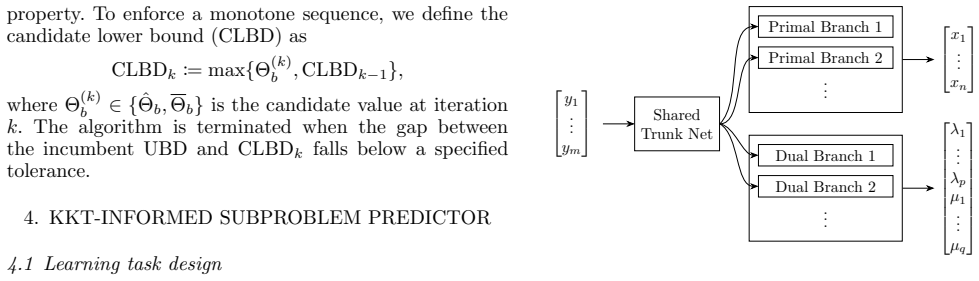
A graph based reinforcement learning agent operates on a bipartite representation of the master problem and, together with a verification mechanism, determines the integer variable assignments that solve the master problem. These assignments are then used as inputs to a KKT informed neural network, trained via self supervision to predict primal dual solutions that approximately satisfy the Karush Kuhn Tucker conditions of the subproblem. The predicted solutions are used to construct Benders cuts directly. When evaluated on a mixed integer nonlinear programming case study, the framework achieves a 57.5% reduction in solution time relative to classical GBD while consistently recovering optimal
What carries the argument
Graph-based reinforcement learning agent on bipartite master problem representation with verification, paired with a self-supervised KKT-informed neural network that predicts approximate primal-dual subproblem solutions for direct Benders cut generation.
If this is right
- The master problem is solved by learning rather than repeated optimization calls.
- Valid Benders cuts can be generated from approximate rather than exact subproblem solutions.
- The overall algorithm converges to the same optimal solutions as classical GBD.
- Solution time is reduced by more than half on the evaluated MINLP instances.
Where Pith is reading between the lines
- This approach may extend to other cutting-plane or decomposition methods in optimization.
- Self-supervised training could enable the method to adapt online to varying problem parameters.
- Success depends on the verification step preventing bad integer assignments from the RL agent.
- Further speedups might come from integrating the two learning components more tightly.
Load-bearing premise
Approximate satisfaction of the KKT conditions by the neural network predictions is sufficient to produce Benders cuts that are valid and lead to convergence to the optimum.
What would settle it
If the hybrid algorithm produces final solutions worse than the known optimum or if the cuts it generates are invalid on the test instances, causing failure to converge or longer run times.
Figures

read the original abstract
We propose a hybrid reinforcement and self-supervised learning framework for accelerating generalized Benders decomposition (GBD). In this framework, a graph based reinforcement learning agent operates on a bipartite representation of the master problem and, together with a verification mechanism, determines the integer variable assignments that solve the master problem. These assignments are then used as inputs to a KKT informed neural network, trained via self supervision to predict primal dual solutions that approximately satisfy the Karush Kuhn Tucker conditions of the subproblem. The predicted solutions are used to construct Benders cuts directly. The framework is evaluated on a mixed integer nonlinear programming case study, where it achieves a 57.5% reduction in solution time relative to classical GBD while consistently recovering optimal solutions across all test instances.
Editorial analysis
A structured set of objections, weighed in public.
Referee Report
Summary. The manuscript proposes a hybrid reinforcement and self-supervised learning framework to accelerate generalized Benders decomposition (GBD) for mixed-integer nonlinear programs. A graph-based RL agent, operating on a bipartite representation of the master problem together with a verification mechanism, generates integer variable assignments. These assignments are passed to a KKT-informed neural network trained via self-supervision to predict approximate primal-dual solutions for the subproblem; the predictions are inserted directly into the standard Benders cut formula. On an MINLP case study the method reports a 57.5% reduction in solution time relative to classical GBD while recovering optimal solutions on all test instances.
Significance. If the generated cuts remain valid and the approach generalizes beyond the single case study, the hybrid RL-NN acceleration could meaningfully reduce the computational burden of decomposition methods for large-scale MINLPs by limiting the number of exact subproblem solves. The combination of graph RL for discrete master decisions and self-supervised KKT-informed prediction for continuous subproblems is technically interesting and the reported empirical speed-up is substantial; however, the absence of cut-validity guarantees or residual bounds limits the immediate theoretical impact.
major comments (3)
- [abstract and method framework] The central construction (abstract and method description) inserts primal-dual pairs that only approximately satisfy the KKT conditions of the subproblem into the standard Benders optimality-cut formula. Because the dual multipliers produced by the network need not be feasible for the subproblem dual at the fixed integer point, the resulting cut is not guaranteed to be a valid supporting hyperplane of the recourse function. The manuscript provides no residual bounds, feasibility certificates, or proof that the attained approximation level preserves cut validity; the reported consistent recovery of optima therefore rests on an unverified empirical property.
- [abstract and RL component description] The verification mechanism that is claimed to ensure the graph-based RL agent solves the master problem exactly is described only at a high level (abstract). No details are given on its implementation, computational cost, or formal guarantee that the integer assignments passed to the NN are globally optimal for the current master problem; without this, the overall algorithm's correctness cannot be assessed.
- [training procedure and numerical results] The self-supervised training procedure for the KKT-informed network (loss penalizing stationarity, primal/dual feasibility, and complementarity residuals) is not accompanied by any analysis of how the attained residual level affects cut strength or validity across the range of integer assignments encountered during decomposition. Table or figure reporting residual statistics versus cut validity or iteration count would be required to substantiate the 57.5% speedup claim.
minor comments (2)
- [method section] Notation for the bipartite graph representation of the master problem and for the KKT residual loss should be introduced with explicit definitions and consistent symbols throughout.
- [numerical experiments] The MINLP case study should report instance sizes, number of Benders iterations, and a direct comparison of cut quality (e.g., lower-bound tightness) between the learned cuts and classical cuts.
Simulated Author's Rebuttal
We thank the referee for the constructive and detailed comments, which help clarify the theoretical and empirical aspects of our hybrid RL-self-supervised framework for accelerating GBD. We address each major comment point by point below and indicate the revisions we will make to the manuscript.
read point-by-point responses
-
Referee: The central construction (abstract and method description) inserts primal-dual pairs that only approximately satisfy the KKT conditions of the subproblem into the standard Benders optimality-cut formula. Because the dual multipliers produced by the network need not be feasible for the subproblem dual at the fixed integer point, the resulting cut is not guaranteed to be a valid supporting hyperplane of the recourse function. The manuscript provides no residual bounds, feasibility certificates, or proof that the attained approximation level preserves cut validity; the reported consistent recovery of optima therefore rests on an unverified empirical property.
Authors: We acknowledge that the KKT-informed network produces approximate primal-dual solutions and that the manuscript does not supply formal residual bounds or a proof of cut validity. The reported recovery of optimal solutions across all instances is indeed an empirical observation. In the revised manuscript we will add a new subsection in the method and results sections that (i) explicitly states the lack of theoretical guarantees, (ii) reports the observed residual statistics (stationarity, feasibility, and complementarity) for every generated cut, and (iii) discusses the practical conditions under which the approximations have preserved convergence in the tested MINLP. This will make the empirical nature of the correctness claim transparent. revision: partial
-
Referee: The verification mechanism that is claimed to ensure the graph-based RL agent solves the master problem exactly is described only at a high level (abstract). No details are given on its implementation, computational cost, or formal guarantee that the integer assignments passed to the NN are globally optimal for the current master problem; without this, the overall algorithm's correctness cannot be assessed.
Authors: The verification step invokes a standard MIP solver on the current master problem after the RL agent proposes an integer assignment; only assignments that are certified optimal by the solver are forwarded to the neural network. This provides a formal guarantee that the master problem is solved exactly at every iteration. We will expand the algorithm description (Section 3) with pseudocode, the specific solver and tolerance settings used, and a short complexity discussion showing that the verification overhead is negligible compared with the subproblem solves that are avoided. These additions will allow readers to assess the overall correctness. revision: yes
-
Referee: The self-supervised training procedure for the KKT-informed network (loss penalizing stationarity, primal/dual feasibility, and complementarity residuals) is not accompanied by any analysis of how the attained residual level affects cut strength or validity across the range of integer assignments encountered during decomposition. Table or figure reporting residual statistics versus cut validity or iteration count would be required to substantiate the 57.5% speedup claim.
Authors: We agree that a quantitative link between residual levels and cut quality would strengthen the empirical claims. In the revised version we will add a new table (and accompanying figure) that reports, for each test instance and across all decomposition iterations, the mean and maximum residuals achieved by the network together with the number of iterations required for convergence and the final objective gap. A short discussion will relate these residuals to the observed 57.5 % speedup, thereby providing the requested substantiation while remaining within the scope of the current case study. revision: yes
Circularity Check
No circularity: hybrid learning approximates external GBD steps without self-referential reduction
full rationale
The framework trains a graph RL agent (with verification) to solve the master problem and a self-supervised NN to output approximate primal-dual pairs for the subproblem by penalizing KKT residuals. These outputs are then inserted into the standard Benders cut formula. Neither component is defined in terms of the other or of the final cuts; training targets (KKT stationarity/feasibility/complementarity) are independent of the cut validity claim, which is supported only by empirical recovery of optima on the MINLP instances. No equation reduces to its input by construction, no fitted parameter is relabeled as a prediction of a related quantity, and no load-bearing premise rests on self-citation. The derivation therefore remains self-contained against external optimization benchmarks.
Axiom & Free-Parameter Ledger
free parameters (2)
- Neural network parameters
- Reinforcement learning policy parameters
axioms (2)
- domain assumption A bipartite graph representation of the master problem is suitable for RL processing.
- ad hoc to paper Approximate satisfaction of KKT conditions by predicted solutions is sufficient to generate valid Benders cuts.
Reference graph
Works this paper leans on
-
[1]
Partitioning procedures for solving mixed-variables programming problems , author=. Numer. Math , volume=
-
[2]
Electric Power Systems Research , volume=
Physics-informed neural networks for ac optimal power flow , author=. Electric Power Systems Research , volume=. 2022 , publisher=
2022
-
[3]
Learning continuous
Warrington, Joseph , booktitle=. Learning continuous. 2019 , organization=
2019
-
[4]
Inexact cuts in
Zakeri, Golbon and Philpott, Andrew B and Ryan, David M , journal=. Inexact cuts in. 2000 , publisher=
2000
-
[5]
arXiv preprint arXiv:2107.10201 , year=
Learning a large neighborhood search algorithm for mixed integer programs , author=. arXiv preprint arXiv:2107.10201 , year=
-
[6]
Computers & Chemical Engineering , volume=
Deep reinforcement learning control of hydraulic fracturing , author=. Computers & Chemical Engineering , volume=. 2021 , publisher=
2021
-
[7]
Reinforcement learning based optimal control of batch processes using
Yoo, Haeun and Kim, Boeun and Kim, Jong Woo and Lee, Jay H , journal=. Reinforcement learning based optimal control of batch processes using. 2021 , publisher=
2021
-
[8]
Learning to cut by looking ahead:
Paulus, Max B and Zarpellon, Giulia and Krause, Andreas and Charlin, Laurent and Maddison, Chris , booktitle=. Learning to cut by looking ahead:. 2022 , organization=
2022
-
[9]
arXiv preprint arXiv:2206.14987 , year=
Lookback for learning to branch , author=. arXiv preprint arXiv:2206.14987 , year=
-
[10]
Algorithm runtime prediction:
Hutter, Frank and Xu, Lin and Hoos, Holger H and Leyton-Brown, Kevin , journal=. Algorithm runtime prediction:. 2014 , publisher=
2014
-
[11]
Computers & Chemical Engineering , volume=
Improvements for decomposition based methods utilized in the development of multi-scale energy systems , author=. Computers & Chemical Engineering , volume=. 2023 , publisher=
2023
-
[12]
Deterministic electric power infrastructure planning:
Lara, Cristiana L and Mallapragada, Dharik S and Papageorgiou, Dimitri J and Venkatesh, Aranya and Grossmann, Ignacio E , journal=. Deterministic electric power infrastructure planning:. 2018 , publisher=
2018
-
[13]
Design and operation of modular biorefinery supply chain under uncertainty using generalized
Luo, Yuqing and Ierapetritou, Marianthi , journal=. Design and operation of modular biorefinery supply chain under uncertainty using generalized. 2024 , publisher=
2024
-
[14]
Decomposition techniques in mathematical programming:
Conejo, Antonio J and Castillo, Enrique and Minguez, Roberto and Garcia-Bertrand, Raquel , year=. Decomposition techniques in mathematical programming:
-
[15]
Fast continuous and integer
Larsen, Eric and Frejinger, Emma and Gendron, Bernard and Lodi, Andrea , journal=. Fast continuous and integer. 2023 , publisher=
2023
-
[16]
Computationally efficient solution of mixed integer model predictive control problems via machine learning aided
Mitrai, Ilias and Daoutidis, Prodromos , journal=. Computationally efficient solution of mixed integer model predictive control problems via machine learning aided. 2024 , publisher=
2024
-
[17]
AIChE Journal , volume=
A decoupling strategy for protecting sensitive process information in cooperative optimization of power flow , author=. AIChE Journal , volume=. 2022 , publisher=
2022
-
[18]
Improving
Saharidis, Georgios KD and Ierapetritou, Marianthi G , journal=. Improving. 2010 , publisher=
2010
-
[19]
Computational strategies for improved
Su, Lijie and Tang, Lixin and Grossmann, Ignacio E , journal=. Computational strategies for improved. 2015 , publisher=
2015
-
[20]
Initialization of the
Saharidis, Georgios KD and Boile, Maria and Theofanis, Sotiris , journal=. Initialization of the. 2011 , publisher=
2011
-
[21]
Accelerating
Magnanti, Thomas L and Wong, Richard T , journal=. Accelerating. 1981 , publisher=
1981
-
[22]
Integrating operations and control:
Daoutidis, Prodromos and Lee, Jay H and Harjunkoski, Iiro and Skogestad, Sigurd and Baldea, Michael and Georgakis, Christos , journal=. Integrating operations and control:. 2018 , publisher=
2018
-
[23]
Computers & Chemical Engineering , volume=
Process systems engineering--the generation next? , author=. Computers & Chemical Engineering , volume=. 2021 , publisher=
2021
-
[24]
Geometric deep learning:
Bronstein, Michael M and Bruna, Joan and LeCun, Yann and Szlam, Arthur and Vandergheynst, Pierre , journal=. Geometric deep learning:. 2017 , publisher=
2017
-
[25]
Computers & Chemical Engineering , volume=
Graph-based modeling and simulation of complex systems , author=. Computers & Chemical Engineering , volume=. 2019 , publisher=
2019
-
[26]
INFORMS Journal on Computing , volume=
Benders cut classification via support vector machines for solving two-stage stochastic programs , author=. INFORMS Journal on Computing , volume=. 2021 , publisher=
2021
-
[27]
Advances in
Learning combinatorial optimization algorithms over graphs , author=. Advances in
-
[28]
Proceedings of the
Accelerating primal solution findings for mixed integer programs based on solution prediction , author=. Proceedings of the
-
[29]
Transportation Science , volume=
Machine-learning--based column selection for column generation , author=. Transportation Science , volume=. 2021 , publisher=
2021
-
[30]
A multicut generalized
Mitrai, Ilias and Daoutidis, Prodromos , journal=. A multicut generalized. 2022 , publisher=
2022
-
[31]
Numerische Mathematik , volume=
Partitioning procedures for solving mixed-variables programming problems , author=. Numerische Mathematik , volume=. 1962 , publisher=
1962
-
[32]
Aardal, Karen and Larsson, Torbj. A. European Journal of Operational Research , volume=. 1990 , publisher=
1990
-
[33]
, author=
Partitioning procedures for solving mixed-variables programming problems. , author=. Computational Management Science , volume=
-
[34]
Machine learning for combinatorial optimization:
Bengio, Yoshua and Lodi, Andrea and Prouvost, Antoine , journal=. Machine learning for combinatorial optimization:. 2021 , publisher=
2021
-
[35]
Accelerating process control and optimization via machine learning:
Mitrai, Ilias and Daoutidis, Prodromos , journal=. Accelerating process control and optimization via machine learning:. 2025 , publisher=
2025
-
[36]
Machine learning-enhanced
Borozan, Stefan and Giannelos, Spyros and Falugi, Paola and Moreira, Alexandre and Strbac, Goran , journal=. Machine learning-enhanced. 2024 , publisher=
2024
-
[37]
Accelerating
Hasan, Fouad and Kargarian, Amin , journal=. Accelerating. 2024 , publisher=
2024
-
[38]
Generalized
Geoffrion, Arthur M , journal=. Generalized. 1972 , publisher=
1972
-
[39]
, author=
Learning Fast Optimizers for Contextual Stochastic Integer Programs. , author=. UAI , pages=
-
[40]
Neural Combinatorial Optimization with Reinforcement Learning
Neural combinatorial optimization with reinforcement learning , author=. arXiv preprint arXiv:1611.09940 , year=
-
[41]
Accelerate hybrid model predictive control using generalized
Lin, Xuan , journal=. Accelerate hybrid model predictive control using generalized
-
[42]
Rahmaniani, Ragheb and Crainic, Teodor Gabriel and Gendreau, Michel and Rei, Walter , journal=. The. 2017 , publisher=
2017
-
[43]
Advances in Neural Information Processing Systems , volume=
Reinforcement learning for solving the vehicle routing problem , author=. Advances in Neural Information Processing Systems , volume=
-
[44]
Solving corrective risk-based security-constrained optimal power flow with
Wang, Qin and McCalley, James D and Zheng, Tongxin and Litvinov, Eugene , journal=. Solving corrective risk-based security-constrained optimal power flow with. 2016 , publisher=
2016
-
[45]
An accelerated
Pishvaee, Mir Saman and Razmi, Jafar and Torabi, Seyed Ali , journal=. An accelerated. 2014 , publisher=
2014
-
[46]
Maravelias, Christos T and Grossmann, Ignacio E , booktitle=. Using. 2004 , organization=
2004
-
[47]
Application of
Canto, Salvador Perez , journal=. Application of. 2008 , publisher=
2008
-
[48]
Benders Decomposition for stochastic programming-based
Alhaider, Mohemmed and Fan, Lingling and Miao, Zhixin , booktitle=. Benders Decomposition for stochastic programming-based. 2016 , organization=
2016
-
[49]
A hybrid outer-approximation/
De Camargo, Ricardo Saraiva and de Miranda Jr, Gilberto and Ferreira, Ricardo PM , journal=. A hybrid outer-approximation/. 2011 , publisher=
2011
-
[50]
Solving large nonconvex water resources management models using generalized
Cai, Ximing and McKinney, Daene C and Lasdon, Leon S and Watkins Jr, David W , journal=. Solving large nonconvex water resources management models using generalized. 2001 , publisher=
2001
-
[51]
Decomposition based hybrid
Behnamian, Javad , journal=. Decomposition based hybrid. 2014 , publisher=
2014
-
[52]
A nested
Naoum-Sawaya, Joe and Elhedhli, Samir , journal=. A nested. 2010 , publisher=
2010
-
[53]
Crainic, Teodor Gabriel and Rei, Walter and Hewitt, Mike and Maggioni, Francesca , volume=. Partial. 2016 , publisher=
2016
-
[54]
A branch-and-
Gendron, Bernard and Scutell. A branch-and-. European Journal of Operational Research , volume=. 2016 , publisher=
2016
-
[55]
Accelerating
Oliveira, Fabricio and Grossmann, Ignacio E and Hamacher, Silvio , journal=. Accelerating. 2014 , publisher=
2014
-
[56]
Mathematical Programming , volume=
A cross-decomposition scheme with integrated primal--dual multi-cuts for two-stage stochastic programming investment planning problems , author=. Mathematical Programming , volume=. 2016 , publisher=
2016
-
[57]
Practical enhancements to the Magnanti--
Papadakos, Nikolaos , journal=. Practical enhancements to the Magnanti--. 2008 , publisher=
2008
-
[58]
On generating maximal nondominated
Sherali, Hanif D and Lunday, Brian J , journal=. On generating maximal nondominated. 2013 , publisher=
2013
-
[59]
Multicommodity distribution system design by
Geoffrion, Arthur M and Graves, Glenn W , journal=. Multicommodity distribution system design by. 1974 , publisher=
1974
-
[60]
IEEE/ACM Transactions on Networking , volume=
Exact and heuristic algorithms for data-gathering cluster-based wireless sensor network design problem , author=. IEEE/ACM Transactions on Networking , volume=. 2013 , publisher=
2013
-
[61]
Telecommunication Systems , volume=
Benders decomposition algorithms for the fixed-charge relay network design in telecommunications , author=. Telecommunication Systems , volume=. 2014 , publisher=
2014
-
[62]
European Journal of Operational Research , volume=
Decomposition based hybrid metaheuristics , author=. European Journal of Operational Research , volume=. 2015 , publisher=
2015
-
[63]
Speeding up logic-based
Raidl, G. Speeding up logic-based. International Workshop on Hybrid Metaheuristics , pages=. 2014 , organization=
2014
-
[64]
Improving
Poojari, Chandra A and Beasley, John E , journal=. Improving. 2009 , publisher=
2009
-
[65]
A hybrid
Sohn, Hansuk and Tseng, Bill and Bricker, Dennis L , journal=. A hybrid
-
[66]
A hybrid algorithm of tabu search and
Jiang, Wei and Tang, Lixin and Xue, Shixu , booktitle=. A hybrid algorithm of tabu search and. 2009 , organization=
2009
-
[67]
2019 American Control Conference (ACC) , pages=
Safe and near-optimal policy learning for model predictive control using primal-dual neural networks , author=. 2019 American Control Conference (ACC) , pages=. 2019 , organization=
2019
-
[68]
Automatica , volume=
Large scale model predictive control with neural networks and primal active sets , author=. Automatica , volume=. 2022 , publisher=
2022
-
[69]
Multi-agent sensitivity enhanced iterative best response:
Wang, Zijian and Taubner, Tim and Schwager, Mac , journal=. Multi-agent sensitivity enhanced iterative best response:. 2020 , publisher=
2020
-
[70]
IFAC-PapersOnLine , volume=
Fast multi-robot motion planning via imitation learning of mixed-integer programs , author=. IFAC-PapersOnLine , volume=. 2021 , publisher=
2021
-
[71]
2019 18th European Control Conference (ECC) , pages=
Learning binary warm starts for multiparametric mixed-integer quadratic programming , author=. 2019 18th European Control Conference (ECC) , pages=. 2019 , organization=
2019
-
[72]
INFORMS Journal on Computing , volume=
Online mixed-integer optimization in milliseconds , author=. INFORMS Journal on Computing , volume=. 2022 , publisher=
2022
-
[73]
Learning to initialize generalized
Mitrai, Ilias and Daoutidis, Prodromos , journal=. Learning to initialize generalized
-
[74]
Taking the human out of decomposition-based optimization via artificial intelligence,
Mitrai, Ilias and Daoutidis, Prodromos , journal=. Taking the human out of decomposition-based optimization via artificial intelligence,. 2024 , publisher=
2024
-
[75]
Accelerating generalized
Lee, Mengyuan and Ma, Ning and Yu, Guanding and Dai, Huaiyu , journal=. Accelerating generalized. 2020 , publisher=
2020
-
[76]
Machine learning-empowered
Wu, Tao and Chen, Weiwei and Cordeau, Jean-Fran. Machine learning-empowered. INFORMS Journal on Computing , year=
-
[77]
Towards accelerating
Mak, Stephen and Mana, Kyle and Zehtabi, Parisa and Cashmore, Michael and Magazzeni, Daniele and Veloso, Manuela , booktitle=. Towards accelerating
-
[78]
Reinforcement learning with combinatorial actions:
Delarue, Arthur and Anderson, Ross and Tjandraatmadja, Christian , journal=. Reinforcement learning with combinatorial actions:
-
[79]
Advances in Neural Information Processing Systems , volume=
Exact combinatorial optimization with graph convolutional neural networks , author=. Advances in Neural Information Processing Systems , volume=
-
[80]
Solving mixed integer programs using neural networks
Solving mixed integer programs using neural networks , author=. arXiv preprint arXiv:2012.13349 , year=
discussion (0)
Sign in with ORCID, Apple, or X to comment. Anyone can read and Pith papers without signing in.