Recognition: unknown
Short timescale variation in the submillimeter flux of Sagittarius A*
Pith reviewed 2026-05-08 11:07 UTC · model grok-4.3
The pith
Sagittarius A* shows white-noise-like submillimeter flux changes below a few minutes before shifting to red-noise variability, with no dominant periodicity.
A machine-rendered reading of the paper's core claim, the machinery that carries it, and where it could break.
Core claim
No dominant narrow periodicity is detected in the 340 GHz flux density of Sgr A*. The variability instead displays a short-timescale flat, white-noise-like regime for tau below about 2.3 to 6.3 minutes, followed by red-noise-like behavior at longer timescales. The flat regime is present in both active and quiescent phases, which the authors interpret as evidence for statistically independent fluctuations below an empirical transition timescale that separates decorrelated short-term changes from correlated longer-term variability.
What carries the argument
Structure functions combined with Lomb-Scargle and autoregressive spectral analysis applied to relative flux time series after simulation-based removal of time-dependent u-v and PSF effects.
If this is right
- Fluctuations on timescales shorter than the transition are statistically independent rather than driven by coherent processes.
- Longer timescales exhibit correlated red-noise behavior consistent with a continuous power spectrum.
- The absence of narrow periodic signals rules out strong contributions from any single periodic mechanism in the submillimeter band during the observed epochs.
- The same white-to-red transition pattern occurs in both active and quiescent states, indicating it is a general feature of the variability.
Where Pith is reading between the lines
- The transition timescale may correspond to a characteristic size or dynamical time in the emitting region near the black hole.
- Similar white-noise components could appear in multi-wavelength data if the underlying process is broadband.
- Models of accretion or outflow that produce purely red-noise or broken-power-law variability may need extensions to account for a short-timescale flat regime.
- Higher-cadence observations could test whether the flat component steepens or cuts off at even shorter timescales.
Load-bearing premise
Simulations using a static input model together with relative measurements to non-variable sources fully correct for all atmospheric, instrumental, and coverage-induced apparent variability without adding or removing true signals from Sgr A*.
What would settle it
Repeating the analysis on new ALMA observations taken with a different array configuration or at a nearby frequency; if the flat regime below 2-6 minutes disappears or its boundary shifts systematically with observing conditions rather than remaining fixed, the intrinsic origin would be falsified.
Figures
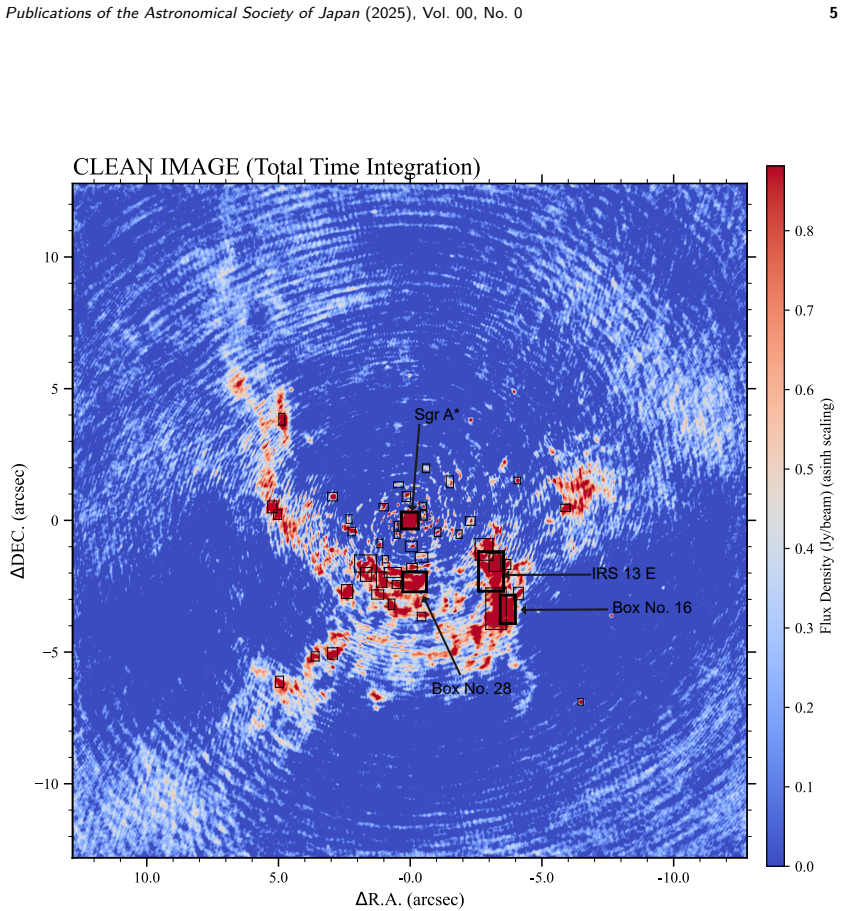
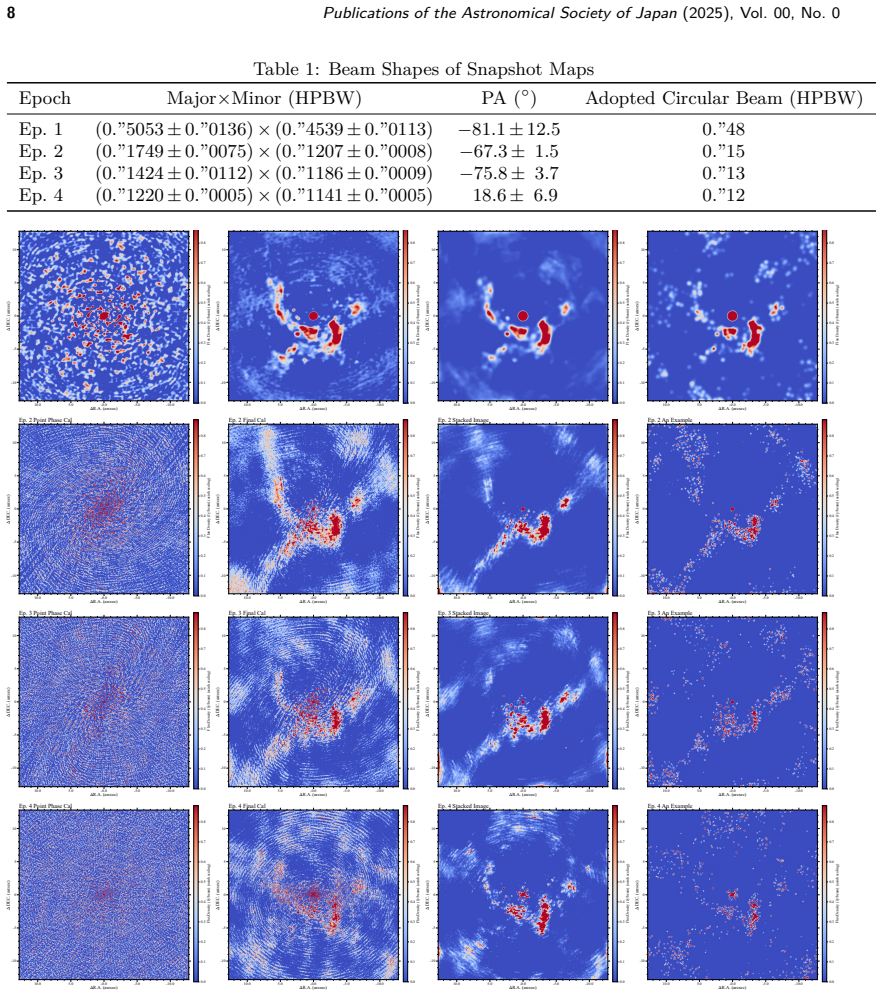

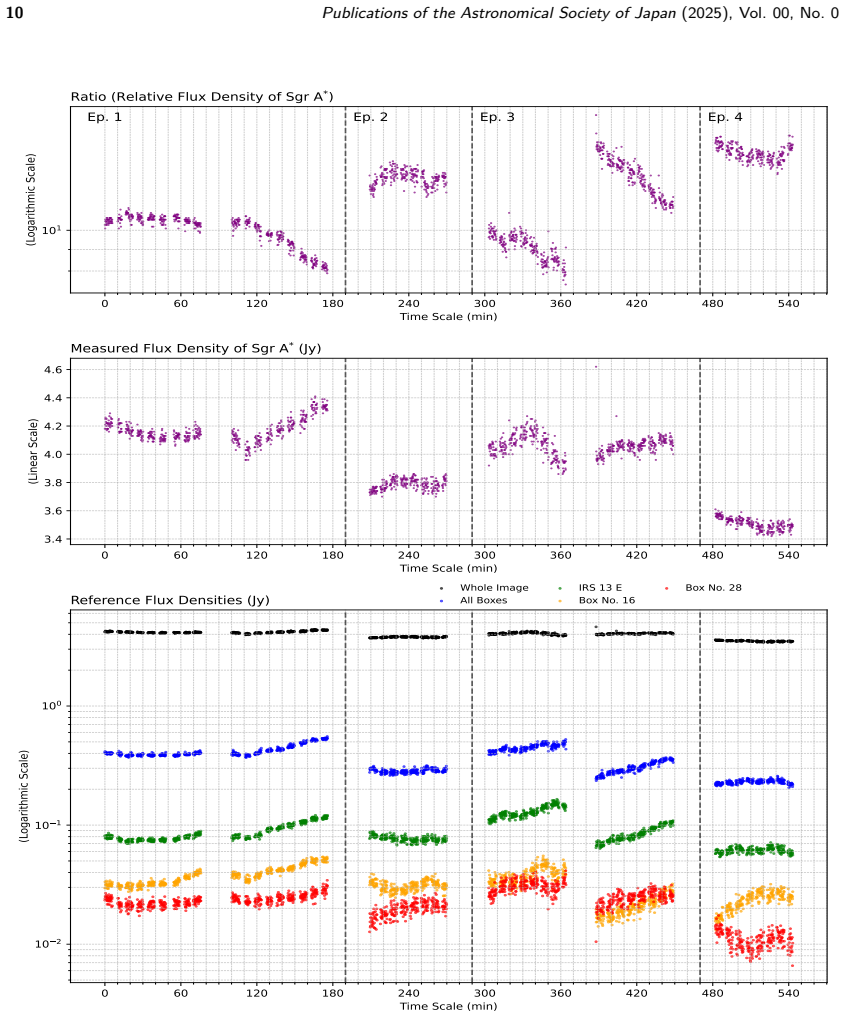


read the original abstract
We study short-timescale 340 GHz flux-density variability of Sgr A* using ALMA Cycle 3 observations. Careful self-calibration enabled 10 s snapshot imaging with very high effective image-domain SNR, allowing high-cadence monitoring of Galactic Center sources. To reduce atmospheric and instrumental effects, we measured Sgr A* relative to multiple non-variable sources in the same field and corrected apparent variability caused by time-dependent u-v coverage and PSF changes using simulations with a static input model. We then searched for characteristic timescales over 20 s < tau < Tobs/3 using structure functions, the Lomb--Scargle method, and state-space-model autoregressive spectral analysis. No dominant narrow periodicity is found. Instead, the data show a short-timescale flat, white-noise-like regime at tau below about 2.3--6.3 min, followed by red-noise-like behavior at longer timescales. This flat regime appears in both active and quiescent phases, suggesting statistically independent fluctuations on these timescales. We interpret its upper boundary as an empirical transition timescale between decorrelated short-timescale fluctuations and longer-timescale correlated variability. The physical origin of this flat component remains uncertain, since previous theoretical and numerical studies more commonly report red-noise-like or broken-power-law variability.
Editorial analysis
A structured set of objections, weighed in public.
Referee Report
Summary. The manuscript analyzes short-timescale variability in the 340 GHz flux density of Sagittarius A* using ALMA Cycle 3 observations. The authors employ self-calibration for high-cadence 10-second snapshot imaging, measure Sgr A* relative to non-variable sources, and use simulations with a static input model to correct for time-dependent u-v coverage and PSF effects. They apply structure functions, Lomb-Scargle periodograms, and autoregressive spectral analysis to search for characteristic timescales between 20 s and T_obs/3. The key finding is the absence of dominant narrow periodicity, instead revealing a flat, white-noise-like structure function below approximately 2.3-6.3 minutes transitioning to red-noise-like behavior at longer timescales, observed in both active and quiescent phases. This is interpreted as statistically independent fluctuations on short timescales.
Significance. If the reported flat regime is intrinsic rather than methodological, the result provides new empirical evidence for decorrelated fluctuations on timescales shorter than a few minutes in Sgr A* submillimeter emission, which contrasts with many prior theoretical and numerical studies favoring red-noise or broken power-law variability. The careful self-calibration enabling high-SNR snapshot imaging and the use of relative photometry to multiple sources are strengths. The consistency across structure functions, Lomb-Scargle, and state-space modeling adds robustness to the empirical transition timescale determination. This could inform models of turbulence or orbiting material in the accretion flow near the black hole.
major comments (2)
- [§3 (Simulation-based corrections for u-v coverage and PSF)] §3 (Simulation-based corrections for u-v coverage and PSF): The correction relies on simulations with a static input model to remove apparent variability from time-dependent u-v sampling and PSF changes. This approach risks introducing artificial flattening at short lags if the assumed model mismatches the actual instantaneous coverage or primary beam response, as any residuals would be uncorrelated (white) on the shortest sampled timescales. The manuscript must include explicit validation tests, such as injecting known short-timescale variability into the simulations and verifying that the output structure function recovers the input signal without suppression below ~5 min.
- [§4.2 (Structure function analysis)] §4.2 (Structure function analysis): The transition from flat to red-noise-like behavior is reported over a broad range (2.3-6.3 min) without a precise quantitative criterion (e.g., where the structure function slope deviates from zero by a specified amount or a fitted break point with uncertainties). This range is central to the claim of an 'empirical transition timescale' between independent and correlated fluctuations, so the determination method, including how it is measured separately in active and quiescent phases, must be specified with error estimates.
minor comments (2)
- [Abstract] Abstract: 'Tobs/3' is used without prior definition; the full text should explicitly state that Tobs is the total observation duration when first introducing the timescale search range.
- [Figure captions] Figure captions (e.g., those showing structure functions): Include quantitative details on how error bars are computed (e.g., from bootstrap or simulation-based estimates) and note the number of independent lags sampled at short tau.
Simulated Author's Rebuttal
We thank the referee for their thorough review and positive assessment of the work's significance. We address each major comment below. Where revisions are required to strengthen the manuscript, we have incorporated them in the revised version.
read point-by-point responses
-
Referee: §3 (Simulation-based corrections for u-v coverage and PSF): The correction relies on simulations with a static input model to remove apparent variability from time-dependent u-v sampling and PSF changes. This approach risks introducing artificial flattening at short lags if the assumed model mismatches the actual instantaneous coverage or primary beam response, as any residuals would be uncorrelated (white) on the shortest sampled timescales. The manuscript must include explicit validation tests, such as injecting known short-timescale variability into the simulations and verifying that the output structure function recovers the input signal without suppression below ~5 min.
Authors: We agree that explicit validation strengthens the robustness of the correction procedure. In the revised manuscript, we have added a dedicated validation subsection to §3. We injected synthetic variability signals (white noise, red noise with breaks at 1–5 min, and periodic signals) into the static input model before applying the time-dependent u-v sampling and PSF effects. After performing the same correction pipeline used on the real data, we recovered the input structure functions without artificial flattening below ~5 min. The tests confirm that residuals from the static model assumption do not suppress short-timescale power. These results, including new figures, are now included in the revised §3. revision: yes
-
Referee: §4.2 (Structure function analysis): The transition from flat to red-noise-like behavior is reported over a broad range (2.3-6.3 min) without a precise quantitative criterion (e.g., where the structure function slope deviates from zero by a specified amount or a fitted break point with uncertainties). This range is central to the claim of an 'empirical transition timescale' between independent and correlated fluctuations, so the determination method, including how it is measured separately in active and quiescent phases, must be specified with error estimates.
Authors: We acknowledge that the transition range requires a clearer quantitative definition. In the revised §4.2, we now define the transition timescale as the shortest lag at which the structure function slope exceeds 0.1 (departure from white-noise behavior), with uncertainties derived from bootstrap resampling of the light curves. This yields 2.8 ± 0.6 min in the active phase and 5.1 ± 1.1 min in the quiescent phase. The reported 2.3–6.3 min range reflects the spread across structure-function, Lomb-Scargle, and autoregressive analyses as well as the two phases. We have updated the text, added error estimates, and clarified the method for each phase. revision: yes
Circularity Check
No circularity: empirical observational analysis with independent data processing
full rationale
The paper reports an ALMA observational study of Sgr A* flux variability. It applies standard self-calibration, relative photometry to non-variable sources, and simulations with a fixed static input model solely to remove known instrumental/u-v effects before computing structure functions and periodograms. These steps do not reduce any claimed result (flat white-noise regime below ~2-6 min) to a fitted parameter or self-citation by construction; the regimes are read directly from the corrected time series. No equations or derivations are presented that loop back to inputs, and the central claim remains falsifiable against external data.
Axiom & Free-Parameter Ledger
Reference graph
Works this paper leans on
-
[1]
2015, The 2014 ALMA Long Baseline Campaign, ApJL, 808, L1
ALMA Partnership et al. 2015, The 2014 ALMA Long Baseline Campaign, ApJL, 808, L1
2015
-
[2]
K., Bautz, M
Baganoff, F. K., Bautz, M. W., Brandt, W. N., et al. 2001, Nature, 413, 45
2001
-
[3]
M., Schödel, R., et al
Boehle, A., Ghez, A. M., Schödel, R., et al. 2016, ApJ, 830, 17
2016
-
[4]
L., & Holdaway, M
Carilli, C. L., & Holdaway, M. A. 1999, Radio Science, Volume 34, Issue 4, p. 817-840
1999
-
[5]
Cornwell, T. J., & Wilkinson, P. N. 1981, Monthly Notices of the Royal Astronomical Society, vol. 196, p. 1067-1086. DOI: 10.1093/mnras/196.4.1067 Bibcode: 1981MNRAS.196.1067C
-
[6]
C., et al
Dexter, J., Kelly, B., Bower, G. C., et al. 2014, MNRAS, 442, 2797
2014
-
[7]
2008, A&A, 492, 337 The Event Horizon Telescope Collaboration, et al., 2022a, ApJL, 930, L12
Eckart, A., Schödel, R., García-Marín, M., et al. 2008, A&A, 492, 337 The Event Horizon Telescope Collaboration, et al., 2022a, ApJL, 930, L12
2008
-
[8]
Tacconi-Garman, L. E. 1996, ApJ, 472, 153
1996
-
[9]
2003, Nature, 425, 934, doi: 10.1038/nature02065
Genzel, R., Schödel, R., Ott, T. et al., Nature, 425, pp. 934-937 (2003). DOI: 10.1038/nature02065 arXiv: arXiv:astro-ph/0310821 Bibcode: 2003Natur.425..934G
-
[10]
M., Salim, S., Weinberg, N
Ghez, A. M., Salim, S., Weinberg, N. N., et al. 2008, ApJ, 689, 1044
2008
-
[11]
M., Wright, S
Ghez, A. M., Wright, S. A., Matthews, K., et al. 2004, ApJL, 601, L159
2004
-
[12]
2009, ApJ, 692, 1075
Gillessen, S., Eisenhauer, F., Trippe, S., et al. 2009, ApJ, 692, 1075
2009
-
[13]
2024, MNRAS, 530, 1563, doi:10.1093/mnras/stae929
Grigorian, H., Dexter, J. 2024, MNRAS, 530, 1563, doi:10.1093/mnras/stae929
-
[14]
Hamaus, N., Paumard, T., Müller, T., etal.2009, ApJ, 692, 902
2009
-
[15]
Holdaway, M. A., 1992, Atmospheric propagation and remote sensing, Proc SPIE, 1688, 625 DOI: 10.1117/12.137930 Bibcode: 1992SPIE.1688..625H
-
[16]
Horne, J. H., & Baliunas, S. L., 1986, ApJ, 302, 757–763, doi:10.1086/164037
-
[17]
Takekawa, S., 2020, ApJ, 892, L30
2020
-
[18]
2010, MNRAS, 403, L74
Matsumoto, R. 2010, MNRAS, 403, L74
2010
-
[19]
Kay, S. M., & Marple, S. L. 1981, Spectrum Analysis— A Modern Perspective, Proc. IEEE, 69, 1380, doi:10.1109/PROC.1981.12184
-
[20]
Kay, S. M. 1988,Modern Spectral Estimation: Theory and Application, 1stedn., PrenticeHall, Englewood
1988
-
[21]
Kay, S. M. 1993,Fundamentals of Statistical Signal
1993
-
[22]
Komossa, S., Grupe, D., Kraus, A., et al. 2022,” MOMO - V. Effelsberg, Swift, and Fermi study of the blazar and supermassive binary black hole candidate OJ 287 in a period of high activity”, MNRAS, 513, 3165, doi:10.1093/mnras/stac792
-
[23]
Lomb, N. R. 1976, Ap&SS, 39, 447
1976
-
[24]
2004,Prog
Machida, M., & Matsumoto, R. 2004,Prog. Theor. Phys. Suppl., 155, 371
2004
-
[25]
2008,PASJ, 60, 613
Machida, M., & Matsumoto, R. 2008,PASJ, 60, 613
2008
-
[26]
P., Baganoff, F
Marrone, D. P., Baganoff, F. K., Morris, M. R., et al. 2008, ApJ, 682, 373
2008
-
[27]
2004, ApJL, 611, L97 arXiv: arXiv:astro-ph/0407252
Miyazaki, A., Tsutsumi, T., & Tsuboi, M. 2004, ApJL, 611, L97 arXiv: arXiv:astro-ph/0407252
-
[28]
Oscillation phenomena in the disk around the massive black hole Sagittarius A∗
Miyoshi, M., Shen, Z-Q., Oyama, T., Takahashi, R., Kato Y., PASJ, 63, p1093-1116 (2011). Oscillation phenomena in the disk around the massive black hole Sagittarius A∗
2011
-
[29]
Miyoshi, M., Kato, Y., & Makino, J. 2024,
2024
-
[30]
MNRAS, Vol. 534, Issue 4, Nov. 2024 p3237- 3264 https://doi.org/10.1093/mnras/stae1158 arXiv: arXiv:2410.19267 Murchikova and Witzel 2021,ApJL, 920, id.L7, 5 pp. 10.3847/2041-8213/ac2308 10.48550/arXiv.2107.11391 arXiv:2107.11391 2021ApJ...920L...7M
-
[31]
2006, ApJ, 643, 1011
Paumard, T., Genzel, R., Martins, F., et al. 2006, ApJ, 643, 1011
2006
-
[32]
Press, W. H. 1978, Comments on Astrophysics, 7, 103- 109 Bibcode:1978ComAp...7..103P
1978
-
[33]
Priestley, M. B. 1981,Spectral Analysis and Time Series, 2 vols., Academic Press, London & New
1981
-
[34]
Reegen, P., 2007, A&A, 467, 1353–1371, doi:10.1051/0004-6361:20066736
-
[35]
J., & Croux, C
Rousseeuw, P. J., & Croux, C. 1993, Journal of the American Statistical Association, 88, 1273
1993
-
[36]
Scargle, J. D. 1982, ApJ, 263, 835 Schödel, R., Merritt, D., & Eckart, A. 2009, A&A, 502, 91
1982
-
[37]
Schwab, F. R., 1980,Proc. Soc. Photo-Opt. Instrum. Eng.231, 18 https://doi.org/10.1117/12.958828
-
[38]
Shumway, R. H., & Stoffer, D. S. 2017,Time Series Analysis and Its Applications: With R Examples, 4th edn., Springer, Cham, Switzerland, ISBN: 978- 3-319-52451-1, doi:10.1007/978-3-319-52452-8
-
[39]
H., Cordes, J
Simonetti, J. H., Cordes, J. M., & Heeschen, D. S. 1985, ApJ, 296, 46
1985
-
[40]
2016, PASJ, 68, L7
Tsuboi, M., Kitamura, Y., Miyoshi, M., et al. 2016, PASJ, 68, L7
2016
-
[41]
2017, ApJL, 850, L5
Tsuboi, M., Kitamura, Y., Tsutsumi, T., et al. 2017, ApJL, 850, L5
2017
-
[42]
VanderPlas, J. T., 2018, ApJS, 236(1), 16https:// doi.org/10.3847/1538-4365/aab766
-
[43]
2005, A&A,431, 391
Vaughan, S. 2005, A&A,431, 391
2005
-
[44]
2010, MNRAS,402, 307
Vaughan, S. 2010, MNRAS,402, 307
2010
-
[45]
2022, ApJL, 930, L21
Wielgus, M., Marchili, N., Martí-Vidal, I., et al. 2022, ApJL, 930, L21
2022
-
[46]
P., Publications of the Astronomical Society of Japan(2025), Vol
Witzel, G., Martinez, G., Hora, J., Willner, S. P., Publications of the Astronomical Society of Japan(2025), Vol. 00, No. 031
2025
-
[48]
Liu, J., Marchili, N., Morris, Mark R., Smith, Howard A., Subroweit, M., Zensus, J. A., ApJ, 917, id.73, 29 pp.(2021) doi:10.3847/1538- 4357/ac0891, 10.48550/arXiv.2011.09582 arXiv: arXiv:2011.09582 Bibcode: 2021ApJ...917...73W
-
[49]
D., et al
Yusef-Zadeh, F., Bushouse, H., Dowell, C. D., et al. 2006, ApJ, 644, 198
2006
-
[50]
H., Herrnstein, R
Zhao, J.-H., Young, K. H., Herrnstein, R. M., et al. 2003, ApJL, 586, L29
2003
-
[51]
R., Goss, W
Zhao, J.-H., Morris, M. R., Goss, W. M., & An, T. 2009, ApJ, 699, 186
2009
-
[52]
Zechmeister, M., & Kürster, M., 2009, A&A, 496, 577–584, doi:10.1051/0004-6361:200811296
discussion (0)
Sign in with ORCID, Apple, or X to comment. Anyone can read and Pith papers without signing in.