Recognition: unknown
ResRank: Unifying Retrieval and Listwise Reranking via End-to-End Joint Training with Residual Passage Compression
Pith reviewed 2026-05-08 10:25 UTC · model grok-4.3
The pith
ResRank achieves competitive ranking effectiveness by compressing each passage into a single embedding for listwise reranking without generating any tokens.
A machine-rendered reading of the paper's core claim, the machinery that carries it, and where it could break.
Core claim
By projecting passages into compact single-token representations via an Encoder-LLM and integrating them through residual connections into the Reranker-LLM, ResRank enables listwise reranking with one-step cosine-similarity scoring, trained end-to-end jointly with the retrieval component, matching or exceeding the effectiveness of full-text LLM rerankers while using zero generated tokens and processing only one token per passage.
What carries the argument
The Encoder-LLM passage compression combined with residual connections to the Reranker-LLM, allowing listwise ranking on compressed inputs without autoregressive decoding.
If this is right
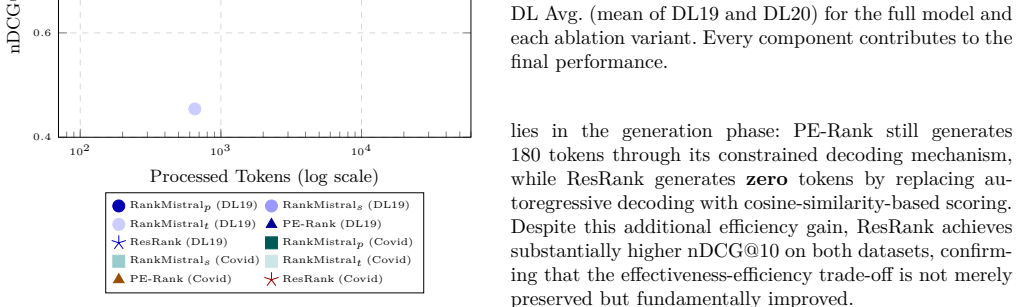
- ResRank eliminates generation latency entirely by using direct similarity scoring.
- The residual structure mitigates misalignment between compressed embeddings and ranking decisions.
- Joint multi-task training unifies the retrieval and reranking stages into one optimization process.
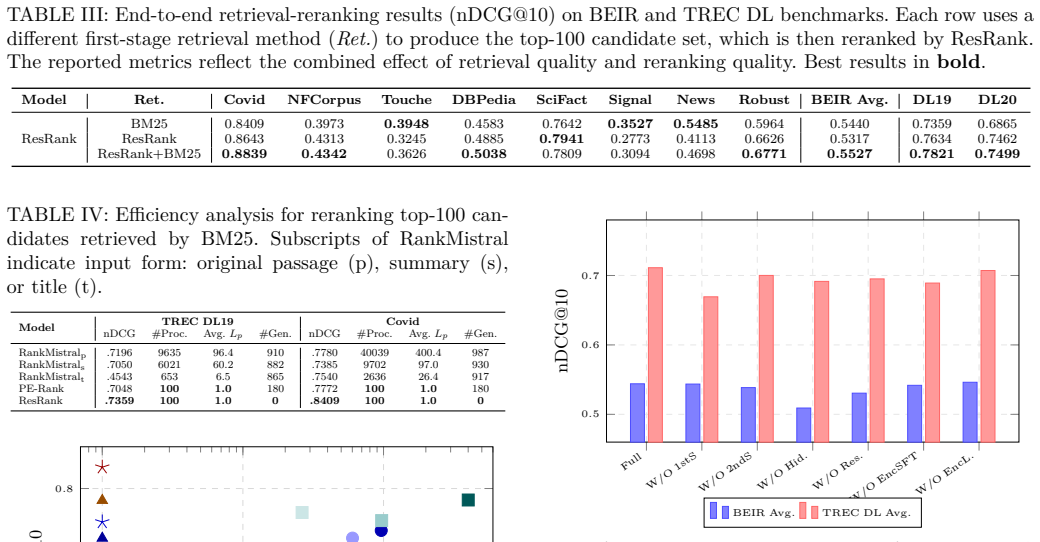
- Performance holds across TREC Deep Learning and multiple BEIR datasets with improved efficiency.
Where Pith is reading between the lines
- The method could scale reranking to much larger candidate sets in production search systems where full-text processing is too slow.
- Similar compression strategies might apply to other LLM tasks involving long contexts, such as summarization or question answering.
- Further reductions in tokens per passage could be explored while maintaining ranking quality.
Load-bearing premise
Compressing each passage to a single embedding via the Encoder-LLM preserves sufficient information for accurate listwise ranking without significant loss compared to using full passage text.
What would settle it
A head-to-head comparison on a dataset where full-text listwise reranking outperforms ResRank by a large margin in NDCG or MAP, despite the efficiency gains.
Figures

read the original abstract
Large language model (LLM) based listwise reranking has emerged as the dominant paradigm for achieving state-of-the-art ranking effectiveness in information retrieval. However, its reliance on feeding full passage texts into the LLM introduces two critical bottlenecks: the "lost in the middle" phenomenon degrades ranking quality as input length grows, and the inference latency scales super-linearly with sequence length, rendering it impractical for industrial deployment. In this paper, we present ResRank, a unified retrieval-reranking framework that fundamentally addresses both challenges. Inspired by multimodal LLMs that project visual inputs into compact token representations, ResRank employs an Encoder-LLM to compress each candidate passage into a single embedding, which is then fed alongside the query text into a Reranker-LLM for listwise ranking. To alleviate the misalignment between the compressed representation space and the ranking space, we introduce a residual connection structure that combines encoder embeddings with contextualized hidden states from the reranker. Furthermore, we replace the conventional autoregressive decoding with a one-step cosine-similarity-based scoring mechanism, eliminating the generation bottleneck entirely. ResRank is trained through a carefully designed dual-stage, multi-task, end-to-end joint optimization strategy that simultaneously trains the encoder and reranker, achieving learning objective alignment between retrieval and reranking while substantially reducing training complexity. Extensive experiments on TREC Deep Learning and eight BEIR benchmark datasets demonstrate that ResRank achieves competitive or superior ranking effectiveness compared to existing approaches while requiring zero generated tokens and processing only one token per passage, yielding a fundamentally better balance between effectiveness and efficiency.
Editorial analysis
A structured set of objections, weighed in public.
Referee Report
Summary. The paper proposes ResRank, a unified retrieval-reranking framework that compresses each candidate passage to a single embedding via an Encoder-LLM, injects it into a Reranker-LLM alongside the query using residual connections to mitigate representation misalignment, and replaces autoregressive generation with one-step cosine-similarity scoring. It employs a dual-stage multi-task end-to-end joint training strategy and claims competitive or superior effectiveness on TREC Deep Learning and eight BEIR datasets while requiring zero generated tokens and only one token per passage.
Significance. If the compression-plus-residual mechanism preserves sufficient ranking-relevant information, the work would meaningfully advance efficient LLM-based reranking by eliminating generation latency and the lost-in-the-middle problem, offering a practical efficiency-effectiveness tradeoff for industrial IR systems. The end-to-end joint optimization and parameter-free inference path are potentially valuable contributions if empirically validated.
major comments (2)
- [Method and Experiments] The central effectiveness claim rests on the assumption that single-embedding compression (plus residual hidden-state injection) retains enough query-specific and inter-passage distinction signals for listwise ranking. No direct measurement of information loss—such as passage reconstruction fidelity, ablation on ranking-feature preservation, or comparison of pre- vs. post-compression cosine similarities—is reported, leaving the weakest assumption untested.
- [Abstract and §5] Abstract and §5: Competitive or superior results are asserted on TREC DL and eight BEIR datasets, yet the abstract supplies no numerical scores, baseline names, statistical significance tests, or ablation tables. Without these, the magnitude of improvement over full-text listwise rerankers and the contribution of the residual structure cannot be assessed.
minor comments (2)
- [Method] Notation for the residual connection (e.g., how encoder embedding is added to which hidden states) could be clarified with an explicit equation in the method section.
- [Training] The dual-stage multi-task training procedure would benefit from a diagram or pseudocode to show the exact loss weighting and stage transitions.
Simulated Author's Rebuttal
We thank the referee for their constructive and detailed feedback. We address each major comment point by point below, providing our responses and indicating the revisions planned for the next version of the manuscript.
read point-by-point responses
-
Referee: [Method and Experiments] The central effectiveness claim rests on the assumption that single-embedding compression (plus residual hidden-state injection) retains enough query-specific and inter-passage distinction signals for listwise ranking. No direct measurement of information loss—such as passage reconstruction fidelity, ablation on ranking-feature preservation, or comparison of pre- vs. post-compression cosine similarities—is reported, leaving the weakest assumption untested.
Authors: We agree that direct measurements of information retention would provide stronger support for the compression and residual mechanisms. While the end-to-end competitive results on TREC DL and BEIR datasets serve as indirect evidence that sufficient ranking-relevant signals are preserved, we acknowledge the value of explicit analysis. In the revised manuscript, we will add an ablation study isolating the residual connection's impact on ranking quality and a comparison of pre- versus post-compression cosine similarities across sampled queries. These will be included in Section 5 to directly test the assumption. revision: yes
-
Referee: [Abstract and §5] Abstract and §5: Competitive or superior results are asserted on TREC DL and eight BEIR datasets, yet the abstract supplies no numerical scores, baseline names, statistical significance tests, or ablation tables. Without these, the magnitude of improvement over full-text listwise rerankers and the contribution of the residual structure cannot be assessed.
Authors: We agree that incorporating specific numerical results into the abstract would improve the reader's ability to assess the improvements. Detailed tables, baseline comparisons (including full-text listwise rerankers such as RankGPT), and statistical significance tests are already present in Section 5. In the revised version, we will update the abstract to include key metrics such as nDCG@10 on TREC DL and average performance across the eight BEIR datasets, along with explicit mentions of the residual structure's contribution as shown in our ablations. revision: yes
Circularity Check
No significant circularity; claims rest on external benchmarks and architectural choices
full rationale
The paper presents ResRank as an architectural unification of retrieval and listwise reranking via Encoder-LLM compression, residual connections, and one-step cosine scoring, trained end-to-end on dual-stage multi-task objectives. All effectiveness claims are grounded in comparisons against existing methods on external TREC Deep Learning and BEIR datasets rather than self-referential metrics or fitted parameters renamed as predictions. No self-definitional equations, load-bearing self-citations, uniqueness theorems imported from prior author work, or ansatz smuggling appear in the derivation. The residual mechanism is introduced as an explicit design choice to address misalignment, not as a tautological fix. This is the common case of a self-contained empirical system whose central results do not reduce to their inputs by construction.
Axiom & Free-Parameter Ledger
free parameters (1)
- training hyperparameters for dual-stage multi-task optimization
axioms (1)
- domain assumption Single-embedding compression of passages retains sufficient semantic information for listwise ranking when combined with residual connections
Reference graph
Works this paper leans on
-
[1]
Y. Zhu, H. Yuan, S. Wang, J. Liu, W. Liu, C. Deng, H. Chen, Z.Liu,Z.Dou,andJ.-R.Wen,“Largelanguagemodelsforinfor- mation retrieval: A survey,”arXiv preprint arXiv:2308.07107, 2024
-
[2]
Is ChatGPT good at search? Investigating large language models as re-ranking agents,
W. Sun, L. Yan, X. Ma, S. Wang, P. Ren, Z. Chen, D. Yin, and Z. Ren, “Is ChatGPT good at search? Investigating large language models as re-ranking agents,”arXiv preprint arXiv:2304.09542, 2023
-
[3]
arXiv preprint arXiv:2309.15088 , year=
R. Pradeep, S. Sharifymoghaddam, and J. Lin, “RankVicuna: Zero-shot listwise document reranking with open-source large language models,”arXiv preprint arXiv:2309.15088, 2023
-
[4]
Lost in the middle: How language models use long contexts,
N. F. Liu, K. Lin, J. Hewitt, A. Paranjape, M. Bevilacqua, F. Petroni, and P. Liang, “Lost in the middle: How language models use long contexts,”Trans. Assoc. Comput. Linguistics, 2024
2024
-
[5]
Sliding windows are not the end: Exploring full rank- ing with long-context large language models,
W. Liu, X. Ma, Y. Zhu, Z. Zhao, S. Wang, D. Yin, and Z. Dou, “Sliding windows are not the end: Exploring full rank- ing with long-context large language models,”arXiv preprint arXiv:2412.14574, 2024
-
[6]
Leveraging passage embeddings for efficient listwise reranking with large language models,
Q. Liu, B. Wang, N. Wang, and J. Mao, “Leveraging passage embeddings for efficient listwise reranking with large language models,” inProc. ACM Web Conf. (WWW), 2025, pp. 4274– 4283
2025
-
[7]
Visual instruction tuning,
H. Liu, C. Li, Q. Wu, and Y. J. Lee, “Visual instruction tuning,” inProc. NeurIPS, 2023
2023
-
[8]
Compress-then-Rank:Fasterandbetterlistwisererankingwith large language models via ranking-aware passage compression,
Z. Zhi, Y. Zhang, Y. Jing, X. Li, J. Liu, H. Liu, and Y. Ding, “Compress-then-Rank:Fasterandbetterlistwisererankingwith large language models via ranking-aware passage compression,” inProc. AAAI, 2026
2026
-
[9]
E2Rank: Your text embedding can also be an effective and efficient listwise reranker,
Q. Liu, Y. Zhang, M. Li, D. Long, P. Xie, and J. Mao, “E2Rank: Your text embedding can also be an effective and efficient listwise reranker,”arXiv preprint arXiv:2510.22733, 2025
-
[10]
Generatingdiversecriteriaon-the-flytoimprove pointwise LLM rankers,
F. Guo, W. Li, H. Zhuang, Y. Luo, Y. Li, Q. Zhu, L. Yan, andY.Zhang,“Generatingdiversecriteriaon-the-flytoimprove pointwise LLM rankers,”arXiv preprint arXiv:2404, 2024
2024
-
[11]
Large language models are effective text rankers with pairwise ranking prompting,
Z.Qin,R.Jagerman,K.Hui,H.Zhuang,J.Wu,L.Yan,J.Shen, T. Liu, J. Liu, D. Metzler, X. Wang, and M. Bendersky, “Large language models are effective text rankers with pairwise ranking prompting,”arXiv preprint arXiv:2306.17563, 2023
-
[12]
arXiv preprint arXiv:1910.14424 , year=
R. Nogueira, W. Yang, K. Cho, and J. Lin, “Multi-stage doc- ument ranking with BERT,”arXiv preprint arXiv:1910.14424, 2019
-
[13]
Document ranking with a pretrained sequence-to-sequence model,
R. Nogueira, Z. Jiang, and J. Lin, “Document ranking with a pretrained sequence-to-sequence model,”arXiv preprint arXiv:2003.06713, 2020
-
[14]
Rankzephyr: Effective and robust zero-shot listwise reranking is a breeze!, 2023
R. Pradeep, S. Sharifymoghaddam, and J. Lin, “RankZephyr: Effective and robust zero-shot listwise reranking is a breeze!” arXiv preprint arXiv:2312.02724, 2023
-
[15]
ListT5: Listwise reranking with fusion-in-decoder improves zero-shot retrieval,
S. Yoon, E. Choi, J. Kim, H. Yun, Y. Kim, and S.-W. Hwang, “ListT5: Listwise reranking with fusion-in-decoder improves zero-shot retrieval,” inProc. ACL, 2024, pp. 2287–2308
2024
-
[16]
TourRank:Utilizinglargelanguagemodels for document ranking with a tournament-inspired strategy,
Y. Chen, Q. Liu, Y. Zhang, W. Sun, X. Ma, W. Yang, D. Shi, J.Mao,andD.Yin,“TourRank:Utilizinglargelanguagemodels for document ranking with a tournament-inspired strategy,” in Proc. ACM Web Conf. (WWW), 2025, pp. 1638–1652
2025
-
[17]
DiffuRank: Effective document reranking with diffusion language models,
Q. Liu, K. Ai, J. Mao, Y. Zhang, M. Li, D. Long, P. Xie, F. Zhu, and J.-R. Wen, “DiffuRank: Effective document reranking with diffusion language models,”arXiv preprint arXiv:2602, 2026
2026
-
[18]
jina-reranker-v3: Last but not late interaction for listwise document reranking,
F. Wang, Y. Li, and H. Xiao, “jina-reranker-v3: Last but not late interaction for listwise document reranking,”arXiv preprint arXiv:2509, 2025
2025
-
[19]
Com- pLLM: Compression for long context Q&A,
G. Berton, J. Unnikrishnan, S. Tran, and M. Shah, “Com- pLLM: Compression for long context Q&A,”arXiv preprint arXiv:2509.12819, 2025
-
[20]
Large search model: Redefining search stack in the era of LLMs,
L. Wang, N. Yang, X. Huang, L. Yang, R. Majumder, and F. Wei, “Large search model: Redefining search stack in the era of LLMs,”ACM SIGIR Forum, arXiv:2310.14587, 2023
-
[21]
OneRec: Unifying Retrieve and Rank with Generative Recommender and Iterative Preference Alignment
J. Deng, S. Wang, K. Cai, L. Ren, Q. Hu, W. Ding, Q. Luo, and G. Zhou, “OneRec: Unifying retrieve and rank with gener- ative recommender and iterative preference alignment,”arXiv preprint arXiv:2502.18965, 2025
work page internal anchor Pith review arXiv 2025
-
[22]
UniSearch: Rethinking search system with a unified generative architecture,
J. Chen, X. Jiang, Z. Wang,et al., “UniSearch: Rethinking search system with a unified generative architecture,”arXiv preprint arXiv:2509.07860, 2025
-
[23]
arXiv preprint arXiv:2409.12740 , year=
J. Chen, L. Chi, B. Peng, and Z. Yuan, “HLLM: Enhanc- ing sequential recommendations via hierarchical large lan- guage models for item and user modeling,”arXiv preprint arXiv:2409.12740, 2024
-
[24]
arXiv preprint arXiv:2110.07367 , year=
R. Ren, Y. Qu, J. Liu, W. X. Zhao, Q. She, H. Wu, H. Wang, and J.-R. Wen, “RocketQAv2: A joint training method for dense passage retrieval and passage re-ranking,”arXiv preprint arXiv:2110.07367, 2021
-
[25]
CoRRabs/2003.07820(2020), https://arxiv.org/ abs/2003.07820
N. Craswell, B. Mitra, E. Yilmaz, D. Campos, and E. M. Voorhees, “Overview of the TREC 2019 deep learning track,”arXiv preprint arXiv:2003.07820, 2020
-
[26]
Overview of the trec 2020 deep learning track, 2021
N. Craswell, B. Mitra, E. Yilmaz, and D. Campos, “Overview of the TREC 2020 deep learning track,”arXiv preprint arXiv:2102.07662, 2021
-
[27]
BEIR: A Heterogenous Benchmark for Zero-shot Evaluation of Information Retrieval Models
N. Thakur, N. Reimers, A. Rücklé, A. Srivastava, and I. Gurevych, “BEIR: A heterogeneous benchmark for zero- shot evaluation of information retrieval models,”arXiv preprint arXiv:2104.08663, 2021
work page internal anchor Pith review arXiv 2021
-
[28]
A. Yang, A. Li, B. Yang, B. Zhang,et al., “Qwen3 technical report,”arXiv preprint arXiv:2505.09388, 2025
work page internal anchor Pith review arXiv 2025
-
[29]
Qwen3 Embedding: Advancing Text Embedding and Reranking Through Foundation Models
Y. Zhang, M. Li, D. Long, X. Zhang, H. Lin, B. Yang, P. Xie, A. Yang, D. Liu, J. Lin, F. Huang, and J. Zhou, “Qwen3 Embedding: Advancing text embedding and reranking through foundation models,”arXiv preprint arXiv:2506.05176, 2025
work page internal anchor Pith review arXiv 2025
-
[30]
FlashAttention: Fast and memory-efficient exact attention with IO-awareness,
T.Dao,D.Fu,S.Ermon,A.Rudra,andC.Ré,“FlashAttention: Fast and memory-efficient exact attention with IO-awareness,” inProc. NeurIPS, vol. 35, 2022, pp. 16344–16359
2022
-
[31]
DeepSpeed: System optimizations enable training deep learning models with over 100 billion parameters,
J. Rasley, S. Rajbhandari, O. Ruwase, and Y. He, “DeepSpeed: System optimizations enable training deep learning models with over 100 billion parameters,” inProc. ACM SIGKDD, 2020, pp. 3505–3506
2020
-
[32]
Reciprocal rank fusion outperforms condorcet and individual rank learning methods,
G. V. Cormack, C. L. A. Clarke, and S. Büttcher, “Reciprocal rank fusion outperforms condorcet and individual rank learning methods,” inProc. SIGIR, 2009, pp. 758–759
2009
-
[33]
Optimizing generative ranking relevance via reinforcement learning in Xiaohongshu search,
Z. Zeng, H. Jing, J. Chen,et al., “Optimizing generative ranking relevance via reinforcement learning in Xiaohongshu search,” arXiv preprint arXiv:2511.00968, 2025
-
[34]
Learning to rank using gra- dient descent,
C. Burges, T. Shaked, E. Renshaw, A. Lazier, M. Deeds, N. Hamilton, and G. Hullender, “Learning to rank using gra- dient descent,” inProc. ICML, 2005, pp. 89–96
2005
discussion (0)
Sign in with ORCID, Apple, or X to comment. Anyone can read and Pith papers without signing in.