Trace estimates and improved pointwise bounds for joint eigenfunctions
Pith reviewed 2026-05-08 10:56 UTC · model grok-4.3
The pith
Joint eigenfunctions of quantum integrable systems satisfy a sharp pointwise bound of order h to the power of (-n + k + 1)/2 at points with rank k non-degeneracy.
A machine-rendered reading of the paper's core claim, the machinery that carries it, and where it could break.
Core claim
In a quantum integrable system, for L2-normalized joint eigenfunctions, at points satisfying a rank k non-degeneracy condition, the pointwise supremum satisfies the bound of order h to the power (-n+k+1)/2, improving on previous polynomial gains and achieving sharpness.
What carries the argument
The rank k non-degeneracy condition at the evaluation points, which enables improved trace estimates leading to the refined pointwise bounds.
If this is right
- This gives a precise power of the semiclassical parameter h in the bound depending on the rank k.
- It applies the improvement to points with this specific non-degeneracy property rather than just typical points.
- The bound is claimed to be sharp.
- These estimates build upon trace estimates for the eigenfunctions.
Where Pith is reading between the lines
- If the bound holds, it could help in deriving better spectral estimates for integrable quantum systems.
- Testing the result on concrete examples like the circle or sphere might confirm the sharpness.
- Similar techniques might apply to systems with partial integrability.
- One could explore whether the non-degeneracy condition can be relaxed in some cases.
Load-bearing premise
The quantum system has to be integrable and the points have to satisfy the rank k non-degeneracy condition, plus the prior polynomial improvements must hold.
What would settle it
Finding an example of a joint eigenfunction in an integrable system where at a rank k non-degenerate point the function exceeds the size given by h to the power (-n+k+1)/2 would falsify the claim.
Figures
read the original abstract
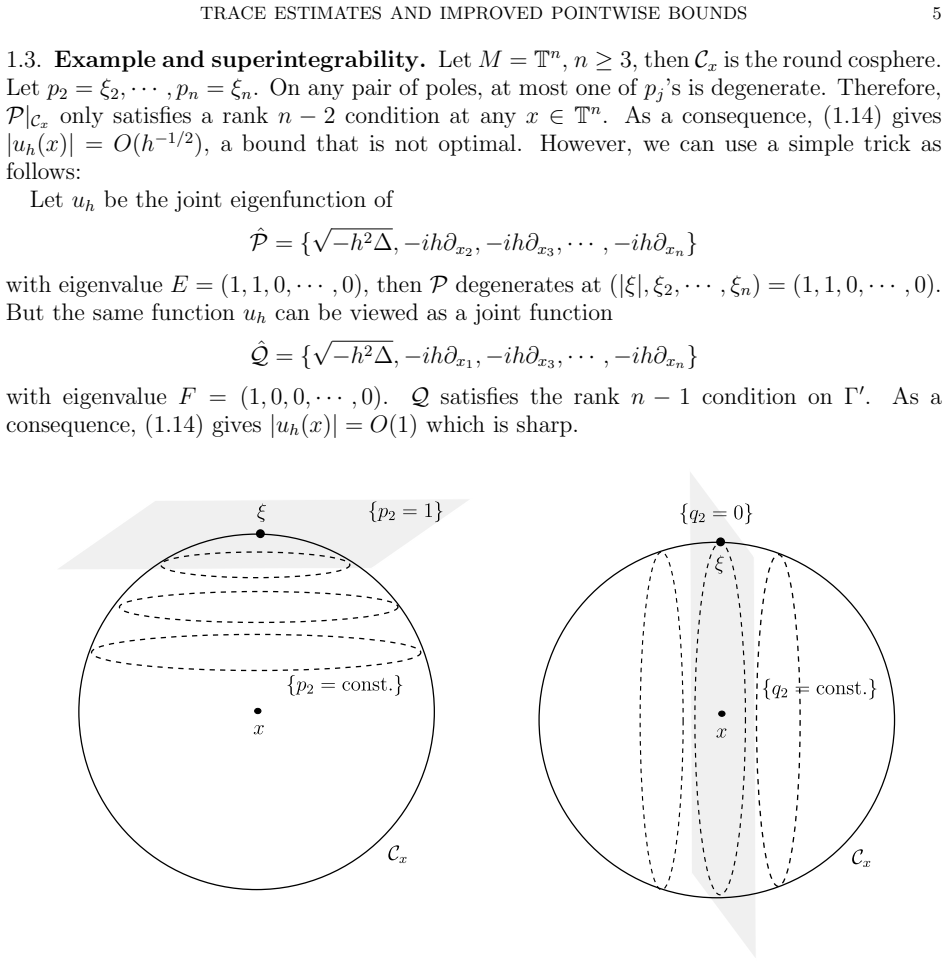
For $L^2$-normalized joint eigenfunctions in a quantum integrable system, [GT20] gave polynomial improvements over the standard H\"omander bounds for typical points. In this paper, we improve their result by establishing a sharp bound of $h^{\frac{-n+k+1}2}$ for the points satisfying a rank $k$ non-degeneracy condition.
Editorial analysis
A structured set of objections, weighed in public.
Referee Report
Summary. The paper develops refined semiclassical trace estimates in the quantum integrable setting and applies them to joint eigenfunctions. It improves on the polynomial gains in [GT20] by proving a sharp pointwise bound of h^{(-n+k+1)/2} for L^2-normalized joint eigenfunctions at points satisfying a rank-k non-degeneracy condition, obtained via stationary-phase or scaling arguments that reduce correctly to the classical Hörmander bound when k=0.
Significance. If the result holds, it supplies sharp, non-degeneracy-dependent sup-norm estimates that refine Hörmander's bound in a precise, parameter-free way for integrable systems. The construction of the trace estimates and their direct application to the non-degeneracy hypothesis constitute a solid technical advance, with the correct reduction to the k=0 case providing internal consistency and falsifiability.
Simulated Author's Rebuttal
We thank the referee for their careful reading and positive evaluation of the manuscript. The report recommends acceptance with no major comments raised, so we have no specific points to address or revise.
Circularity Check
No significant circularity
full rationale
The paper develops semiclassical trace estimates for joint eigenfunctions in the quantum integrable setting and applies them via stationary-phase scaling to obtain the sharp pointwise bound h^{(-n+k+1)/2} under the rank-k non-degeneracy hypothesis. This chain is self-contained: the trace estimates are constructed directly from the semiclassical calculus and the non-degeneracy condition, without reducing to fitted parameters, self-definitions, or load-bearing self-citations. The reference to [GT20] supplies only a baseline polynomial improvement; the new sharp exponent is derived independently and recovers the classical Hörmander bound when k=0. No step equates a claimed prediction to its own input by construction.
Axiom & Free-Parameter Ledger
axioms (2)
- domain assumption The system is quantum integrable
- domain assumption Points satisfy a rank k non-degeneracy condition
Reference graph
Works this paper leans on
-
[1]
[Ava56] Vojislav G. Avakumovi´ c. ¨Uber die Eigenfunktionen auf geschlossenen Riemannschen Mannig- faltigkeiten.Math. Z., 65:327–344, 1956. [B´77] Pierre H. B´ erard. On the wave equation on a compact Riemannian manifold without conjugate points.Math. Z., 155(3):249–276, 1977. [Bon17] Yannick Bonthonneau. The Θ function and the Weyl law on manifolds witho...
work page 1956
discussion (0)
Sign in with ORCID, Apple, or X to comment. Anyone can read and Pith papers without signing in.