Discrete Einstein metrics on trees
Pith reviewed 2026-05-08 09:49 UTC · model grok-4.3
The pith
Discrete Einstein metrics exist and are unique on trees under Lin-Lu-Yau curvature, but positive-curvature cases require caterpillar trees.
A machine-rendered reading of the paper's core claim, the machinery that carries it, and where it could break.
Core claim
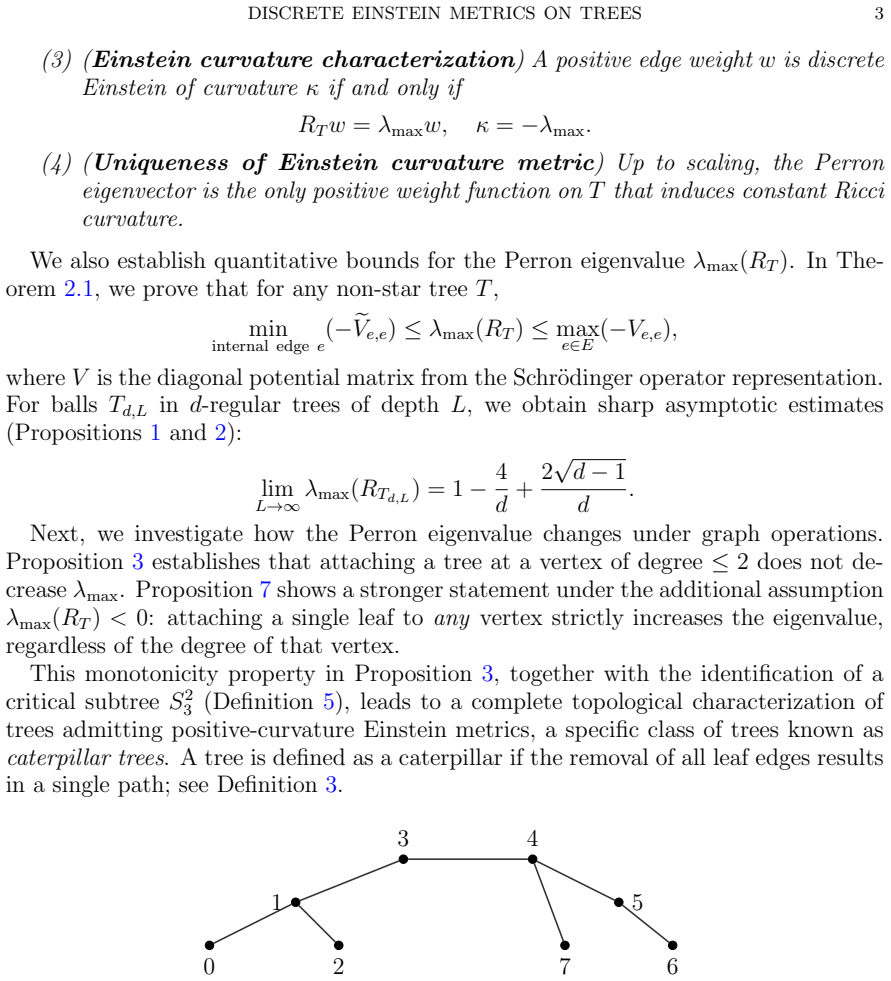
Using Perron-Frobenius theory applied to the curvature operator derived from Lin-Lu-Yau Ricci curvature, we establish existence and uniqueness of discrete Einstein metrics on trees. The existence of a positive-curvature Einstein metric forces the tree to be a caterpillar. Any such metric exhibits radial monotonicity, with edge weights decreasing strictly away from the maximal edge.
What carries the argument
The curvature operator built from the Lin-Lu-Yau Ricci curvature on the tree, whose positive eigenvector supplies the edge weights of the Einstein metric.
Load-bearing premise
The curvature operator constructed from the Lin-Lu-Yau Ricci curvature must satisfy positivity or irreducibility conditions so that Perron-Frobenius theory applies and yields a unique positive eigenvector.
What would settle it
A concrete counterexample would be any non-caterpillar tree (for instance a balanced binary tree of height greater than one) that nevertheless admits a positive-curvature discrete Einstein metric, or a caterpillar tree whose curvature operator has no positive eigenvector.
Figures



read the original abstract
We establish the existence and uniqueness of discrete Einstein metrics on trees under Lin-Lu-Yau Ricci curvature using Perron-Frobenius theory. Notably, the existence of a positive-curvature Einstein metric implies the tree must be a caterpillar. Furthermore, these metrics exhibit radial monotonicity, with edge weights decreasing strictly away from the maximal edge.
Editorial analysis
A structured set of objections, weighed in public.
Referee Report
Summary. The paper establishes existence and uniqueness of discrete Einstein metrics on trees under the Lin-Lu-Yau Ricci curvature by constructing a curvature-derived operator and invoking Perron-Frobenius theory to obtain a positive eigenvector. It further proves that a positive-curvature Einstein metric exists only when the tree is a caterpillar and that all such metrics are radially monotone, with edge weights strictly decreasing away from a maximal edge.
Significance. If the operator is correctly defined and the Perron-Frobenius hypotheses (nonnegativity and irreducibility) are verified, the result gives a clean characterization of trees admitting positive discrete Einstein metrics and supplies an explicit monotonicity property. The application of Perron-Frobenius to a curvature operator is a strength when the technical conditions are fully checked.
major comments (1)
- [Operator construction and proof of main theorem] The central step is the construction of the curvature operator (presumably in the section preceding the main theorem) and the verification that it is nonnegative and irreducible precisely when the tree is a caterpillar. The manuscript must supply the explicit matrix entries (or local formulas) indexed by edges/vertices and the argument showing that distant branches produce reducible blocks or zero entries for non-caterpillars; without this the existence/uniqueness claim and the caterpillar implication rest on unverified hypotheses for Perron-Frobenius.
minor comments (1)
- [Abstract] The abstract could briefly indicate how the discrete metric is represented (edge weights or vertex potentials) and state the precise Einstein equation being solved.
Simulated Author's Rebuttal
We thank the referee for the careful reading and constructive recommendation for major revision. We address the major comment below by agreeing to expand the explicit details in the revised manuscript.
read point-by-point responses
-
Referee: [Operator construction and proof of main theorem] The central step is the construction of the curvature operator (presumably in the section preceding the main theorem) and the verification that it is nonnegative and irreducible precisely when the tree is a caterpillar. The manuscript must supply the explicit matrix entries (or local formulas) indexed by edges/vertices and the argument showing that distant branches produce reducible blocks or zero entries for non-caterpillars; without this the existence/uniqueness claim and the caterpillar implication rest on unverified hypotheses for Perron-Frobenius.
Authors: We agree that a fully explicit presentation of the curvature operator is necessary to rigorously justify the Perron-Frobenius application. In the revised manuscript we will add a dedicated subsection that defines the operator explicitly: its rows and columns are indexed by the edges of the tree, and the (e,f)-entry is given by the local formula derived from the Lin-Lu-Yau Ricci curvature expression evaluated at the common vertex of e and f (specifically, a positive multiple of the curvature term when e and f share a vertex and zero otherwise). Nonnegativity follows immediately from the nonnegativity of the curvature terms for positive edge weights. Irreducibility holds if and only if the tree is a caterpillar, because the directed graph associated with the operator is strongly connected precisely when every edge lies on a unique path between the two leaves of the diameter; for non-caterpillar trees, branches off the main path produce zero blocks that disconnect the graph into reducible components. We will include a short combinatorial argument and a small illustrative example for a non-caterpillar tree to make this transparent. revision: yes
Circularity Check
No significant circularity; external Perron-Frobenius theorem applied to independently constructed operator
full rationale
The derivation constructs an operator from the given Lin-Lu-Yau Ricci curvature on the tree graph and invokes the classical Perron-Frobenius theorem for existence and uniqueness of a positive eigenvector that defines the discrete Einstein metric. The additional result that positive-curvature solutions force the tree to be a caterpillar follows from analyzing when the operator satisfies the nonnegativity and irreducibility hypotheses of the theorem. No equations or steps in the provided abstract reduce the target metric to a tautological input, a fitted parameter renamed as prediction, or a self-citation chain; the operator definition and PF application remain independent of the final metric values.
Axiom & Free-Parameter Ledger
axioms (2)
- domain assumption Lin-Lu-Yau Ricci curvature is a valid discrete curvature on graphs and trees
- domain assumption The operator encoding the Einstein condition on a tree is positive or irreducible
Forward citations
Cited by 1 Pith paper
-
A Classification of Positive-Curvature Discrete Einstein Metrics on Trees
Classification of finite trees with positive-curvature discrete Einstein metrics via λ_max(R_T)<0, giving explicit endpoint families for long-spine caterpillars and exhaustive algebraic verification for short spines.
Reference graph
Works this paper leans on
-
[1]
On the ricci flow on trees.arXiv:2509.22140, 2025
Shuliang Bai, Bobo Hua, Yong Lin, and Shuang Liu. On the ricci flow on trees.arXiv:2509.22140, 2025
-
[2]
On the sum of ricci-curvatures for weighted graphs.Pure and Applied Mathematics Quarterly, 17(5):1599–1617, 2021
Shuliang Bai, An Huang, Linyuan Lu, and Shing-Tung Yau. On the sum of ricci-curvatures for weighted graphs.Pure and Applied Mathematics Quarterly, 17(5):1599–1617, 2021
2021
-
[3]
Ollivier ricci-flow on weighted graphs.American Journal of Mathematics, 146(4), 2024
Shuliang Bai, Yong Lin, Linyuan Lu, Zhiyu Wang, and Shing-Tung Yau. Ollivier ricci-flow on weighted graphs.American Journal of Mathematics, 146(4), 2024
2024
-
[4]
Ricci-flat graphs with maximum degree at most 4.Asian J
Shuliang Bai, Linyuan Lu, and Shing-Tung Yau. Ricci-flat graphs with maximum degree at most 4.Asian J. Math., 25(6):757–813, 2021
2021
-
[5]
Ollivier-ricci curvature and the spectrum of the normalized graph laplace operator.Math
Frank Bauer, J¨ urgen Jost, and Shiping Liu. Ollivier-ricci curvature and the spectrum of the normalized graph laplace operator.Math. Res. Lett., 19:1185–1205, 2012
2012
-
[6]
Plemmons.Nonnegative matrices in the mathematical sciences
Abraham Berman and Robert J. Plemmons.Nonnegative matrices in the mathematical sciences. Computer Science and Applied Mathematics. Academic Press [Harcourt Brace Jovanovich, Pub- lishers], New York-London, 1979
1979
-
[7]
Besse.Einstein Manifolds, volume 10 ofErgebnisse der Mathematik und ihrer Gren- zgebiete
Arthur L. Besse.Einstein Manifolds, volume 10 ofErgebnisse der Mathematik und ihrer Gren- zgebiete. Springer-Verlag, Berlin, Heidelberg, 1987
1987
-
[8]
D. P. Bourne, D. Cushing, S. Liu, F. M¨ unch, and N. Peyerimhoff. Ollivier-Ricci idleness functions of graphs.SIAM J. Discrete Math., 32(2):1408–1424, 2018
2018
-
[9]
Manifolds with 1/4-pinched curvature are space forms.Jour- nal of the American Mathematical Society, 22(1):287–307, 2009
Simon Brendle and Richard Schoen. Manifolds with 1/4-pinched curvature are space forms.Jour- nal of the American Mathematical Society, 22(1):287–307, 2009
2009
-
[10]
Part I, volume 135 ofMathematical Surveys and Monographs
Bennett Chow, Sun-Chin Chu, David Glickenstein, Christine Guenther, James Isenberg, Tom Ivey, Dan Knopf, Peng Lu, Feng Luo, and Lei Ni.The Ricci flow: techniques and applications. Part I, volume 135 ofMathematical Surveys and Monographs. American Mathematical Society, Providence, RI, 2007. Geometric aspects
2007
-
[11]
Cushing, S
D. Cushing, S. Kamtue, J. Koolen, S. Liu, F. M¨ unch, and N. Peyerimhoff. Rigidity of the Bonnet- Myers inequality for graphs with respect to Ollivier Ricci curvature.Adv. Math., 369:107188, 53, 2020
2020
-
[12]
Ricci-flat cubic graphs with girth five.Comm
David Cushing, Riikka Kangaslampi, Yong Lin, Shiping Liu, Linyuan Lu, and Shing-Tung Yau. Ricci-flat cubic graphs with girth five.Comm. Anal. Geom., 29(7):1559–1570, 2021
2021
-
[13]
Eigenvectors of acyclic matrices.Czechoslovak Mathematical Journal, 25(4):607– 618, 1975
Miroslav Fiedler. Eigenvectors of acyclic matrices.Czechoslovak Mathematical Journal, 25(4):607– 618, 1975
1975
-
[14]
Three-manifolds with positive ricci curvature.Journal of Differential Geom- etry, 17:255–362, 06 1982
Richard Hamilton. Three-manifolds with positive ricci curvature.Journal of Differential Geom- etry, 17:255–362, 06 1982
1982
-
[15]
Ricci-flat graphs with girth four.Acta Math
Wei Hua He, Jun Luo, Chao Yang, Wei Yuan, and Hui Chun Zhang. Ricci-flat graphs with girth four.Acta Math. Sin. (Engl. Ser.), 37(11):1679–1691, 2021
2021
-
[16]
Every salami has two ends.J
Bobo Hua and Florentin M¨ unch. Every salami has two ends.J. Reine Angew. Math., 821:291–321, 2025
2025
-
[17]
Ollivier’s Ricci curvature, local clustering and curvature-dimension inequalities on graphs.Discrete Comput
J¨ urgen Jost and Shiping Liu. Ollivier’s Ricci curvature, local clustering and curvature-dimension inequalities on graphs.Discrete Comput. Geom., 51(2):300–322, 2014
2014
-
[18]
The ricci flow on trees: Linear convergence, curvature bounds, and spectral appli- cations
Shengdao Ke. The ricci flow on trees: Linear convergence, curvature bounds, and spectral appli- cations. 2026. 28 SHULIANG BAI AND BOBO HUA
2026
-
[19]
Ricci curvature of graphs.Tohoku Mathematical Journal, 63, 12 2011
Yong Lin, Linyuan Lu, and Shing-Tung Yau. Ricci curvature of graphs.Tohoku Mathematical Journal, 63, 12 2011
2011
-
[20]
H. Minc. Nonnegative matrices.Wiley, New York, 1988
1988
-
[21]
Non-negative Ollivier curvature on graphs, reverse Poincar´ e inequality, Buser inequality, Liouville property, Harnack inequality and eigenvalue estimates.J
Florentin M¨ unch. Non-negative Ollivier curvature on graphs, reverse Poincar´ e inequality, Buser inequality, Liouville property, Harnack inequality and eigenvalue estimates.J. Math. Pures Appl. (9), 170:231–257, 2023
2023
-
[22]
Wojciechowski
Florentin M¨ unch and Radoslaw K. Wojciechowski. Ollivier ricci curvature for general graph lapla- cians: Heat equation, laplacian comparison, non-explosion and diameter bounds.Advances in Mathematics, 356, 11 2019
2019
-
[23]
Ricci curvature of markov chains on metric spaces.Journal of Functional Analysis, 256:810–864, 02 2009
Yann Ollivier. Ricci curvature of markov chains on metric spaces.Journal of Functional Analysis, 256:810–864, 02 2009
2009
-
[24]
Volume and diameter of a graph and Ollivier’s Ricci curvature.European J
Seong-Hun Paeng. Volume and diameter of a graph and Ollivier’s Ricci curvature.European J. Combin., 33(8):1808–1819, 2012
2012
-
[25]
The entropy formula for the ricci flow and its geometric applications, 2002
Grigori Perelman. The entropy formula for the ricci flow and its geometric applications, 2002
2002
-
[26]
Ricci flow with surgery on three-manifolds, 2003
Grigori Perelman. Ricci flow with surgery on three-manifolds, 2003
2003
-
[27]
Ollivier curvature of random geometric graphs converges to Ricci curvature of their Riemannian manifolds.Discrete Comput
Pim van der Hoorn, Gabor Lippner, Carlo Trugenberger, and Dmitri Krioukov. Ollivier curvature of random geometric graphs converges to Ricci curvature of their Riemannian manifolds.Discrete Comput. Geom., 70(3):671–712, 2023
2023
-
[28]
Relation between combinatorial Ricci curvature and Lin-Lu-Yau’s Ricci curvature on cell complexes.Tokyo J
Kazuyoshi Watanabe and Taiki Yamada. Relation between combinatorial Ricci curvature and Lin-Lu-Yau’s Ricci curvature on cell complexes.Tokyo J. Math., 43(1):25–45, 2020
2020
-
[29]
On the ricci curvature of a compact k¨ ahler manifold and the complex monge- amp` ere equation, i.Communications on Pure and Applied Mathematics, 31(3):339–411, 1978
Shing-Tung Yau. On the ricci curvature of a compact k¨ ahler manifold and the complex monge- amp` ere equation, i.Communications on Pure and Applied Mathematics, 31(3):339–411, 1978
1978
discussion (0)
Sign in with ORCID, Apple, or X to comment. Anyone can read and Pith papers without signing in.