A Classification of Positive-Curvature Discrete Einstein Metrics on Trees
Pith reviewed 2026-05-21 02:26 UTC · model grok-4.3
The pith
Finite trees admitting positive-curvature discrete Einstein metrics are precisely the short-endpoint caterpillars plus a handful of small exceptions.
A machine-rendered reading of the paper's core claim, the machinery that carries it, and where it could break.
Core claim
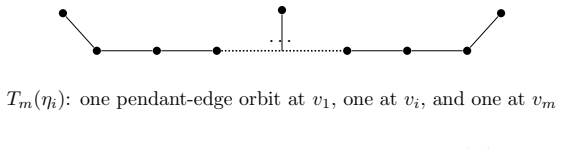
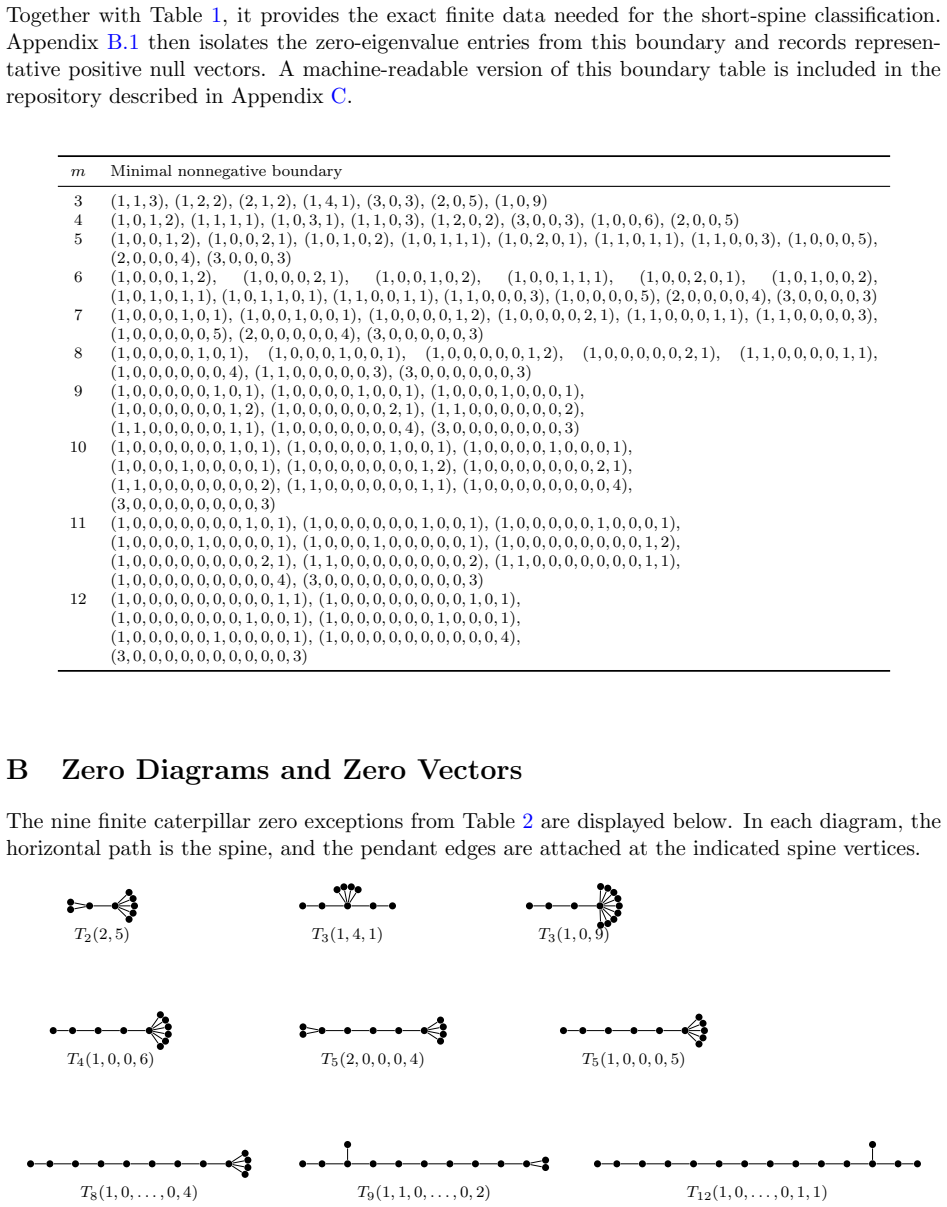
We classify all finite trees whose discrete Einstein metric has positive curvature, equivalently all trees satisfying λ_max(R_T)<0. For caterpillars with spine order m≥12, this occurs precisely for the endpoint families T_m(a,0,…,0,b) with 1≤a,b≤3 and (a,b)≠(3,3). The remaining cases 3≤m≤11 are settled by an exact finite verification using rational characteristic polynomials and Sturm root counts. We also determine the zero level set λ_max(R_T)=0: among caterpillars, it consists of the stable family (3,0,…,0,3) together with nine exceptional short-spine caterpillars, while S_3^2 is the unique non-caterpillar zero example.
What carries the argument
The edge-indexed Ricci matrix R_T whose largest eigenvalue determines the sign of the constant-curvature condition for the Lin-Lu-Yau Ricci curvature on the weighted tree.
If this is right
- Any long-spine caterpillar with positive discrete Einstein curvature must have all internal spine vertices of degree exactly two except for the two endpoints.
- The zero-curvature set is exhausted by the single stable family (3,0,…,0,3), nine short-spine exceptions, and the graph S_3^2.
- The sign of λ_max(R_T) can be decided for any concrete tree by computing the characteristic polynomial and applying Sturm sequences.
- The classification reduces the geometric problem on trees to a finite list of matrix eigenvalue checks once the spine length is fixed.
Where Pith is reading between the lines
- The same spectral criterion might be used to search for positive-curvature metrics on non-tree graphs if an analogous explicit formula for Ricci curvature becomes available.
- The restriction to at most three leaves per end suggests a discrete analogue of the fact that positive Ricci curvature on manifolds forces bounded diameter and simple topology.
- One could generate large random trees and count the fraction whose R_T matrix has negative largest eigenvalue to test how rare positive curvature is in the space of all trees.
- Extending the classification from finite to infinite trees would require studying the spectrum of the corresponding infinite edge-indexed operator.
Load-bearing premise
The Lin-Lu-Yau Ricci curvature on a weighted tree admits an explicit formula in terms of the edge weights, turning the constant-curvature equation into the eigenvalue problem for the matrix R_T.
What would settle it
A single caterpillar with spine order twelve or larger whose endpoint degrees lie outside the range one to three (or equal three at both ends) yet still satisfies λ_max(R_T)<0 would falsify the classification for long spines.
Figures



read the original abstract
For a weighted tree, the Lin--Lu--Yau Ricci curvature admits an explicit formula in terms of the edge weights. Consequently, the constant-curvature equation is equivalent to an eigenvalue problem for an edge-indexed Ricci matrix $R_T$. Building on the spectral characterization of discrete Einstein metrics on trees, we classify all finite trees whose discrete Einstein metric has positive curvature, equivalently all trees satisfying $\lambda_{\max}(R_T)<0$. For caterpillars with spine order $m\ge 12$, this occurs precisely for the endpoint families $T_m(a,0,\ldots,0,b)$ with $1\le a,b\le 3$ and $(a,b)\ne(3,3)$. The remaining cases $3\le m\le 11$ are settled by an exact finite verification using rational characteristic polynomials and Sturm root counts. We also determine the zero level set $\lambda_{\max}(R_T)=0$: among caterpillars, it consists of the stable family $(3,0,\ldots,0,3)$ together with nine exceptional short-spine caterpillars, while $S_3^2$ is the unique non-caterpillar zero example.
Editorial analysis
A structured set of objections, weighed in public.
Referee Report
Summary. The manuscript classifies all finite trees that admit a discrete Einstein metric of positive Lin-Lu-Yau Ricci curvature. It establishes that this property is equivalent to the largest eigenvalue of the explicitly constructed edge-indexed Ricci matrix R_T satisfying λ_max(R_T)<0. For caterpillars whose spine has order m≥12 the positive-curvature examples are precisely the endpoint families T_m(a,0,…,0,b) with 1≤a,b≤3 and (a,b)≠(3,3). The finitely many cases 3≤m≤11 are settled by direct computation of the rational characteristic polynomials of R_T together with Sturm root counts. The zero set λ_max(R_T)=0 is also determined completely, consisting of the stable family (3,0,…,0,3), nine exceptional short-spine caterpillars, and the unique non-caterpillar S_3^2.
Significance. The classification supplies a complete, explicit description of positive-curvature discrete Einstein metrics on finite trees. The reduction to an eigenvalue problem rests on the explicit Lin-Lu-Yau curvature formula stated in the first sentence of the abstract; the large-m cases follow from a direct combinatorial argument, while the small-m cases rest on exact algebraic computations that are in principle machine-checkable. These features make the result a concrete contribution to the spectral theory of discrete Ricci curvature on graphs.
minor comments (2)
- §2, definition of the matrix R_T: the indexing of rows and columns by edges is clear, but a short sentence reminding the reader that the off-diagonal entries are determined by the common-vertex condition would improve readability for readers outside the immediate subfield.
- Table 1 (or the corresponding enumeration for m=3 to 11): the list of exceptional zero examples would be easier to parse if the spine lengths and endpoint pairs were displayed in a uniform tabular format rather than inline text.
Simulated Author's Rebuttal
We thank the referee for the careful reading of the manuscript and the positive assessment. The referee's summary accurately reflects the main results and methods. We appreciate the recommendation to accept.
Circularity Check
No significant circularity identified
full rationale
The derivation begins from the explicit Lin-Lu-Yau curvature formula on weighted trees, which directly converts the constant-curvature condition into the eigenvalue problem λ_max(R_T)<0 for the edge-indexed matrix R_T. Classification for spine length m≥12 proceeds by direct inspection of the resulting families T_m(a,0,…,0,b), while 3≤m≤11 is settled by explicit computation of rational characteristic polynomials followed by Sturm root counting; the zero set λ_max(R_T)=0 is likewise obtained by the same algebraic procedure. No parameters are fitted to data, no quantity is defined in terms of itself, and the spectral characterization is invoked only as an external starting point whose consequences are then verified independently by finite algebraic checks. The entire argument is therefore self-contained against external benchmarks and exhibits no reduction of outputs to inputs by construction.
Axiom & Free-Parameter Ledger
axioms (1)
- domain assumption Lin-Lu-Yau Ricci curvature admits an explicit formula in terms of edge weights on weighted trees
Reference graph
Works this paper leans on
-
[1]
A. L. Besse,Einstein Manifolds, Ergebnisse der Mathematik und ihrer Grenzgebiete (3), 10. Springer-Verlag, Berlin, 1987
work page 1987
-
[2]
Hamilton, Three-manifolds with positive Ricci curvature,J
R. Hamilton, Three-manifolds with positive Ricci curvature,J. Differential Geom.17(1982), 255–306
work page 1982
-
[3]
B. Chow, P. Lu, and L. Ni,Hamilton’s Ricci Flow, Graduate Studies in Mathematics, 77. American Mathematical Society, Providence, RI; Science Press, New York, 2006
work page 2006
-
[4]
Ollivier, Ricci curvature of Markov chains on metric spaces,J
Y. Ollivier, Ricci curvature of Markov chains on metric spaces,J. Funct. Anal.256(2009), 810–864
work page 2009
-
[5]
Y. Lin, L. Lu, and S.-T. Yau, Ricci curvature of graphs,Tohoku Math. J.63(2011), 605–627
work page 2011
- [6]
-
[7]
J. Jost and S. Liu, Ollivier’s Ricci curvature, local clustering and curvature-dimension inequal- ities on graphs,Discrete Comput. Geom.51(2014), 300–322
work page 2014
-
[8]
Y. Lin and S.-T. Yau, Ricci curvature and eigenvalue estimate on locally finite graphs,Math. Res. Lett.17(2010), 343–356
work page 2010
-
[9]
Cho, S-H Paeng, Ollivier’s Ricci curvature and the coloring of graphs,European J
H-J. Cho, S-H Paeng, Ollivier’s Ricci curvature and the coloring of graphs,European J. Com- bin.34(2013), no. 5, 916–922
work page 2013
-
[10]
Paeng, Volume and diameter of a graph and Ollivier’s Ricci curvature,European J
S.-H. Paeng, Volume and diameter of a graph and Ollivier’s Ricci curvature,European J. Combin.33(2012), 1808–1819
work page 2012
- [11]
-
[12]
F. M¨ unch and R. K. Wojciechowski, Ollivier Ricci curvature for general graph Laplacians: heat equation, Laplacian comparison, non-explosion and diameter bounds,Adv. Math.356 (2019), 106759
work page 2019
-
[13]
D. Cushing, S. Kamtue, R. Kangaslampi, S. Liu, and N. Peyerimhoff, Curvatures, graph products and Ricci flatness,J. Graph Theory96(2021), no. 4, 522–553
work page 2021
-
[14]
D. Cushing, R. Kangaslampi, V. Lipi¨ ainen, S. Liu, and G. W. Stagg, The graph curvature calculator and the curvatures of cubic graphs,Exp. Math.31(2022), no. 2, 583–595
work page 2022
- [15]
-
[16]
J. Sia, E. Jonckheere, and P. Bogdan, Ollivier-Ricci curvature-based method to community detection in complex networks,Sci. Rep.9(2019), Article No. 9800
work page 2019
-
[17]
A. Gosztolai and A. Arnaudon, Unfolding the multiscale structure of networks with dynamical Ollivier-Ricci curvature,Nat. Commun.12(2021), Article No. 4561
work page 2021
-
[18]
P. van der Hoorn, G. Lippner, C. Trugenberger, and D. Krioukov, Ollivier curvature of ran- dom geometric graphs converges to Ricci curvature of their Riemannian manifolds,Discrete Comput. Geom.70(2023), no. 3, 671–712
work page 2023
-
[19]
Hehl, Graphs with Lin-Lu-Yau curvature at least one and regular bone-idle graphs,Calc
M. Hehl, Graphs with Lin-Lu-Yau curvature at least one and regular bone-idle graphs,Calc. Var. Partial Differential Equations64(2025), Article No. 196
work page 2025
-
[20]
Hehl, Regular graphs with positive Ollivier–Ricci curvature,Math
M. Hehl, Regular graphs with positive Ollivier–Ricci curvature,Math. Ann.394(2026), Article No. 24
work page 2026
-
[21]
S. Bai, A. Huang, L. Lu, and S.-T. Yau, On the sum of Ricci curvatures for weighted graphs, Pure Appl. Math. Q.17(2021), 1599–1617
work page 2021
-
[22]
S. Bai, Y. Lin, L. Lu, Z. Wang, and S.-T. Yau, Ollivier Ricci-flow on weighted graphs,Amer. J. Math.146(2024), 1033–1064
work page 2024
- [23]
-
[24]
Discrete Einstein metrics on trees
S. Bai and B. Hua,Discrete Einstein metrics on trees, preprint, arXiv:2604.22449, 2026
work page internal anchor Pith review Pith/arXiv arXiv 2026
-
[25]
A. Berman and R. J. Plemmons,Nonnegative Matrices in the Mathematical Sciences, Academic Press, New York, 1979. A Minimal Nonnegative Boundary The following table records the minimal nonnegative boundary ∂+Nm for 3≤m≤12. 21 Together with Table 1, it provides the exact finite data needed for the short-spine classification. Appendix B.1 then isolates the ze...
work page 1979
discussion (0)
Sign in with ORCID, Apple, or X to comment. Anyone can read and Pith papers without signing in.