Recognition: unknown
Construction Methods for Space-Filling Heterogeneous Topological Interlocking Assemblies
Pith reviewed 2026-05-08 08:53 UTC · model grok-4.3
The pith
Deforming fundamental domains of wallpaper groups generates non-convex blocks for space-filling heterogeneous topological interlocking assemblies.
A machine-rendered reading of the paper's core claim, the machinery that carries it, and where it could break.
Core claim
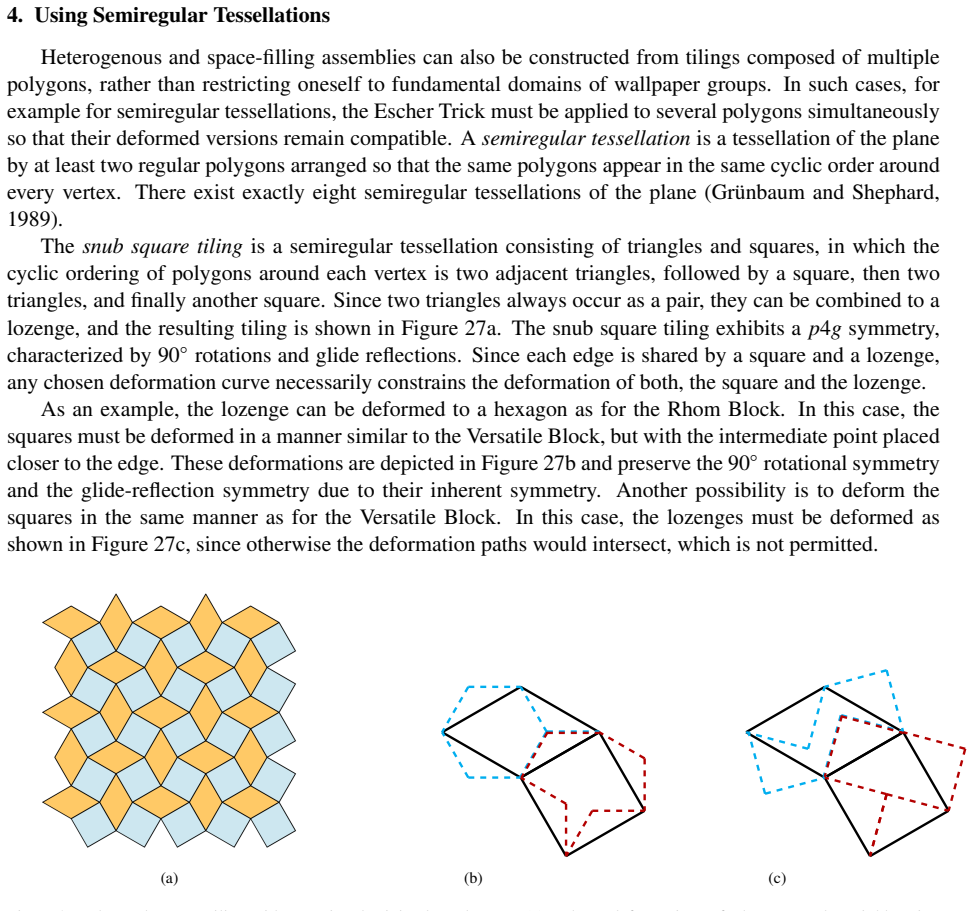
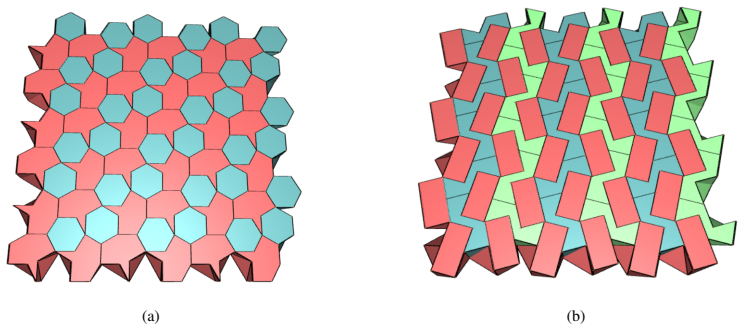
Deforming fundamental domains of wallpaper groups provides a systematic way to generate non-convex blocks which admit topological interlocking assemblies (TIAs). We use this approach to construct TIAs that fully occupy the space between two parallel planes and incorporate multiple block types. In addition to wallpaper groups, semiregular tessellations are employed in the construction of such TIAs. Several resulting block families can be interpreted as geometric realizations of generalized Truchet tiles or decorated lozenge tilings and, with suitable colouring rules, we establish a one-to-one correspondence between these tilings and specific TIAs. This framework enables a systematic study of
What carries the argument
Deformation of wallpaper group fundamental domains to create non-convex blocks, augmented by semiregular tessellations, for building space-filling TIAs with heterogeneous block types.
If this is right
- TIAs that occupy the full space between parallel planes can be built using multiple block types.
- The design space for interlocking systems in architecture and materials is significantly expanded.
- Resulting block families correspond to geometric realizations of generalized Truchet tiles or decorated lozenge tilings.
- Coloring rules create a one-to-one correspondence between specific tilings and the TIAs.
- Symmetric and asymmetric assemblies from various block types become amenable to systematic study.
Where Pith is reading between the lines
- These construction techniques could be adapted to generate interlocking structures in three dimensions.
- Automation of the deformations might allow custom design of blocks for specific applications.
- Physical prototypes could be tested to confirm the topological interlocking holds under various forces.
- Links to tiling theory may provide new tools for classifying and generating interlocking patterns.
Load-bearing premise
Deformations of wallpaper group fundamental domains and semiregular tessellations will always produce non-convex blocks that interlock topologically and fill space completely with no gaps or overlaps.
What would settle it
A particular deformation of a wallpaper group domain or a semiregular tessellation that generates blocks resulting in an assembly containing gaps or allowing separation without planar sliding.
Figures












read the original abstract
Deforming fundamental domains of wallpaper groups provides a systematic way to generate non-convex blocks which admit topological interlocking assemblies (TIAs). We use this approach to construct TIAs that fully occupy the space between two parallel planes and incorporate multiple block types. In addition to wallpaper groups, semiregular tessellations are employed in the construction of such TIAs. These construction methods open up an extensive design space for TIAs, expanding the possibilities of feasible interlocking systems and creating new opportunities for architectural and material design. Several resulting block families can be interpreted as geometric realizations of generalized Truchet tiles or decorated lozenge tilings and, with suitable colouring rules, we establish a one-to-one correspondence between these tilings and specific TIAs. This framework enables a systematic investigation of symmetric and asymmetric assemblies derived from diverse block types.
Editorial analysis
A structured set of objections, weighed in public.
Referee Report
Summary. The manuscript proposes construction methods for space-filling heterogeneous topological interlocking assemblies (TIAs) by deforming fundamental domains of wallpaper groups, augmented by semiregular tessellations. It claims these deformations generate non-convex blocks admitting TIAs that fully occupy the slab between two parallel planes using multiple block types, and establishes a one-to-one correspondence between the resulting tilings and specific TIAs, interpreting several block families as geometric realizations of generalized Truchet tiles or decorated lozenge tilings.
Significance. If the constructions are rigorously verified, the work provides a systematic framework for generating TIAs rather than ad-hoc designs, expanding the feasible design space with potential applications in architecture and materials. The explicit link to tiling theory (Truchet tiles, lozenge tilings) is a strength that enables investigation of symmetric and asymmetric assemblies from diverse block types.
major comments (1)
- [Abstract] Abstract: The central claim that deforming wallpaper-group fundamental domains (and applying semiregular tessellations) systematically produces valid non-convex blocks for heterogeneous, space-filling TIAs is asserted without any explicit constructions, deformation parameters, verification steps, or concrete examples. This leaves the three required properties (topological locking under deformation, gap-free heterogeneous tiling, and preservation under 3D extrusion) unsubstantiated.
Simulated Author's Rebuttal
We thank the referee for their positive evaluation of the significance of our work and for the detailed reading of the manuscript. We address the concern raised about the abstract below and have made revisions to improve clarity and substantiation of the central claims.
read point-by-point responses
-
Referee: [Abstract] Abstract: The central claim that deforming wallpaper-group fundamental domains (and applying semiregular tessellations) systematically produces valid non-convex blocks for heterogeneous, space-filling TIAs is asserted without any explicit constructions, deformation parameters, verification steps, or concrete examples. This leaves the three required properties (topological locking under deformation, gap-free heterogeneous tiling, and preservation under 3D extrusion) unsubstantiated.
Authors: The abstract is necessarily concise, but the full manuscript does contain the requested elements: Section 3 details the deformation maps applied to the fundamental domains of the 17 wallpaper groups, with explicit parameter ranges (e.g., shear and scaling factors) that preserve the required edge-matching conditions; Section 4 introduces the semiregular tessellations and provides step-by-step verification that the resulting non-convex blocks satisfy topological interlocking (via local locking graphs) and admit gap-free heterogeneous tilings of the slab; Section 5 shows the 3D extrusion construction and proves invariance of the interlocking property. Concrete examples with coordinates and figures are given for the p4m and p6m cases. To address the referee's point directly, we have expanded the abstract to include a brief outline of these construction steps and explicit references to the verification sections. revision: yes
Circularity Check
No circularity: forward construction from wallpaper groups and tessellations
full rationale
The paper describes a systematic forward construction that begins with known wallpaper groups and semiregular tessellations, deforms their fundamental domains to produce non-convex blocks, and then assembles them into space-filling TIAs between parallel planes. It further notes that certain resulting families correspond to generalized Truchet tiles or decorated lozenge tilings under suitable colouring rules, establishing a one-to-one mapping. No equations, definitions, or claims reduce the output assemblies to fitted parameters, self-referential quantities, or prior results by the same authors that presuppose the target construction. The derivation chain is therefore self-contained and does not exhibit any of the enumerated circularity patterns.
Axiom & Free-Parameter Ledger
axioms (2)
- standard math Wallpaper groups have well-defined fundamental domains that can be deformed while preserving periodicity
- standard math Semiregular tessellations exist and can be combined with deformed domains to produce space-filling assemblies
Reference graph
Works this paper leans on
-
[1]
Akpanya, T
R. Akpanya, T. Goertzen, S. Wiesenhuetter, A. C. Niemeyer, and J. Noennig. Topological interlocking, truchet tiles and self-assemblies: A construction-kit for civil engineering design. InProceedings of Bridges 2023: Mathematics, Art, Music, Architecture, Culture, pages 61–68,
2023
-
[2]
bridgesmathart.org/2023/bridges2023-61.html
URL http://archive. bridgesmathart.org/2023/bridges2023-61.html. M. A. Armstrong.Groups and symmetry. Undergraduate Texts in Mathematics. Springer-Verlag, New York,
2023
-
[3]
doi: 10.1007/978-1-4757-4034-9. A. Dyskin, Y . Estrin, E. Pasternak, H. Khor, and A. Kanel-Belov. Fracture resistant structures based on topological interlocking with non-planar contacts.Advanced Engineering Materials, 5(3):116–119,
-
[4]
doi: https://doi.org/10.1002/adem.200390016. A. V . Dyskin, Y . Estrin, A. J. Kanel-Belov, and E. Pasternak. A new concept in design of materials and structures: assemblies of interlocked tetrahedron-shaped elements.Scripta Materialia, 44(12):2689– 2694, 2001a. doi: https://doi.org/10.1016/S1359-6462(01)00968-X. A. V . Dyskin, Y . Estrin, A. J. Kanel-Belo...
-
[5]
doi: https: //doi.org/10.1002/adem.202300831. A.-F. Frézier.La théorie et la pratique de la coupe des pierres et des bois pour la construction des voutes et autres parties des bâtiments civils. Jean-Daniel Doulsseker, Paris,
-
[6]
URL https://publications.rwth-aachen.de/record/992149. T. Goertzen, A. C. Niemeyer, and W. Plesken. Topological interlocking via symmetry. In S. Stokkeland and H. Braarud, editors,6th fib International Congress on Concrete Innovation for Sustainability, 2022; Oslo; Norway, pages 1235–1244,
2022
-
[7]
doi: https://doi.org/ 10.1016/j.ijsolstr.2024.113102. V . Gorin.Lectures on Random Lozenge Tilings. Cambridge Studies in Advanced Mathematics. Cambridge University Press,
-
[8]
An introduction
ISBN 0-7167-1998-3. An introduction. IUCr.International Tables for Crystallography, Volume A: Space Group Symmetry. International Tables for Crystallography. Kluwer Academic Publishers, Dordrecht, Boston, London,
1998
-
[9]
doi: https://doi.org/10.1016/j.cag.2019.05.021
ISSN 0097-8493. doi: https://doi.org/10.1016/j.cag.2019.05.021. M. Tavoosi Gazkoh, X. Lin, and A. Zhou. Innovative approach for designing topological interlocking bricks with precise morphological representation and controlled interface curvature.Materials&Design, 253: 113844,
-
[10]
doi: https://doi.org/10.1016/j.matdes.2025.113844. M. Weizmann, O. Amir, and Y . J. Grobman. Topological interlocking in buildings: A case for the design and construction of floors.Automation in Construction, 72:18–25,
-
[11]
Pattern Recognition 127 (2022), 108611
doi: https://doi.org/10.1016/j. autcon.2016.05.014. 22
work page doi:10.1016/j 2016
discussion (0)
Sign in with ORCID, Apple, or X to comment. Anyone can read and Pith papers without signing in.