Recognition: unknown
The Effect of Mass Loss and Convective Overshooting on the Pre-Collapse Structure, Composition, and Neutrino Emission of Red Supergiants
Pith reviewed 2026-05-08 09:46 UTC · model grok-4.3
The pith
Mass loss and convective overshooting alter red supergiant core evolution, causing pre-supernova neutrino emission to shift to higher energies and become beta-process dominated hours before collapse.
A machine-rendered reading of the paper's core claim, the machinery that carries it, and where it could break.
Core claim
Models of red supergiants show that in the last days before collapse the core contracts, heats, and deleptonizes, but core silicon burning and shell burning cause temporary expansion and convective mixing with higher-proton-fraction material; the resulting pre-SN neutrino emission shifts gradually to higher energies and larger flux, becoming dominated by beta processes a few hours prior to collapse.
What carries the argument
A grid of MESA models with 12-20 solar mass zero-age main sequence stars, Dutch mass-loss scheme at efficiencies 0.2-1.0, two convective overshooting schemes, and a 206-isotope network that tracks composition to compute neutrino emission from the evolving core.
If this is right
- The timing of the neutrino flux increase depends on when silicon burning initiates in the core.
- Convective mixing during shell burning temporarily reverses deleptonization, affecting the neutrino spectrum.
- Stars with higher mass-loss rates evolve differently in core composition, leading to varied neutrino signals.
- The shift to beta-process dominance provides a temporal marker for the final hours before collapse.
- Pre-SN neutrinos from RSGs within 1 kpc become observable with current detectors due to the increased flux.
Where Pith is reading between the lines
- Observing the neutrino spectrum evolution could constrain the uncertain mass-loss rates in massive stars.
- Similar modeling for other progenitor types might reveal distinct pre-SN neutrino signatures.
- Combining neutrino data with electromagnetic observations of the progenitor could test stellar evolution assumptions.
- The findings suggest that pre-collapse neutrino monitoring could give hours of warning for nearby supernovae.
Load-bearing premise
The chosen Dutch mass-loss scheme, specific overshooting parameters, and 206-isotope network in MESA capture the dominant physics of red supergiant core evolution without large systematic errors from missing processes.
What would settle it
A detected pre-collapse neutrino signal from a nearby red supergiant whose energy spectrum and flux evolution do not match the predicted gradual increase and beta-process dominance in the final hours.
Figures






read the original abstract
Prior to core collapse, the neutrino emission from red supergiants (RSGs) is so large that a nearby ($\lesssim1$kpc) RSG will become visible in current and near-future neutrino detectors. The rate of emission and the spectra of the pre-supernova (pre-SN) neutrinos from RSGs are sensitive to the temperature, density, and detailed isotopic composition of the core. During the last year of the star's life, these properties change considerably. Several factors of stellar evolution modeling - such as the treatment of mass loss and convective overshooting - alter the thermal conditions and composition of the RSG core as it approaches collapse. In this paper we present the first study of how varying the treatment of mass loss and convective overshooting together affects the pre-collapse core properties and neutrino emission of RSGs. We use the stellar evolution instrument MESA and construct a grid of 32 models with zero-age main sequence masses of $\{ 12, 15, 18, 20\}$ $M_\odot$, use the so-called 'Dutch' mass-loss scheme with wind efficiencies of $\{0.2, 0.4, 0.8, 1.0\}$, and consider two convective overshooting schemes. Our models use a large 206-isotope nuclear network in order to accurately compute the structure and composition of the star. We find that, in the last few days of the star's life, the general trend of the conditions and composition in the core of the star is one of contraction, heating, and deleptonization, but that during this phase, this general trend will be interrupted by the initiation of core silicon burning and shell burning episodes that cause the core to expand and undergo convective mixing with material of a higher proton fraction that temporarily reverses the deleptonization. The pre-SN neutrino emission reflects these changes with a gradual shift to higher energies and larger flux that becomes dominated by beta processes a few hours prior to the collapse.
Editorial analysis
A structured set of objections, weighed in public.
Referee Report
Summary. The manuscript constructs a grid of 32 MESA models of red supergiants (ZAMS masses 12–20 M⊙) that vary the Dutch wind efficiency factor (0.2–1.0) and employ two convective overshooting prescriptions while using a 206-isotope network. It reports that the final days of evolution are characterized by core contraction, heating, and deleptonization, interrupted by silicon burning and shell-burning episodes that drive expansion and mixing; these structural changes produce a gradual increase in pre-SN neutrino flux and mean energy, with beta processes becoming dominant a few hours before collapse.
Significance. If the reported trends are robust within the adopted physics, the work supplies the first systematic exploration of the joint effect of mass-loss efficiency and overshooting on pre-collapse neutrino emission from RSGs. The use of an extended nuclear network and an explicit 32-model grid are strengths that allow direct assessment of parameter sensitivity; the results bear on the expected signal in near-future neutrino detectors for a Galactic supernova progenitor.
major comments (2)
- [Abstract and §4] Abstract and §4: The central claim that beta processes dominate the neutrino emission 'a few hours prior to collapse' is load-bearing for the neutrino-emission conclusion, yet the manuscript provides no quantitative definition of dominance (e.g., fractional contribution threshold) nor shows the time-dependent breakdown of emission channels for representative models across the grid. Without this, it is unclear how sensitive the reported few-hour window is to the precise timing of Si burning.
- [§3.1 and Table 1] §3.1 and Table 1: The Dutch wind efficiencies and the two overshooting schemes are varied explicitly, but the paper does not quantify how the resulting core-mass and mixing differences propagate into the exact onset time of core Si burning or the duration of the beta-dominated phase. A sensitivity plot or table showing the spread in these timings across the 32 models would be required to substantiate that the qualitative trend is not an artifact of the particular parameter choices.
minor comments (2)
- [§2] The abstract states that the models use a 'large 206-isotope nuclear network' but does not specify which reactions are included or omitted for the weak processes that dominate the late-time neutrino emission; a brief statement in §2 would improve reproducibility.
- [Figures] Figure captions and axis labels in the neutrino-related figures should explicitly state the energy range and the definition of 'mean energy' used, as these quantities are central to the reported spectral shift.
Simulated Author's Rebuttal
We thank the referee for their constructive and detailed review of our manuscript. The comments highlight areas where additional clarity and quantification will strengthen the presentation of our results on pre-collapse neutrino emission. We address each major comment below and will revise the manuscript accordingly.
read point-by-point responses
-
Referee: [Abstract and §4] Abstract and §4: The central claim that beta processes dominate the neutrino emission 'a few hours prior to collapse' is load-bearing for the neutrino-emission conclusion, yet the manuscript provides no quantitative definition of dominance (e.g., fractional contribution threshold) nor shows the time-dependent breakdown of emission channels for representative models across the grid. Without this, it is unclear how sensitive the reported few-hour window is to the precise timing of Si burning.
Authors: We agree that a precise definition and explicit channel breakdown would improve the robustness of this key claim. In the revised manuscript we will define 'dominance' quantitatively as the epoch when beta-process neutrinos exceed 50% of the total neutrino luminosity. We will add a new figure in §4 showing the time-dependent fractional contributions from beta, pair, and other processes for at least four representative models spanning the grid (different masses and wind efficiencies). The figure will also mark the onset of core Si burning to illustrate the sensitivity of the few-hour window. These additions will make the reported trend directly verifiable from the data. revision: yes
-
Referee: [§3.1 and Table 1] §3.1 and Table 1: The Dutch wind efficiencies and the two overshooting schemes are varied explicitly, but the paper does not quantify how the resulting core-mass and mixing differences propagate into the exact onset time of core Si burning or the duration of the beta-dominated phase. A sensitivity plot or table showing the spread in these timings across the 32 models would be required to substantiate that the qualitative trend is not an artifact of the particular parameter choices.
Authors: We concur that quantifying the spread in Si-burning onset and beta-phase duration across the full grid is necessary to demonstrate that the reported behavior is not sensitive to specific parameter choices. In the revision we will insert a new table in §3.1 (or an accompanying figure) that reports, for every model, (i) the time from core Si ignition to collapse and (ii) the duration of the beta-dominated neutrino phase. The table will be accompanied by a brief discussion of trends with Dutch wind efficiency and overshooting scheme. This will directly address the propagation of core-mass and mixing differences into the neutrino-emission timeline. revision: yes
Circularity Check
No significant circularity in forward simulation results
full rationale
The paper constructs a grid of 32 MESA models varying ZAMS mass, Dutch wind efficiencies, and two overshooting schemes, then directly evolves each model with a 206-isotope network to obtain core temperature-density-composition histories and the resulting neutrino spectra. All reported trends (core contraction/heating/deleptonization interrupted by Si burning, gradual neutrino energy/flux shift, and late beta-process dominance) are numerical outputs of these simulations rather than any analytical derivation, fitted parameter renamed as prediction, or self-citation chain. No load-bearing premise reduces to its own inputs by construction, and the analysis remains self-contained against the stated modeling choices.
Axiom & Free-Parameter Ledger
free parameters (2)
- wind efficiency factor
- convective overshooting parameters
axioms (2)
- domain assumption MESA stellar evolution code accurately models RSG structure and evolution under the chosen physics inputs
- domain assumption The 206-isotope nuclear network provides sufficient accuracy for isotopic composition and neutrino-producing reactions
Reference graph
Works this paper leans on
-
[1]
core only
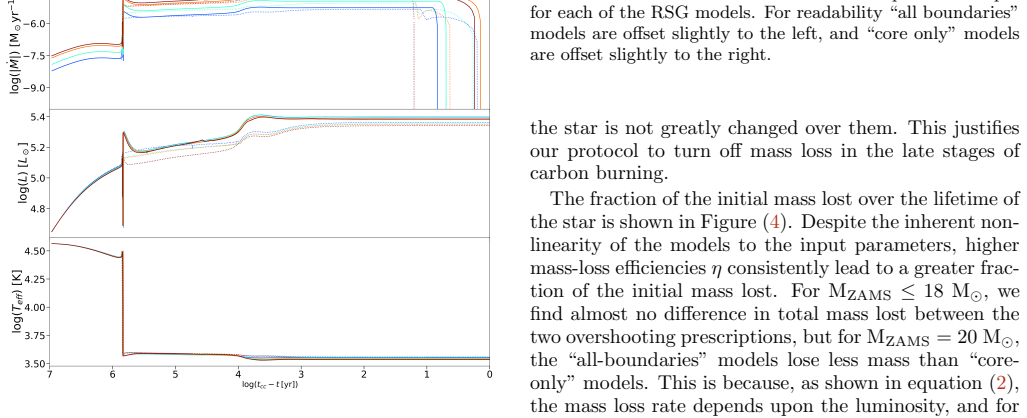
assumes that mass-loss rates depend most heavily on luminosity and effective temperature, some more re- cent studies propose that it is the wind profile density distribution that most strongly affects mass-loss rates [20]. Others have found evidence supporting the idea that mass-loss rates are strongly related to the convec- tive velocity of RSG chromosph...
-
[2]
compactness
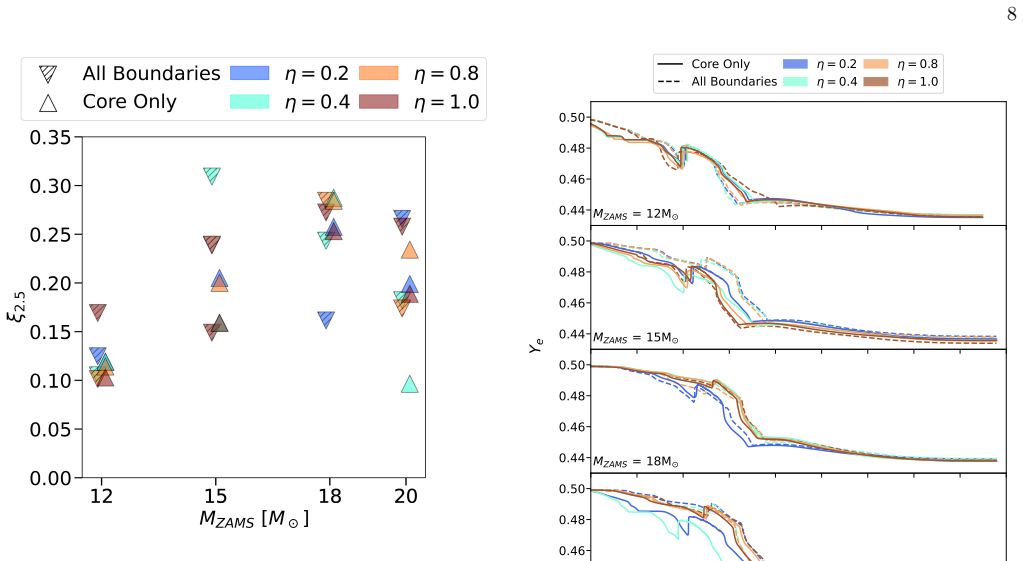
[64]. As equation (6) indicates, the beta neutrino emission is proportional to the density, and the thermal neutrinos are also functions ofρandTvia the distribu- tions of the electron-positron momenta in equation (7). Thus, the differences in the mass loss and overshooting treatment will affect the pre-SN neutrino emission start- ing with carbon burning, ...
-
[3]
E. M. Levesque,Astrophysics of Red Supergiants, 2514- 3433 (IOP Publishing, 2017)
2017
-
[4]
Davies, Red supergiants as supernova progenitors, Philosophical Transactions of the Royal Society of Lon- don Series A375, 20160270 (2017)
B. Davies, Red supergiants as supernova progenitors, Philosophical Transactions of the Royal Society of Lon- don Series A375, 20160270 (2017)
2017
- [5]
-
[6]
Habig and K
A. Habig and K. Scholberg, The Supernova Early Warn- ing System, Nature Reviews Physics2, 458 (2020)
2020
-
[7]
S. Al Kharusi, S. Y. BenZvi, J. S. Bobowski, W. Bonivento, V. Brdar, T. Brunner, E. Caden, M. Clark, A. Coleiro, M. Colomer-Molla, J. I. Crespo- Anad´ on, A. Depoian, D. Dornic, V. Fischer, D. Franco, W. Fulgione, A. Gallo Rosso, M. Geske, S. Gris- wold, M. Gromov, D. Haggard, A. Habig, O. Halim, A. Higuera, R. Hill, S. Horiuchi, K. Ishidoshiro, C. Kato, ...
-
[8]
M. Kara, S. Torres-Lara, A. L. Baxter, S. BenZvi, M. Colomer Molla, A. Habig, J. P. Kneller, M. Lai, R. F. Lang, M. Linvill, D. Milisavljevic, J. Migenda, C. Orr, K. Scholberg, J. Smolsky, J. Tseng, C. D. Tun- nell, J. Vasel, and A. Sheshukov, The SNEWS 2.0 alert software for the coincident detection of neutrinos from core-collapse supernovae, Journal of ...
- [9]
-
[10]
Beaudet, V
G. Beaudet, V. Petrosian, and E. E. Salpeter, Energy Losses due to Neutrino Processes, ApJ150, 979 (1967)
1967
-
[11]
N. Itoh, H. Hayashi, A. Nishikawa, and Y. Kohyama, Neutrino Energy Loss in Stellar Interiors. VII. Pair, Photo-, Plasma, Bremsstrahlung, and Recombination Neutrino Processes, Astrophysical Journals102, 411 (1996)
1996
-
[12]
Farag, F
E. Farag, F. X. Timmes, M. Taylor, K. M. Patton, and R. Farmer, On stellar evolution in a neutrino 15 hertzsprung–russell diagram, The Astrophysical Journal 893, 133 (2020)
2020
-
[13]
S. E. Woosley, A. Heger, and T. A. Weaver, The evolution and explosion of massive stars, Rev. Mod. Phys.74, 1015 (2002)
2002
-
[14]
Odrzywolek, M
A. Odrzywolek, M. Misiaszek, and M. Kutschera, Detec- tion possibility of the pair-annihilation neutrinos from the neutrino-cooled pre-supernova star, Astroparticle Physics21, 303 (2004)
2004
-
[15]
K. Asakura, A. Gando, Y. Gando, T. Hachiya, S. Hayashida, H. Ikeda, K. Inoue, K. Ishidoshiro, T. Ishikawa, S. Ishio, M. Koga, S. Matsuda, T. Mitsui, D. Motoki, K. Nakamura, S. Obara, T. Oura, I. Shimizu, Y. Shirahata, J. Shirai, A. Suzuki, H. Tachibana, K. Tamae, K. Ueshima, H. Watanabe, B. D. Xu, A. Ko- zlov, Y. Takemoto, S. Yoshida, K. Fushimi, A. Piepk...
- [16]
- [17]
-
[18]
M. Mukhopadhyay, C. Lunardini, F. X. Timmes, and K. Zuber, Presupernova Neutrinos: Directional Sensitiv- ity and Prospects for Progenitor Identification, ApJ899, 153 (2020), arXiv:2004.02045 [astro-ph.HE]
-
[19]
S. Abe, M. Eizuka, S. Futagi, A. Gando, Y. Gando, S. Goto, T. Hachiya, K. Hata, K. Ichimura, S. Ieki, H. Ikeda, K. Inoue, K. Ishidoshiro, Y. Kamei, N. Kawada, Y. Kishimoto, M. Koga, M. Kurasawa, T. Mitsui, H. Miyake, D. Morita, T. Nakahata, R. Nakajima, K. Nakamura, R. Nakamura, R. Nakamura, J. Nakane, H. Ozaki, K. Saito, T. Sakai, I. Shimizu, J. Shirai, ...
- [20]
- [21]
-
[22]
K. Antoniadis, A. Z. Bonanos, S. de Wit, E. Za- partas, G. Munoz-Sanchez, and G. Maravelias, Estab- lishing a mass-loss rate relation for red supergiants in the Large Magellanic Cloud, A&A686, A88 (2024), arXiv:2401.15163 [astro-ph.SR]
-
[23]
J. Fuller and D. Tsuna, Boil-off of red supergiants: mass loss and type II-P supernovae, The Open Journal of As- trophysics7, 47 (2024), arXiv:2405.21049 [astro-ph.SR]
-
[24]
K. Antoniadis, E. Zapartas, A. Z. Bonanos, G. Mar- avelias, S. Vlassis, G. Mu˜ noz-Sanchez, C. Nally, M. Meixner, O. C. Jones, L. Lenki´ c, and P. J. Kavanagh, Investigating the metallicity dependence of the mass-loss rate relation of red supergiants, A&A702, A178 (2025), arXiv:2503.05876 [astro-ph.SR]
-
[25]
de Jager, H
C. de Jager, H. Nieuwenhuijzen, and K. A. van der Hucht, Mass loss rates in the Hertzsprung-Russell dia- gram., A&AS72, 259 (1988)
1988
- [26]
-
[27]
Freytag, H
B. Freytag, H. G. Ludwig, and M. Steffen, Hydrodynam- ical models of stellar convection. The role of overshoot in DA white dwarfs, A-type stars, and the Sun., A&A313, 497 (1996)
1996
-
[28]
F. Herwig, The evolution of AGB stars with con- vective overshoot, A&A360, 952 (2000), arXiv:astro- ph/0007139 [astro-ph]
- [29]
-
[30]
Schroder, O
K.-P. Schroder, O. R. Pols, and P. P. Eggleton, A critical test of stellar evolution and convective core ‘overshooting’ 16 by means of zeta Aurigae systems, MNRAS285, 696 (1997)
1997
- [31]
- [32]
- [33]
-
[34]
Paxton, L
B. Paxton, L. Bildsten, A. Dotter, F. Herwig, P. Lesaf- fre, and F. Timmes, Modules for experiments in stellar astrophysics (mesa), The Astrophysical Journal Supple- ment Series192, 3 (2010)
2010
-
[35]
Farmer, C
R. Farmer, C. E. Fields, I. Petermann, L. Dessart, M. Cantiello, B. Paxton, and F. X. Timmes, On varia- tions of pre-supernova model properties, The Astrophys- ical Journal Supplement Series227, 22 (2016)
2016
-
[36]
C. E. Fields, The three-dimensional collapse of a rapidly rotating 16 msun star, The Astrophysical Journal Letters 924, L15 (2022)
2022
-
[37]
R. Andrassy, F. Herwig, P. Woodward, and C. Ritter, 3D hydrodynamic simulations of C ingestion into a convec- tive O shell, MNRAS491, 972 (2020), arXiv:1808.04014 [astro-ph.SR]
-
[38]
M. Renzo, J. A. Goldberg, A. Grichener, O. Gottlieb, and M. Cantiello, Progenitor Stars Calculated with Small Re- action Networks should not be Used as Initial Conditions for Core Collapse, Research Notes of the American Astro- nomical Society8, 152 (2024), arXiv:2406.02590 [astro- ph.SR]
-
[39]
A. Grichener, M. Renzo, W. E. Kerzendorf, R. Farmer, S. E. de Mink, E. P. Bellinger, C.-k. Chan, N. Chen, E. Farag, and S. Justham, Nuclear Neural Networks: Emulating Late Burning Stages in Core-collapse Super- nova Progenitors, ApJS279, 49 (2025), arXiv:2503.00115 [astro-ph.SR]
- [40]
-
[41]
Grichener, A., Bug in the nuclear reaction rates of reactions with more than two reactants and/or products,https://github.com/MESAHub/mesa/issues/ 575(2023), mESAHub/mesa Issue #575
2023
-
[42]
com/MESAHub/mesa/pull/632(2024), mESAHub/mesa Pull Request #632
Farag, E., Fix rates detailed balance,https://github. com/MESAHub/mesa/pull/632(2024), mESAHub/mesa Pull Request #632. Merged: 2024-05-06. Accessed: 2026- 01-24
2024
-
[43]
The chemical composition of the Sun
M. Asplund, N. Grevesse, A. J. Sauval, and P. Scott, The Chemical Composition of the Sun, ARA&A47, 481 (2009), arXiv:0909.0948 [astro-ph.SR]
work page Pith review arXiv 2009
-
[44]
A. S. Jermyn, E. B. Bauer, J. Schwab, R. Farmer, W. H. Ball, E. P. Bellinger, A. Dotter, M. Joyce, P. Marchant, J. S. G. Mombarg, W. M. Wolf, T. L. Sunny Wong, G. C. Cinquegrana, E. Farrell, R. Smolec, A. Thoul, M. Cantiello, F. Herwig, O. Toloza, L. Bildsten, R. H. D. Townsend, and F. X. Timmes, Modules for Experiments in Stellar Astrophysics (MESA): Tim...
- [45]
- [46]
-
[47]
2013, ApJS, 208, 4, doi: 10.1088/0067-0049/208/1/4 10
B. Paxton, M. Cantiello, P. Arras, L. Bildsten, E. F. Brown, A. Dotter, C. Mankovich, M. H. Montgomery, D. Stello, F. X. Timmes, and R. Townsend, Modules for Experiments in Stellar Astrophysics (MESA): Planets, Oscillations, Rotation, and Massive Stars, ApJS208, 4 (2013), arXiv:1301.0319 [astro-ph.SR]
work page internal anchor Pith review arXiv 2013
-
[48]
Vink, Jorick S., de Koter, A., and Lamers, H. J. G. L. M., Mass-loss predictions for o and b stars as a function of metallicity, A&A369, 574 (2001)
2001
- [49]
-
[50]
N. Smith, Mass Loss: Its Effect on the Evolution and Fate of High-Mass Stars, ARA&A52, 487 (2014), arXiv:1402.1237 [astro-ph.SR]
- [51]
- [52]
-
[53]
K. Langanke, G. Mart´ ınez-Pinedo, and J. M. Sam- paio, Neutrino spectra from stellar electron capture, Phys. Rev. C64, 055801 (2001), arXiv:nucl-th/0101039 [nucl-th]
-
[54]
T. Oda, M. Hino, K. Muto, M. Takahara, and K. Sato, Rate tables for the weak processes of sd-shell nuclei in stellar matter, Atomic Data and Nuclear Data Tables 56, 231 (1994)
1994
-
[55]
G. M. Fuller, W. A. Fowler, and M. J. Newman, Stellar weak-interaction rates for sd-shell nuclei. I - Nuclear ma- trix element systematics with application to Al-26 and selected nuclei of importance to the supernova problem, Astrophysical Journals42, 447 (1980)
1980
-
[56]
G. M. Fuller, W. A. Fowler, and M. J. Newman, Stellar weak interaction rates for intermediate-mass nuclei. II - A = 21 to A = 60, ApJ252, 715 (1982)
1982
-
[57]
G. M. Fuller, W. A. Fowler, and M. J. Newman, Stellar weak interaction rates for intermediate mass nuclei. III - Rate tables for the free nucleons and nuclei with A = 21 to A = 60, Astrophysical Journals48, 279 (1982)
1982
-
[58]
G. M. Fuller, W. A. Fowler, and M. J. Newman, Stel- lar weak interaction rates for intermediate-mass nuclei. IV - Interpolation procedures for rapidly varying lepton capture rates using effective log (ft)-values, ApJ293, 1 (1985)
1985
-
[59]
A. A. Dzhioev, A. V. Yudin, N. V. Dunina-Barkovskaya, A. I. Vdovin, A. A. Dzhioev, A. V. Yudin, N. V. Dunina- 17 Barkovskaya, and A. I. Vdovin, Neutrino Spectrum and Energy Loss Rates Due to Weak Processes on Hot 56Fe in Pre-Supernova Environment, Particles6, 682 (2023), company: Multidisciplinary Digital Publishing Institute Distributor: Multidisciplinar...
2023
- [60]
-
[61]
A. A. Dzhioev, A. V. Yudin, N. V. Dunina-Barkovskaya, and A. I. Vdovin, Neutrinos from pre-supernova: Effects of nuclear temperature on luminosities and spectra, Int. J. Mod. Phys. E33, 2441014 (2024)
2024
- [62]
-
[63]
Misiaszek, A
M. Misiaszek, A. Odrzywolek, and M. Kutschera, Neu- trino spectrum from the pair-annihilation process in the hot stellar plasma, Phys. Rev. D74, 043006 (2006)
2006
-
[64]
J. Buchner, A. Georgakakis, K. Nandra, L. Hsu, C. Rangel, M. Brightman, A. Merloni, M. Salvato, J. Donley, and D. Kocevski, X-ray spectral modelling of the AGN obscuring region in the CDFS: Bayesian model selection and catalogue, A&A564, A125 (2014), arXiv:1402.0004 [astro-ph.HE]
work page internal anchor Pith review arXiv 2014
-
[65]
E. E. Whitehead, R. Hirschi, V. Varma, B. Mueller, F. Rizzuti, C. Georgy, and W. D. Arnett, The Impact of Initial Mass Dependent Convective Boundary Mixing on the Structure and Fates of Massive Stars, MNRAS 10.1093/mnras/staf2245 (2026), arXiv:2512.11728 [astro- ph.SR]
-
[66]
Iliadis,Nuclear physics of stars(2015)
C. Iliadis,Nuclear physics of stars(2015)
2015
-
[67]
E. O’Connor and C. D. Ott, Black Hole Formation in Failing Core-Collapse Supernovae, ApJ730, 70 (2011), arXiv:1010.5550 [astro-ph.HE]
-
[68]
L. Boccioli, D. Vartanyan, E. P. O’Connor, and D. Kasen, Neutrino Heating in 1D, 2D, and 3D core- collapse supernovae: characterizing the explosion of high- compactness stars, arXiv e-prints , arXiv:2501.06784 (2025), arXiv:2501.06784 [astro-ph.HE]
-
[69]
S. Horiuchi, K. Nakamura, T. Takiwaki, and K. Kotake, Estimating the core compactness of massive stars with Galactic supernova neutrinos, Journal of Physics G Nu- clear Physics44, 114001 (2017), arXiv:1708.08513 [astro- ph.HE]
-
[70]
M. Segerlund, E. O’Sullivan, and E. O’Connor, Measur- ing the distance and mass of galactic core-collapse super- novae using neutrinos, arXiv e-prints , arXiv:2101.10624 (2021), arXiv:2101.10624 [astro-ph.HE]
-
[71]
E. Laplace, F. R. N. Schneider, and P. Podsiadlowski, It’s written in the massive stars: The role of stellar physics in the formation of black holes, A&A695, A71 (2025), arXiv:2409.02058 [astro-ph.SR]
-
[72]
T. Sukhbold and S. E. Woosley, The Compactness of Presupernova Stellar Cores, ApJ783, 10 (2014), arXiv:1311.6546 [astro-ph.SR]
-
[73]
A. Griffiths, M.- ´A. Aloy, R. Hirschi, M. Reichert, M. Obergaulinger, E. E. Whitehead, S. Martinet, L. Scia- rini, S. Ekstr¨ om, and G. Meynet, Evolving massive stars to core collapse with GENEC: Extension of equation of state, opacities and effective nuclear network, A&A693, A93 (2025), arXiv:2408.03368 [astro-ph.SR]
-
[74]
A. Chieffi and M. Limongi, The Presupernova Core Mass-Radius Relation of Massive Stars: Understand- ing Its Formation and Evolution, ApJ890, 43 (2020), arXiv:1911.08988 [astro-ph.SR]
- [75]
-
[76]
C. Kato, M. D. Azari, S. Yamada, K. Taka- hashi, H. Umeda, T. Yoshida, and K. Ishidoshiro, PRE-SUPERNOVA NEUTRINO EMISSIONS FROM ONe CORES IN THE PROGENITORS OF CORE- COLLAPSE SUPERNOVAE: ARE THEY DISTIN- GUISHABLE FROM THOSE OF Fe CORES?, The As- trophysical Journal808, 168 (2015), publisher: The American Astronomical Society
2015
-
[77]
T. Yoshida, K. Takahashi, H. Umeda, and K. Ishidoshiro, Presupernova neutrino events relating to the final evolu- tion of massive stars, Phys. Rev. D93, 123012 (2016), arXiv:1606.04915 [astro-ph]
- [78]
-
[79]
A. L. Baxter, S. Benzvi, J. C. Jaimes, A. Coleiro, M. C. Molla, D. Dornic, T. Goldhagen, A. Graf, S. Gris- wold, A. Habig, R. Hill, S. Horiuchi, J. P. Kneller, R. F. Lang, M. Lincetto, J. Migenda, K. Nakamura, E. O’Connor, A. Renshaw, K. Scholberg, C. Tunnell, N. Uberoi, A. Worlikar, and The Snews Collaboration, SNEWPY: A Data Pipeline from Supernova Simu...
2022
-
[80]
R. Hirschi, K. Goodman, G. Meynet, A. Maeder, S. Ek- str¨ om, P. Eggenberger, C. Georgy, Y. Sibony, N. Yusof, S. Martinet, V. Varma, and K. Nomoto, The fate of ro- tating massive stars across cosmic times, MNRAS543, 2796 (2025), arXiv:2508.21233 [astro-ph.SR]
discussion (0)
Sign in with ORCID, Apple, or X to comment. Anyone can read and Pith papers without signing in.