Recognition: unknown
Nonreciprocal Thermophotonic Cooling
Pith reviewed 2026-05-10 13:33 UTC · model grok-4.3
The pith
A nonreciprocal intermediate layer in thermophotonic coolers boosts cooling power density by nearly an order of magnitude while preserving efficiency gains.
A machine-rendered reading of the paper's core claim, the machinery that carries it, and where it could break.
Core claim
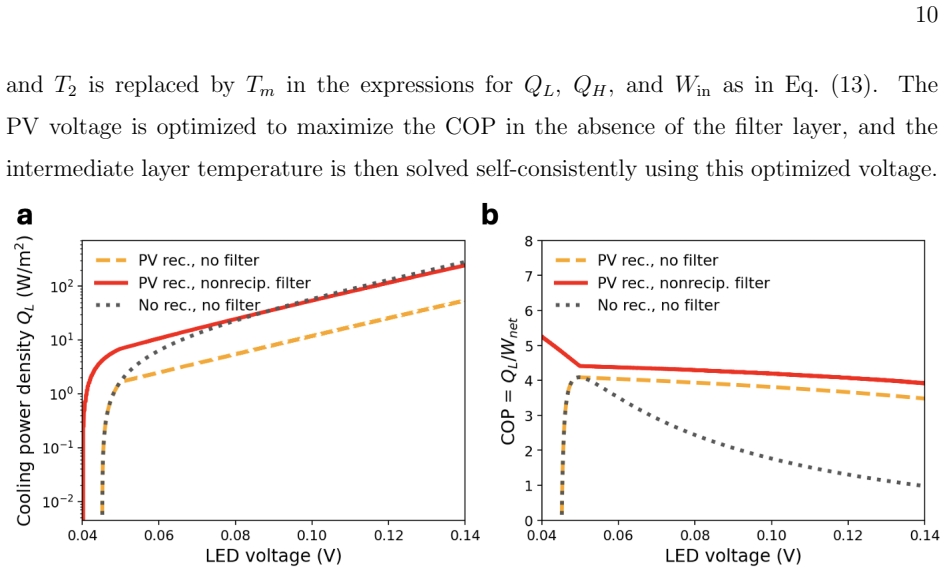
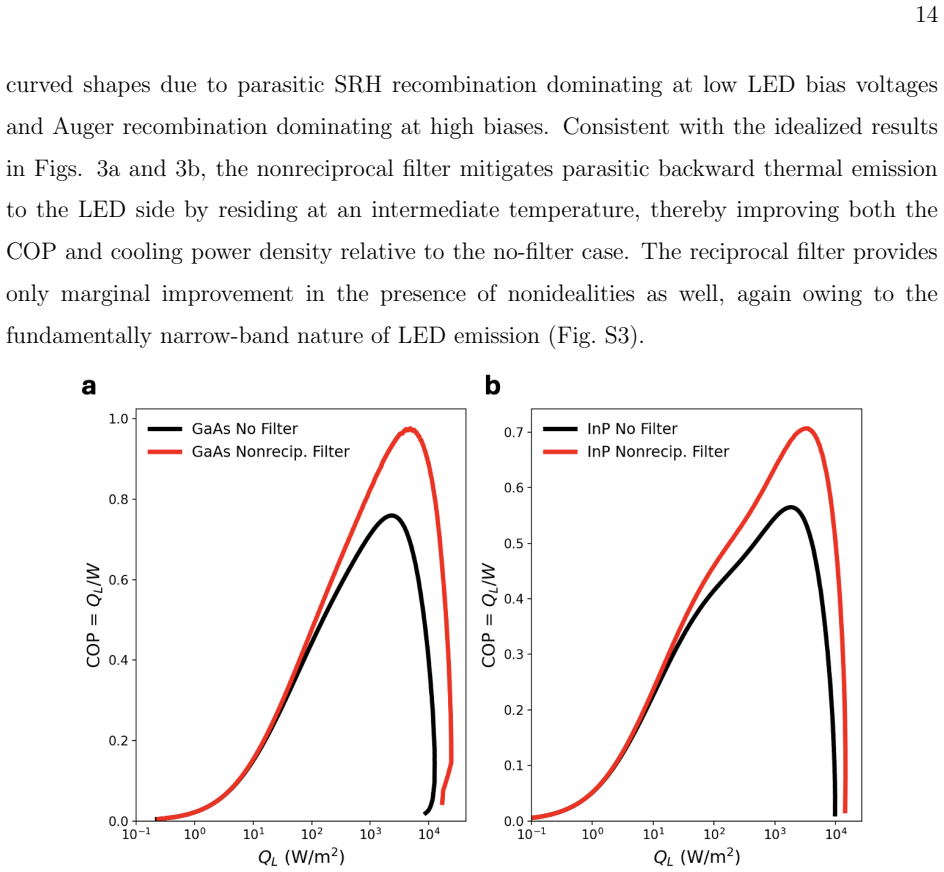
In the idealized limit for a 50 K temperature difference between hot and cold sides, the nonreciprocal filter improves cooling power density by nearly an order of magnitude over the unfiltered thermophotonic case while preserving the coefficient of performance benefit, whereas a reciprocal filter provides no improvement. When Shockley-Read-Hall and Auger recombination are added to GaAs and InP LED device models, enhancements of approximately 50 percent in both cooling power density and COP persist across temperature differences from 50 K to 100 K.
What carries the argument
The nonreciprocal semi-transparent intermediate layer that violates Kirchhoff's law, transmitting unity from LED to PV while absorbing all backward PV flux and re-emitting toward the LED at an intermediate temperature.
Load-bearing premise
A nonreciprocal semi-transparent layer can be realized with unity forward transmission, full absorption of the backward PV flux, and re-emission at an intermediate temperature without introducing significant additional losses.
What would settle it
Build a prototype with the nonreciprocal layer at a 50 K temperature difference and measure whether cooling power density reaches nearly ten times the unfiltered thermophotonic value while COP stays comparable.
Figures



read the original abstract
Solid-state cooling via electroluminescent emission from light-emitting diodes is a promising alternative to thermoelectric and vapor-compression refrigeration, but practical performance remains limited by nonradiative losses and unfavorable tradeoffs between efficiency and cooling power. Thermophotonic (TPX) architectures partially address this by recycling PV-generated power back to the LED, improving the coefficient of performance (COP) but introducing a parasitic backward photon flux from the PV that reduces the cooling power density. Here we show that this tradeoff can be circumvented by inserting a nonreciprocal semi-transparent intermediate layer that violates Kirchhoff's law of thermal radiation. The layer permits unity transmission from the LED to the PV while fully absorbing the backward PV flux, functioning as a radiative heat shield that re-emits toward the LED at a lower intermediate temperature. In the idealized limit for $\Delta$ T = 50 K between the hot and cold side, the nonreciprocal filter improves the cooling power density by nearly an order of magnitude over the unfiltered TPX case while preserving the COP benefit, while a reciprocal filter provides no improvement. Incorporating Shockley-Read-Hall and Auger recombination into GaAs and InP-based LED device models, we find enhancements of approximately 50% in both cooling power density and COP persisting across temperature differences from $\Delta$ T = 50 K to 100 K. These results highlight the potential importance of electromagnetic nonreciprocity in improving the real-world performance of thermophotonic cooling devices.
Editorial analysis
A structured set of objections, weighed in public.
Referee Report
Summary. The manuscript proposes inserting a nonreciprocal semi-transparent intermediate layer into thermophotonic (TPX) cooling architectures to break the tradeoff between cooling power density and coefficient of performance (COP) that arises from parasitic backward photon flux in conventional TPX designs. In the idealized limit with ΔT = 50 K, the nonreciprocal layer is shown to increase cooling power density by nearly an order of magnitude relative to the unfiltered TPX case while retaining the COP advantage; a reciprocal filter yields no benefit. Device-level models for GaAs and InP LEDs that incorporate Shockley-Read-Hall and Auger recombination then predict approximately 50 % gains in both cooling power density and COP that persist for temperature differences between 50 K and 100 K.
Significance. If the assumed ideal nonreciprocal layer can be realized, the approach offers a concrete route to higher-performance solid-state cooling that mitigates a key limitation of existing TPX concepts. The inclusion of realistic non-radiative recombination mechanisms in the LED models provides a more applied assessment than purely radiative analyses. The work also illustrates a potential practical use of electromagnetic nonreciprocity for radiative heat management, which could influence future device design in applied physics.
major comments (1)
- The central performance claims rest on the explicit assumption of an ideal nonreciprocal layer (unity forward transmission, complete absorption of the backward PV flux, and re-emission at an intermediate temperature with no additional losses). While this idealization is clearly stated, the manuscript would be strengthened by a quantitative sensitivity study showing how deviations from unity transmission or perfect absorption affect the reported 50 % enhancements (particularly in the ΔT = 50–100 K range).
minor comments (2)
- The abstract states an 'approximately 50 %' enhancement; providing the precise numerical factors obtained from the GaAs and InP models (with and without the nonreciprocal layer) in a table would improve clarity and allow direct comparison.
- All symbols appearing in the device-model equations (e.g., recombination coefficients, photon fluxes, and temperatures) should be defined at first use or collected in a nomenclature table.
Simulated Author's Rebuttal
We thank the referee for their positive assessment of the manuscript and for the constructive suggestion regarding the ideal nonreciprocal layer assumption. We address the major comment below.
read point-by-point responses
-
Referee: The central performance claims rest on the explicit assumption of an ideal nonreciprocal layer (unity forward transmission, complete absorption of the backward PV flux, and re-emission at an intermediate temperature with no additional losses). While this idealization is clearly stated, the manuscript would be strengthened by a quantitative sensitivity study showing how deviations from unity transmission or perfect absorption affect the reported 50 % enhancements (particularly in the ΔT = 50–100 K range).
Authors: We agree that a quantitative sensitivity study would strengthen the presentation of the results. In the revised manuscript we will add an analysis (new figure or subsection) that varies the forward transmission coefficient and the backward absorption efficiency away from their ideal values of unity and unity, respectively, and reports the resulting changes to cooling power density and COP. The study will focus on the ΔT = 50–100 K range relevant to the GaAs/InP device models and will demonstrate that the reported ~50 % gains remain substantial for moderate deviations from ideality. revision: yes
Circularity Check
No significant circularity in the derivation chain
full rationale
The paper derives its performance claims (cooling power density and COP enhancements) from standard numerical device models of GaAs/InP LEDs that incorporate explicit Shockley-Read-Hall and Auger recombination terms. These are computed outputs under stated idealized assumptions for the nonreciprocal layer (unity forward transmission, full backward absorption, intermediate-temperature re-emission), not quantities that reduce algebraically or by construction to the inputs or to any fitted parameters from the same dataset. No self-definitional steps, renamed empirical patterns, or load-bearing self-citations appear in the provided text; the modeling chain remains independent of the target results.
Axiom & Free-Parameter Ledger
axioms (2)
- domain assumption Kirchhoff's law of thermal radiation can be violated by the intermediate layer in the manner described
- standard math Shockley-Read-Hall and Auger recombination rates in GaAs and InP follow standard device-physics expressions
invented entities (1)
-
nonreciprocal semi-transparent intermediate layer
no independent evidence
Reference graph
Works this paper leans on
-
[1]
Tauc, Cechoslovackij fiziceskij zurnal7, 275 (1957)
J. Tauc, Cechoslovackij fiziceskij zurnal7, 275 (1957)
1957
-
[2]
Santhanam, D
P. Santhanam, D. J. Gray, and R. J. Ram, Physical Review Letters108, 097403 (2012). 17
2012
-
[3]
Radevici, J
I. Radevici, J. Tiira, T. Sadi, S. Ranta, A. Tukiainen, and M. Guina, Applied Physics Letters (2019)
2019
-
[4]
K. P. Pipe, R. J. Ram, and A. Shakouri, Phys. Rev. B66, 125316 (2002)
2002
-
[5]
T. Sadi, I. Radevici, and J. Oksanen, Nature Photonics14, 205 (2020)
2020
-
[6]
Santhanam, D
P. Santhanam, D. Huang, R. J. Ram, M. A. Remennyi, and B. A. Matveev, Applied Physics Letters103, 183513 (2013)
2013
-
[7]
K. Chen, T. P. Xiao, P. Santhanam, E. Yablonovitch, and S. Fan, Journal of Applied Physics 122, 143104 (2017)
2017
-
[8]
T. P. Xiao, K. Chen, P. Santhanam, S. Fan, and E. Yablonovitch, Journal of Applied Physics 123, 173104 (2018)
2018
-
[9]
T. Sadi, I. Radevici, P. Kivisaari, and J. Oksanen, IEEE Transactions on Electron Devices 66, 2651 (2019)
2019
-
[10]
Habibi and L
M. Habibi and L. Cui, PRX Energy5, 013005 (2026)
2026
-
[11]
R. C. Ng, A. El Sachat, J. Jaramillo-Fernandez, C. M. Sotomayor- Torres, and E. Chavez-Angel, ACS Applied Optical Materials2, 973 (2024), https://doi.org/10.1021/acsaom.3c00235
-
[12]
Chtelet, J
T. Chtelet, J. Legendre, O. Merchiers, and P.-O. Chapuis, Journal of Applied Physics138, 173106 (2025)
2025
-
[13]
DeSutter, R
J. DeSutter, R. Vaillon, and M. Francoeur, Phys. Rev. Appl.8, 014030 (2017)
2017
-
[14]
K. Chen, P. Santhanam, and S. Fan, Applied Physics Letters107, 091106 (2015)
2015
-
[15]
B. Zhao, S. Buddhiraju, P. Santhanam, K. Chen, and S. Fan, Pro- ceedings of the National Academy of Sciences116, 11596 (2019), https://www.pnas.org/doi/pdf/10.1073/pnas.1904938116
-
[16]
K. J. Shayegan, J. S. Hwang, B. Zhao, A. P. Raman, and H. A. Atwater, Light: Science & Applications13, 176 (2024)
2024
-
[17]
K. J. Shayegan, B. Zhao, Y. Kim, S. Fan, and H. A. Atwater, Science Advances8, eabm4308 (2022)
2022
-
[18]
Zhang, A
Z. Zhang, A. Kalantari Dehaghi, P. Ghosh, and L. Zhu, Phys. Rev. Lett.135, 016901 (2025)
2025
-
[19]
B. Zhao, C. Guo, C. A. C. Garcia, P. Narang, and S. Fan, Nano Letters20, 1923 (2020)
1923
-
[20]
Tsurimaki, X
Y. Tsurimaki, X. Qian, S. Pajovic, F. Han, M. Li, and G. Chen, Physical Review B101, 165426 (2020). 18
2020
-
[21]
Butler and C
A. Butler and C. Argyropoulos, J. Opt. Soc. Am. B40, 2122 (2023)
2023
-
[22]
Y. Park, V. S. Asadchy, B. Zhao, C. Guo, J. Wang, and S. Fan, ACS Photonics8, 2417 (2021)
2021
-
[23]
V. S. Asadchy, C. Guo, B. Zhao, and S. Fan, Advanced Optical Materials8, 2000100 (2020), https://advanced.onlinelibrary.wiley.com/doi/pdf/10.1002/adom.202000100
-
[24]
Y. Park, Z. Omair, and S. Fan, ACS Photonics9, 3943 (2022)
2022
-
[25]
B. Zhao, K. Chen, S. Buddhiraju, G. Bhatt, M. Lipson, and S. Fan, Nano Energy41, 344 (2017)
2017
-
[26]
Jafari Ghalekohneh and B
S. Jafari Ghalekohneh and B. Zhao, Phys. Rev. Appl.18, 034083 (2022)
2022
-
[27]
Y. Park, B. Zhao, and S. Fan, Nano Letters22, 448 (2022)
2022
-
[28]
Park and S
Y. Park and S. Fan, Applied Physics Letters121, 111102 (2022)
2022
-
[29]
P Wurfel, Journal of Physics C: Solid State Physics15, 3967 (1982)
1982
-
[30]
Zhao and S
B. Zhao and S. Fan, Annual Review of Heat Transfer23(2020)
2020
-
[31]
R. T. Ross, The Journal of Chemical Physics46, 4590 (1967)
1967
-
[32]
K. Chen, P. Santhanam, S. Sandhu, L. Zhu, and S. Fan, Phys. Rev. B91, 134301 (2015)
2015
-
[33]
Fiorino, L
A. Fiorino, L. Zhu, D. Thompson, R. Mittapally, P. Reddy, and E. Meyhofer, Nature Nan- otechnology13, 806 (2018)
2018
-
[34]
L. Zhu, A. Fiorino, D. Thompson, R. Mittapally, E. Meyhofer, and P. Reddy, Nature566, 239 (2019)
2019
-
[35]
Benenti, K
G. Benenti, K. Saito, and G. Casati, Phys. Rev. Lett.106, 230602 (2011)
2011
-
[36]
Shiraishi, K
N. Shiraishi, K. Saito, and H. Tasaki, Phys. Rev. Lett.117, 190601 (2016)
2016
-
[37]
Pietzonka and U
P. Pietzonka and U. Seifert, Phys. Rev. Lett.120, 190602 (2018)
2018
-
[38]
A. S. Brown and M. A. Green, Progress in Photovoltaics: Research and Applications10, 299 (2002)
2002
-
[39]
Park and S
Y. Park and S. Fan, PRX Energy3, 033002 (2024)
2024
-
[40]
Marti and G
A. Marti and G. L. Araujo, Solar Energy Materials and Solar Cells43, 203 (1996)
1996
discussion (0)
Sign in with ORCID, Apple, or X to comment. Anyone can read and Pith papers without signing in.