Recognition: unknown
Diffusion-based Galaxy Simulations for the Roman High Latitude Survey
Pith reviewed 2026-05-08 09:55 UTC · model grok-4.3
The pith
Diffusion models generate realistic multi-band galaxy images for Roman weak lensing by learning from transformed JWST observations.
A machine-rendered reading of the paper's core claim, the machinery that carries it, and where it could break.
Core claim
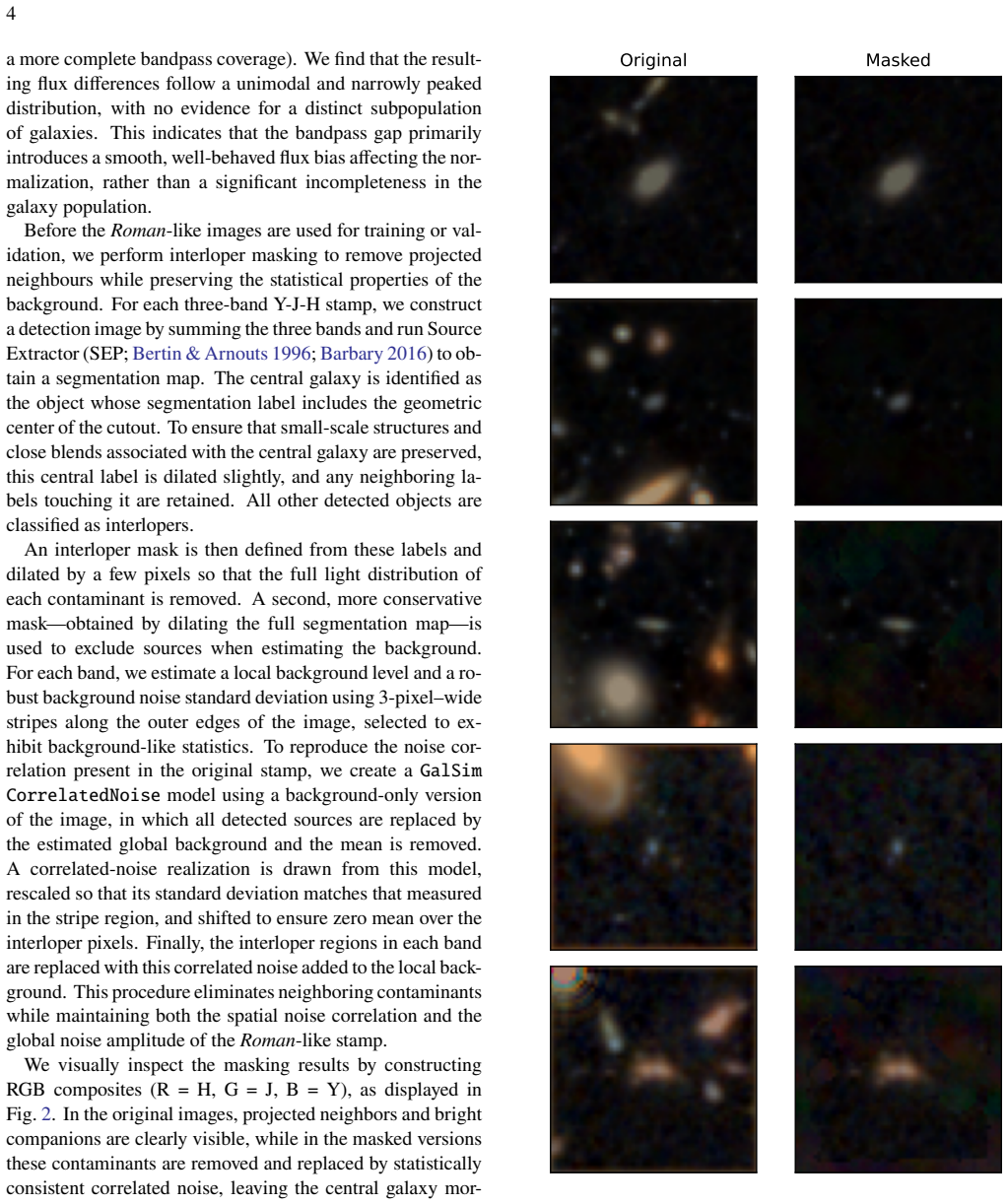
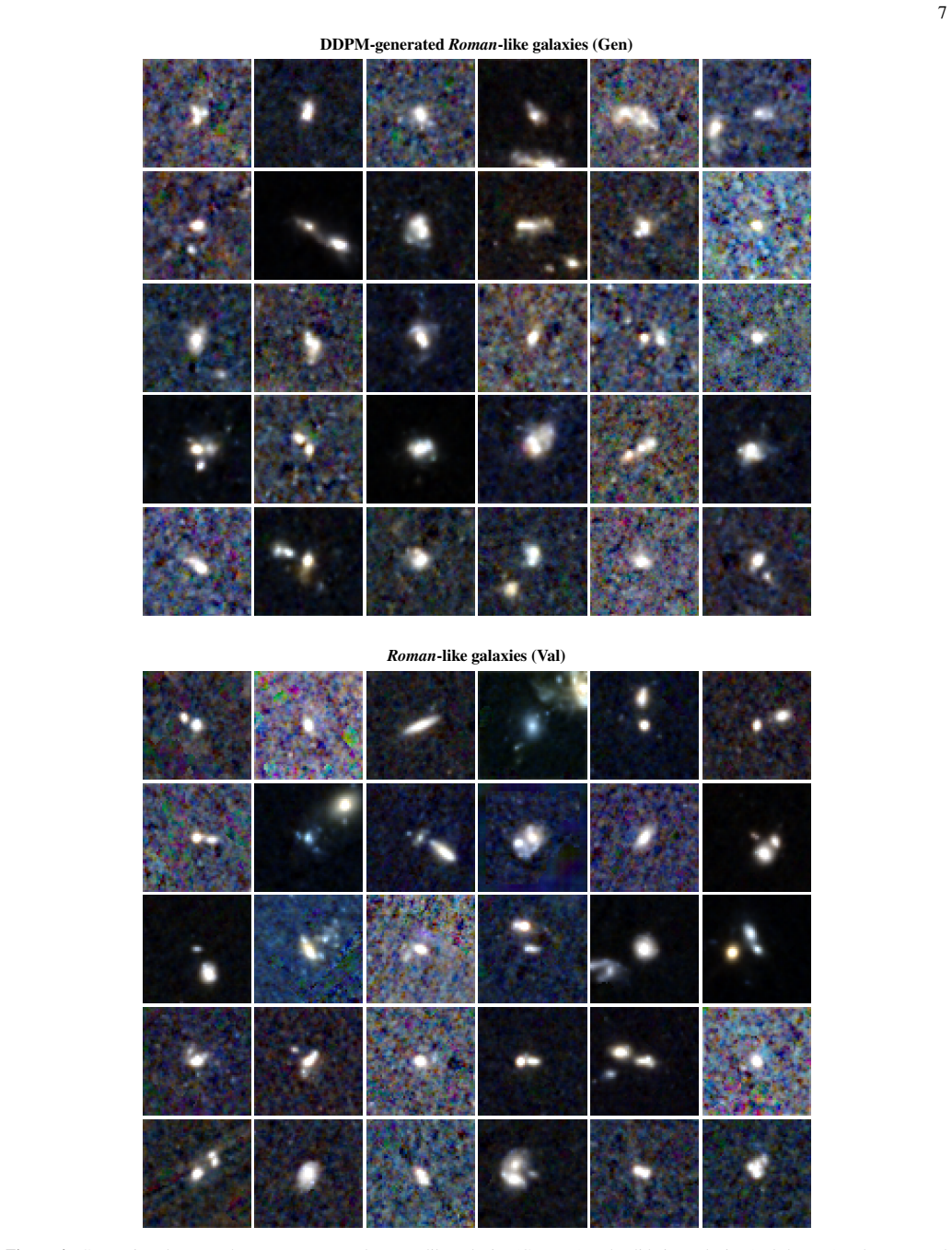
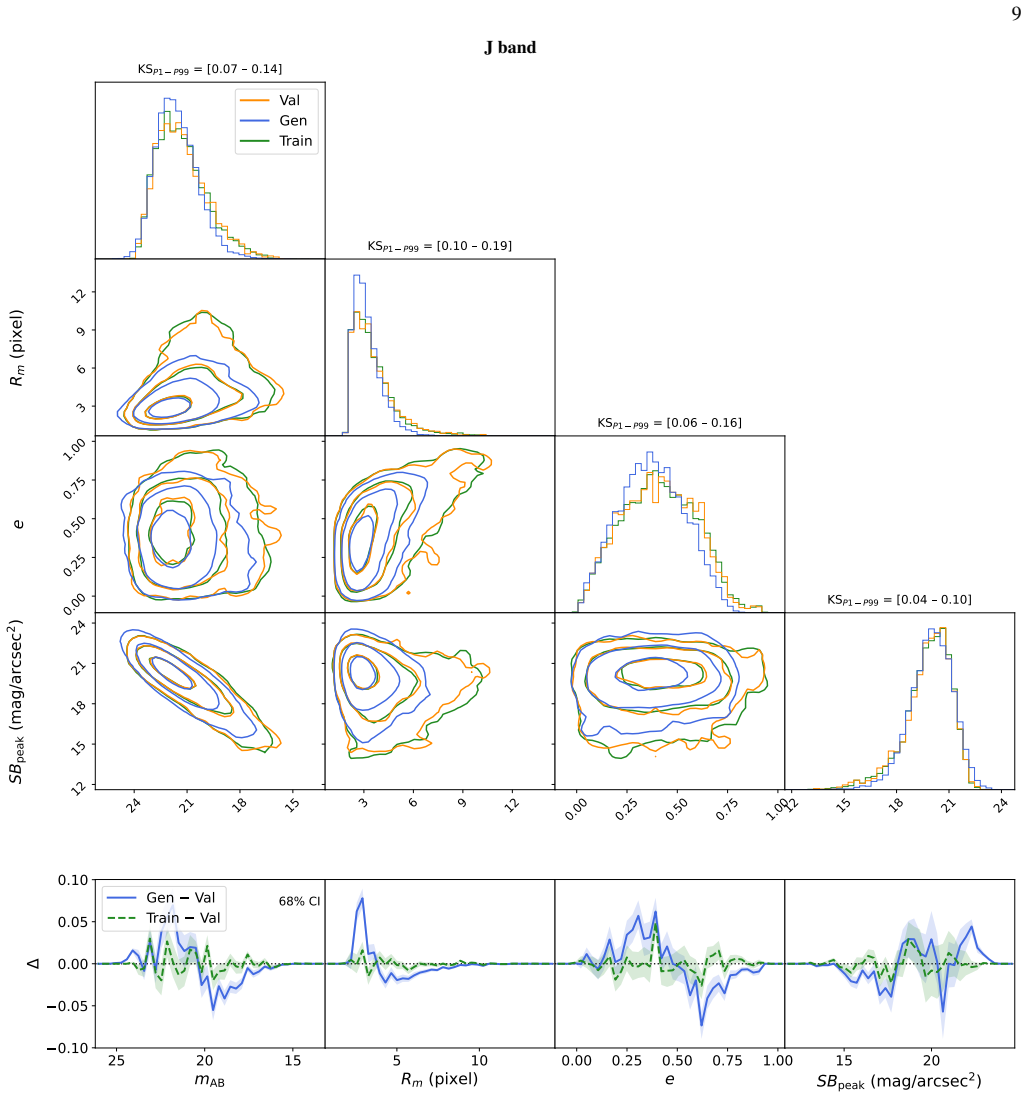
We construct Roman-like galaxy images from multi-band JWST/NIRCam observations in the GOODS fields through PSF matching, pixel-scale conversion, and interloper masking that preserves correlated noise. These images train a denoising diffusion probabilistic model that generates multi-band postage stamps in the Roman Y, J, and H filters. Validation against an independent dataset shows that the generated sample reproduces the marginal distributions and covariance structure of magnitude, size, ellipticity, peak surface brightness, and colors, with only modest deviations in low-occupancy regions of parameter space.
What carries the argument
Denoising diffusion probabilistic model trained on multi-band Roman-like galaxy postage stamps obtained by transforming JWST/NIRCam data via PSF matching, pixel-scale conversion, and interloper masking.
If this is right
- The method supplies high-fidelity galaxy populations for Roman weak lensing calibration without relying on analytic light-profile assumptions.
- It scales to produce the large simulation volumes required for upcoming cosmological surveys.
- The same framework can be applied to other future experiments by retraining on appropriately transformed high-resolution data.
- Generated samples preserve both one-point and joint statistics of observable galaxy properties.
Where Pith is reading between the lines
- The approach could lower the computational cost of producing large simulation suites once the diffusion model is trained.
- It opens a route to incorporate rare morphological features observed in JWST data that analytic models miss.
- Similar data-transformation pipelines might allow diffusion models to be adapted for ground-based surveys with different noise and seeing characteristics.
Load-bearing premise
The JWST-to-Roman image transformation preserves every galaxy property that matters for weak lensing shear measurement and does not introduce artifacts that the diffusion model then reproduces.
What would settle it
If the generated galaxies show statistically significant mismatches in ellipticity distributions or color covariances compared with an independent validation catalog processed through the same photometric pipeline, the claim that the model supplies usable simulations for shear calibration would fail.
Figures





read the original abstract
Future weak lensing analyses with the Nancy Grace Roman Space Telescope will require highly realistic image simulations to control shear systematics at unprecedented precision. A key limitation of existing approaches is their reliance on analytic light-profile models, which cannot fully capture the complex, non-parametric morphologies revealed by high-resolution observations. We present a diffusion-based framework for generating realistic galaxy image simulations tailored to the weak lensing requirements of the Roman High Latitude Survey. We construct Roman-like galaxy images from multi-band JWST/NIRCam observations in the GOODS-S and GOODS-N fields, transforming them into the Roman observing regime through point-spread-function matching, pixel-scale conversion, and interloper masking that preserves correlated noise properties. These data are used to train a denoising diffusion probabilistic model to generate multi-band galaxy postage stamps in the Roman Y, J, and H filters. We validate the generated sample against an independent dataset using a consistent photometric pipeline, comparing key galaxy observables including magnitude, size, ellipticity, peak surface brightness, and three-band colors. The generated galaxies reproduce both the marginal distributions and the covariance structure of these properties, with only modest deviations in low-occupancy regions of parameter space. These results demonstrate that diffusion models provide a scalable and physically motivated alternative to analytic simulations, enabling high-fidelity galaxy populations for Roman weak lensing calibration and, more generally, for survey preparation in upcoming cosmological experiments.
Editorial analysis
A structured set of objections, weighed in public.
Referee Report
Summary. The manuscript introduces a denoising diffusion probabilistic model trained on multi-band JWST/NIRCam observations from GOODS-S and GOODS-N, transformed to Roman-like conditions via PSF matching, pixel-scale conversion, and interloper masking that preserves correlated noise. The model generates multi-band (Y, J, H) galaxy postage stamps, which are validated against an independent dataset using a consistent photometric pipeline by comparing marginal distributions and covariances of magnitude, size, ellipticity, peak surface brightness, and colors, with only modest deviations reported in low-occupancy regions. The central claim is that this provides a scalable, data-driven alternative to analytic light-profile models for high-fidelity galaxy populations needed in Roman weak lensing calibration.
Significance. If the generated images can be shown to yield unbiased shear estimates, the approach would represent a meaningful advance by capturing non-parametric morphologies from real high-resolution data rather than relying on parametric assumptions. The data-driven training on transformed JWST observations and the reproduction of covariance structure are strengths that could improve realism in survey preparation simulations. However, the current evidence does not yet establish control of shear systematics at the precision required for Roman weak lensing.
major comments (1)
- The validation procedure (as described in the abstract) compares only marginal distributions and covariances of five scalar observables (magnitude, size, ellipticity, peak surface brightness, and colors). This does not establish that the generated images produce unbiased shear estimates when passed through a Roman-like measurement pipeline, as higher-order morphological features, residual noise correlations after PSF matching, and the response of shape estimators (e.g., metacalibration) to potential diffusion artifacts at low surface brightness or in light-profile wings remain untested. A direct quantification of multiplicative and additive shear biases on the generated sample is required to support the claim of enabling high-fidelity populations for weak lensing calibration.
Simulated Author's Rebuttal
We thank the referee for their constructive review and for recognizing the potential of our diffusion-based approach. We address the major comment below, agreeing on the need for stronger validation while clarifying the scope of the current work.
read point-by-point responses
-
Referee: The validation procedure (as described in the abstract) compares only marginal distributions and covariances of five scalar observables (magnitude, size, ellipticity, peak surface brightness, and colors). This does not establish that the generated images produce unbiased shear estimates when passed through a Roman-like measurement pipeline, as higher-order morphological features, residual noise correlations after PSF matching, and the response of shape estimators (e.g., metacalibration) to potential diffusion artifacts at low surface brightness or in light-profile wings remain untested. A direct quantification of multiplicative and additive shear biases on the generated sample is required to support the claim of enabling high-fidelity populations for weak lensing calibration.
Authors: We agree that direct quantification of multiplicative and additive shear biases via a Roman-like shape measurement pipeline (e.g., metacalibration) would constitute the strongest test of suitability for weak lensing calibration. Our validation was intentionally focused on reproducing the marginal distributions and covariances of photometric and morphological properties that serve as direct inputs to such pipelines, including ellipticity and size, which are central to shear estimation. We acknowledge that higher-order morphological details, residual noise correlations, and potential low-surface-brightness artifacts from the diffusion process could introduce unquantified systematics. In the revised manuscript we have added a dedicated limitations subsection (Section 5.3) that explicitly discusses these gaps, includes qualitative inspection of generated light-profile wings, and outlines planned future work to perform end-to-end shear bias measurements once a full Roman simulation framework is available. We have also tempered the abstract and conclusion language from 'enabling high-fidelity galaxy populations for Roman weak lensing calibration' to 'providing a scalable, data-driven foundation that can be integrated into future weak lensing calibration pipelines.' We view the current results as an important intermediate step demonstrating statistical fidelity of the generated population, but we do not claim that shear bias control has been demonstrated. revision: partial
Circularity Check
No significant circularity in the derivation chain.
full rationale
The paper presents a data-driven pipeline: JWST observations are transformed via PSF matching, pixel rescaling, and masking to create training images in the Roman regime, a denoising diffusion model is trained on these data, and outputs are validated by comparing marginal distributions and covariances of five scalar observables (magnitude, size, ellipticity, peak surface brightness, colors) against an independent test set. No equations, ansatzes, or self-citations are invoked that reduce the generated galaxy images or the central claim to the training inputs by construction. The validation step is an external statistical comparison rather than a tautological re-expression of fitted parameters, and the approach remains self-contained against external benchmarks without load-bearing self-referential steps.
Axiom & Free-Parameter Ledger
free parameters (1)
- diffusion model training hyperparameters
axioms (2)
- domain assumption Denoising diffusion probabilistic models can faithfully capture the joint distribution of complex, non-parametric galaxy morphologies across bands
- domain assumption The PSF matching, pixel-scale conversion, and interloper masking preserve correlated noise and morphological properties relevant to weak lensing
Reference graph
Works this paper leans on
-
[1]
The Wide Field Infrared Survey Telescope: 100 Hubbles for the 2020s
Akeson, R., Armus, L., Bachelet, E., et al. 2019, The Wide Field Infrared Survey Telescope: 100 Hubbles for the 2020s. https://arxiv.org/abs/1902.05569
work page Pith review arXiv 2019
-
[2]
2025, MNRAS, 544, 3799–3823, doi: 10.1093/mnras/staf1833 Astropy Collaboration, Robitaille, T
Alarcon, A., Aldoroty, L., Beltz-Mohrmann, G., et al. 2025, MNRAS, 544, 3799–3823, doi: 10.1093/mnras/staf1833 Astropy Collaboration, Robitaille, T. P., Tollerud, E. J., et al. 2013, A&A, 558, A33, doi: 10.1051/0004-6361/201322068 Astropy Collaboration, Price-Whelan, A. M., Sip˝ocz, B. M., et al. 2018, AJ, 156, 123, doi: 10.3847/1538-3881/aabc4f
-
[3]
The Journal of Open Source Software , year = 2016, month = oct, volume =
Barbary, K. 2016, The Journal of Open Source Software, 1, 58, doi: 10.21105/joss.00058
-
[4]
Bartelmann, M., & Schneider, P. 2001, PhR, 340, 291, doi: 10.1016/S0370-1573(00)00082-X
-
[5]
2025, MNRAS, 542, 608–628, doi: 10.1093/mnras/staf1255
Berlfein, F., Mandelbaum, R., Li, X., et al. 2025, MNRAS, 542, 608–628, doi: 10.1093/mnras/staf1255
-
[6]
Bertin, E., & Arnouts, S. 1996, A&AS, 117, 393, doi: 10.1051/aas:1996164
-
[7]
2024, astropy/photutils: 2.0.2, 2.0.2, Zenodo, doi: 10.5281/zenodo.13989456
Bradley, L., Sip˝ocz, B., Robitaille, T., et al. 2024, astropy/photutils: 2.0.2, 2.0.2, Zenodo, doi: 10.5281/zenodo.13989456
-
[8]
2021, in Advances in Neural Information Processing Systems, ed
Dhariwal, P., & Nichol, A. 2021, in Advances in Neural Information Processing Systems, ed. M. Ranzato, A. Beygelzimer, Y. Dauphin, P. Liang, & J. W. Vaughan, Vol. 34 (Curran Associates, Inc.), 8780–8794. https://proceedings.neurips.cc/paper files/paper/2021/file/ 49ad23d1ec9fa4bd8d77d02681df5cfa-Paper.pdf Dor´e, O., Hirata, C., Wang, Y., et al. 2018, arXi...
-
[9]
J., Willott, C., Alberts, S., et al
Eisenstein, D. J., Willott, C., Alberts, S., et al. 2023, Overview of the JWST Advanced Deep Extragalactic Survey (JADES). https://arxiv.org/abs/2306.02465
-
[10]
Generative Adversarial Networks
Goodfellow, I. J., Pouget-Abadie, J., Mirza, M., et al. 2014, Generative Adversarial Networks. https://arxiv.org/abs/1406.2661
work page internal anchor Pith review arXiv 2014
-
[11]
2019, ApJ, 877, 117, doi: 10.3847/1538-4357/ab1be5
Hemmati, S., Capak, P., Masters, D., et al. 2019, ApJ, 877, 117, doi: 10.3847/1538-4357/ab1be5
-
[12]
2022, ApJ, 941, 141, doi: 10.3847/1538-4357/aca1b8
Hemmati, S., Huff, E., Nayyeri, H., et al. 2022, ApJ, 941, 141, doi: 10.3847/1538-4357/aca1b8
-
[13]
M., Yamamoto, M., Laliotis, K., et al
Hirata, C. M., Yamamoto, M., Laliotis, K., et al. 2024, MNRAS, 528, 2533–2561, doi: 10.1093/mnras/stae182
-
[14]
2020, in Advances in Neural Information Processing Systems, ed
Ho, J., Jain, A., & Abbeel, P. 2020, in Advances in Neural Information Processing Systems, ed. H. Larochelle, M. Ranzato, R. Hadsell, M. Balcan, & H. Lin, Vol. 33 (Curran Associates, Inc.), 6840–6851. https://proceedings.neurips.cc/paper files/ paper/2020/file/4c5bcfec8584af0d967f1ab10179ca4b-Paper.pdf
2020
-
[15]
Classifier-Free Diffusion Guidance
Ho, J., & Salimans, T. 2022, arXiv preprint arXiv:2207.12598
work page internal anchor Pith review arXiv 2022
-
[16]
2017, MNRAS, 468, 3295–3311, doi: 10.1093/mnras/stx724 Ivezi´c, ˇZ., Kahn, S
Hoekstra, H., Viola, M., & Herbonnet, R. 2017, MNRAS, 468, 3295–3311, doi: 10.1093/mnras/stx724 Ivezi´c, ˇZ., Kahn, S. M., Tyson, J. A., et al. 2019, ApJ, 873, 111, doi: 10.3847/1538-4357/ab042c
-
[17]
2022, Advances in neural information processing systems, 35, 26565
Karras, T., Aittala, M., Aila, T., & Laine, S. 2022, Advances in neural information processing systems, 35, 26565
2022
-
[18]
Kron, R. G. 1980, ApJS, 43, 305, doi: 10.1086/190669
-
[19]
Lallo, M. D. 2012, Optical Engineering, 51, 011011, doi: 10.1117/1.oe.51.1.011011
-
[20]
Euclid Definition Study Report
Laureijs, R., Amiaux, J., Arduini, S., et al. 2011, arXiv:1110.3193. https://arxiv.org/abs/1110.3193
work page internal anchor Pith review arXiv 2011
-
[21]
Lizarraga, A., Jiang, E. H., Nowack, J., et al. 2024, arXiv preprint arXiv:2411.18440
-
[22]
2017, in International Conference on Learning Representations
Loshchilov, I., & Hutter, F. 2017, in International Conference on Learning Representations. https://api.semanticscholar.org/CorpusID:53592270
2017
-
[23]
2022, Advances in neural information processing systems, 35, 5775
Lu, C., Zhou, Y., Bao, F., et al. 2022, Advances in neural information processing systems, 35, 5775
2022
-
[24]
Lu, C., Zhou, Y., Bao, F., et al. 2025, Machine Intelligence Research, 22, 730, doi: 10.1007/s11633-025-1562-4
-
[25]
McElwain, M. W., Feinberg, L. D., Perrin, M. D., et al. 2023, Publications of the Astronomical Society of the Pacific, 135, 058001, doi: 10.1088/1538-3873/acada0
- [26]
-
[27]
D., Sivaramakrishnan, A., Lajoie, C.-P., et al
Perrin, M. D., Sivaramakrishnan, A., Lajoie, C.-P., et al. 2014, in Society of Photo-Optical Instrumentation Engineers (SPIE) Conference Series, Vol. 9143, Space Telescopes and Instrumentation 2014: Optical, Infrared, and Millimeter Wave, ed. J. M. Oschmann, Jr., M. Clampin, G. G. Fazio, & H. A. MacEwen, 91433X, doi: 10.1117/12.2056689
-
[28]
2012, in Proceedings of SPIE, Vol
Sivaramakrishnan, A. 2012, in Proceedings of SPIE, Vol. 8442, Space Telescopes and Instrumentation 2012: Optical, Infrared, and Millimeter Wave, ed. M. C. Clampin, G. G. Fazio, H. A. MacEwen, & J. Oschmann, Jacobus M., 84423D, doi: 10.1117/12.925230
-
[29]
K., Saavedra, P
Riveros, J. K., Saavedra, P. A., Hort´ ua, H. J., Garc´ıa-Farieta, J. E., & Olier, I. 2025, Machine Learning: Science and Technology, 6, 035031
2025
-
[30]
Ronneberger, O., Fischer, P., & Brox, T. 2015, in Medical image computing and computer-assisted intervention–MICCAI 2015: 18th international conference, Munich, Germany, October 5-9, 2015, proceedings, part III 18, Springer, 234–241
2015
-
[31]
Rowe, B. T. P., Jarvis, M., Mandelbaum, R., et al. 2015, Astronomy and Computing, 10, 121, doi: 10.1016/j.ascom.2015.02.002
-
[32]
2026, roman-galaxy-ddpm, Zenodo, doi: 10.5281/zenodo.19699521
Hemmati, S. 2026, roman-galaxy-ddpm, Zenodo, doi: 10.5281/zenodo.19699521
-
[33]
2025, ApJ, 985, 2, doi: 10.3847/1538-4357/adcec4
Hemmati, S. 2025, ApJ, 985, 2, doi: 10.3847/1538-4357/adcec4
-
[34]
Smith, M. J., Geach, J. E., Jackson, R. A., et al. 2022, MNRAS, 511, 1808, doi: 10.1093/mnras/stac130
-
[35]
2015, in Proceedings of Machine Learning Research, Vol
Sohl-Dickstein, J., Weiss, E., Maheswaranathan, N., & Ganguli, S. 2015, in Proceedings of Machine Learning Research, Vol. 37, Proceedings of the 32nd International Conference on Machine Learning, ed. F. Bach & D. Blei (Lille, France: PMLR), 2256–2265. https://proceedings.mlr.press/v37/sohl-dickstein15.html
2015
-
[36]
Wide-Field InfrarRed Survey Telescope-Astrophysics Focused Telescope Assets WFIRST-AFTA 2015 Report
Spergel, D., Gehrels, N., Baltay, C., et al. 2015, Wide-Field InfrarRed Survey Telescope-Astrophysics Focused Telescope Assets WFIRST-AFTA 2015 Report. https://arxiv.org/abs/1503.03757
work page internal anchor Pith review arXiv 2015
-
[37]
Troxel, M. A., Long, H., Hirata, C. M., et al. 2020, MNRAS, 501, 2044–2070, doi: 10.1093/mnras/staa3658 von Platen, P., Patil, S., Lozhkov, A., et al. 2022, Diffusers: State-of-the-art diffusion models, https://github.com/huggingface/diffusers, GitHub
-
[38]
2024, MNRAS, 528, 6680–6705, doi: 10.1093/mnras/stae177
Yamamoto, M., Laliotis, K., Macbeth, E., et al. 2024, MNRAS, 528, 6680–6705, doi: 10.1093/mnras/stae177
discussion (0)
Sign in with ORCID, Apple, or X to comment. Anyone can read and Pith papers without signing in.