Recognition: unknown
Delocalization transition for light in two dimensions
Pith reviewed 2026-05-08 08:45 UTC · model grok-4.3
The pith
Light in a 2D waveguide with random atoms delocalizes above a critical density via near-field interactions, contrary to standard 2D localization expectations.
A machine-rendered reading of the paper's core claim, the machinery that carries it, and where it could break.
Core claim
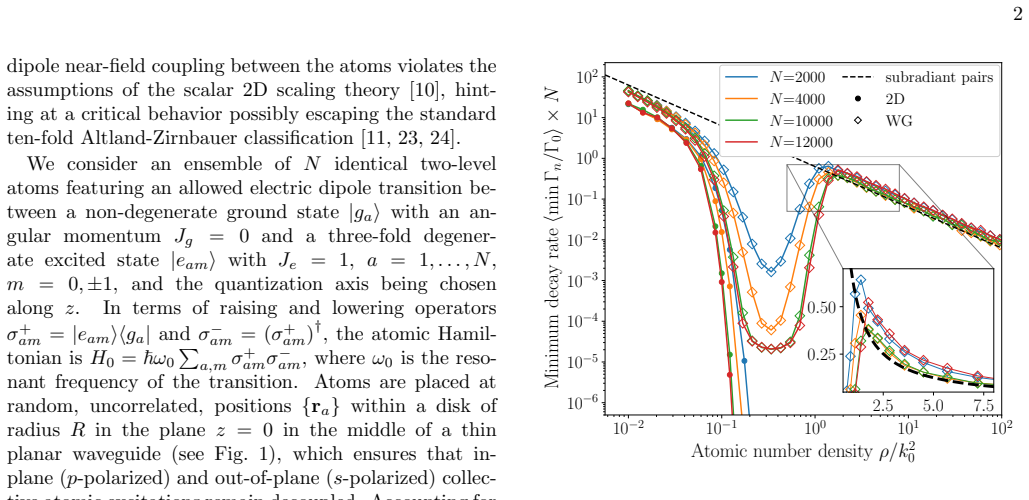
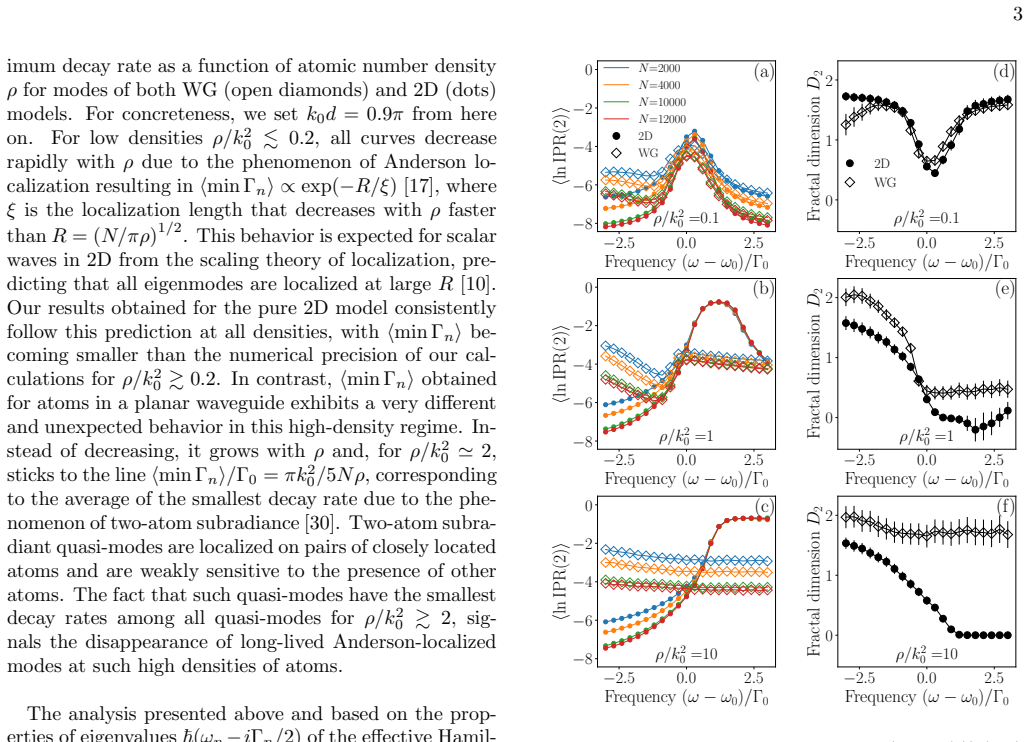
Contrary to the common belief that arbitrarily weak disorder localizes eigenmodes in 2D, a localization-delocalization transition occurs for light scattered by two-level atoms at random positions in the middle plane of a parallel-plate 2D waveguide fed by its fundamental TM mode. The transition is driven by near-field dipole-dipole interactions and sets in when the areal number density of atoms surpasses a critical value, with finite-size scaling analysis yielding a critical exponent of 1.4 plus or minus 0.2.
What carries the argument
near-field dipole-dipole interactions between the randomly placed two-level atoms, which strengthen with density and overcome the expected 2D localization in the TM waveguide mode.
If this is right
- Eigenmodes of the light field switch from localized to delocalized as areal atom density rises past the critical value.
- The transition is continuous and belongs to a universality class characterized by critical exponent approximately 1.4.
- The effect is specific to the TM polarization and the waveguide geometry where near-field coupling is prominent.
- At low densities the system follows the expected 2D localization, but high density overrides it through atom-atom interactions.
Where Pith is reading between the lines
- Experiments with cold atoms trapped in waveguides could vary density to map the transition point directly.
- The mechanism suggests density as a control knob for switching between localized and propagating light states in planar devices.
- Similar near-field-driven delocalization may appear in other 2D wave systems where dipole-like couplings are strong.
Load-bearing premise
Near-field dipole-dipole interactions dominate the dynamics and the two-level atom model with scalar treatment accurately describes the system without significant losses, higher-order scattering, or polarization mixing that would prevent delocalization.
What would settle it
Numerical or experimental computation of the inverse participation ratio or mode extent versus areal atom density in finite waveguides, checking whether a transition appears at a finite critical density and whether the scaling of the correlation length matches an exponent near 1.4.
Figures


read the original abstract
Common belief, confirmed by existing experiments, is that arbitrarily weak disorder should lead to spatial localization of eigenmodes of scalar wave equations when wave propagation is two-dimensional (2D). We predict that contrary to this belief, a localization-delocalization transition can take place for light scattered by two-level atoms placed at random positions in the middle plane of a parallel-plate 2D waveguide fed by its fundamental transverse-magnetic (TM) mode (electric field polarized perpendicular to the waveguide and atomic planes). This transition, driven by near-field dipole-dipole interactions between atoms, occurs upon increasing the areal number density of atoms beyond some critical value. A finite-size scaling analysis of the transition yields an estimate of its critical exponent ${\nu}$ = 1.4 $\pm$ 0.2.
Editorial analysis
A structured set of objections, weighed in public.
Referee Report
Summary. The manuscript claims that, contrary to the standard expectation of localization for scalar waves in 2D, a localization-delocalization transition occurs for the fundamental TM mode in a parallel-plate waveguide when two-level atoms are placed at random positions in the mid-plane, once the areal density exceeds a critical value. The transition is attributed to near-field dipole-dipole interactions, and finite-size scaling analysis is used to extract the critical exponent ν = 1.4 ± 0.2.
Significance. If the central claim holds, the result would be significant because it identifies a concrete physical setting in which near-field couplings can apparently overcome the marginality of 2D localization for guided light. The numerical exponent supplies a quantitative target for future analytic work on long-range hopping models in waveguides.
major comments (3)
- [Finite-size scaling analysis] The finite-size scaling analysis that yields ν = 1.4 ± 0.2 provides no information on the system sizes employed, the number of disorder realizations, the localization diagnostic (e.g., inverse participation ratio or level statistics), or the fitting procedure used to locate the critical density. In the presence of the long-range 1/√r tail of the waveguide Green's function, such details are required to establish that the observed crossings survive the thermodynamic limit rather than representing a crossover.
- [Model Hamiltonian and Green's function] The effective Hamiltonian combines a singular near-field 1/r³ dipole-dipole term with the propagating Hankel-function tail. The manuscript must demonstrate that the delocalization is driven by the near-field regularization and not by the long-range component; this could be shown by repeating the scaling analysis with a truncated interaction or by comparing the participation-ratio flow for the full versus short-range-only models.
- [Introduction and discussion of 2D localization] Standard 2D localization theorems apply to scalar waves with arbitrary disorder strength. The paper should explicitly address how the combination of the waveguide geometry and the specific form of the dipole interaction places the system outside those theorems, for example by deriving the effective hopping range or by showing the absence of localization at arbitrarily weak density.
minor comments (2)
- The abstract states the TM polarization but the main text should specify the approximations made in reducing the vector Maxwell equations to the scalar model and quantify any residual polarization mixing.
- Notation for the areal density and the critical value should be introduced with a clear symbol and units in the first section where the model is defined.
Simulated Author's Rebuttal
We thank the referee for the careful and constructive report. We address each major comment below and will revise the manuscript to incorporate clarifications and additional analyses where appropriate.
read point-by-point responses
-
Referee: The finite-size scaling analysis that yields ν = 1.4 ± 0.2 provides no information on the system sizes employed, the number of disorder realizations, the localization diagnostic (e.g., inverse participation ratio or level statistics), or the fitting procedure used to locate the critical density. In the presence of the long-range 1/√r tail of the waveguide Green's function, such details are required to establish that the observed crossings survive the thermodynamic limit rather than representing a crossover.
Authors: We agree that these technical details are essential for assessing the robustness of the finite-size scaling. In the revised manuscript we will add an appendix (or dedicated subsection) specifying the range of system sizes (N = 64 to 1024 atoms), the number of independent disorder realizations (typically 200–500 per size), the use of the inverse participation ratio as the primary localization diagnostic, and the precise fitting procedure employed to extract crossing points and the exponent ν. Our existing data already show that the crossings remain stable and the estimated ν converges with increasing N, supporting survival of the transition in the thermodynamic limit; we will include a supplementary plot demonstrating this convergence explicitly. revision: yes
-
Referee: The effective Hamiltonian combines a singular near-field 1/r³ dipole-dipole term with the propagating Hankel-function tail. The manuscript must demonstrate that the delocalization is driven by the near-field regularization and not by the long-range component; this could be shown by repeating the scaling analysis with a truncated interaction or by comparing the participation-ratio flow for the full versus short-range-only models.
Authors: We appreciate this important clarification request. To isolate the role of the near-field term, we will add a new figure and accompanying text in the revised manuscript comparing the participation-ratio flow under the full Green's function versus a truncated model that retains only the 1/r³ near-field singularity (cutting off the Hankel tail beyond a few wavelengths). The comparison confirms that the delocalization transition disappears in the truncated long-range-only case while persisting in the near-field-dominated model, thereby establishing that the singular short-range interactions are responsible for the transition. revision: yes
-
Referee: Standard 2D localization theorems apply to scalar waves with arbitrary disorder strength. The paper should explicitly address how the combination of the waveguide geometry and the specific form of the dipole interaction places the system outside those theorems, for example by deriving the effective hopping range or by showing the absence of localization at arbitrarily weak density.
Authors: We will expand both the introduction and the concluding discussion to address this point directly. We will derive the effective hopping amplitudes from the waveguide Green's function, emphasizing that the 1/r³ near-field singularity renders the interaction non-integrable in a manner that evades the assumptions of standard 2D localization theorems for scalar waves. We will also show explicitly that, at sufficiently low areal densities, the system remains localized (consistent with weak-disorder expectations), while the transition to delocalization occurs only above a finite critical density set by the strength of the near-field couplings. revision: yes
Circularity Check
No significant circularity; numerical scaling analysis is independent of inputs.
full rationale
The paper constructs an effective non-Hermitian Hamiltonian from the TM waveguide Green's function plus near-field dipole-dipole couplings, then performs finite-size numerical diagonalization to extract localization properties and applies standard scaling collapse to locate the critical density and estimate ν. This procedure does not reduce the reported transition or exponent to a tautology or to parameters fitted from the same data used to define the transition; the crossings and data collapse are falsifiable outputs that could fail to appear. No load-bearing self-citations, self-definitional steps, or smuggled ansatzes are present that would force the result by construction. The derivation chain remains self-contained against external benchmarks.
Axiom & Free-Parameter Ledger
axioms (2)
- standard math Finite-size scaling analysis applied to numerical data from finite systems can reliably estimate the critical exponent of a localization-delocalization transition.
- domain assumption The waveguide supports a fundamental TM mode with electric field perpendicular to the plane, and atoms act as two-level scatterers whose near-field interactions dominate at high density.
Reference graph
Works this paper leans on
-
[1]
P. W. Anderson, Phys. Rev.109, 1492 (1958)
1958
-
[2]
Lagendijk, B
A. Lagendijk, B. Tiggelen, and D. Wiersma, Phys. Today 62, 24 (2009)
2009
-
[3]
Abrahams,50 Years of Anderson Localization(World Scientific Publishing Company, 2010)
E. Abrahams,50 Years of Anderson Localization(World Scientific Publishing Company, 2010)
2010
-
[4]
A. A. Chabanov, M. Stoytchev, and A. Z. Genack, Nature 404, 850 (2000)
2000
-
[5]
Wang and A
J. Wang and A. Z. Genack, Nature471, 345 (2011)
2011
-
[6]
Dalichaouch, J
R. Dalichaouch, J. Armstrong, S. Schultz, P. Platzman, and S. McCall, Nature354, 53 (1991)
1991
-
[7]
Schwartz, G
T. Schwartz, G. Bartal, S. Fishman, and M. Segev, Na- ture446, 52 (2007)
2007
-
[8]
Laurent, O
D. Laurent, O. Legrand, P. Sebbah, C. Vanneste, and F. Mortessagne, Phys. Rev. Lett.99, 253902 (2007)
2007
-
[9]
Riboli, P
F. Riboli, P. Barthelemy, S. Vignolini, F. Intonti, A. D. Rossi, S. Combrie, and D. S. Wiersma, Opt. Lett.36, 127 (2011)
2011
-
[10]
Abrahams, P
E. Abrahams, P. W. Anderson, D. C. Licciardello, and T. V. Ramakrishnan, Phys. Rev. Lett.42, 673 (1979)
1979
-
[11]
Evers and A
F. Evers and A. D. Mirlin, Rev. Mod. Phys.80, 1355 (2008)
2008
-
[12]
S. E. Skipetrov and I. M. Sokolov, Phys. Rev. Lett.112, 023905 (2014)
2014
-
[13]
B. A. van Tiggelen and S. E. Skipetrov, Phys. Rev. B 103, 174204 (2021)
2021
-
[14]
Yamilov, S
A. Yamilov, S. E. Skipetrov, T. W. Hughes, M. Minkov, Z. Yu, and H. Cao, Nature Physics19, 1308–1313 (2023)
2023
-
[15]
John, Phys
S. John, Phys. Rev. Lett.58, 2486 (1987)
1987
-
[16]
S. E. Skipetrov, Phys. Rev. B102, 134206 (2020)
2020
-
[17]
S. E. Skipetrov and I. M. Sokolov, Phys. Rev. Lett.114, 053902 (2015)
2015
-
[18]
S. E. Skipetrov, Phys. Rev. Lett.121, 093601 (2018)
2018
-
[19]
Yamilov, H
A. Yamilov, H. Cao, and S. E. Skipetrov, Phys. Rev. Lett. 134, 046302 (2025)
2025
-
[20]
C. E. M´ aximo, N. Piovella, P. W. Courteille, R. Kaiser, and R. Bachelard, Phys. Rev. A92, 062702 (2015)
2015
-
[21]
Saint-Jalm, M
R. Saint-Jalm, M. Aidelsburger, J. L. Ville, L. Corman, Z. Hadzibabic, D. Delande, S. Nascimbene, N. Cherroret, J. Dalibard, and J. Beugnon, Phys. Rev. A97, 061801 (2018)
2018
-
[22]
Vatr´ e, R
R. Vatr´ e, R. Lopes, J. Beugnon, and F. Gerbier, Phys. Rev. A113, L021301 (2026)
2026
-
[23]
M. R. Zirnbauer, J. Math. Phys.37, 4986 (1996)
1996
-
[24]
Altland and M
A. Altland and M. R. Zirnbauer, Phys. Rev. B55, 1142 (1997)
1997
-
[25]
R. H. Lehmberg, Phys. Rev. A2, 883 (1970)
1970
-
[26]
R. H. Lehmberg, Phys. Rev. A2, 889 (1970)
1970
-
[27]
G. S. Agarwal, Quantum statistical theories of sponta- neous emission and their relation to other approaches, in Quantum Optics, edited by G. H¨ ohler (Springer Berlin Heidelberg, Berlin, Heidelberg, 1974) pp. 1–128
1974
-
[28]
Asenjo-Garcia, J
A. Asenjo-Garcia, J. D. Hood, D. E. Chang, and H. J. Kimble, Phys. Rev. A95, 033818 (2017)
2017
-
[29]
J. S. Peter, S. Ostermann, and S. F. Yelin, Phys. Rev. Res.6, 023200 (2024)
2024
-
[30]
Supplementary material,URL_will_be_inserted_by_ publisher
-
[31]
D. J. Thouless, Phys. Rev. Lett.39, 1167 (1977)
1977
-
[32]
Slevin and T
K. Slevin and T. Ohtsuki, New J. Phys.16, 015012 (2014)
2014
-
[33]
M. A. Branch, T. F. Coleman, and Y. Li, SIAM J. Sci. Comp.21, 1 (1999)
1999
-
[34]
Delocalization transition for light in two dimensions
S. Lucas, C. Miniatura, and S. E. Skipetrov, in prepara- tion. 6 Supplementary material for “Delocalization transition for light in two dimensions” Here we present (i) a detailed analysis of the electromagnetic Green’s function in a planar waveguide and its relation to 2D and 3D free-space cases, as well as single-atom radiative prop- erties; (ii) an anal...
2000
-
[35]
Chap. 9. [S15] J. Brown and P. Ruel V. Churchill,Fourier Series and Boundary Value Problems(McGraw-Hill Educa- tion, 2011). [S16] A. Lagendijk and B. A. Van Tiggelen, Resonant multi- ple scattering of light, Phys. Rep.270, 143 (1996). [S17] S. Mondal, K. Khare, S. E. Skipetrov, M. Kamp, and S. Mujumdar, Modal complexity as a metric for Ander- son localiza...
2011
discussion (0)
Sign in with ORCID, Apple, or X to comment. Anyone can read and Pith papers without signing in.