Recognition: unknown
Material coherence and life cycle of a wildfire-generated stratospheric vortex
Pith reviewed 2026-05-08 08:44 UTC · model grok-4.3
The pith
Wildfire-induced stratospheric vortex maintained material coherence for nearly 60 days through overlapping boundaries.
A machine-rendered reading of the paper's core claim, the machinery that carries it, and where it could break.
Core claim
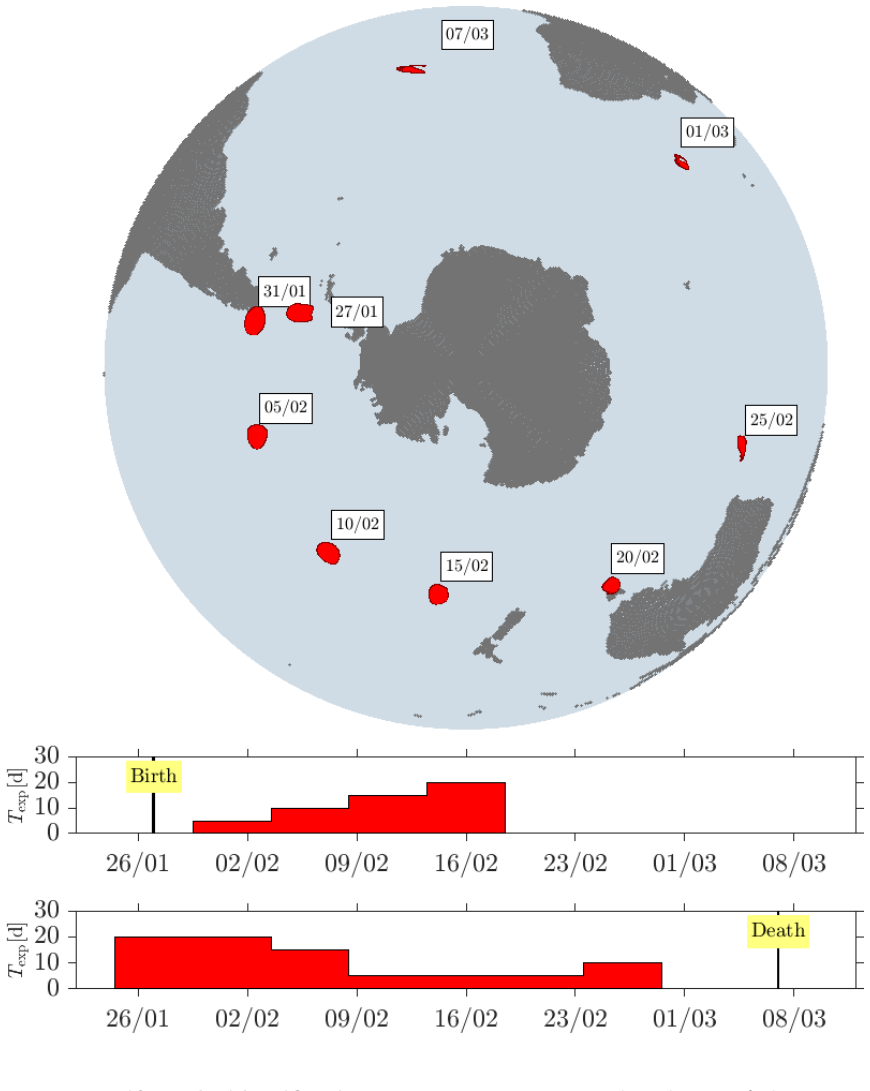
By applying geodesic vortex detection to reanalysis winds, the authors identify a coherent Lagrangian vortex, dubbed Koobor, whose boundary is given by materially coherent loops exhibiting nearly uniform stretching and strong resistance to filamentation over finite time intervals of up to 40 days. Taken together across isentropic levels, the reconstructed life cycle indicates that Koobor maintained quasi-material coherence for nearly 60 days from its first detection through a sequence of overlapping materially coherent boundaries rather than a single boundary advected over the entire period.
What carries the argument
Geodesic vortex detection, which locates loops of nearly uniform stretching that resist filamentation over finite-time intervals in the reanalysis wind fields.
If this is right
- The vortex exhibits delayed onset and reduced persistence at higher isentropic levels.
- Quasi-material coherence arises from overlapping boundaries rather than advection of one fixed boundary.
- The life cycle runs from formation through decay in a dynamically consistent manner.
- The approach supplies a material framework for describing wildfire-induced stratospheric vortices.
Where Pith is reading between the lines
- The same detection method could quantify material coherence in other long-lived atmospheric vortices.
- Sustained material boundaries may control the transport of smoke and aerosols over multi-week periods in the stratosphere.
- If the overlapping-boundary picture holds, models of stratospheric chemistry could incorporate time-dependent coherent barriers instead of fixed vortex edges.
Load-bearing premise
Reanalysis wind fields accurately represent true Lagrangian trajectories over 40- to 60-day intervals without significant assimilation errors or resolution limits that would artificially preserve apparent material coherence.
What would settle it
Particle trajectories computed from independent high-resolution observations that show the detected boundaries losing uniform stretching or failing to resist filamentation over the claimed 40- to 60-day intervals.
Figures


read the original abstract
Pyro-cumulonimbus convection associated with extreme wildfires can generate long-lived vortical structures in the stratosphere. These structures have been described as coherent, yet a rigorous material characterization has remained lacking. Here we provide such a characterization by applying geodesic vortex detection to reanalysis winds during the 2019--2020 Australian bushfires. We identify a coherent Lagrangian vortex, dubbed \emph{Koobor}, whose boundary is given by materially coherent loops exhibiting nearly uniform stretching and strong resistance to filamentation over finite time intervals of up to 40~days. The detected vortex extends across multiple isentropic levels, revealing a vertically organized evolution with delayed onset and reduced persistence at higher levels. Taken together across isentropic levels, the reconstructed life cycle indicates that \emph{Koobor} maintained quasi-material coherence for nearly 60~days from its first detection, through a sequence of overlapping materially coherent boundaries rather than a single boundary advected over the entire period. Our results establish a material framework for wildfire-induced stratospheric vortices and provide a dynamically consistent description of their life cycle, from formation to decay.
Editorial analysis
A structured set of objections, weighed in public.
Referee Report
Summary. The paper applies geodesic vortex detection to reanalysis wind fields to identify a wildfire-generated stratospheric vortex named Koobor during the 2019-2020 Australian bushfires. It reports that the vortex boundary consists of materially coherent loops with nearly uniform stretching and strong resistance to filamentation over finite-time intervals up to 40 days across multiple isentropic levels. The reconstructed life cycle indicates quasi-material coherence for nearly 60 days through a sequence of overlapping boundaries rather than a single advected boundary, providing a material framework for such structures.
Significance. If the coherence detections hold, the work supplies the first rigorous Lagrangian characterization of pyro-cumulonimbus-generated stratospheric vortices, replacing qualitative descriptions with quantifiable material boundaries and a dynamically consistent life-cycle reconstruction. This could inform models of stratospheric transport, ozone chemistry, and aerosol persistence following extreme wildfires.
major comments (2)
- [Abstract, paragraph 3; results on vertically organized evolution] Abstract and results on life-cycle reconstruction: the claim that Koobor maintained quasi-material coherence for nearly 60 days rests on chaining geodesic detections across isentropic levels via overlapping boundaries, yet no quantitative criteria, overlap metrics, or continuity tests for the sequence of boundaries are provided; without these, the transition from 40-day individual intervals to a 60-day composite life cycle lacks direct support.
- [Methods (trajectory computation and vortex detection)] Methods description of trajectory integration and geodesic detection: no sensitivity tests to integration time step, vertical interpolation, or reanalysis resolution are reported, nor any cross-validation against independent wind observations or alternative reanalyses; over 40-60 day intervals, even small assimilation biases can accumulate and affect apparent uniform stretching and filamentation resistance, directly undermining the central coherence claim.
minor comments (2)
- [Abstract and results] Notation for isentropic levels and coherence intervals should be defined explicitly on first use rather than assumed from context.
- [Figures] Figure captions for vortex boundaries and life-cycle diagrams should include explicit time intervals and level ranges to allow direct comparison with the 40-day and 60-day claims.
Simulated Author's Rebuttal
We thank the referee for the constructive and detailed review. We address each major comment below and indicate the revisions we will make to the manuscript.
read point-by-point responses
-
Referee: Abstract and results on life-cycle reconstruction: the claim that Koobor maintained quasi-material coherence for nearly 60 days rests on chaining geodesic detections across isentropic levels via overlapping boundaries, yet no quantitative criteria, overlap metrics, or continuity tests for the sequence of boundaries are provided; without these, the transition from 40-day individual intervals to a 60-day composite life cycle lacks direct support.
Authors: We agree that the life-cycle reconstruction requires explicit quantitative support. The manuscript describes the 60-day coherence as arising from overlapping boundaries but does not report overlap metrics or continuity tests. In the revised manuscript we will add a dedicated subsection that defines the overlap criterion (fraction of boundary arc length lying within a fixed distance threshold between successive detections), reports the measured overlap values at each level, and includes continuity tests based on the evolution of the geodesic stretching and filamentation diagnostics. These additions will directly substantiate the composite life cycle. revision: yes
-
Referee: Methods description of trajectory integration and geodesic detection: no sensitivity tests to integration time step, vertical interpolation, or reanalysis resolution are reported, nor any cross-validation against independent wind observations or alternative reanalyses; over 40-60 day intervals, even small assimilation biases can accumulate and affect apparent uniform stretching and filamentation resistance, directly undermining the central coherence claim.
Authors: We accept that the absence of reported sensitivity tests is a weakness. We will add explicit sensitivity experiments to the methods section that vary the integration time step and vertical interpolation scheme and demonstrate that the detected coherent boundaries remain essentially unchanged. Cross-validation against independent observations or alternative reanalyses is not feasible within the scope of the present study; we will therefore add a limitations paragraph acknowledging the potential accumulation of assimilation biases over long intervals and note that the geodesic method’s emphasis on material invariance offers partial robustness, while recommending such cross-validation for future work. revision: partial
Circularity Check
No circularity: detection on external reanalysis data using established algorithm
full rationale
The paper's central result follows from applying geodesic vortex detection—an established external method—to independent reanalysis wind fields, then reconstructing the life cycle by identifying overlapping materially coherent boundaries across isentropic levels and time intervals. No equations or steps reduce the reported 60-day quasi-material coherence to a fitted parameter, self-definition, or self-citation chain; the coherence times are outputs of the detection algorithm applied to the data rather than inputs. The derivation remains self-contained against external benchmarks.
Axiom & Free-Parameter Ledger
axioms (2)
- domain assumption Geodesic vortex detection correctly identifies materially coherent structures in stratospheric flows
- domain assumption Reanalysis wind fields are adequate for 40-60 day Lagrangian advection
Reference graph
Works this paper leans on
-
[1]
Andrade‐Canto and F
F. Andrade‐Canto and F. J. Beron‐Vera. Do eddies connect the tropical Atlantic Ocean and the Gulf of Mexico? Geophysical Research Letters , 49:e2022GL099637, 2022
2022
-
[2]
Beron-Vera, and Gage Bonner
Fernando Andrade-Canto, Francisco J. Beron-Vera, and Gage Bonner. Geodesic vortex detection on curved surfaces: Analyzing the 2002 austral stratospheric polar vortex warming event . Chaos , 35:053140, 2025
2002
-
[3]
Andrade-Canto, D
F. Andrade-Canto, D. Karrasch, and F. J. Beron-Vera. Genesis, evolution, and apocalyse of Loop Current rings . Phys. Fluids , 32:116603, 2020
2020
-
[4]
Allen, Michael D
Douglas R. Allen, Michael D. Fromm, George P. Kablick III, and Gerald E. Nedoluha. Smoke with Induced Rotation and Lofting (SWIRL) in the stratosphere . Journal of the Atmospheric Sciences , 77(12):4297–4316, December 2020
2020
-
[5]
Jezabel Curbelo and Irina I. Rypina. A three dimensional L agrangian analysis of the smoke plume from the 2019/2020 A ustralian wildfire event. Journal of Geophysical Research: Atmospheres , 128(21), November 2023
2019
-
[6]
A. T. J. de Laat, D. C. Stein Zweers, R. Boers, and O. N. E. Tuinder. A solar escalator: Observational evidence of the self‐lifting of smoke and aerosols by absorption of solar radiation in the february 2009 australian black saturday plume. Journal of Geophysical Research: Atmospheres , 117(D4), February 2012
2009
-
[7]
Lindsey, René Servranckx, Glenn Yue, Thomas Trickl, Robert Sica, Paul Doucet, and Sophie Godin-Beekmann
Michael Fromm, Daniel T. Lindsey, René Servranckx, Glenn Yue, Thomas Trickl, Robert Sica, Paul Doucet, and Sophie Godin-Beekmann. The untold story of pyrocumulonimbus. Bulletin of the American Meteorological Society , 91(9):1193–1210, September 2010
2010
-
[8]
G. Haller. Lagrangian coherent structures. Ann. Rev. Fluid Mech. , 47:137--162, 2015
2015
-
[9]
Transport Barriers and Coherent Structures in Flow Data
George Haller. Transport Barriers and Coherent Structures in Flow Data . Cambridge University Press, Cambridge, United Kindom, 2023
2023
-
[10]
P. Haynes. Stratospheric dynamics. Annu. Rev. Fluid Mech. , 37:263--293, 2005
2005
-
[11]
Hans Hersbach, Bill Bell, Paul Berrisford, Shoji Hirahara, András Horányi, Joaquín Muñoz‐Sabater, Julien Nicolas, Carole Peubey, Raluca Radu, Dinand Schepers, Adrian Simmons, Cornel Soci, Saleh Abdalla, Xavier Abellan, Gianpaolo Balsamo, Peter Bechtold, Gionata Biavati, Jean Bidlot, Massimo Bonavita, Giovanna Chiara, Per Dahlgren, Dick Dee, Michail Diaman...
1999
-
[12]
Beron-Vera
George Haller and Francisco J. Beron-Vera. Coherent Lagrangian vortices: The black holes of turbulence . J. Fluid Mech. , 731:R4, 2013
2013
-
[13]
Beron-Vera
George Haller and Francisco J. Beron-Vera. Addendum to `Coherent Lagrangian vortices: The black holes of turbulence' . J. Fluid Mech. , 755:R3, 2014
2014
-
[14]
J. R. Holton. An introduction to dynamic metereology . Academic, second edition, 1979
1979
-
[15]
G. P. Kablick, D. R. Allen, M. D. Fromm, and G. E. Nedoluha. Australian PyroCb smoke generates synoptic‐scale stratospheric anticyclones. Geophysical Research Letters , 47(13), July 2020
2020
-
[16]
Karrasch, F
D. Karrasch, F. Huhn, and G. Haller. Automated detection of coherent Lagrangian vortices in two-dimensional unsteady flows . Proc. Royal Soc. A , 471:20140639, 2014
2014
-
[17]
The 2019/20 australian wildfires generated a persistent smoke-charged vortex rising up to 35-km altitude
Sergey Khaykin, Bernard Legras, Silvia Bucci, Pasquale Sellitto, Lars Isaksen, Florent Tenc\'e, Slimane Bekki, Adam Bourassa, Landon Rieger, Daniel Zawada, Julien Jumelet, and Sophie Godin-Beekmann. The 2019/20 australian wildfires generated a persistent smoke-charged vortex rising up to 35-km altitude. Communications Earth & Environment , 1(1), 2020
2019
-
[18]
Smoke-charged vortices in the stratosphere generated by wildfires and their behaviour in both hemispheres: comparing Australia 2020 to Canada 2017
Hugo Lestrelin, Bernard Legras, Aurélien Podglajen, and Mikail Salihoglu. Smoke-charged vortices in the stratosphere generated by wildfires and their behaviour in both hemispheres: comparing Australia 2020 to Canada 2017 . Atmospheric Chemistry and Physics , 21(9):7113–7134, May 2021
2020
-
[19]
McIntyre
M.E. McIntyre. DYNAMICAL METEOROLOGY | Balanced Flow , page 298–303. Elsevier, 2015
2015
-
[20]
Peterson, James R
David A. Peterson, James R. Campbell, Edward J. Hyer, Michael D. Fromm, George P. Kablick, Joshua H. Cossuth, and Matthew T. DeLand. Wildfire-driven thunderstorms cause a volcano-like stratospheric injection of smoke. npj Climate and Atmospheric Science , 1(1), August 2018
2018
-
[21]
Tsitouras
Ch. Tsitouras. Runge--Kutta pairs of order 5(4) satisfying only the first column simplifying assumption . Computers & Mathematics with Applications , 62:770–775, 2011
2011
-
[22]
Toon, Charles G
Pengfei Yu, Owen B. Toon, Charles G. Bardeen, Yunqian Zhu, Karen H. Rosenlof, Robert W. Portmann, Troy D. Thornberry, Ru-Shan Gao, Sean M. Davis, Eric T. Wolf, Joost de Gouw, David A. Peterson, Michael D. Fromm, and Alan Robock. Black carbon lofts wildfire smoke high into the stratosphere to form a persistent plume. Science , 365(6453):587–590, August 2019
2019
discussion (0)
Sign in with ORCID, Apple, or X to comment. Anyone can read and Pith papers without signing in.