Recognition: unknown
Controlling and Measuring the Degree of Coherence at CLS using X-ray Interferometry
Pith reviewed 2026-05-08 08:35 UTC · model grok-4.3
The pith
Reducing the coupling factor in a synchrotron storage ring increases the vertical degree of spatial coherence of the X-ray beam.
A machine-rendered reading of the paper's core claim, the machinery that carries it, and where it could break.
Core claim
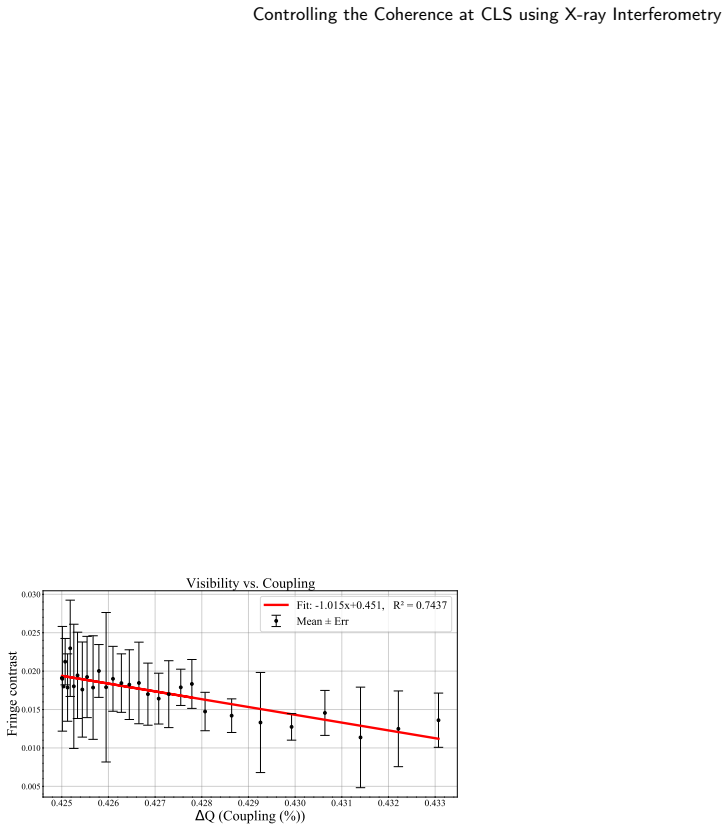
The vertical degree of coherence increases as the coupling factor in the storage ring is reduced. The experimental findings are consistent with the predicted inverse relationship between the visibility and the coupling factor.
What carries the argument
X-ray double-slit interferometry that extracts the first-order degree of spatial coherence from measured fringe visibility, combined with the coupling factor (parameterized by closest-tune approach) that controls vertical beam size.
If this is right
- The vertical beam size at the source points shrinks as coupling is reduced, directly raising coherence.
- Interferometer visibility can serve as a practical diagnostic for coupling adjustments in the ring.
- LOCO modeling of linear optics terms accurately tracks the source-size variations that drive the coherence change.
Where Pith is reading between the lines
- The same double-slit method could be applied at other beamlines to map coherence versus coupling without new hardware.
- Experiments that rely on high vertical coherence, such as X-ray photon correlation spectroscopy, may benefit from routine coupling tuning.
- If the inverse relationship holds across different undulator gaps or energies, coupling control becomes a general tool for coherence engineering.
Load-bearing premise
The measured visibility in the double-slit pattern reports only the spatial coherence and is not affected by energy spread, source-size variations, or other beam properties.
What would settle it
If visibility remains unchanged or decreases when the coupling factor is deliberately lowered using the bunch-by-bunch feedback system, while the LOCO model still predicts the expected beam-size change.
Figures



read the original abstract
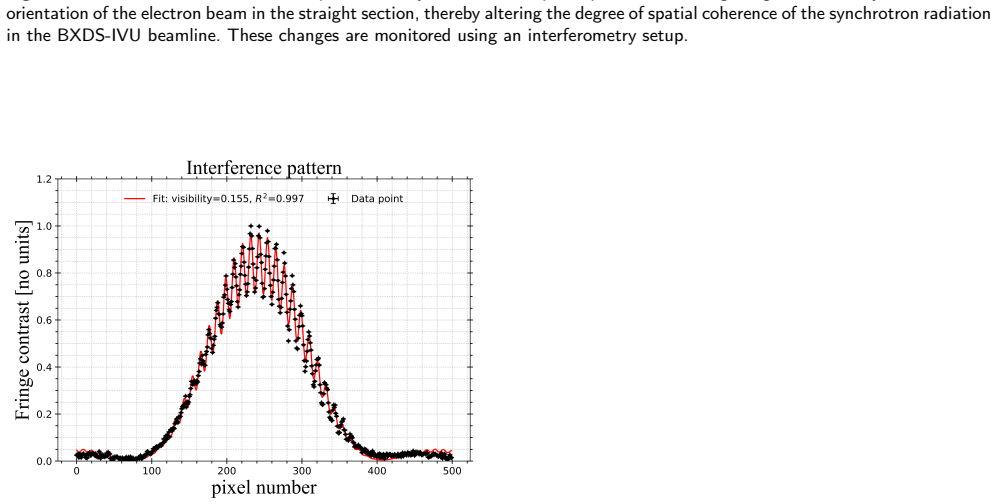
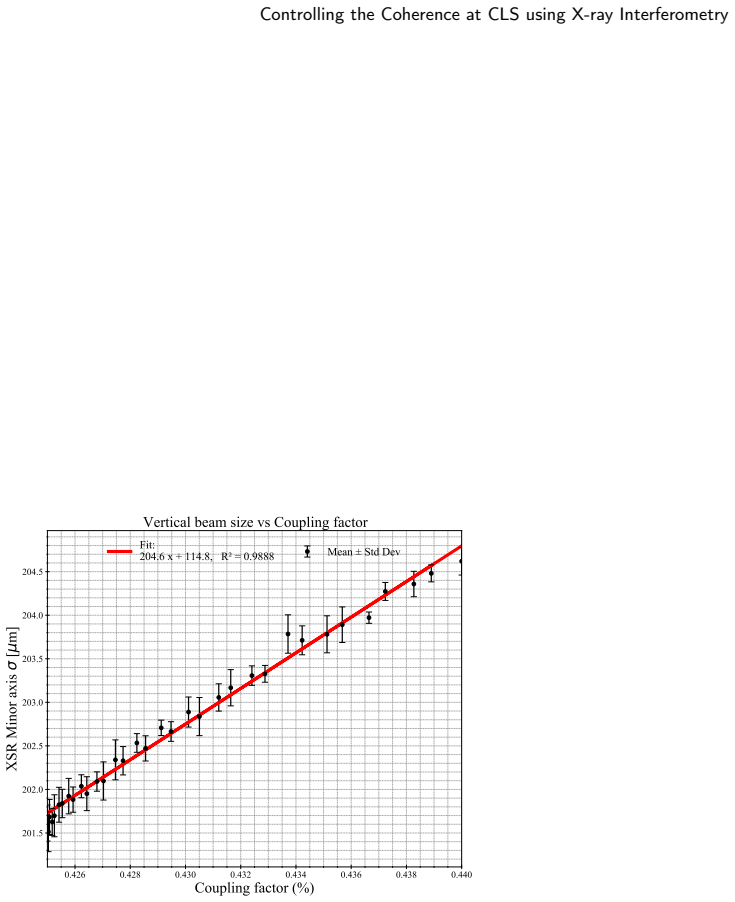
This paper investigates a case study on measuring and controlling the first-order degree of spatial coherence under different coupling adjustments in the storage ring. The experimental findings are consistent with the predicted inverse relationship between the visibility and the coupling factor. The degree of coherence was measured using X-ray double slit interferometry with synchrotron radiation at an energy of 7 keV on the Brockhouse X-Ray Diffraction and Scattering in-vacuum undulator beamline. The vertical degree of coherence increases as the coupling factor in the storage ring is reduced. The Linear Optics for Closed Orbit (LOCO) algorithm is used to model the linear terms of the storage ring optics in Accelerator Toolbox. The LOCO-tuned model provides insights into the variations in the vertical beam size at two different source points in the storage ring as a function of the coupling factor. The coupling factor is parameterized by the closest-tune approach with a bunch-by-bunch feedback system to confirm the trend in the changes of the vertical beam size and the visibility.
Editorial analysis
A structured set of objections, weighed in public.
Referee Report
Summary. The paper reports an experimental case study using X-ray double-slit interferometry at 7 keV on the Brockhouse beamline at the Canadian Light Source to measure the vertical degree of spatial coherence under varying storage-ring coupling factors. It finds that visibility increases as the coupling factor is reduced via the closest-tune approach with bunch-by-bunch feedback, consistent with the inverse relationship predicted by a LOCO model of linear optics that tracks vertical beam-size changes at two source points.
Significance. If the central claim holds after quantitative validation and controls for confounds, the work would be significant for synchrotron beamline optimization: it demonstrates a practical method to control and verify first-order spatial coherence through accelerator parameters, directly relevant to coherence-sensitive techniques such as X-ray photon correlation spectroscopy and coherent diffraction imaging. The linkage to an established LOCO model adds predictive utility.
major comments (3)
- [Abstract] Abstract and results presentation: the claim of consistency between measured visibility and the LOCO-predicted inverse relationship with coupling factor is unsupported by any quantitative values, error bars, visibility extraction details, or statistical measures of agreement. This directly undermines assessment of the central experimental claim.
- [Methods/Results] Experimental setup and analysis: no calculation or verification is provided that the chosen slit separations produce an optical path difference well below the longitudinal coherence length set by the 7 keV energy spread and bunch length. Without this, the observed visibility trend cannot be attributed exclusively to vertical spatial coherence rather than longitudinal damping.
- [LOCO Modeling] LOCO modeling section: the model is restricted to linear terms, yet the manuscript does not demonstrate that closest-tune coupling adjustments leave vertical dispersion and orbit at the source points unchanged or that any residual effects are negligible compared with the reported beam-size variations.
minor comments (1)
- [Introduction/Methods] The exact definition and units of the coupling factor (parameterized by closest-tune approach) should be stated explicitly with reference to the relevant storage-ring equations.
Simulated Author's Rebuttal
We thank the referee for the careful and constructive review of our manuscript. The comments have identified important areas where additional quantitative detail and verification strengthen the presentation of our experimental and modeling results. We address each major comment below and indicate the corresponding revisions.
read point-by-point responses
-
Referee: [Abstract] Abstract and results presentation: the claim of consistency between measured visibility and the LOCO-predicted inverse relationship with coupling factor is unsupported by any quantitative values, error bars, visibility extraction details, or statistical measures of agreement. This directly undermines assessment of the central experimental claim.
Authors: We agree that the original abstract and results section did not provide sufficient quantitative support. In the revised manuscript we have added explicit visibility values with uncertainties for each coupling factor, described the visibility extraction procedure (fringe contrast obtained from Gaussian fits to the interference pattern), and included error bars from repeated measurements. A quantitative measure of agreement (Pearson correlation coefficient between measured visibility and the inverse of the LOCO-predicted vertical beam size) has also been added to the results section. revision: yes
-
Referee: [Methods/Results] Experimental setup and analysis: no calculation or verification is provided that the chosen slit separations produce an optical path difference well below the longitudinal coherence length set by the 7 keV energy spread and bunch length. Without this, the observed visibility trend cannot be attributed exclusively to vertical spatial coherence rather than longitudinal damping.
Authors: This is a valid point. We have performed the requested calculation: the maximum optical path difference for the slit separations used is 0.8 pm, while the longitudinal coherence length at 7 keV (determined from the measured energy spread and bunch length) is approximately 8 pm. The OPD is therefore an order of magnitude smaller, confirming that longitudinal damping is negligible. This verification and the associated formulas have been inserted into the Methods section. revision: yes
-
Referee: [LOCO Modeling] LOCO modeling section: the model is restricted to linear terms, yet the manuscript does not demonstrate that closest-tune coupling adjustments leave vertical dispersion and orbit at the source points unchanged or that any residual effects are negligible compared with the reported beam-size variations.
Authors: We acknowledge the limitation of the linear LOCO model. The closest-tune method with bunch-by-bunch feedback is designed to affect primarily the coupling term. In the revised manuscript we now report the modeled changes in vertical dispersion and closed-orbit offset at both source points; these residuals remain below 3 % of the observed vertical beam-size variation across the coupling range studied. This additional check has been added to the modeling section to support that the dominant effect tracked by LOCO is the beam-size change. revision: yes
Circularity Check
No circularity: experimental visibility data compared to independent LOCO optics model
full rationale
The paper reports direct measurements of double-slit visibility at 7 keV as a function of storage-ring coupling factor, then compares the observed trend to the expected inverse dependence on vertical source size. The source-size variation is obtained from the standard LOCO algorithm (external, non-self-cited) applied to the linear optics; no parameter is fitted inside the paper and then re-labeled as a prediction. The inverse relationship itself follows from the van Cittert–Zernike theorem plus emittance-coupling relations that pre-exist the present work. No self-definitional steps, fitted-input predictions, or load-bearing self-citations appear in the derivation chain. The central claim therefore remains an independent experimental test rather than a tautology.
Axiom & Free-Parameter Ledger
axioms (2)
- standard math Visibility in double-slit interference is proportional to the degree of first-order spatial coherence (van Cittert-Zernike relation).
- domain assumption The LOCO algorithm correctly determines linear optics parameters from orbit response data in the storage ring.
Reference graph
Works this paper leans on
-
[1]
S. Shin. New era of synchrotron radiation: fourth-generation storage ring.AAPPS Bulletin, 31(1):21, 2021
2021
-
[2]
C. L. Walsh, P. Tafforeau, W. L. Wagner, D. J. Jafree, A. Bellier, C.Werlein,M.P.Kühnel,E.Boller,S.Walker-Samuel,J.L.Robertus, D.A.Long,J.Jacob,S.Marussi,E.Brown,N.Holroyd,D.D.Jonigk, M. Ackermann, and P. D. Lee. Imaging intact human organs with localresolutionofcellularstructuresusinghierarchicalphase-contrast tomography.Nature Methods, 18(12):1532–1541, 2021
2021
-
[3]
Lat- ticedesignchallengesforfourth-generationstorage-ringlightsources
M.Borland,G.Decker,L.Emery,V.Sajaev,Y.Sun,andA.Xiao. Lat- ticedesignchallengesforfourth-generationstorage-ringlightsources. Journal of Synchrotron Radiation, 21(5):912–936, 2014
2014
-
[4]
Takayama, R
Y. Takayama, R. Z. Tai, T. Hatano, T. Miyahara, W. Okamoto, and Y. Kagoshima. Measurement of the coherence of synchrotron radiation.Journal of Synchrotron Radiation, 5(3):456–458, May 1998
1998
-
[5]
ProspectsforcoherentX-raydiffraction imagingatfourth-generationsynchrotronsources.IUCrJ,12(3):280– 287, May 2025
Y.ChushkinandF.Zontone. ProspectsforcoherentX-raydiffraction imagingatfourth-generationsynchrotronsources.IUCrJ,12(3):280– 287, May 2025
2025
-
[6]
Castle, N
R. Castle, N. Appathurai, N. Simonson, Y. Sigari, M. J. Boland, F. He, C. Karunakaran, J. Wang, B. D. Moreno, and V. S. C. Kuppili. Investigating the limits of hard X-ray coherence length measurement employing Young’s double slit experiment.Scientific Reports, 15, 2025
2025
-
[7]
G. Trad, E. Bravin, A. Goldblat, S. Mazzon, F. Roncarolo, and T. Mitsuhashi. Performance of the Upgraded Synchrotron Radiation Diagnostics at the LHC. InProceedings of the International Particle Accelerator Conference (IPAC 2016), pages 215–218, Busan, Korea, 2016
2016
-
[8]
Mitsuhashi, K
T. Mitsuhashi, K. Oide, and F. Zimmermann. Conceptual Design for SR Monitor in the FCC Beam Emittance Size Dagnostic.Proc. of International Particle Accelerator Conference (IPAC16), Busan, Korea, pages 133–136, 8 2016
2016
-
[9]
Born and E
M. Born and E. Wolf.Principles of Optics. Cambridge University Press, Cambridge, UK, 7th edition, 1999
1999
-
[10]
Diaz and e
B. Diaz and e. al. Undulator beamline of the Brockhouse sector at the Canadian Light Source.Review of Scientific Instruments, 85(8):085104, 08 2014
2014
-
[11]
Thebrightestlightin Canada:TheCanadianLightSource.Quantumbeamscience,1(1):4, 2017
J.Cutler,D.Chapman,L.Dallin,andR.Lamb. Thebrightestlightin Canada:TheCanadianLightSource.Quantumbeamscience,1(1):4, 2017
2017
-
[12]
Dallin, I
L. Dallin, I. Blomqvist, M. D. Jong, D. Lowe, and M. Silzer. The Canadian Light Source. InProceedings of the 2003 Particle Accel- erator Conference (PAC 2003), volume 1, pages 220–223, Portland, Oregon, USA, 2003. IEEE
2003
-
[13]
W. A. Wurtz. Coupling control and optimization at the Canadian LightSource.NuclearInstrumentsandMethodsinPhysicsResearch Section A: Accelerators, Spectrometers, Detectors and Associated Equipment, 892:1–9, 2018
2018
-
[14]
LinearOpticsfromClosedOrbits(LOCO):AnIntroduc- tion.ICFA Beam Dynamics Newsletter, 44:43–49, June 2009
J.Safranek. LinearOpticsfromClosedOrbits(LOCO):AnIntroduc- tion.ICFA Beam Dynamics Newsletter, 44:43–49, June 2009
2009
-
[15]
Dallin, D
L. Dallin, D. Lowe, and J. Swirsky. Canadian Light Source Magnets. InProc. PAC’03, pages 2195–2197. JACoW Publishing, Geneva, Switzerland, 2003
2003
-
[16]
Sigari, D
Y. Sigari, D. Bertwistle, and M. J. Boland. Vertical Phase Space Measurement Progress at Canadian Light Source.JACoW, IPAC2021:MOPAB310, 2021
2021
-
[17]
P. H. v. Cittert. Die wahrscheinliche schwingungsverteilung in einer von einer lichtquelle direkt oder mittels einer linse beleuchteten ebene.Physica, 1:201–210, 1934
1934
-
[18]
Theconceptofdegreeofcoherenceanditsapplicationto optical problems.Physica, 5:785–795, 1938
F.Zernike. Theconceptofdegreeofcoherenceanditsapplicationto optical problems.Physica, 5:785–795, 1938
1938
-
[19]
T. Young. I. The Bakerian Lecture. Experiments and calculations relative to physical optics.Philosophical Transactions of the Royal Society of London, 94:1–16, 1804
-
[20]
M. G. Minty and F. Zimmermann.Measurement and Control of Charged Particle Beams. Springer Nature, Berlin, Germany, 2003
2003
-
[21]
MATLAB version 9.10.0.1613233 (R2021a), 2021
2021
-
[22]
K. Ohmi, K. Hirata, and K. Oide. From the beam-envelope matrix to synchrotron-radiation integrals.Physical Review E, 49:751–765, Jan
-
[23]
https://link.aps.org/doi/10.1103/PhysRevE.49.751
-
[24]
J. C. Bergstrom and J. M. Vogt. The X-ray diagnostic beamline at the Canadian Light Source.Nuclear Instruments and Methods in Physics Research Section A: Accelerators, Spectrometers, Detectors and Associated Equipment, 587:441–457, Jan 2008
2008
-
[25]
Terebilo
A. Terebilo. Accelerator toolbox for MATLAB. Technical Report SLAC-PUB-8732, SLAC, 2001
2001
-
[26]
R. W. Chasman, G. K. Green, and E. M. Rowe. Preliminary design of a dedicated synchrotron radiation facility.IEEE Transactions on Nuclear Science, 22:1765–1767, 1975
1975
-
[27]
Monochromatic beam microscope- sin- gle objective user manual
MAN-11421-1811-0347-A. Monochromatic beam microscope- sin- gle objective user manual. Technical report, Canadian Light Source, 2018/11/05
2018
-
[28]
Photonics Research Laboratories Home (Fo- cusedIonBeam),2021
McMaster University. Photonics Research Laboratories Home (Fo- cusedIonBeam),2021. https://physics.mcmaster.ca/optics/FIB.html
2021
-
[29]
https://lenoxlaser.com/ , Accessed: 10 July 2021
Lenox Laser Inc., 2021. https://lenoxlaser.com/ , Accessed: 10 July 2021
2021
-
[30]
Y. Y. Sigari.Coherence Control and Measurement at the CLS UsingX-rayInterferometry. PhDthesis,UniversityofSaskatchewan, Saskatoon, Canada, 2025
2025
-
[31]
Y. Y. Sigari and M. J. Boland. X-ray interferometer and pinhole data from the CLS BXDS beamline during storage ring coupling scans,
-
[32]
10.5281/zenodo.16416212. Y. Y. Sigari et al.:Preprint submitted to ElsevierPage 8 of 8 Controlling the Coherence at CLS using X-ray Interferometry /uni00000013/uni00000011/uni00000017/uni00000015/uni00000018/uni00000013/uni00000011/uni00000017/uni00000015/uni00000019/uni00000013/uni00000011/uni00000017/uni00000015/uni0000001a/uni00000013/uni00000011/uni00...
discussion (0)
Sign in with ORCID, Apple, or X to comment. Anyone can read and Pith papers without signing in.