Recognition: unknown
The coloured mutation class of mathbb{D}_n- quivers and their application to m-cluster tilted algebras
Pith reviewed 2026-05-08 09:03 UTC · model grok-4.3
The pith
An explicit combinatorial characterization identifies every m-coloured quiver reachable by m-coloured mutations from a type D_n quiver.
A machine-rendered reading of the paper's core claim, the machinery that carries it, and where it could break.
Core claim
We present an explicit and purely combinatorial characterization of the m-coloured quivers that appear within the m-coloured mutation class of a quiver of type D_n. Consequently, we derive a comprehensive description of the Gabriel quivers associated with m-cluster-tilted algebras of type D_n. The characterization extends the m=1 result of Vatne to arbitrary m.
What carries the argument
The m-coloured mutation class of D_n quivers, defined by explicit rules on arrow counts, directions, and colour assignments between vertices.
If this is right
- The Gabriel quiver of any m-cluster-tilted algebra of type D_n must obey the combinatorial conditions.
- For m=1 the conditions reduce exactly to the classification of cluster-tilted algebras of type D_n obtained by Vatne.
- The same rules classify the underlying quivers for all m-cluster-tilted algebras of type D_n, independent of the choice of initial seed.
- Checking the combinatorial conditions suffices to decide membership in the m-coloured mutation class without performing mutations.
Where Pith is reading between the lines
- The same style of combinatorial rules may exist for other Dynkin types, allowing uniform descriptions across ADE cases.
- The conditions provide a direct test that could be implemented to enumerate all such algebras for fixed small values of n and m.
- Knowledge of the allowed quivers supplies a concrete starting point for studying the representation theory or derived equivalences of these algebras.
Load-bearing premise
Every m-coloured quiver obtained by mutating a D_n quiver satisfies the stated combinatorial conditions, and every quiver satisfying those conditions arises from some sequence of such mutations.
What would settle it
A single m-coloured quiver that can be reached from a D_n quiver by m-coloured mutations yet violates at least one of the listed combinatorial rules.
Figures


read the original abstract
In this paper, we present an explicit and purely combinatorial characterization of the $m$-coloured quivers that appear within the $m$-coloured mutation class of a quiver of type $\mathbb{D}_n$. The $m$-coloured mutation, as defined by Buan and Thomas in \cite{BT}, generalises the well-known quiver mutation introduced by Fomin and Zelevinsky \cite{FZ}. Consequently, we derive a comprehensive description of the Gabriel quivers associated with $m$-cluster-tilted algebras of type $\mathbb{D}_n$. Notably, our characterization extends a result by Vatne, \cite{Va}, which we recover when $m=1$.
Editorial analysis
A structured set of objections, weighed in public.
Referee Report
Summary. The manuscript presents an explicit and purely combinatorial characterization of the m-coloured quivers that lie in the m-coloured mutation class of any quiver of type D_n. The authors prove that the stated conditions are invariant under m-coloured mutation (in the sense of Buan-Thomas) and that every quiver satisfying the conditions can be reduced to a standard representative via a finite sequence of such mutations. The result recovers Vatne's characterization when m=1 and is applied to give a complete description of the Gabriel quivers of m-cluster-tilted algebras of type D_n.
Significance. If the characterization is complete, the paper supplies a parameter-free combinatorial description of an entire mutation class, generalizing a known m=1 result and directly yielding the quivers of a family of algebras. This strengthens the toolkit for studying higher cluster categories and m-cluster-tilted algebras without iterative mutation computations.
minor comments (2)
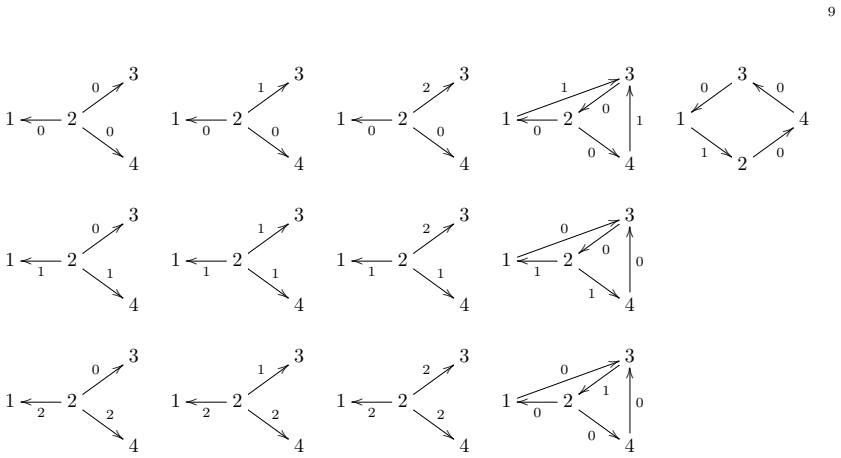
- In the statement of the main characterization (presumably Theorem 3.1 or equivalent), the conditions on coloured arrows and cycles would be easier to verify if accompanied by a single explicit diagram for small values (e.g., n=4, m=2).
- The reduction argument establishing reachability is described as exhibiting a sequence to a standard representative; a brief remark on how the length of this sequence is bounded independently of the starting quiver would clarify the argument's uniformity.
Simulated Author's Rebuttal
We thank the referee for their supportive summary of our manuscript and for recommending minor revision. The report accurately captures the core contribution: an explicit combinatorial characterization of the m-coloured mutation class of D_n quivers that is invariant under Buan-Thomas m-coloured mutation and reduces every such quiver to a standard representative, recovering Vatne's m=1 case and yielding the Gabriel quivers of m-cluster-tilted algebras of type D_n. Since the report lists no specific major comments or requested changes, we have no individual points to address at this stage and await any further details to incorporate into a revised version.
Circularity Check
No significant circularity; characterization is independent and combinatorial
full rationale
The paper claims an explicit combinatorial characterization of m-coloured quivers in the mutation class of D_n type, proved by showing the conditions are preserved under m-coloured mutation (defined externally in Buan-Thomas) and that every such quiver reduces to a standard representative. This relies on the external mutation operation and prior results like Vatne's for m=1, without any self-definitional loops, fitted parameters renamed as predictions, or load-bearing self-citations. The central theorem is self-contained against the given mutation rules and does not reduce to its own output by construction.
Axiom & Free-Parameter Ledger
axioms (2)
- domain assumption m-coloured mutation is defined exactly as in Buan and Thomas
- standard math The mutation class of a D_n quiver is the standard one from cluster algebra theory
Reference graph
Works this paper leans on
-
[1]
Bastian,Mutation classes of ˜An-quivers and derived equivalence classification of cluster tilted algebras of type ˜An,Algebra and Number Theory 5:567-594, 2009
J. Bastian,Mutation classes of ˜An-quivers and derived equivalence classification of cluster tilted algebras of type ˜An,Algebra and Number Theory 5:567-594, 2009
2009
-
[2]
A. Buan, B. Marsh, I. Reiten,Cluster mutation via quiver representations,Comment. Math. Helv. 83 (1): 143–177, 2008
2008
-
[3]
Bastian, T
J. Bastian, T. Prellberg, M. Rubey and C. Stump,Counting the Number of Elements in the Mutation Classes ofA n-Quivers, Electron. J. Comb. 18, 2009
2009
-
[4]
A. Buan, I. Reiten,Acyclic quivers of finite mutation type,Int. Math. Res. Not., 2006
2006
-
[5]
Buan, H.Torkildsen,The number of elements in the mutation class of a quiver of typeDn
A. Buan, H.Torkildsen,The number of elements in the mutation class of a quiver of typeDn. Electron. J. Combin. 16(1), 2009
2009
-
[6]
A. Buan, H. Thomas,Coloured quiver mutation for higher cluster categories.Adv. Math. 222(3):971-995, 2009
2009
-
[7]
A. Buan, D. Vatne,Derived equivalence classification for cluster-tilted algebras of typeAn, J. Algebra 319 (7): 2723-2738, 2008
2008
-
[8]
Fomin, N
S. Fomin, N. Reading,Generalized cluster complexes and Coxeter combinatorics. Int. Math. Res. Not. 44: 2709–2757, 2005
2005
-
[9]
Fomin, A
S. Fomin, A. Zelevinsky,Cluster algebras I: Foundations, J. Amer. Math. Soc. 15 (2): 497-529, 2002
2002
-
[10]
Gubitosi, R
V. Gubitosi, R. Parra, C. Qureshi,The coloured mutation class ofAn quivers, Revista de la Real Academia de Ciencias Exactas, Físicas y Naturales. Serie A. Matemáticas 118 no. 4, 152, 2024
2024
-
[11]
V. Gubitosi, P. Rosero,An explicit description of the colored mutation class of eAn-quivers, https://arxiv.org/abs/2512.20450
-
[12]
Murphy,Derived equivalence classification of m-cluster tilted algebras of type An, J
G.J. Murphy,Derived equivalence classification of m-cluster tilted algebras of type An, J. Algebra 323 (4): 920-965, 2010
2010
-
[13]
Thomas.Defining an m-cluster category.Journal of Algebra, 318(1):37-46, 2007
H. Thomas.Defining an m-cluster category.Journal of Algebra, 318(1):37-46, 2007
2007
-
[14]
Torkildsen,Finite mutation classes of coloured quivers.Colloq
H. Torkildsen,Finite mutation classes of coloured quivers.Colloq. Math. 122 (1):53-58, 2011
2011
-
[15]
Torkildsen,Colored quivers of type A and the cell-growth problem.J
H. Torkildsen,Colored quivers of type A and the cell-growth problem.J. Algebra Appl. 12 (1), 2013
2013
-
[16]
Vatne,The mutation class of Dn quivers.Comm
D. Vatne,The mutation class of Dn quivers.Comm. Algebra 38 (3): 1137-1146, 2010
2010
-
[17]
Y. Zhou, B. Zhu,Cluster combinatorics ofd-cluster categories.J. Algebra 321: 2898-2915, 2009. Instituto de Matemática y Estadística Raf ael Laguardia, F acultad de Ingeniería - UdelaR, Mon- tevideo, Uruguay, 11200 Email address:gubitosi@fing.edu.uy Instituto de Matemática y Estadística Raf ael Laguardia, F acultad de Ingeniería - UdelaR, Mon- tevideo, Uru...
2009
discussion (0)
Sign in with ORCID, Apple, or X to comment. Anyone can read and Pith papers without signing in.