Recognition: unknown
The POKEMON Speckle Survey of Nearby M dwarfs. IV. Distance-Limited Catalog (POKEMON-DLC)
Pith reviewed 2026-05-08 09:42 UTC · model grok-4.3
The pith
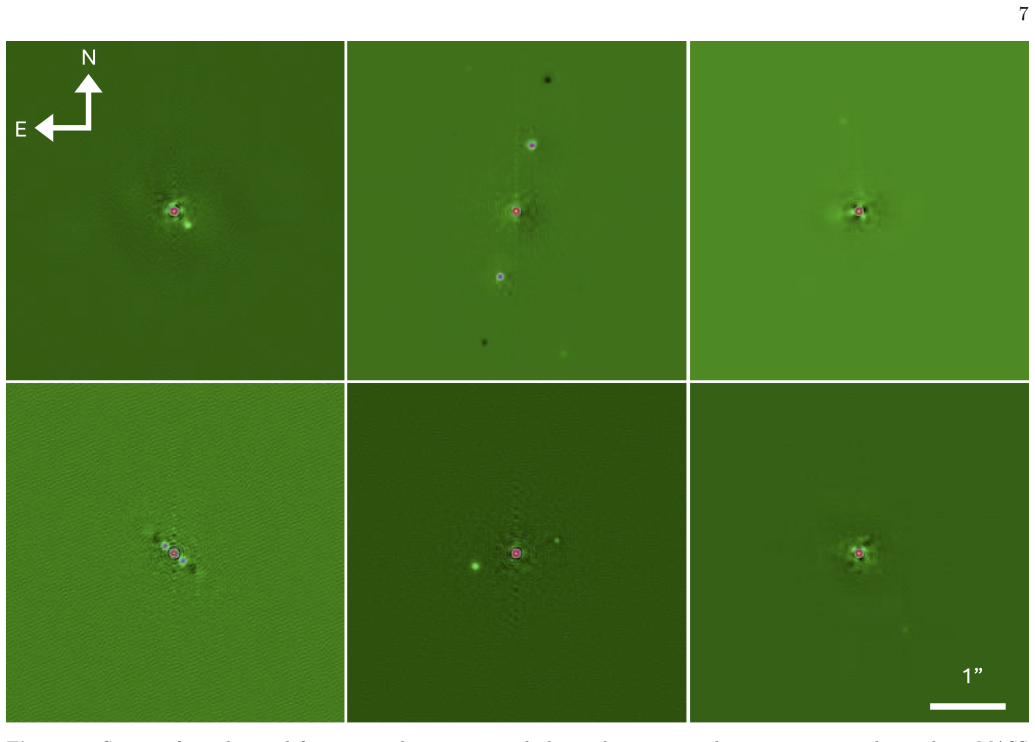
Speckle imaging of 66 additional Gaia-identified M dwarfs within 15 pc detects four new companions and revises the projected separation peak to 7.91 AU with multiplicity rate 22.7%.
A machine-rendered reading of the paper's core claim, the machinery that carries it, and where it could break.
Core claim
The POKEMON-DLC catalog supplies diffraction-limited speckle observations for the 66 supplemental M-dwarf primaries, yielding four likely bound companions. After a literature search for additional companions, the projected separation distribution peaks at 7.91 au with log-normal parameters σ_log(a) = 1.1 and SE_log(a) = 0.10. The updated M-dwarf stellar multiplicity rate is 22.7 ± 1.8% and the companion rate is 27.5 ± 2.0%. These results demonstrate the value of Gaia for completing nearby low-mass samples and point to future characterization by SPHEREx.
What carries the argument
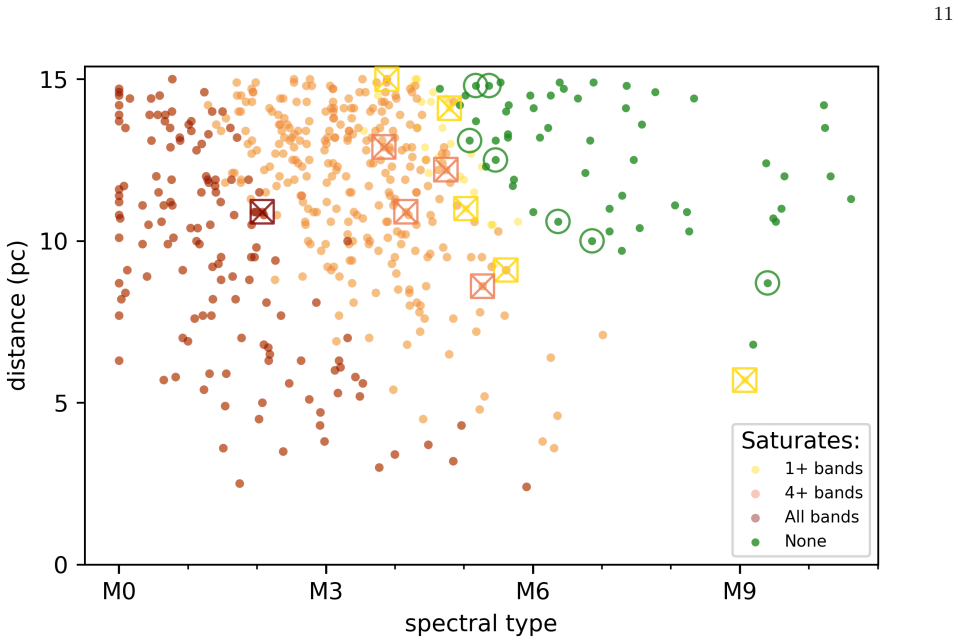
The POKEMON-DLC supplemental catalog of 66 Gaia-selected M-dwarf primaries observed at diffraction-limited resolution to detect close companions.
If this is right
- The refined separation distribution supplies a tighter observational prior for models of low-mass binary formation.
- The 22.7% multiplicity rate raises the expected number of close stellar companions that must be accounted for in planet-search surveys around M dwarfs.
- The expanded ultracool dwarf sample enables more complete demographic studies of the faintest stars in the solar neighborhood.
- Gaia-based selection of volume-limited targets can be applied to other stellar populations to reduce incompleteness in multiplicity statistics.
Where Pith is reading between the lines
- The 7.91 au peak may correspond to a characteristic scale set by the typical fragmentation radius in low-mass molecular cores.
- Higher companion rates imply that dynamical interactions in M-dwarf systems could truncate or excite protoplanetary disks more often than around solar-type stars.
- Extending the same speckle survey to the southern sky would remove the declination bias and yield a truly all-sky multiplicity census.
- Cross-matching the updated catalog with upcoming infrared spectroscopy from SPHEREx could directly test whether the new companions have the same metallicity and age as their primaries.
Load-bearing premise
The four newly detected sources are physically bound companions and the Gaia-selected targets are all genuine M-dwarf primaries inside 15 pc with negligible contamination or selection bias.
What would settle it
Radial-velocity time series or common-proper-motion follow-up showing that any of the four new companions lack orbital motion or shared motion with the primary at the observed separation.
Figures





read the original abstract
The Solar Neighborhood is dominated by stars smaller, colder, and fainter than the Sun: the M dwarfs. If we are to understand the context in which the Sun formed and evolved, then we must investigate the system architectures of our low-mass neighbors. We have therefore carried out the Pervasive Overview of Kompanions of Every M Dwarf in Our Neighborhood (POKEMON) speckle survey of nearby M-dwarf primaries. We created the survey with the goal of observing a volume-limited (north of -30 degrees) sample of M-dwarf primaries through M9 out to 15 pc at diffraction-limited resolution. Pre-Gaia parallax measurements yielded a catalog of 454 nearby M-dwarf primaries. However, the precise astrometry from Gaia indicated that there are additional low-mass sources within 15 pc. Here we present the POKEMON-Distance Limited Catalog (POKEMON-DLC), a supplemental catalog that consists of speckle observations for the 66 additional M-dwarf primaries identified by Gaia, increasing the number of ultracool dwarf (later than M6.5) primaries in the POKEMON catalog by a factor of 1.6. In our observations we detect four likely bound companions. After carrying out a literature search for additional companions, we update the projected separation distribution and find a peak at 7.91 au ({\sigma}log(a) = 1.1, SElog(a) = 0.10). We also update the M-dwarf stellar multiplicity and companion rates, and find values of 22.7 p/m 1.8% and 27.5 p/m 2.0%, respectively. These results emphasize the utility of Gaia for identifying low-mass, nearby sources, and we find that ensuing characterization of these sources by SPHEREx will continue to clarify the nature of the Solar Neighborhood.
Editorial analysis
A structured set of objections, weighed in public.
Referee Report
Summary. The paper presents the POKEMON-Distance Limited Catalog (POKEMON-DLC) as a supplement to the original POKEMON speckle survey. It adds speckle observations of 66 additional M-dwarf primaries within 15 pc identified via Gaia astrometry (increasing the ultracool dwarf primary count by a factor of 1.6), reports four new likely bound companions, performs a literature search for additional companions, and updates the projected separation distribution (peak at 7.91 au with σ_log(a) = 1.1) along with the M-dwarf multiplicity rate (22.7 ± 1.8%) and companion rate (27.5 ± 2.0%).
Significance. If the new primaries are confirmed as genuine nearby M dwarfs and the four detections are bound, the work provides a concrete observational update to the solar-neighborhood M-dwarf binary statistics by enlarging the volume-limited sample and refining the separation distribution. This strengthens the empirical foundation for low-mass star formation studies and highlights Gaia's utility for completing the nearby stellar census, with potential follow-up value for missions such as SPHEREx.
major comments (4)
- [Section 2] Section 2 (Sample Selection): The 66 Gaia-identified sources are treated as clean M-dwarf primaries, but the manuscript provides no quantitative contamination estimate, no explicit parallax-error threshold, no color-magnitude verification procedure, and no assessment of possible background or non-M-dwarf interlopers. With the total sample size only ~520 stars, even modest contamination would shift the reported rates by amounts comparable to the quoted uncertainties.
- [Section 3] Section 3 (Observations and Companion Detection): The four detected sources are labeled 'likely bound companions' without supporting calculations such as chance-alignment probabilities, common-proper-motion checks, RUWE values, or multi-epoch astrometric follow-up. This assumption is load-bearing for the updated companion rate of 27.5 ± 2.0%.
- [Section 5] Section 5 (Statistical Updates): The multiplicity rate (22.7 ± 1.8%) and companion rate are presented after adding the new primaries and companions, yet the error-propagation method, sample-completeness corrections, and handling of selection biases in the supplemental Gaia sample are not detailed. It is therefore unclear whether the quoted uncertainties fully reflect the impact of the 66 new objects.
- [Section 4] Section 4 (Separation Distribution): The reported peak at 7.91 au (σ_log(a) = 1.1, SE_log(a) = 0.10) is derived after a literature search, but the fitting method (e.g., maximum-likelihood, kernel density, or binned histogram) and robustness tests against the four new companions are not specified, making it difficult to assess whether the peak is stable.
minor comments (3)
- [References] Ensure consistent citation of the Gaia data release version used for the 66 sources and provide a reference for the original POKEMON catalog construction.
- [Figure 3] The separation-distribution figure would benefit from explicit error bars or bootstrap confidence intervals on the peak location.
- [Section 5] Clarify the definition of SE_log(a) in the text and table captions.
Simulated Author's Rebuttal
We thank the referee for their careful reading and valuable comments on our manuscript. We have carefully considered each point and made revisions to the manuscript to address the concerns raised. Our point-by-point responses are provided below.
read point-by-point responses
-
Referee: [Section 2] Section 2 (Sample Selection): The 66 Gaia-identified sources are treated as clean M-dwarf primaries, but the manuscript provides no quantitative contamination estimate, no explicit parallax-error threshold, no color-magnitude verification procedure, and no assessment of possible background or non-M-dwarf interlopers. With the total sample size only ~520 stars, even modest contamination would shift the reported rates by amounts comparable to the quoted uncertainties.
Authors: We agree that a more detailed discussion of the sample selection and potential contamination is warranted. In the original manuscript, the selection was based on Gaia DR3 astrometry with a parallax threshold corresponding to distances <15 pc and photometric criteria to identify M dwarfs. However, we did not quantify the contamination rate. In the revised version, we will include an estimate of contamination using the expected number of background stars from Gaia source density and a color-magnitude diagram verification procedure. We will also specify the parallax_over_error threshold used (typically >5 or 10 for reliable distances). This will be added to Section 2. revision: yes
-
Referee: [Section 3] Section 3 (Observations and Companion Detection): The four detected sources are labeled 'likely bound companions' without supporting calculations such as chance-alignment probabilities, common-proper-motion checks, RUWE values, or multi-epoch astrometric follow-up. This assumption is load-bearing for the updated companion rate of 27.5 ± 2.0%.
Authors: The labeling as 'likely bound' is based on their small angular separations (well within the expected binary separation distribution) and the low surface density of stars in the solar neighborhood, making chance alignment improbable. However, we acknowledge the lack of explicit calculations. In revision, we will add chance-alignment probability estimates calculated using the formula P = 1 - exp(-π θ^2 Σ), where Σ is the local stellar density from Gaia. For common proper motion, since these are new Gaia sources, we note that follow-up is planned but not available yet; we will qualify the companions as candidates pending confirmation. RUWE values for the primaries are typically low (<1.4), indicating no significant astrometric perturbation, but we will report them. This addresses the concern without overclaiming. revision: partial
-
Referee: [Section 5] Section 5 (Statistical Updates): The multiplicity rate (22.7 ± 1.8%) and companion rate are presented after adding the new primaries and companions, yet the error-propagation method, sample-completeness corrections, and handling of selection biases in the supplemental Gaia sample are not detailed. It is therefore unclear whether the quoted uncertainties fully reflect the impact of the 66 new objects.
Authors: The rates were calculated using binomial statistics for the multiplicity fraction, with uncertainties from the standard error formula sqrt(p(1-p)/N). For the supplemental sample, we assumed similar completeness to the original POKEMON sample since the observations were conducted with the same instrument and strategy. However, we did not explicitly detail bias corrections for the Gaia selection. In the revised manuscript, we will expand Section 5 to include the error propagation method (using Monte Carlo simulations to account for uncertainties in companion detections), discuss completeness (estimated at >90% for separations >0.1 arcsec), and address potential biases by comparing the new sample's properties to the original. We will also provide the updated rates with and without the new objects to show the impact. revision: yes
-
Referee: [Section 4] Section 4 (Separation Distribution): The reported peak at 7.91 au (σ_log(a) = 1.1, SE_log(a) = 0.10) is derived after a literature search, but the fitting method (e.g., maximum-likelihood, kernel density, or binned histogram) and robustness tests against the four new companions are not specified, making it difficult to assess whether the peak is stable.
Authors: The projected separation distribution was modeled as a log-normal distribution, with parameters estimated via maximum likelihood estimation on the combined sample of companions from literature and new detections. The peak at 7.91 au corresponds to the mode of the fitted distribution. To address robustness, we will add in the revision a description of the fitting procedure and results from jackknife tests or fits excluding the four new companions, which show the peak remains stable around 7-8 au. We will also specify the use of the emcee or scipy.optimize for the fit and provide the likelihood function used. revision: yes
Circularity Check
No circularity: purely observational catalog compilation and literature update with no self-referential derivations or fitted predictions.
full rationale
The paper reports new speckle observations of 66 Gaia-identified M-dwarf primaries, detects four companions, performs a literature search for known companions, and tabulates updated empirical statistics (separation peak, multiplicity rate 22.7±1.8%, companion rate 27.5±2.0%). These are direct counts and histogram summaries from the combined sample; no equations, model fits, or ansatzes are introduced that reduce the reported quantities to prior results by construction. The separation distribution and rates are computed from the observed and literature-compiled data without any self-citation chain or uniqueness theorem invoked to force the outcome. The analysis is self-contained against external benchmarks (Gaia astrometry, speckle imaging, published companion lists) and does not rename known results or smuggle assumptions via citation. Minor self-citations to prior POKEMON papers exist for survey context but are not load-bearing for the new catalog statistics.
Axiom & Free-Parameter Ledger
axioms (2)
- domain assumption Gaia DR3 astrometry reliably identifies additional M-dwarf primaries within the 15 pc volume limit north of -30 degrees
- domain assumption Speckle detections at small projected separations correspond to likely bound companions
Reference graph
Works this paper leans on
-
[1]
1200, The HIPPARCOS and TYCHO catalogues
1997, ESA Special Publication, Vol. 1200, The HIPPARCOS and TYCHO catalogues. Astrometric and photometric star catalogues derived from the ESA HIPPARCOS Space Astrometry Mission
1997
-
[2]
Aitken, R. G. 1899, Astronomische Nachrichten, 150, 113, doi: 10.1002/asna.18991500802
-
[3]
Exploring the Formation and Evolution of Planetary Systems , year = 2014, editor =
Allard, F. 2014, in IAU Symposium, Vol. 299, Exploring the Formation and Evolution of Planetary Systems, ed. M. Booth, B. C. Matthews, & J. R. Graham, 271–272, doi: 10.1017/S1743921313008545 Astropy Collaboration, Robitaille, T. P., Tollerud, E. J., et al. 2013, A&A, 558, A33, doi: 10.1051/0004-6361/201322068
-
[4]
Balega, I. I., Balega, Y. Y., Maksimov, A. F., et al. 1999, A&AS, 140, 287, doi: 10.1051/aas:1999422
-
[5]
1996, ApJL, 461, L51, doi: 10.1086/309988
Baraffe, I., & Chabrier, G. 1996, ApJL, 461, L51, doi: 10.1086/309988
-
[6]
Baroch, D., Morales, J. C., Ribas, I., et al. 2018, A&A, 619, A32, doi: 10.1051/0004-6361/201833440
-
[7]
Wasserman, L. H., & Henry, T. J. 2000, AJ, 120, 1106, doi: 10.1086/301495
-
[8]
L., S´ egransan, D., Forveille, T., et al
Beuzit, J. L., S´ egransan, D., Forveille, T., et al. 2004, A&A, 425, 997, doi: 10.1051/0004-6361:20048006
-
[9]
1987, A&AS, 71, 57
Blazit, A., Bonneau, D., & Foy, R. 1987, A&AS, 71, 57
1987
-
[10]
Bock, J. J., Aboobaker, A. M., Adamo, J., et al. 2025, arXiv e-prints, arXiv:2511.02985, doi: 10.48550/arXiv.2511.02985
-
[11]
Bowler, B. P., Liu, M. C., Shkolnik, E. L., & Tamura, M. 2015, ApJS, 216, 7, doi: 10.1088/0067-0049/216/1/7
-
[12]
Brooks, H., Caselden, D., Kirkpatrick, J. D., et al. 2024, AJ, 168, 211, doi: 10.3847/1538-3881/ad77d2
-
[13]
Burnham, S. W. 1891b, Astronomische Nachrichten, 127, 369, doi: 10.1002/asna.18911272301
-
[14]
Burnham, S. W. 1913, Measures of proper motion stars made with the 40-inch refractor of the Yerkes observatory in the years 1907 to 1912
1913
-
[15]
Ciardi, D. R., Beichman, C. A., Horch, E. P., & Howell, S. B. 2015, ApJ, 805, 16, doi: 10.1088/0004-637X/805/1/16
-
[16]
Clark, C. A., Horch, E. P., & Davidson, J. W. 2023, Research Notes of the American Astronomical Society, 7, 206, doi: 10.3847/2515-5172/acfee1
-
[17]
Clark, C. A., van Belle, G. T., Ciardi, D. R., et al. 2022a, AJ, 163, 232, doi: 10.3847/1538-3881/ac6101
-
[18]
Clark, C. A., van Belle, G. T., Horch, E. P., et al. 2022b, AJ, 164, 33, doi: 10.3847/1538-3881/ac739c
-
[19]
Clark, C. A., van Belle, G. T., Horch, E. P., et al. 2024a, AJ, 167, 56, doi: 10.3847/1538-3881/ad0bfd
-
[20]
Clark, C. A., van Belle, G. T., Horch, E. P., et al. 2024b, AJ, 167, 174, doi: 10.3847/1538-3881/ad267d
-
[21]
Clark, C. A., van Belle, G. T., Horch, E. P., et al. 2024c, AJ, 168, 228, doi: 10.3847/1538-3881/ad81fa
-
[22]
Clark, C. A., van Belle, G. T., Horch, E. P., et al. 2024d, AJ, 168, 229, doi: 10.3847/1538-3881/ad7eb3
-
[23]
Condon, S. S., Padin, S., Bock, J., et al. 2024, ApOpt, 63, 3453, doi: 10.1364/AO.514784 Cort´ es-Contreras, M., B´ ejar, V. J. S., Caballero, J. A., et al. 2017, A&A, 597, A47, doi: 10.1051/0004-6361/201629056
-
[24]
C., Harrington, R
Dahn, C. C., Harrington, R. S., Riepe, B. Y., et al. 1976, Publications of the U.S. Naval Observatory Second Series, 24, 1
1976
-
[25]
Delfosse, X., Forveille, T., Beuzit, J. L., et al. 1999a, A&A, 344, 897, doi: 10.48550/arXiv.astro-ph/9812008
work page internal anchor Pith review doi:10.48550/arxiv.astro-ph/9812008
-
[26]
1999b, A&A, 350, L39, doi: 10.48550/arXiv.astro-ph/9909409
Delfosse, X., Forveille, T., Udry, S., et al. 1999b, A&A, 350, L39, doi: 10.48550/arXiv.astro-ph/9909409
work page internal anchor Pith review doi:10.48550/arxiv.astro-ph/9909409
-
[27]
Deshpande, R., Blake, C. H., Bender, C. F., et al. 2013, AJ, 146, 156, doi: 10.1088/0004-6256/146/6/156
-
[28]
Dieterich, S. B., Henry, T. J., Jao, W.-C., et al. 2014, AJ, 147, 94, doi: 10.1088/0004-6256/147/5/94 Duchˆ ene, G., & Kraus, A. 2013, ARA&A, 51, 269, doi: 10.1146/annurev-astro-081710-102602
-
[29]
Dupuy, T. J., & Liu, M. C. 2012, ApJS, 201, 19, doi: 10.1088/0067-0049/201/2/19
-
[30]
1988, A&A, 200, 135
Duquennoy, A., & Mayor, M. 1988, A&A, 200, 135
1988
-
[31]
El-Badry, K., Rix, H.-W., & Heintz, T. M. 2021, MNRAS, 506, 2269, doi: 10.1093/mnras/stab323
-
[32]
Espin, T. E. 1920, MNRAS, 80, 329, doi: 10.1093/mnras/80.3.329
-
[33]
Espin, T. E., & Milburn, W. 1926, MNRAS, 86, 131, doi: 10.1093/mnras/86.3.131
-
[34]
Forrest, W. J., Skrutskie, M. F., & Shure, M. 1988, ApJL, 330, L119, doi: 10.1086/185218
-
[35]
Forveille, T., Beuzit, J. L., Delorme, P., et al. 2005, A&A, 435, L5, doi: 10.1051/0004-6361:200500101 Fouqu´ e, P., Moutou, C., Malo, L., et al. 2018, MNRAS, 475, 1960, doi: 10.1093/mnras/stx3246
-
[36]
Franz, O. G., Henry, T. J., Wasserman, L. H., et al. 1998, AJ, 116, 1432, doi: 10.1086/300500 Gaia Collaboration, Prusti, T., de Bruijne, J. H. J., et al. 2016, A&A, 595, A1, doi: 10.1051/0004-6361/201629272 Gaia Collaboration, Smart, R. L., Sarro, L. M., et al. 2021, A&A, 649, A6, doi: 10.1051/0004-6361/202039498 20 Gaia Collaboration, Vallenari, A., Bro...
-
[37]
L., Burnham, R., & Thomas, N
Giclas, H. L., Burnham, R., & Thomas, N. G. 1971, Lowell proper motion survey Northern Hemisphere. The G numbered stars. 8991 stars fainter than magnitude 8 with motions>0”.26/year
1971
-
[38]
2022, Astronomische Nachrichten, 343, e20224008, doi: 10.1002/asna.20224008
Gili, R., Prieur, J.-L., Rivet, J.-P., et al. 2022, Astronomische Nachrichten, 343, e20224008, doi: 10.1002/asna.20224008
-
[39]
Gillon, M., Pedersen, P. P., Rackham, B. V., et al. 2024, Nature Astronomy, 8, 865, doi: 10.1038/s41550-024-02271-2
-
[40]
Gizis, J. E., & Reid, N. I. 1996, AJ, 111, 365, doi: 10.1086/117789
-
[41]
1991, Preliminary Version of the Third Catalogue of Nearby Stars,, On: The Astronomical Data Center CD-ROM: Selected Astronomical Catalogs, Vol
Gliese, W., & Jahreiß, H. 1991, Preliminary Version of the Third Catalogue of Nearby Stars,, On: The Astronomical Data Center CD-ROM: Selected Astronomical Catalogs, Vol. I; L.E. Brotzmann, S.E. Gesser (eds.), NASA/Astronomical Data Center, Goddard Space Flight
1991
-
[42]
Harris, C. R., Millman, K. J., van der Walt, S. J., et al. 2020, Nature, 585, 357–362, doi: 10.1038/s41586-020-2649-2
-
[43]
Hartkopf, W. I., Mason, B. D., & Worley, C. E. 2001, AJ, 122, 3472, doi: 10.1086/323921
-
[44]
Hartkopf, W. I., McAlister, H. A., Mason, B. D., et al. 1994, AJ, 108, 2299, doi: 10.1086/117242
-
[45]
Heintz, W. D. 1987, ApJS, 65, 161, doi: 10.1086/191221
-
[46]
Heintz, W. D. 1993, AJ, 105, 1188, doi: 10.1086/116503
-
[47]
Henry, T. J., Franz, O. G., Wasserman, L. H., et al. 1999, ApJ, 512, 864, doi: 10.1086/306793
-
[48]
Henry, T. J., Ianna, P. A., Kirkpatrick, J. D., & Jahreiss, H. 1997, AJ, 114, 388, doi: 10.1086/118482
-
[49]
Henry, T. J., & Jao, W.-C. 2024, ARA&A, 62, 593, doi: 10.1146/annurev-astro-052722-102740
-
[50]
Henry, T. J., Jao, W.-C., Subasavage, J. P., et al. 2006, AJ, 132, 2360, doi: 10.1086/508233
-
[51]
Henry, T. J., Jao, W.-C., Winters, J. G., et al. 2018, AJ, 155, 265, doi: 10.3847/1538-3881/aac262
-
[52]
Herbig, G. H., & Moorhead, J. M. 1965, ApJ, 141, 649, doi: 10.1086/148150
-
[53]
1909, Astronomische Nachrichten, 180, 39, doi: 10.1002/asna.19091800203
Hertzsprung, E. 1909, Astronomische Nachrichten, 180, 39, doi: 10.1002/asna.19091800203
-
[54]
Hirsch, L. A., Rosenthal, L., Fulton, B. J., et al. 2021, AJ, 161, 134, doi: 10.3847/1538-3881/abd639
-
[55]
1982, The Bright Star Catalogue
Hoffleit, D., & Jaschek, C. 1982, The Bright Star Catalogue. Fourth revised edition. (Containing data compiled through 1979)
1982
-
[56]
Horch, E. P., Bahi, L. A. P., Gaulin, J. R., et al. 2012, AJ, 143, 10, doi: 10.1088/0004-6256/143/1/10
-
[57]
Horch, E. P., Falta, D., Anderson, L. M., et al. 2010, AJ, 139, 205, doi: 10.1088/0004-6256/139/1/205
-
[58]
Horch, E. P., Gomez, S. C., Sherry, W. H., et al. 2011a, AJ, 141, 45, doi: 10.1088/0004-6256/141/2/45
-
[59]
Horch, E. P., Meyer, R. D., & van Altena, W. F. 2004, AJ, 127, 1727, doi: 10.1086/381956
-
[60]
Horch, E. P., van Altena, W. F., Howell, S. B., Sherry, W. H., & Ciardi, D. R. 2011b, AJ, 141, 180, doi: 10.1088/0004-6256/141/6/180
-
[61]
Horch, E. P., van Belle, G. T., Davidson, Jr., J. W., et al. 2015, AJ, 150, 151, doi: 10.1088/0004-6256/150/5/151
-
[62]
Horch, E. P., Veillette, D. R., Baena Gall´ e, R., et al. 2009, AJ, 137, 5057, doi: 10.1088/0004-6256/137/6/5057
-
[63]
Horch, E. P., van Belle, G. T., Davidson, Jr., J. W., et al. 2020, AJ, 159, 233, doi: 10.3847/1538-3881/ab87a6
-
[64]
Horch, E. P., Broderick, K. G., Casetti-Dinescu, D. I., et al. 2021, AJ, 161, 295, doi: 10.3847/1538-3881/abf9a8
-
[65]
Hough, G. W. 1899, Astronomische Nachrichten, 149, 65, doi: 10.1002/asna.18991490502
-
[66]
Hunter, J. D. 2007, Computing in science & engineering, 9, 90
2007
-
[67]
Hussey, W. J. 1904, Lick Observatory Bulletin, 57, 180, doi: 10.5479/ADS/bib/1904LicOB.2.180H
-
[68]
Faherty, J. K. 2025, arXiv e-prints, arXiv:2512.02269, doi: 10.48550/arXiv.2512.02269
-
[69]
Gharib-Nezhad, E. 2023, ApJ, 944, 41, doi: 10.3847/1538-4357/acabc2
-
[70]
2014, ApJ, 789, 102, doi: 10.1088/0004-637X/789/2/102
Janson, M., Bergfors, C., Brandner, W., et al. 2014, ApJ, 789, 102, doi: 10.1088/0004-637X/789/2/102
-
[71]
2012, title The AstraLux Large M-dwarf Multiplicity Survey , , 754, 44, 10.1088/0004-637X/754/1/44
Janson, M., Hormuth, F., Bergfors, C., et al. 2012, ApJ, 754, 44, doi: 10.1088/0004-637X/754/1/44
-
[72]
doi:10.1051/0004-6361/201629599 , keywords =
Jeffers, S. V., Sch¨ ofer, P., Lamert, A., et al. 2018, A&A, 614, A76, doi: 10.1051/0004-6361/201629599 J´ odar, E., P´ erez-Garrido, A., D´ ıaz-S´ anchez, A., et al. 2013, MNRAS, 429, 859, doi: 10.1093/mnras/sts382
-
[73]
Joy, A. H. 1942, PASP, 54, 33, doi: 10.1086/125392
-
[74]
Joy, A. H. 1947, ApJ, 105, 96, doi: 10.1086/144886
-
[75]
2025, A&A, 695, A195, doi: 10.1051/0004-6361/202452011
Karpov, S., Malkov, O., & Avdeeva, A. 2025, A&A, 695, A195, doi: 10.1051/0004-6361/202452011
-
[76]
F., Steinz, J
Kessler, M. F., Steinz, J. A., Anderegg, M. E., et al. 1996, A&A, 315, L27
1996
-
[77]
Kirkpatrick, J. D., Henry, T. J., & Irwin, M. J. 1997, AJ, 113, 1421, doi: 10.1086/118357
-
[78]
Kirkpatrick, J. D., Reid, I. N., Liebert, J., et al. 2000, AJ, 120, 447, doi: 10.1086/301427
-
[79]
D., Schneider, A., Fajardo-Acosta, S., et al
Kirkpatrick, J. D., Schneider, A., Fajardo-Acosta, S., et al. 2014, ApJ, 783, 122, doi: 10.1088/0004-637X/783/2/122 21
-
[80]
Kirkpatrick, J. D., Marocco, F., Gelino, C. R., et al. 2024, ApJS, 271, 55, doi: 10.3847/1538-4365/ad24e2
discussion (0)
Sign in with ORCID, Apple, or X to comment. Anyone can read and Pith papers without signing in.