Recognition: unknown
Hard to See, Hard to Label: Generative and Symbolic Acquisition for Subtle Visual Phenomena
Pith reviewed 2026-05-08 12:13 UTC · model grok-4.3
The pith
GSAL combines diffusion difficulty scoring with semantic concept graphs to acquire subtle visual anomalies more effectively in active learning.
A machine-rendered reading of the paper's core claim, the machinery that carries it, and where it could break.
Core claim
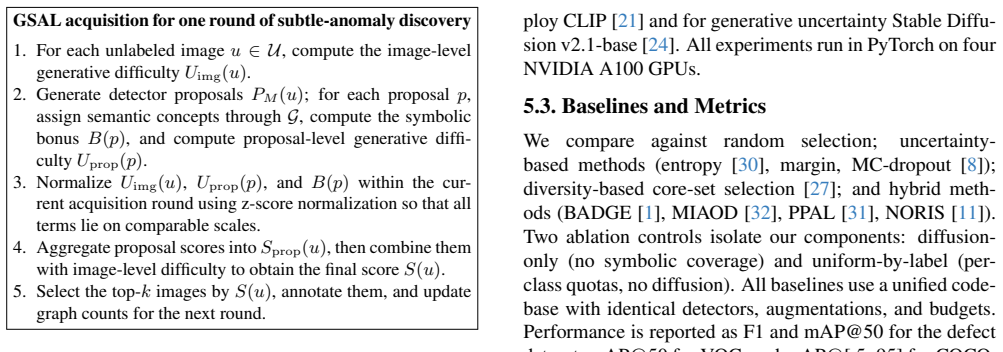
GSAL is an active learning framework for object detection that combines a diffusion-based difficulty signal with a hierarchical semantic coverage prior. The diffusion component scores images and proposals using reconstruction discrepancy and denoising variability to prioritize visually atypical or ambiguous examples. The semantic component organizes candidates in a three-level concept graph to promote coverage of underrepresented regions while supplying interpretable acquisition rationales. By balancing the two, GSAL improves retrieval of subtle and rare targets that uncertainty-only selection often misses, with consistent gains in label efficiency on a proprietary thin-film defect dataset,
What carries the argument
GSAL's dual acquisition mechanism: diffusion-derived visual difficulty (reconstruction discrepancy plus denoising variability) paired with a three-level concept graph that enforces semantic coverage.
If this is right
- GSAL yields higher label efficiency than uncertainty-, diversity-, and hybrid baselines on industrial defect data and on Pascal VOC and MS COCO.
- The method retrieves more rare classes that are typically overlooked by uncertainty-only selection.
- Acquisition decisions become interpretable through the semantic concept graph rationales.
- Diffusion scoring prevents repeated selection of hard examples that still lie inside dominant semantic modes.
- The framework applies directly to object detection tasks where anomalies are both low-prevalence and visually ambiguous.
Where Pith is reading between the lines
- The same difficulty-plus-coverage logic could be tested on medical imaging or autonomous-driving edge-case datasets where subtle anomalies also matter.
- If the concept graph can be learned automatically rather than hand-built, the method would require less domain expertise to deploy.
- Replacing the diffusion model with other generative models would test whether the difficulty signal is specific to diffusion or more general.
- In high-volume industrial inspection, the reported gains in rare-class retrieval could translate into measurable reductions in missed defects and therefore in warranty or safety costs.
Load-bearing premise
The diffusion signals must identify subtle anomalies without being overwhelmed by unrelated image properties, and the concept graph must be constructible in a way that genuinely covers rare semantic regions without adding its own selection biases.
What would settle it
On a dataset containing a known set of subtle anomalies with ground-truth labels, compare the fraction of those anomalies acquired by GSAL versus pure uncertainty sampling after a fixed labeling budget; a clear drop in recall for the subtle set would falsify the central claim.
Figures


read the original abstract
Subtle visual anomalies such as hairline cracks, sub-millimeter voids, and low-contrast inclusions are structurally atypical yet visually ambiguous, making them both difficult to annotate and easy to overlook during active learning. Standard acquisition heuristics based on discriminative uncertainty or feature diversity often overselect dominant patterns while underexploring sparse yet important regions of the data space. This failure mode is especially severe in industrial defect inspection, where anomalies may be both low-prevalence and difficult to distinguish from surrounding structure. To resolve this, we propose GSAL, an active learning framework for object detection that combines a diffusion-based difficulty signal with a hierarchical semantic coverage prior. The diffusion component scores images and proposals using reconstruction discrepancy and denoising variability, prioritizing visually atypical or ambiguous examples. However, diffusion alone does not prevent acquisition from repeatedly favoring hard samples within dominant semantic modes. The semantic component therefore organizes candidate samples in a three-level concept graph and promotes coverage of underrepresented semantic regions while providing interpretable acquisition rationales. By balancing visual difficulty with semantic coverage, GSAL improves retrieval of subtle and rare targets that are often missed by uncertainty-only selection. Experiments on a proprietary thin-film defect, Pascal VOC and MS COCO dataset show consistent gains in label efficiency and rare-class retrieval over uncertainty-, diversity-, and hybrid-based baselines
Editorial analysis
A structured set of objections, weighed in public.
Referee Report
Summary. The paper introduces GSAL, an active learning framework for object detection that integrates a diffusion-based difficulty signal (reconstruction discrepancy and denoising variability) with a three-level hierarchical concept graph for semantic coverage. It claims this combination balances visual atypicality with underrepresented semantic regions to improve retrieval of subtle and rare targets (e.g., hairline cracks, low-contrast inclusions) that uncertainty- or diversity-only methods miss. Experiments on a proprietary thin-film defect dataset plus Pascal VOC and MS COCO report consistent gains in label efficiency and rare-class retrieval over uncertainty, diversity, and hybrid baselines.
Significance. If the results hold with full quantitative support and public verification, the work could meaningfully advance active learning for domains with low-prevalence, visually ambiguous anomalies such as industrial inspection. The dual generative-symbolic design and emphasis on interpretable acquisition rationales are strengths that distinguish it from purely uncertainty-driven approaches. The paper correctly identifies a failure mode of standard heuristics and proposes a coherent mitigation.
major comments (3)
- [Abstract] Abstract: the central claim of 'consistent gains in label efficiency and rare-class retrieval' is asserted without any reported numbers, error bars, statistical tests, or ablation details on how the diffusion signal is combined with the concept-graph prior. This is load-bearing for the empirical contribution.
- [Experiments] Experiments section: reliance on a proprietary thin-film defect dataset prevents independent replication of the industrial-defect results that motivate the method; this blocks verification of the key practical claim.
- [Method] Method description: no explicit formulation or pseudocode is given for the joint acquisition function that trades off diffusion difficulty against semantic coverage, nor for construction of the three-level concept graph. This leaves open whether the reported improvement reduces to an ad-hoc weighting parameter.
minor comments (1)
- [Figures/Tables] Figure captions and table headers should explicitly state the exact metrics (e.g., mAP@0.5, rare-class recall) and number of runs used for the reported gains.
Simulated Author's Rebuttal
We thank the referee for the constructive and detailed feedback. We address each major comment below, indicating the revisions we will make to strengthen the manuscript.
read point-by-point responses
-
Referee: [Abstract] Abstract: the central claim of 'consistent gains in label efficiency and rare-class retrieval' is asserted without any reported numbers, error bars, statistical tests, or ablation details on how the diffusion signal is combined with the concept-graph prior. This is load-bearing for the empirical contribution.
Authors: We agree that the abstract would benefit from more concrete quantitative support. In the revised manuscript we will update the abstract to include specific metrics (e.g., relative gains in label efficiency and rare-class recall on the evaluated datasets), reference the corresponding tables, and briefly note the ablation results that isolate the contribution of the diffusion signal versus the semantic coverage prior. revision: yes
-
Referee: [Experiments] Experiments section: reliance on a proprietary thin-film defect dataset prevents independent replication of the industrial-defect results that motivate the method; this blocks verification of the key practical claim.
Authors: We acknowledge that the proprietary thin-film dataset limits full independent replication of the motivating industrial results. To mitigate this, the revision will place greater emphasis on the fully reproducible results obtained on Pascal VOC and MS COCO, include additional analysis of generalization across these public benchmarks, and release the complete implementation code so that the algorithmic components and public-dataset experiments can be reproduced exactly. revision: partial
-
Referee: [Method] Method description: no explicit formulation or pseudocode is given for the joint acquisition function that trades off diffusion difficulty against semantic coverage, nor for construction of the three-level concept graph. This leaves open whether the reported improvement reduces to an ad-hoc weighting parameter.
Authors: We thank the referee for highlighting this omission. The revised manuscript will contain the explicit mathematical formulation of the joint acquisition function (including the precise weighting between diffusion difficulty and semantic coverage, together with the procedure used to select the weight), as well as pseudocode for both the acquisition function and the hierarchical concept-graph construction. These additions will demonstrate that the reported gains arise from a principled combination rather than an arbitrary hyper-parameter choice. revision: yes
- The proprietary thin-film defect dataset cannot be released, preventing full independent replication of the industrial-defect experiments that originally motivated the work.
Circularity Check
No significant circularity detected
full rationale
The paper presents GSAL as a method that integrates a diffusion-based visual difficulty signal (reconstruction discrepancy and denoising variability) with a three-level concept graph for semantic coverage. No equations, derivations, fitted parameters renamed as predictions, or self-citation chains are described that reduce the claimed gains in label efficiency or rare-class retrieval to the inputs by construction. The central claim is framed as the result of balancing two independent external signals, with no self-definitional steps or load-bearing internal reductions visible in the abstract or method outline.
Axiom & Free-Parameter Ledger
Reference graph
Works this paper leans on
-
[1]
Deep batch active learning by diverse, uncertain gradient lower bounds
Jordan Ash, Chicheng Zhang, Akshay Krishnamurthy, John Langford, and Alekh Agarwal. Deep batch active learning by diverse, uncertain gradient lower bounds. InInternational Conference on Learning Representations (ICLR), 2019. 1, 3, 6, 7
2019
-
[2]
Luis Barba, Johannes Kirschner, Tomas Aidukas, Manuel Guizar-Sicairos, and Benjam´ın B´ejar. Diffusion active learn- ing: Towards data-driven experimental design in computed tomography.arXiv preprint arXiv:2504.03491, 2025. 3
-
[3]
The power of ensembles for active learning in image classification
William H Beluch, Tim Genewein, Andreas N ¨urnberger, and Jan M K¨orner. The power of ensembles for active learning in image classification. InProceedings of the IEEE Conference on Computer Vision and Pattern Recognition (CVPR), pages 9368–9377, 2018. 1, 2, 3
2018
-
[4]
Shedding light on large generative networks: Estimating epistemic uncer- tainty in diffusion models
Lucas Berry, Axel Brando, and David Meger. Shedding light on large generative networks: Estimating epistemic uncer- tainty in diffusion models. InUncertainty in Artificial Intel- ligence, pages 360–376. PMLR, 2024. 2, 3
2024
-
[5]
Neural-symbolic learning and reasoning: A survey and interpretation.arXiv preprint arXiv:1711.03902,
Tarek R Besold, Artur d’Avila Garcez, Sebastian Bader, Howard Bowman, Pedro Domingos, Pascal Hitzler, Kai- Uwe K ¨uhnberger, Luis C Lamb, Risto Miikkulainen, and Daniel L Silver. Neural-symbolic learning and reasoning: A survey and interpretation.arXiv preprint arXiv:1711.03902,
-
[6]
Diffusion-based probabilistic un- certainty estimation for active domain adaptation.Advances in Neural Information Processing Systems, 36:17129–17155,
Zhekai Du and Jingjing Li. Diffusion-based probabilistic un- certainty estimation for active domain adaptation.Advances in Neural Information Processing Systems, 36:17129–17155,
-
[7]
The pascal visual object classes (voc) challenge.International Journal of Computer Vision (IJCV), 88(2):303–338, 2010
Mark Everingham, Luc Van Gool, Christopher KI Williams, John Winn, and Andrew Zisserman. The pascal visual object classes (voc) challenge.International Journal of Computer Vision (IJCV), 88(2):303–338, 2010. 6
2010
-
[8]
Deep bayesian active learning with image data
Yarin Gal, Riashat Islam, and Zoubin Ghahramani. Deep bayesian active learning with image data. InProceedings of the 34th International Conference on Machine Learning (ICML), pages 1183–1192, 2017. 1, 3, 6
2017
-
[9]
Artur d’Avila Garcez, Tarek R Besold, Luc De Raedt, Peter F ¨oldiak, Pascal Hitzler, Thomas Icard, Kai-Uwe K¨uhnberger, Luis C Lamb, Risto Miikkulainen, and Daniel L Silver.Neurosymbolic AI: The 3rd wave. arXiv preprint arXiv:1905.06088, 2019. 2, 3
work page Pith review arXiv 1905
-
[10]
Deep residual learning for image recognition
Kaiming He, Xiangyu Zhang, Shaoqing Ren, and Jian Sun. Deep residual learning for image recognition. InProceed- ings of the IEEE Conference on Computer Vision and Pattern Recognition (CVPR), pages 770–778, 2016. 6
2016
-
[11]
Aral Hekimoglu, Adrian Brucker, Alper Kagan Kayali, Michael Schmidt, and Alvaro Marcos-Ramiro. Active learn- ing for object detection with non-redundant informative sam- pling.arXiv preprint arXiv:2307.08414, 2023. 1, 3, 6, 7
-
[12]
Segment any- thing
Alexander Kirillov, Eric Mintun, Nikhila Ravi, Hanzi Mao, Chloe Rolland, Laura Gustafson, Tete Xiao, Spencer White- head, Alexander C Berg, Wan-Yen Lo, et al. Segment any- thing. InProceedings of the IEEE/CVF international confer- ence on computer vision, pages 4015–4026, 2023. 2
2023
-
[13]
Concept bottleneck models
Pang Wei Koh, Thao Nguyen, Yew Siang Tang, Stephen Mussmann, Emma Pierson, Been Kim, and Percy Liang. Concept bottleneck models. InInternational conference on machine learning, pages 5338–5348. PMLR, 2020. 3
2020
-
[14]
Diffusion-based deep active learning.arXiv preprint arXiv:2003.10339, 2020
Dan Kushnir and Luca Venturi. Diffusion-based deep active learning.arXiv preprint arXiv:2003.10339, 2020. 3
-
[15]
A sequential algorithm for training text classifiers
David D Lewis and William A Gale. A sequential algorithm for training text classifiers. InProceedings of the 17th An- nual International ACM SIGIR Conference on Research and Development in Information Retrieval, pages 3–12, 1994. 1, 3
1994
-
[16]
Dong Liang, Jing-Wei Zhang, Ying-Peng Tang, and Sheng- Jun Huang. Mus-cdb: Mixed uncertainty sampling with class distribution balancing for active annotation in aerial object detection.IEEE Transactions on Geoscience and Remote Sensing, 61:1–13, 2023. 2, 3
2023
-
[17]
Microsoft coco: Common objects in context
Tsung-Yi Lin, Michael Maire, Serge Belongie, James Hays, Pietro Perona, Deva Ramanan, Piotr Doll´ar, and C Lawrence Zitnick. Microsoft coco: Common objects in context. InEu- ropean Conference on Computer Vision (ECCV), pages 740– 755, 2014. 6
2014
-
[18]
Improved denoising diffusion probabilistic models
Alexander Quinn Nichol and Prafulla Dhariwal. Improved denoising diffusion probabilistic models. InInternational conference on machine learning, pages 8162–8171. PMLR,
-
[19]
Can you trust your model’s uncertainty? evaluating predictive uncertainty under dataset shift.Advances in neural information processing systems, 32, 2019
Yaniv Ovadia, Emily Fertig, Jie Ren, Zachary Nado, David Sculley, Sebastian Nowozin, Joshua Dillon, Balaji Lakshmi- narayanan, and Jasper Snoek. Can you trust your model’s uncertainty? evaluating predictive uncertainty under dataset shift.Advances in neural information processing systems, 32, 2019. 2, 3
2019
-
[20]
Assemai: Interpretable image-based anomaly detection for manufacturing pipelines
Renjith Prasad, Chathurangi Shyalika, Fadi El Kalach, Re- vathy Venkataramanan, Ramtin Zand, Ramy Harik, and Amit Sheth. Assemai: Interpretable image-based anomaly detection for manufacturing pipelines. In2024 Interna- tional Conference on Machine Learning and Applications (ICMLA), pages 1720–1727. IEEE, 2024. 2
2024
-
[21]
Learning transferable visual models from natural language supervision
Alec Radford, Jong Wook Kim, Chris Hallacy, Aditya Ramesh, Gabriel Goh, Sandhini Agarwal, Girish Sastry, Amanda Askell, Pamela Mishkin, Jack Clark, Gretchen Krueger, and Ilya Sutskever. Learning transferable visual models from natural language supervision. InProceedings of the International Conference on Machine Learning (ICML),
-
[22]
Faster r-cnn: Towards real-time object detection with region proposal networks
Shaoqing Ren, Kaiming He, Ross Girshick, and Jian Sun. Faster r-cnn: Towards real-time object detection with region proposal networks. InAdvances in Neural Information Pro- cessing Systems (NeurIPS), 2015. 6
2015
-
[23]
Gradient-based quantification of epis- temic uncertainty for deep object detectors
Tobias Riedlinger, Matthias Rottmann, Marius Schubert, and Hanno Gottschalk. Gradient-based quantification of epis- temic uncertainty for deep object detectors. InProceed- ings of the IEEE/CVF Winter Conference on Applications of Computer Vision, pages 3921–3931, 2023. 2, 3
2023
-
[24]
High-resolution image syn- thesis with latent diffusion models
Robin Rombach, Andreas Blattmann, Dominik Lorenz, Patrick Esser, and Bj¨orn Ommer. High-resolution image syn- thesis with latent diffusion models. InProceedings of the IEEE Conference on Computer Vision and Pattern Recogni- tion (CVPR), pages 10684–10695, 2022. 2, 3, 5, 6
2022
-
[25]
Deep active learning for object detection
Soumya Roy, Asim Unmesh, and Vinay P Namboodiri. Deep active learning for object detection. InBMVC, page 375,
-
[26]
Overcoming data scarcity in biomedical imaging with a foundational multi- task model.Nature Computational Science, 4(7):495–509,
Raphael Sch ¨afer, Till Nicke, Henning H ¨ofener, Annkristin Lange, Dorit Merhof, Friedrich Feuerhake, V olkmar Schulz, Johannes Lotz, and Fabian Kiessling. Overcoming data scarcity in biomedical imaging with a foundational multi- task model.Nature Computational Science, 4(7):495–509,
-
[27]
Active learning for convolu- tional neural networks: A core-set approach
Ozan Sener and Silvio Savarese. Active learning for convolu- tional neural networks: A core-set approach. InInternational Conference on Learning Representations (ICLR), 2018. 1, 3, 6, 7
2018
-
[28]
Neurosymbolic ai-why, what, and how.IEEE Intelligent Systems, 38, 2023
Amit Sheth, Kaushik Roy, and Manas Gaur. Neurosymbolic ai-why, what, and how.IEEE Intelligent Systems, 38, 2023. 2, 3
2023
-
[29]
A comprehensive survey on rare event prediction
Chathurangi Shyalika, Ruwan Wickramarachchi, and Amit P Sheth. A comprehensive survey on rare event prediction. ACM Computing Surveys, 57(3):1–39, 2024. 2
2024
-
[30]
Entropy-based ac- tive learning for object detection with progressive diversity constraint
Jiaxi Wu, Jiaxin Chen, and Di Huang. Entropy-based ac- tive learning for object detection with progressive diversity constraint. InProceedings of the IEEE/CVF conference on computer vision and pattern recognition, pages 9397–9406,
-
[31]
Plug and Play Active Learning for Object Detection
Yang, Chenhongyi and Huang, Lichao and Crowley, Elliot J. Plug and Play Active Learning for Object Detection. InPro- ceedings of the IEEE/CVF Conference on Computer Vision and Pattern Recognition (CVPR), 2024. 1, 3, 6, 7
2024
-
[32]
Multiple instance active learning for object detection
Tianning Yuan, Fang Wan, Mengying Fu, Jianzhuang Liu, Songcen Xu, Xiangyang Ji, and Qixiang Ye. Multiple instance active learning for object detection. In2021 IEEE/CVF Conference on Computer Vision and Pattern Recognition (CVPR), pages 5326–5335. IEEE, 2021. 1, 3, 6, 7
2021
discussion (0)
Sign in with ORCID, Apple, or X to comment. Anyone can read and Pith papers without signing in.