RAT: RunAnyThing via Fully Automated Environment Configuration
Pith reviewed 2026-07-04 15:17 UTC · model glm-5.2
The pith
RAT automates environment setup for code agents
A machine-rendered reading of the paper's core claim, the machinery that carries it, and where it could break.
Core claim
The central mechanism is a modular, language-agnostic pipeline that decomposes environment configuration into stages: abstracting repository requirements, initializing container images, applying specialized configuration tools, and executing within a sandbox. This decomposition allows the framework to generalize across arbitrary repositories and programming languages without relying on pre-defined artifacts. If the pipeline's automation is effective, it removes a primary bottleneck preventing autonomous code agents from operating end-to-end on real software projects.
What carries the argument
multi-stage pipeline: language-aware abstraction, image initialization, specialized configuration toolset, robust sandbox; RATBench benchmark; Environment Setup Success Rate (ESSR) metric
If this is right
- Autonomous code agents could operate end-to-end on arbitrary repositories without human intervention for environment setup, lowering the barrier to deploying agents in real software engineering workflows.
- A standardized benchmark for environment configuration could drive rapid improvement in automated DevOps tooling and agent reliability.
- The modular design suggests that individual stages could be swapped or upgraded independently, enabling adaptation to new languages or package managers without redesigning the full system.
Where Pith is reading between the lines
- If environment configuration becomes fully automated, the next bottleneck for repository-level code agents likely shifts to test generation, dependency resolution at the semantic level, or understanding project-specific conventions not captured by configuration scripts.
- A language-aware abstraction layer implies the framework must maintain language-specific heuristics; the maintenance burden of these heuristics could limit scaling to niche or rapidly evolving ecosystems.
- The 36.1% improvement in ESSR over baselines, while substantial, leaves a residual failure rate that may concentrate in repositories with unusual build systems, circular dependencies, or undocumented external requirements.
Load-bearing premise
The paper assumes that a fixed multi-stage pipeline can reliably abstract and configure environments across arbitrary repositories and programming languages, but does not provide evidence that the most complex or idiosyncratic real-world repositories (e.g., those with non-standard build systems or undocumented dependencies) are adequately represented in the evaluation.
What would settle it
If repositories with highly idiosyncratic build systems or undocumented dependencies are systematically underrepresented in RATBench, the 36.1% ESSR improvement may not generalize to the hardest real-world cases.
Figures




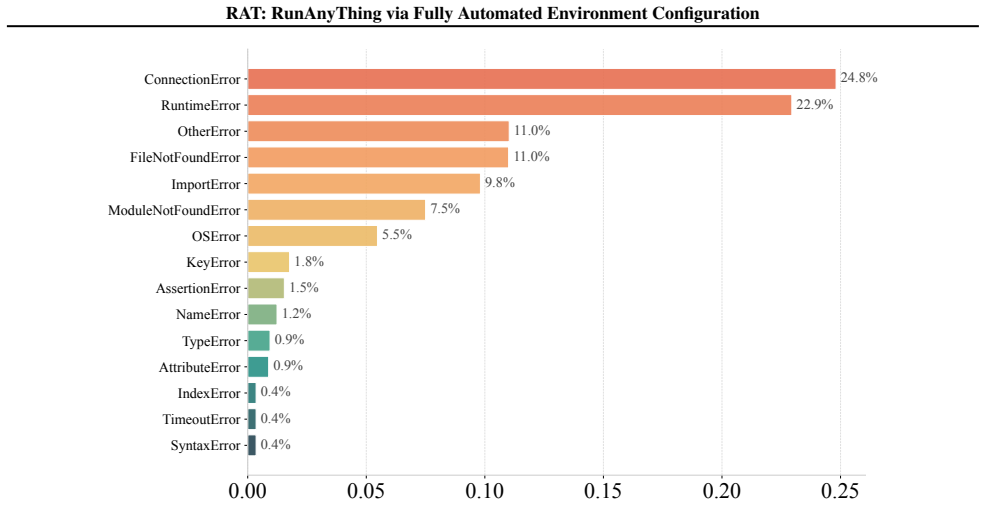
read the original abstract
Automating repository-level software engineering tasks is a foundational challenge for autonomous code agents, largely due to the difficulty of configuring executable environments. However, manual configuration remains a labor-intensive bottleneck, necessitating a transition toward fully automated environment configuration. Existing approaches often rely on pre-defined artifacts or are restricted to specific programming languages, limiting their applicability to diverse real-world repositories. In this paper, we first propose RAT (RunAnyThing), a modular and extensible agent framework for fully automated configuration across programming languages on arbitrary repositories. RAT adopts a multi-stage pipeline that integrates language-aware abstraction, image initialization, specialized configuration toolset, and robust sandbox. Furthermore, to enable rigorous evaluation, we propose RATBench, a benchmark reflects the comprehensive coverage of real-world repositories. Extensive experiments demonstrate that RAT achieves state-of-the-art performance, improving Environment Setup Success Rate (ESSR) by an average of 36.1% over strong baselines.
Editorial analysis
A structured set of objections, weighed in public.
Referee Report
Summary. This manuscript proposes three techniques for vector quantization (VQ) based neural network weight compression: (1) STE with cosine-similarity-based assignment and projection-based scaling, (2) differentiable hard-attention VQ-QAT that eliminates temperature tuning via top-1 sampling with STE, and (3) a ProxylessNAS-based framework for layer-wise selection between VQ and linear quantization. The methods are evaluated on ResNet-18/ImageNet-1K. The hard-attention method (Section III.B) achieves accuracy within ~0.7-0.9% of DKM and EWGS baselines at 4/8 and 8/8 bit-widths while reducing per-epoch training time from ~40 to ~6 minutes. The scalar method (Section III.A) and the NAS method (Section III.C) underperform baselines.
Significance. The primary contribution is the hard-attention VQ-QAT formulation (Section III.B), which eliminates the soft-to-hard mismatch of DKM by using cosine-similarity attention with top-1 sampling and STE, ensuring training-inference consistency without temperature scheduling. The 6.7x training speedup over DKM (40 min to 6 min per epoch) is a practical and verifiable advantage. The gradient analysis showing that each probability p_i receives a meaningful gradient signal proportional to the alignment between the upstream gradient and codeword v_i is a clean theoretical insight. The ProxylessNAS-based VQ/LQ selection framework is a reasonable extension, though its empirical results are not yet competitive. The manuscript is honest about limitations—the scalar method and NAS method do not consistently outperform baselines—which is commendable.
major comments (4)
- §V.B, Table II: The claim that the method is 'within 0.3–0.8% of best reported accuracy' is inaccurate for the 4/8 configuration. The gap is 0.94% (68.66% vs 69.6% EWGS), which exceeds the stated 0.8% upper bound. This mischaracterization is load-bearing because the 'comparable accuracy' claim is the central selling point of the hard-attention method. The text should be corrected to accurately reflect the observed gaps (0.94% at 4/8, 0.72% at 8/8).
- §IV.C and §V.B: All results in Tables I-III are from single runs with individually tuned learning rates ('The learning rate was individually tuned for each experiment to ensure optimal convergence'), with no error bars or multiple seeds. For ResNet-18/ImageNet QAT, run-to-run variance is typically 0.1-0.3%, meaning the 0.72% gap at 8/8 could be partially within noise. Without at least 3 seeds and variance estimates, the 'comparable accuracy' claim is not well-established. This is load-bearing for the paper's central claim and should be addressed with multi-seed runs or, at minimum, an explicit acknowledgment of this limitation.
- §III.A, Fig. 2: The cosine-similarity assignment is motivated by the claim that weight vector directions are 'approximately uniformly distributed,' but this is supported only by a visualization of ResNet-18 weights at vector dimension 2. No evidence is provided that this directional uniformity holds at other vector dimensions (4, 8, 16, 32) used in the experiments, or across different layers. Since the method's applicability to longer vectors (where the paper itself notes accuracy degradation, §VI) may depend on this distributional property, the lack of evidence at the actual experimental dimensions weakens the theoretical motivation. At minimum, the authors should show the angular distribution at d=8 or d=16, or qualify the claim's scope.
- §V.C, Table III: The NAS-based VQ/LQ selection 'does not outperform vanilla linear quantization or our formally proposed method' (as stated in the text). The best NAS result (63.89% at 0.85 average bitwidth) is below the 8/8 hard-attention result (67.08% at 1 bit). This means the NAS contribution does not provide a demonstrated advantage. The paper should either (a) provide a direct comparison at matched bit-widths between NAS and the fixed-configuration methods, or (b) explicitly frame this as a negative result with analysis of why the NAS approach underperforms.
minor comments (9)
- The abstract and title reference 'RAT: RunAnyThing via Fully Automated Environment Configuration' and RATBench, but the paper body is entirely about VQ-QAT for neural network compression. This appears to be a title/abstract mismatch—possibly a different paper's metadata was attached. This must be corrected.
- §III.A: The compression ratio formula CR = 32L / (b_index + b_scalar) is introduced but never used in the results section. Clarify how it applies to the configurations in Tables I-III.
- Table I: The notation '8/(4+4) (1bit)' is unclear. Explain what the (4+4) split means (presumably 4 bits for index, 4 bits for scalar) and how the '1bit' effective rate is computed.
- §V.B: The text states 'the relative ordering is preserved' when the bit budget is reduced to 4/4 or 16/8, but Table II shows the method drops below DKM by 3.2% and 2.9% respectively. The phrase 'relative ordering is preserved' is misleading; clarify what is meant.
- Fig. 2 caption: 'Visualization of weight direction and magnitude distributions' could specify that these are from a specific layer or aggregated across all layers of the pretrained ResNet-18.
- §II.E: The critique of CIMPool [4] for using Food-101 rather than ImageNet is valid but somewhat tangential. Consider condensing this to keep the related work focused.
- References: Several arXiv preprints are cited without version information. Reference [8] (OmniQuant) is described as targeting LLMs but is used here for CNN quantization—clarify the adaptation.
- §III.C, Eq. for E[storage]: The formula 'p N_LQvq + (1-p) Q_lq N' has unclear notation. Define N, Q_vq, Q_lq explicitly.
- Typos: 'protential' (§I), 'broudly' (§II.B), 'mechnisms' (§VI), 'envolved' (§VI).
Simulated Author's Rebuttal
We thank the referee for a careful and constructive report. The referee correctly identifies the hard-attention VQ-QAT formulation (Section III.B) as the primary contribution and accurately characterizes the limitations of the scalar and NAS methods. We address each major comment below, accepting the factual corrections where the referee is right and explaining our position where we respectfully disagree.
read point-by-point responses
-
Referee: §V.B, Table II: The claim that the method is 'within 0.3–0.8% of best reported accuracy' is inaccurate for the 4/8 configuration. The gap is 0.94% (68.66% vs 69.6% EWGS), which exceeds the stated 0.8% upper bound.
Authors: The referee is correct. The gap at 4/8 is 0.94%, not within the stated 0.3–0.8% range. This is a factual error in our text that we will correct. The revised text will state the observed gaps accurately: 0.94% at 4/8 and 0.72% at 8/8. We will also soften the 'comparable accuracy' language to 'competitive accuracy' to better reflect the actual margins. revision: yes
-
Referee: §IV.C and §V.B: All results in Tables I-III are from single runs with individually tuned learning rates, with no error bars or multiple seeds. For ResNet-18/ImageNet QAT, run-to-run variance is typically 0.1-0.3%, meaning the 0.72% gap at 8/8 could be partially within noise. Without at least 3 seeds and variance estimates, the 'comparable accuracy' claim is not well-established.
Authors: The referee raises a valid concern. We acknowledge that single-run results without variance estimates are insufficient to rigorously establish 'comparable accuracy,' especially when the gaps are on the order of typical run-to-run variance. We will add an explicit acknowledgment of this limitation in the revised manuscript. Regarding multi-seed runs: we will attempt to complete at least 3 seeds for the 4/8 and 8/8 hard-attention configurations before the next submission deadline, but we cannot guarantee this will be completed in time given our single-GPU setup (RTX 4090). If multi-seed results are not available, we will at minimum add the limitation discussion and adjust the claims accordingly. revision: partial
-
Referee: §III.A, Fig. 2: The cosine-similarity assignment is motivated by the claim that weight vector directions are 'approximately uniformly distributed,' but this is supported only by a visualization of ResNet-18 weights at vector dimension 2. No evidence is provided that this directional uniformity holds at other vector dimensions (4, 8, 16, 32) used in the experiments, or across different layers.
Authors: The referee is correct that we only provide distributional evidence at d=2. We will add angular distribution visualizations at d=8 and d=16 to the revised manuscript. If the uniformity property does not hold at higher dimensions, we will explicitly qualify the scope of the claim. We note that the cosine-similarity assignment is used as a design heuristic that empirically mitigates codebook collapse; the method's validity does not strictly depend on perfect uniformity, but the referee is right that the motivation should be supported by evidence at the dimensions actually used. revision: yes
-
Referee: §V.C, Table III: The NAS-based VQ/LQ selection 'does not outperform vanilla linear quantization or our formally proposed method.' The best NAS result (63.89% at 0.85 average bitwidth) is below the 8/8 hard-attention result (67.08% at 1 bit). The paper should either (a) provide a direct comparison at matched bit-widths between NAS and the fixed-configuration methods, or (b) explicitly frame this as a negative result with analysis of why the NAS approach underperforms.
Authors: We agree with the referee that the NAS contribution currently lacks a demonstrated advantage. We will adopt option (b): explicitly framing this as a negative result with analysis. The manuscript already contains some analysis (attributing the underperformance to excessive information loss from long VQ vectors), but we will expand this discussion to provide a more thorough diagnosis, including why the ProxylessNAS search did not find configurations competitive with fixed-quantization settings. We will also add a direct comparison table at matched bit-widths to make the negative result transparent. We will not claim the NAS method as a positive contribution in the revised version. revision: yes
Circularity Check
No circularity found: the method is derived from external references and first-principles motivation, with no self-citation chain or fitted-input-as-prediction pattern.
full rationale
The paper proposes three techniques for VQ-based weight compression: (1) STE with cosine-similarity assignment and projection-based scaling, (2) hard-attention VQ-QAT with top-1 sampling and STE, and (3) ProxylessNAS-based layer-wise VQ/LQ selection. All three build on externally cited methods (DKM [1], VQ-VAE [2], Soundstream [3], CIMPool [4], ProxylessNAS [5], EWGS [7], OmniQuant [8]) with no self-citation chain. The cosine-similarity assignment is motivated by an empirical observation (Fig. 2: weight directions are approximately uniformly distributed) — this is a design choice justified by a visualization, not a result that is circularly derived from the method's own outputs. The STE gradient formulation (Eqs. 1–5 and the gradient expressions) is a standard straight-through estimator applied to the hard-attention assignment; it is not defined in terms of the results it claims to produce. The compression ratio formula (CR = 32L/(b_index + b_scalar)) is a straightforward bit-counting expression. The ProxylessNAS component follows the method in [5] (an external citation) with an added storage expectation term. No parameter is fitted to a subset of data and then 'predicted' on a closely related quantity. The experimental results in Tables I–III are compared against external baselines (DKM, EWGS) and the paper honestly reports cases where its method underperforms (e.g., 4/4 and 16/8 configurations, and the NAS results not outperforming vanilla methods). The training-time improvement (40 min/epoch → 6 min/epoch) is a direct consequence of eliminating iterative K-means clustering, which is a structural property of the method, not a fitted quantity. The paper is self-contained against external benchmarks and contains no self-citation chain, no fitted-input-renamed-as-prediction pattern, and no definitional circularity.
Axiom & Free-Parameter Ledger
free parameters (4)
- Learning rate (per experiment) =
individually tuned, not stated
- Lambda (weight decay regularization) =
1e-4
- Beta (storage loss weight) =
not stated
- Codebook size N =
varies by experiment, not systematically tabulated
axioms (3)
- domain assumption Weight vector directions are approximately uniformly distributed, motivating cosine-similarity assignment.
- standard math Straight-through estimator provides sufficient gradient signal for end-to-end optimization of discrete assignments.
- domain assumption ProxylessNAS architecture parameter optimization via STE converges to meaningful layer-wise quantization choices.
Reference graph
Works this paper leans on
-
[1]
Cho, Minsik, et al. ”DKM: Differentiable K-Means Clustering Layer for Neural Network Compression.” arXiv preprint arXiv:2108.12659 (2021)
-
[2]
Van Den Oord, Aaron, and Oriol Vinyals. ”Neural discrete representation learning.” Advances in neural information processing systems 30 (2017)
work page 2017
-
[3]
Zeghidour, Neil, et al. ”Soundstream: An end-to-end neural audio codec.” IEEE/ACM Transactions on Audio, Speech, and Language Processing 30 (2021): 495-507
work page 2021
-
[4]
Li, Shurui, and Puneet Gupta. ”CIMPool: Scalable Neural Network Ac- celeration for Compute-In-Memory using Weight Pools.” arXiv preprint arXiv:2503.22044 (2025)
-
[5]
ProxylessNAS: Direct Neural Architecture Search on Target Task and Hardware
Cai, Han, Ligeng Zhu, and Song Han. ”Proxylessnas: Direct neu- ral architecture search on target task and hardware.” arXiv preprint arXiv:1812.00332 (2018)
work page internal anchor Pith review Pith/arXiv arXiv 2018
-
[6]
https://huggingface.co/microsoft/resnet-18
-
[7]
Lee, Junghyup, Dohyung Kim, and Bumsub Ham. ”Network quantiza- tion with element-wise gradient scaling.” Proceedings of the IEEE/CVF conference on computer vision and pattern recognition. 2021
work page 2021
-
[8]
Shao, Wenqi, et al. ”Omniquant: Omnidirectionally calibrated quantiza- tion for large language models.” arXiv preprint arXiv:2308.13137 (2023)
-
[9]
He, Kaiming, et al. ”Deep residual learning for image recognition.” Proceedings of the IEEE conference on computer vision and pattern recognition. 2016
work page 2016
discussion (0)
Sign in with ORCID, Apple, or X to comment. Anyone can read and Pith papers without signing in.