Recognition: unknown
AnalogRetriever: Learning Cross-Modal Representations for Analog Circuit Retrieval
Pith reviewed 2026-05-08 08:35 UTC · model grok-4.3
The pith
AnalogRetriever aligns schematics, netlists, and descriptions into a shared space for analog circuit retrieval.
A machine-rendered reading of the paper's core claim, the machinery that carries it, and where it could break.
Core claim
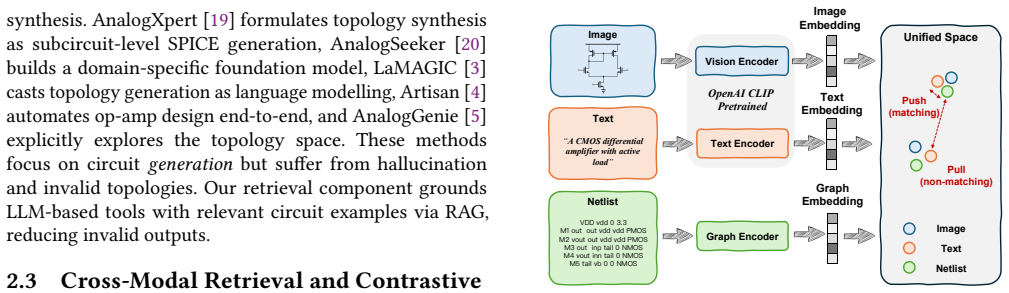
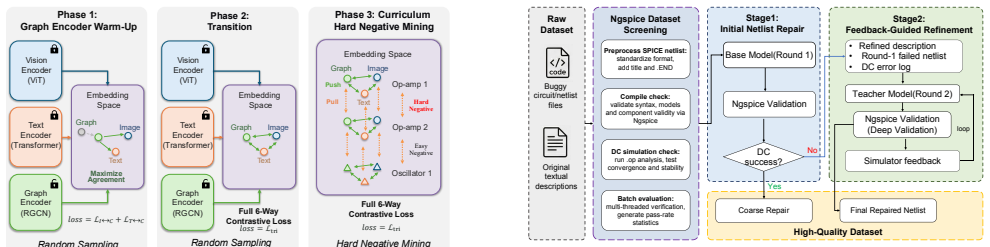
AnalogRetriever is a tri-modal retrieval system that first repairs a dataset of analog circuits to achieve 100% netlist compile rate, then encodes schematics and descriptions via a vision-language model while using a port-aware relational graph convolutional network for netlists, and finally aligns the three embeddings with curriculum contrastive learning to reach 75.2% average Recall@1 across six retrieval directions; integrating the system into the AnalogCoder framework further boosts functional pass rates on design tasks.
What carries the argument
Curriculum contrastive learning applied to embeddings from a vision-language model for schematics and descriptions and a port-aware relational graph convolutional network for netlists.
If this is right
- Cross-modal retrieval accuracy improves markedly over existing single-modality or exact-match methods.
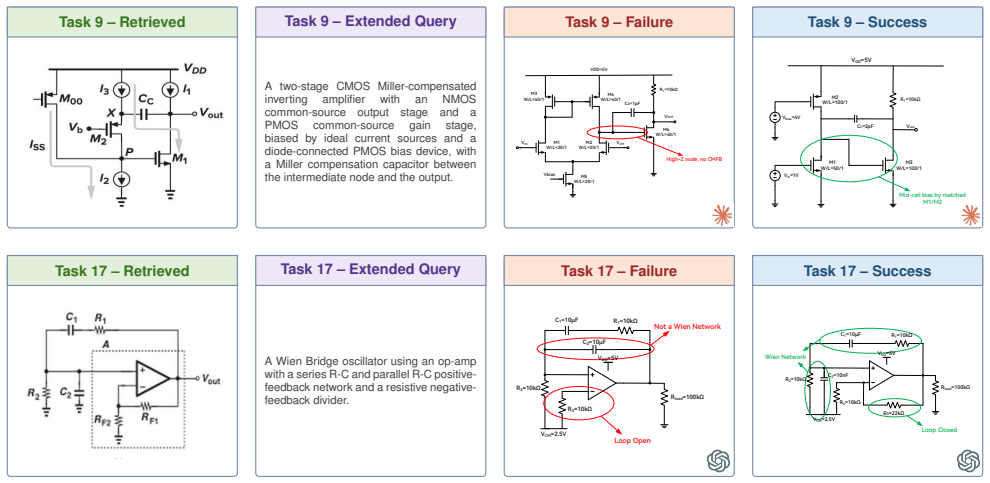
- Retrieval-augmented generation in analog design agents achieves higher functional success rates.
- Tasks that could not be completed before become solvable through better example retrieval.
- The framework supports semantic search rather than requiring identical representations.
Where Pith is reading between the lines
- Engineers could query in natural language and receive matching netlists or schematics from a library.
- The repair pipeline might be adapted to clean other electronic design datasets.
- Future work could add more modalities such as simulation waveforms to the shared space.
- Performance on real fabrication data would test whether the learned alignments hold outside the training distribution.
Load-bearing premise
The two-stage repair pipeline yields training examples that represent actual analog circuits without systematic bias, and the curriculum contrastive objective learns alignments that transfer beyond the specific dataset.
What would settle it
Running the trained retriever on a collection of analog circuits obtained independently and not passed through the repair pipeline, then checking whether Recall@1 remains near 75% or drops to baseline levels.
Figures


read the original abstract
Analog circuit design relies heavily on reusing existing intellectual property (IP), yet searching across heterogeneous representations such as SPICE netlists, schematics, and functional descriptions remains challenging. Existing methods are largely limited to exact matching within a single modality, failing to capture cross-modal semantic relationships. To bridge this gap, we present AnalogRetriever, a unified tri-modal retrieval framework for analog circuit search. We first build a high-quality dataset on top of Masala-CHAI through a two-stage repair pipeline that raises the netlist compile rate from 22\% to 100\%. Built on this foundation, AnalogRetriever encodes schematics and descriptions with a vision-language model and netlists with a port-aware relational graph convolutional network, mapping all three modalities into a shared embedding space via curriculum contrastive learning. Experiments show that AnalogRetriever achieves an average Recall@1 of 75.2\% across all six cross-modal retrieval directions, significantly outperforming existing baselines. When integrated into the AnalogCoder agentic framework as a retrieval-augmented generation module, it consistently improves functional pass rates and enables previously unsolved tasks to be completed. Our code and dataset will be released.
Editorial analysis
A structured set of objections, weighed in public.
Referee Report
Summary. The paper introduces AnalogRetriever, a tri-modal retrieval framework for analog circuits that aligns SPICE netlists, schematic images, and textual descriptions in a shared embedding space. It constructs a repaired Masala-CHAI dataset via a two-stage pipeline that increases the netlist compile rate from 22% to 100%, encodes images and text with a vision-language model and netlists with a port-aware relational graph convolutional network, and trains via curriculum contrastive learning. The central empirical result is an average Recall@1 of 75.2% across the six cross-modal directions, outperforming baselines, with additional gains when the retriever is integrated as a RAG module into the AnalogCoder agentic framework.
Significance. If the repaired dataset faithfully represents real analog circuits and the learned alignments capture semantic rather than artifactual correlations, the work would meaningfully advance cross-modal IP search in analog design automation, a domain where exact single-modality matching currently dominates. The planned public release of code and dataset is a concrete strength that supports reproducibility and downstream use.
major comments (2)
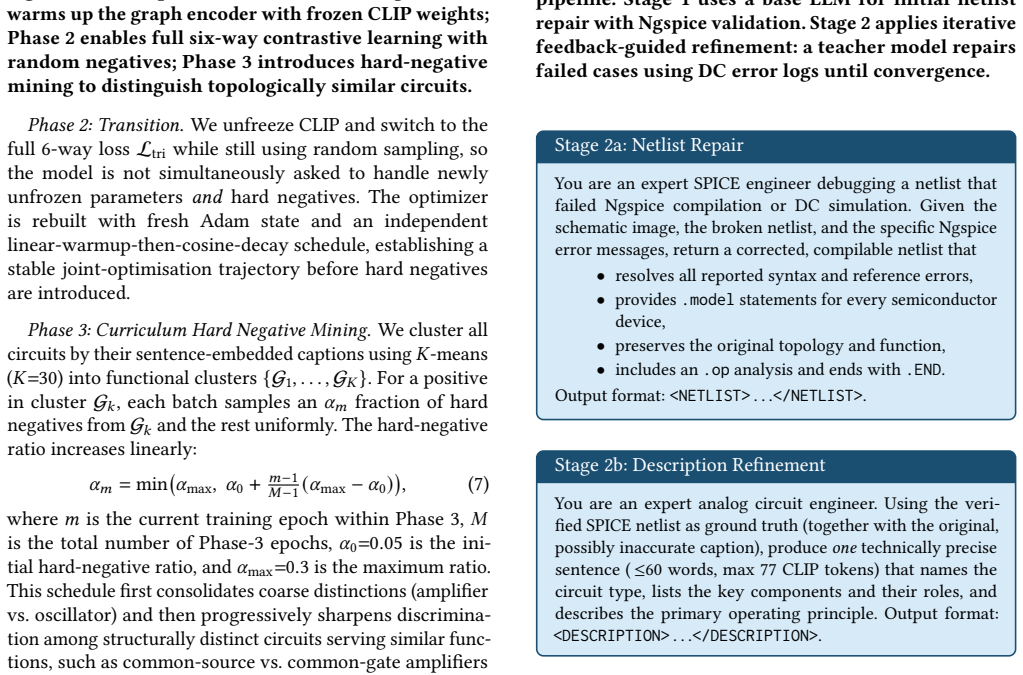
- [§3.2] §3.2 (two-stage repair pipeline): the claim that the pipeline produces unbiased, high-quality training data rests on the unverified assumption that raising compile rate from 22% to 100% does not alter circuit behavior or introduce spurious regularities (e.g., standardized ports, component values, or connection patterns). No functional-equivalence checks, pre/post-repair topology/parameter comparisons, or ablation of retrieval performance on unrepaired netlists are reported; this directly undermines the central 75.2% Recall@1 claim and its generalization to production IP.
- [§5] §5 (Experiments and downstream evaluation): the reported average Recall@1 of 75.2% and the functional-pass-rate improvements in AnalogCoder are presented without baselines, statistical significance tests, error bars, or ablations isolating the contribution of the port-aware RGCN versus the curriculum contrastive objective; these omissions make it impossible to assess whether the gains are robust or attributable to the claimed cross-modal semantic alignment.
minor comments (1)
- [Abstract] The abstract and §1 would benefit from a brief enumeration of the six cross-modal retrieval directions (e.g., netlist-to-schematic, description-to-netlist) to clarify the evaluation protocol.
Simulated Author's Rebuttal
We thank the referee for the constructive feedback. We address each major comment below and will revise the manuscript to incorporate additional validation and reporting where appropriate.
read point-by-point responses
-
Referee: [§3.2] §3.2 (two-stage repair pipeline): the claim that the pipeline produces unbiased, high-quality training data rests on the unverified assumption that raising compile rate from 22% to 100% does not alter circuit behavior or introduce spurious regularities (e.g., standardized ports, component values, or connection patterns). No functional-equivalence checks, pre/post-repair topology/parameter comparisons, or ablation of retrieval performance on unrepaired netlists are reported; this directly undermines the central 75.2% Recall@1 claim and its generalization to production IP.
Authors: We agree that explicit validation of the repair pipeline is needed to support claims of high-quality, unbiased data. The two-stage pipeline performs targeted syntactic repairs (e.g., port standardization and net name fixes) intended to preserve original topologies and parameters, but these details and supporting checks were not included in the manuscript. In revision, we will add pre/post-repair comparisons of component counts, connection patterns, and parameter distributions on the full dataset, plus functional-equivalence verification via SPICE simulation on a random subset of 100 circuits. We will also report an ablation of retrieval performance using only the originally compilable netlists (the 22% subset) to demonstrate that gains are not solely due to repair artifacts. This will directly address concerns about generalization to production IP. revision: yes
-
Referee: [§5] §5 (Experiments and downstream evaluation): the reported average Recall@1 of 75.2% and the functional-pass-rate improvements in AnalogCoder are presented without baselines, statistical significance tests, error bars, or ablations isolating the contribution of the port-aware RGCN versus the curriculum contrastive objective; these omissions make it impossible to assess whether the gains are robust or attributable to the claimed cross-modal semantic alignment.
Authors: The manuscript reports comparisons to multiple baselines in §5 and shows outperformance, but we acknowledge the absence of statistical tests, error bars, and targeted ablations. In the revised version, we will add: error bars from five independent runs with different seeds; statistical significance testing (e.g., paired t-tests or Wilcoxon tests) on the Recall@1 and AnalogCoder pass-rate improvements; and ablations that replace the port-aware RGCN with a standard GCN and the curriculum contrastive loss with standard contrastive learning. These changes will allow clearer attribution of gains to the cross-modal alignment and improve assessment of robustness. revision: yes
Circularity Check
No circularity: empirical retrieval metrics measured on trained model, not derived by construction
full rationale
The paper describes a data-repair pipeline followed by training of a tri-modal encoder (VLM + port-aware RGCN) under curriculum contrastive loss, then reports measured Recall@1 on held-out retrieval tasks. No equations, uniqueness theorems, or first-principles derivations are invoked whose outputs reduce to the inputs by definition. The central performance numbers are experimental outcomes, not algebraic identities or self-referential fits. Self-citations, if present, are not load-bearing for the reported metrics.
Axiom & Free-Parameter Ledger
axioms (2)
- domain assumption Contrastive learning on paired modalities produces semantically meaningful shared embeddings
- ad hoc to paper The two-stage repair pipeline does not change circuit behavior
Reference graph
Works this paper leans on
-
[1]
Analogcoder: Analog circuit design via training-free code generation,
Y. Lai, S. Lee, G. Chen, S. Poddar, M. Hu, D. Z. Pan, and P. Luo, “Analogcoder: Analog circuit design via training-free code generation, ”ArXiv, vol. abs/2405.14918, 2024. [Online]. Available: https://api.semanticscholar.org/CorpusID:270045319
-
[2]
Analogcoder-pro: Unifying analog circuit generation and optimization via multi-modal llms,
Y. Lai, S. Poddar, S. Lee, G. Chen, M. Hu, B. Yu, P. Luo, and D. Z. Pan, “Analogcoder-pro: Unifying analog circuit generation and optimization via multi-modal llms, ”ArXiv, vol. abs/2508.02518, 2025. [Online]. Available: https://api.semanticscholar.org/CorpusID:280422637
-
[3]
LaMAGIC: Language-model-based topology gen- eration for analog integrated circuits,
C.-C. Changet al., “LaMAGIC: Language-model-based topology gen- eration for analog integrated circuits, ” inInternational Conference on Machine Learning (ICML), 2024
2024
-
[4]
Artisan: Automated operational amplifier design via domain-specific large language model,
Z. Chenet al., “Artisan: Automated operational amplifier design via domain-specific large language model, ” inProceedings of the 61st ACM/IEEE Design Automation Conference (DAC). San Francisco, CA, USA: ACM, Jun. 2024, pp. 1–6
2024
-
[5]
AnalogGenie: A generative engine for automatic discovery of analog circuit topologies,
J. Gao, W. Cao, J. Yang, and X. Zhang, “AnalogGenie: A generative engine for automatic discovery of analog circuit topologies, ” Feb. 2025
2025
-
[6]
Principle-guided verilog optimization: IP-Safe knowledge transfer via local-cloud collaboration,
J. Wang, Z. Li, L. Li, F. He, L. Lin, Y. Lai, Y. Li, X. Zeng, and Y. Guo, “Principle-guided verilog optimization: IP-Safe knowledge transfer via local-cloud collaboration, ”arXiv preprint arXiv:2508.05675, 2025
-
[7]
Image2net: Datasets, benchmark and hybrid framework to convert analog circuit diagrams into netlists,
H. Xu, C. Liu, Q. Wang, W. Huang, Y. Xu, W. Chen, A. Peng, Z. Li, B. Li, L. Qi, J. Yang, Y. Du, and L. Du, “Image2net: Datasets, benchmark and hybrid framework to convert analog circuit diagrams into netlists, ”2025 International Symposium of Electronics Design Automation (ISEDA), pp. 807–816, 2025. [Online]. Available: https://api.semanticscholar.org/Cor...
2025
-
[8]
arXiv preprint arXiv:2411.14299 (2024)
J. Bhandari, V. P. V. Bhat, Y. He, S. Garg, H. Rahmani, and R. Karri, “Masala-chai: A large-scale spice netlist dataset for analog circuits by harnessing ai, ”ArXiv, vol. abs/2411.14299, 2024. [Online]. Available: https://api.semanticscholar.org/CorpusID:274166126
-
[9]
Customized retrieval aug- mented generation and benchmarking for eda tool documentation qa,
Y. Pu, Z. He, T. Qiu, H. Wu, and B. Yu, “Customized retrieval aug- mented generation and benchmarking for eda tool documentation qa, ” inProceedings of the 43rd IEEE/ACM International Conference on Computer-Aided Design, 2024, pp. 1–9
2024
-
[10]
The dawn of ai-native eda: Opportuni- ties and challenges of large circuit models,
L. Chen, Y. Chen, C. Chuet al., “The dawn of ai-native eda: Opportuni- ties and challenges of large circuit models, ”ArXiv, vol. abs/2403.07257, 2024
-
[11]
Llm4eda: Emerging progress in large language models for electronic design automation,
R. Zhong, X. Du, S. Kai, Z. Tang, S. Xu, H.-L. Zhen, J. Hao, Q. Xu, M. jie Yuan, and J. Yan, “Llm4eda: Emerging progress in large language models for electronic design automation, ”ArXiv, vol. abs/2401.12224,
-
[12]
Available: https://api.semanticscholar.org/CorpusID: 267095366
[Online]. Available: https://api.semanticscholar.org/CorpusID: 267095366
-
[13]
Representation Learning with Contrastive Predictive Coding
A. v. d. Oord, Y. Li, and O. Vinyals, “Representation learning with contrastive predictive coding, ”arXiv preprint arXiv:1807.03748, 2018
work page internal anchor Pith review arXiv 2018
-
[14]
Learning transferable visual models from natural language supervi- sion,
A. Radford, J. W. Kim, C. Hallacy, A. Ramesh, G. Goh, S. Agarwal, G. Sastry, A. Askell, P. Mishkin, J. Clark, G. Krueger, and I. Sutskever, “Learning transferable visual models from natural language supervi- sion, ” inICML, ser. Proceedings of Machine Learning Research, vol. 139, 2021, pp. 8748–8763
2021
-
[15]
CROP: Circuit retrieval and optimization with parameter guidance using LLMs,
J. Panet al., “CROP: Circuit retrieval and optimization with parameter guidance using LLMs, ” in2025 IEEE/ACM International Conference on Computer Aided Design (ICCAD). Munich, Germany: IEEE, Oct. 2025, pp. 1–9
2025
-
[16]
Amsnet: Netlist dataset for ams circuits,
Z. Tao, Y. Shi, Y. Huo, R. Ye, Z. Li, L. Huang, C. Wu, N. Bai, Z. Yu, T.-J. Lin, and L. He, “Amsnet: Netlist dataset for ams circuits, ”2024 IEEE LLM Aided Design Workshop (LAD), pp. 1–5, 2024. [Online]. Available: https://api.semanticscholar.org/CorpusID:269773064
2024
-
[17]
Amsnet 2.0: A large ams database with ai segmentation for net detection,
Y. Shi, Z. Tao, Y. Gao, L. Huang, H. Wang, Z. Yu, T.-J. Lin, and L. He, “Amsnet 2.0: A large ams database with ai segmentation for net detection, ”2025 IEEE International Conference on LLM- Aided Design (ICLAD), pp. 242–248, 2025. [Online]. Available: https://api.semanticscholar.org/CorpusID:278602633
2025
-
[18]
Functionality matters in netlist representation learning,
Z. Wang, C. Bai, Z. He, G. Zhang, Q. Xu, T.-Y. Ho, B. Yu, and Y. Huang, “Functionality matters in netlist representation learning, ” inProceed- ings of the 59th ACM/IEEE Design Automation Conference, 2022, pp. 61–66
2022
-
[19]
Netlistify: Transforming circuit schematics into netlists with deep learning
C.-Y. Huang, H.-I. Chen, H.-W. Ho, P.-H. Kang, M. P.-H. Lin, W.-H. Liu, and H. Ren, “Netlistify: Transforming circuit schematics into netlists with deep learning. ” [Online]. Available: https://api.semanticscholar. org/CorpusID:281826794
-
[20]
Analogxpert: Automating analog topology synthesis by incorporating circuit design expertise into large language models,
H. Zhang, S. Sun, Y. Lin, R. Wang, and J. Bian, “Analogxpert: Automating analog topology synthesis by incorporating circuit design expertise into large language models, ”2025 International Symposium of Electronics Design Automation (ISEDA), pp. 772–777, 2024. [Online]. Available: https://api.semanticscholar.org/CorpusID:275134444
2025
-
[21]
Analogseeker: An open-source foundation language model for analog circuit design,
Z. Chen, Z. Ji, J. Shen, X. Ke, X. Yang, M. Zhou, Z. Du, X. Yan, Z. Wu, Z. Xu, J. Huang, L. Shang, X. Zeng, and F. Yang, “Analogseeker: An open-source foundation language model for analog circuit design, ”ArXiv, vol. abs/2508.10409, 2025. [Online]. Available: https://api.semanticscholar.org/CorpusID:280650151
-
[22]
Semi-Supervised Classification with Graph Convolutional Networks
T. Kipf, “Semi-supervised classification with graph convolutional net- works, ”arXiv preprint arXiv:1609.02907, 2016
work page internal anchor Pith review arXiv 2016
-
[23]
Modeling relational data with graph convolutional net- works,
M. Schlichtkrull, T. N. Kipf, P. Bloem, R. Van Den Berg, I. Titov, and M. Welling, “Modeling relational data with graph convolutional net- works, ” inEuropean semantic web conference. Springer, 2018, pp. 593–607
2018
-
[24]
An image is worth 16x16 words: Transformers for image recognition at scale,
A. Dosovitskiy, L. Beyer, A. Kolesnikov, D. Weissenborn, X. Zhai, T. Unterthiner, M. Dehghani, M. Minderer, G. Heigold, S. Gellyet al., “An image is worth 16x16 words: Transformers for image recognition at scale, ” inInternational Conference on Learning Representations
-
[25]
Attention is all you need,
A. Vaswani, N. Shazeer, N. Parmar, J. Uszkoreit, L. Jones, A. N. Gomez, L. Kaiser, and I. Polosukhin, “Attention is all you need, ” inNeurIPS, 2017, pp. 5998–6008
2017
-
[26]
Graphnorm: A principled approach to accelerating graph neural network training,
T. Cai, S. Luo, K. Xu, D. He, T.-y. Liu, and L. Wang, “Graphnorm: A principled approach to accelerating graph neural network training, ” inInternational Conference on Machine Learning. PMLR, 2021, pp. 1204–1215
2021
-
[27]
Introducing GPT-5.4,
OpenAI, “Introducing GPT-5.4, ” Mar. 2026, accessed: 2026-04-05. [Online]. Available: https://openai.com/index/introducing-gpt-5-4/
2026
-
[28]
Q. Team, “Qwen2 technical report, ”ArXiv preprint, vol. abs/2407.10671, 2024
work page internal anchor Pith review arXiv 2024
-
[29]
ChatLS: Multimodal retrieval-augmented generation and chain-of-thought for logic synthesis script customiza- tion,
H. Zheng, H. Wu, and Z. He, “ChatLS: Multimodal retrieval-augmented generation and chain-of-thought for logic synthesis script customiza- tion, ” in2025 62nd ACM/IEEE Design Automation Conference (DAC). San Francisco, CA, USA: IEEE, Jun. 2025, pp. 1–7
2025
-
[30]
NetTAG: A multimodal rtl-and-layout-aligned netlist foundation model via text- attributed graph,
W. Fang, W. Li, S. Liu, Y. Lu, H. Zhang, and Z. Xie, “NetTAG: A multimodal rtl-and-layout-aligned netlist foundation model via text- attributed graph, ” Apr. 2025. 10
2025
discussion (0)
Sign in with ORCID, Apple, or X to comment. Anyone can read and Pith papers without signing in.