Recognition: unknown
The functional form of galaxy and halo luminosity and mass functions
Pith reviewed 2026-05-08 07:30 UTC · model grok-4.3
The pith
Symbolic regression discovers functional forms for galaxy luminosity, stellar mass, and halo mass functions that outperform Schechter and Press-Schechter parametrizations.
A machine-rendered reading of the paper's core claim, the machinery that carries it, and where it could break.
Core claim
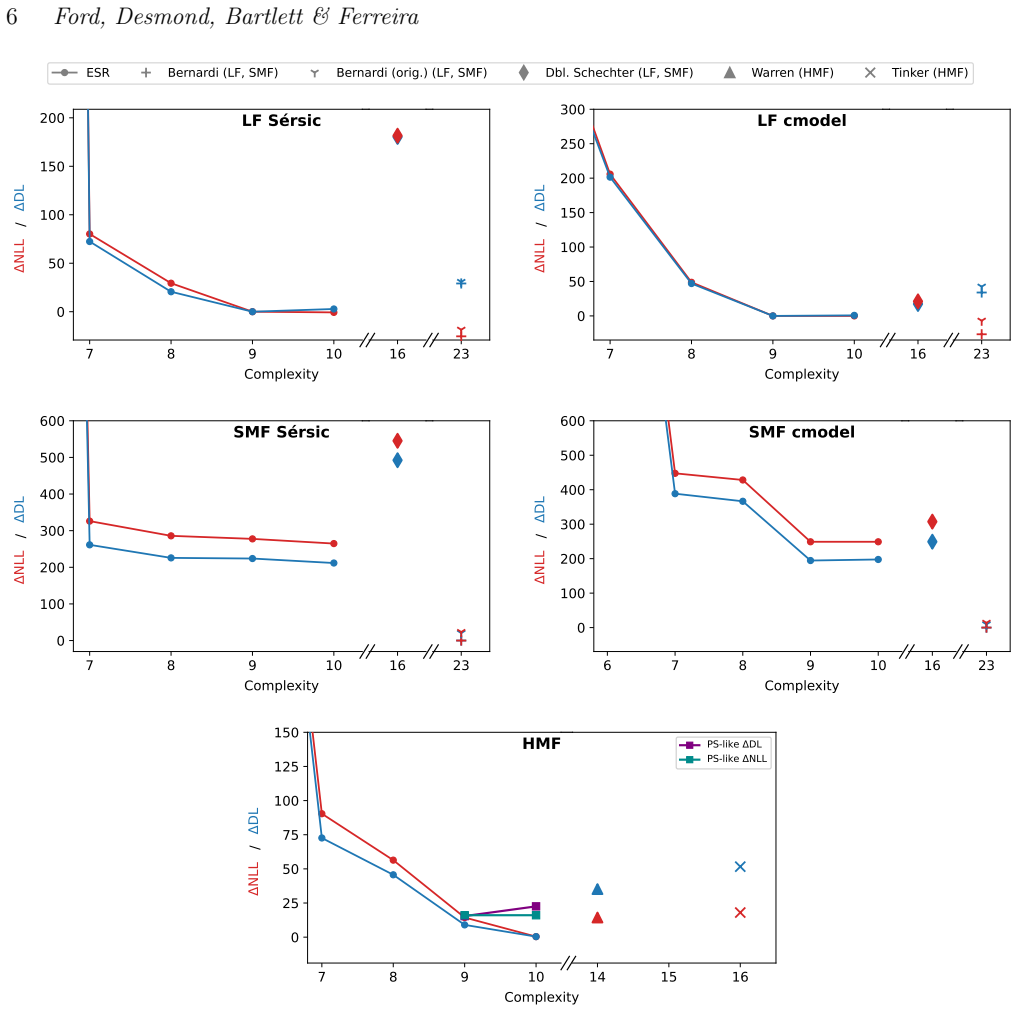
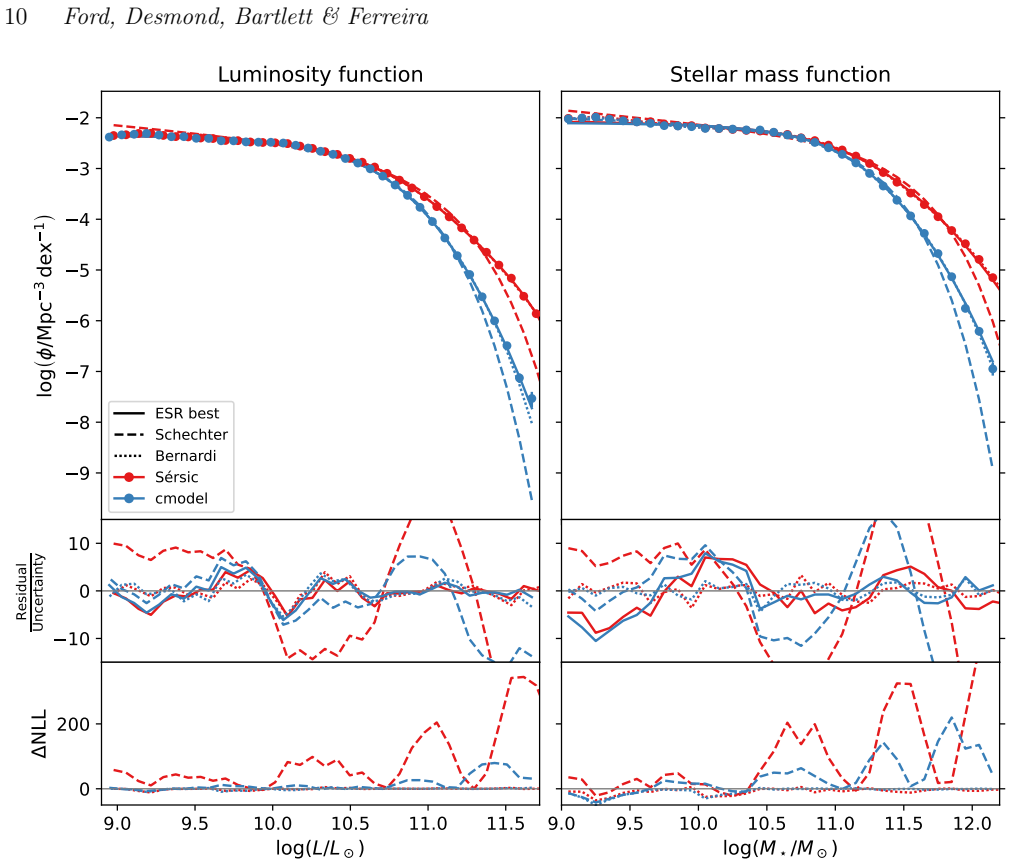
Exhaustive symbolic regression combined with description-length scoring and physicality constraints on extrapolation and integration yields optimal, low-complexity functional forms for the luminosity function, stellar mass function, and halo mass function that achieve higher accuracy than the conventional Schechter and Press-Schechter families while remaining simple and physically well-behaved outside the data range.
What carries the argument
The Exhaustive Symbolic Regression (ESR) algorithm, which enumerates all expressions up to a chosen complexity from a user-specified basis of operators and ranks them by description length.
Load-bearing premise
The description length score is a reliable proxy for Bayesian evidence and the user-chosen basis of operators is rich enough to contain the true underlying functional form.
What would settle it
New, higher-precision luminosity-function or halo-mass-function measurements from an independent survey or simulation that are fit substantially worse by the ESR-selected functions than by the Schechter or Press-Schechter forms would falsify the claim of superior performance.
Figures



read the original abstract
The galaxy luminosity and stellar mass function (LF, SMF), and halo mass function (HMF), are fundamental quantities in astrophysics and crucial inputs to a range of astrophysical and cosmological analyses. They are typically parametrised by fitting functions that have been chosen "by eye" to match observed or simulated data. We apply symbolic regression -- specifically the Exhaustive Symbolic Regression (ESR) algorithm -- to automate the search for optimal LF, SMF and HMF functional forms. ESR scores all functions up to a maximum complexity composed of a user-defined basis set of operators using the description length, an approximation to the Bayesian evidence that balances accuracy with complexity. We find many functions outperforming the Schechter and double Schechter functions for the LF and SMF, and that outperform the Press--Schechter and Warren/Tinker functions for the HMF. By additionally imposing "physicality checks" on functions' extrapolation and integration properties, we identify the optimal, low-complexity functional forms in terms of accuracy, simplicity and behaviour beyond the data range. As well as providing drop-in replacements for literature LF, SMF and HMF fitting functions, and identifying robust behaviour across well-fitting functions, we present a framework with which symbolic regression may be used to automate the discovery of optimal functions for any astrophysical dataset.
Editorial analysis
A structured set of objections, weighed in public.
Referee Report
Summary. The manuscript applies Exhaustive Symbolic Regression (ESR) to automate the discovery of functional forms for galaxy luminosity functions (LF), stellar mass functions (SMF), and halo mass functions (HMF). Using description length to score candidate expressions built from a user-defined operator basis, the authors identify multiple forms that outperform the Schechter/double-Schechter parametrizations for LF/SMF and the Press-Schechter/Warren-Tinker forms for HMF. Additional post-search physicality checks on extrapolation and integration properties are used to select optimal low-complexity expressions, and the work is framed as a general methodology for data-driven function discovery in astrophysics.
Significance. If the underlying assumptions hold, the results would supply improved, data-driven fitting functions for three cornerstone distributions in galaxy formation and cosmology, with better accuracy, lower complexity, and improved behavior outside the fitted range. The approach also demonstrates a reproducible framework that could replace ad-hoc functional choices in future analyses. The use of description length for explicit accuracy-complexity trade-off and the imposition of physical constraints are positive methodological features.
major comments (3)
- [§2] §2 (ESR algorithm and description-length scoring): The central claim that ESR identifies outperforming functions rests on the description length being an unbiased proxy for Bayesian evidence, yet no synthetic recovery tests are reported in which known true forms are injected into mock data to verify correct ranking and recovery.
- [§3] §3 (operator basis and search results): The user-specified operator basis is fixed a priori, but the manuscript provides no completeness tests (e.g., expanding the basis and re-running the search) to show that superior expressions are not systematically excluded; this directly affects the assertion that the reported forms are optimal.
- [§4] §4 (physicality checks): The extrapolation and integration checks are applied only after the description-length ranking, so they cannot mitigate potential bias in the scoring metric or incompleteness of the searched function space; the final selection of “optimal” forms therefore inherits any upstream ranking deficiencies.
minor comments (3)
- The abstract states that “many functions” outperform the literature forms; a quantitative summary (e.g., number of functions passing a given threshold) should appear early in the introduction or results for clarity.
- [Figures 2-5] Figure captions and table footnotes should explicitly list the observational or simulation datasets (including redshift ranges) used for each fit to aid reproducibility.
- [Tables 1-3] Notation for the free parameters in the newly discovered functional forms could be standardized across tables to avoid ambiguity when the expressions are adopted by other authors.
Simulated Author's Rebuttal
We thank the referee for their constructive and detailed comments. We respond to each major comment below and indicate the revisions we will make to strengthen the manuscript.
read point-by-point responses
-
Referee: [§2] §2 (ESR algorithm and description-length scoring): The central claim that ESR identifies outperforming functions rests on the description length being an unbiased proxy for Bayesian evidence, yet no synthetic recovery tests are reported in which known true forms are injected into mock data to verify correct ranking and recovery.
Authors: We agree that explicit synthetic recovery tests would strengthen the validation of the ESR approach in this specific application. Although the description-length criterion has been tested in earlier ESR work, we will add a dedicated subsection to §2 that generates mock datasets from known Schechter, double-Schechter, Press–Schechter and Warren–Tinker forms (with realistic noise levels matching the real data), applies the full ESR pipeline, and reports the recovery rate and ranking accuracy of the true forms among the low-complexity candidates. revision: yes
-
Referee: [§3] §3 (operator basis and search results): The user-specified operator basis is fixed a priori, but the manuscript provides no completeness tests (e.g., expanding the basis and re-running the search) to show that superior expressions are not systematically excluded; this directly affects the assertion that the reported forms are optimal.
Authors: The operator basis was chosen to encompass the standard arithmetic, power and logarithmic operations that appear in established astrophysical fitting functions. We acknowledge the absence of explicit completeness tests. In the revision we will add a limited completeness check: we augment the basis with a small number of additional operators (e.g., exp, sin) and re-run ESR on a representative subset of the data; the results will be reported to confirm that no substantially better low-complexity expressions emerge. revision: partial
-
Referee: [§4] §4 (physicality checks): The extrapolation and integration checks are applied only after the description-length ranking, so they cannot mitigate potential bias in the scoring metric or incompleteness of the searched function space; the final selection of “optimal” forms therefore inherits any upstream ranking deficiencies.
Authors: We will revise the text in §4 to make explicit that description length supplies the primary ranking while the physicality checks serve as a post-hoc filter that selects, from the top-ranked expressions, those that satisfy the required extrapolation and integration properties. This two-stage procedure is intentional: the checks guarantee that the final recommended functions remain usable beyond the fitted range, which is a key requirement for the applications we target. We note that embedding the physical constraints inside the search itself would constitute a non-trivial methodological extension and lies outside the present scope. revision: partial
Circularity Check
Minor self-citation for ESR method; central results remain data-driven and independent
full rationale
The paper applies ESR symbolic regression with description-length scoring directly to external LF/SMF/HMF datasets, then ranks functions and applies post-hoc physicality checks. No step reduces a claimed prediction to a fitted input by construction, no self-definitional loop appears in the functional forms, and no uniqueness theorem or ansatz is smuggled via self-citation. The sole potential circularity is a likely self-citation to the ESR algorithm itself, but this is not load-bearing for the specific astrophysical results, which are externally falsifiable against the data. The derivation is therefore self-contained against benchmarks.
Axiom & Free-Parameter Ledger
Forward citations
Cited by 1 Pith paper
-
Exhaustive Symbolic Integration: Integration by Differentiation and the Landscape of Symbolic Integrability
Exhaustive enumeration of functions up to complexity k across operator bases shows the integrability fraction declines with k but rises sharply with logarithms, and the method discovers three integrals that resist Sym...
Reference graph
Works this paper leans on
-
[1]
Allen S. W., Evrard A. E., Mantz A. B., 2011, @doi [ ] 10.1146/annurev-astro-081710-102514 , 49, 409
-
[2]
2012, MNRAS, 423, 600, doi: 10.1111/j.1365-2966.2012.20901.x
Baldry I. K., et al., 2012, @doi [ ] 10.1111/j.1365-2966.2012.20340.x , 421, 621
-
[3]
Bartlett D. J., Desmond H., Ferreira P. G., 2022, @doi [IEEE Transactions on Evolutionary Computation] 10.1109/TEVC.2023.3280250
-
[4]
Bartlett D. J., Desmond H., Ferreira P. G., 2023a, in The Genetic and Evolutionary Computation Conference 2023 . ( @eprint arXiv 2304.06333 ), @doi 10.1145/3583133.3596327
-
[5]
Bartlett D. J., Desmond H., Ferreira P. G., 2023b, @doi [arXiv e-prints] 10.48550/arXiv.2304.06333 , https://ui.adsabs.harvard.edu/abs/2023arXiv230406333B p. arXiv:2304.06333
-
[7]
Behroozi P. S., Wechsler R. H., Conroy C., 2013b, @doi [ ] 10.1088/0004-637X/770/1/57 , 770, 57
-
[8]
Bell E. F., McIntosh D. H., Katz N., Weinberg M. D., 2003, @doi [ ] 10.1086/378847 , 149, 289
-
[9]
Benson A. J., Bower R. G., Frenk C. S., Lacey C. G., Baugh C. M., Cole S., 2003, @doi [ ] 10.1086/379160 , 599, 38
-
[10]
Bernardi M., Meert A., Sheth R. K., Vikram V., Huertas-Company M., Mei S., Shankar F., 2013, @doi [ ] 10.1093/mnras/stt1607 , https://ui.adsabs.harvard.edu/abs/2013MNRAS.436..697B 436, 697
-
[11]
Bernardi M., Fischer J.-L., Sheth R. K., Meert A., Huertas-Company M., Shankar F., Vikram V., 2017, @doi [ ] 10.1093/mnras/stx275 , 468, 2569
-
[12]
139, Proceedings of the 38th International Conference on Machine Learning
Biggio L., Bendinelli T., Neitz A., Lucchi A., Parascandolo G., 2021, in Meila M., Zhang T., eds, Proceedings of Machine Learning Research Vol. 139, Proceedings of the 38th International Conference on Machine Learning. PMLR, pp 936--945, https://proceedings.mlr.press/v139/biggio21a.html
2021
-
[13]
Blanton M. R., Roweis S., 2007, @doi [ ] 10.1086/510127 , 133, 734
-
[14]
Blanton M. R., et al., 2003, @doi [ ] 10.1086/375776 , https://ui.adsabs.harvard.edu/abs/2003ApJ...592..819B 592, 819
-
[15]
2011, AJ, 142, 31, doi: 10.1088/0004-6256/142/1/31
Blanton M. R., Kazin E., Muna D., Weaver B. A., Price-Whelan A., 2011, @doi [ ] 10.1088/0004-6256/142/1/31 , 142, 31
-
[16]
Bower R. G., Benson A. J., Malbon R., Helly J. C., Frenk C. S., Baugh C. M., Cole S., Lacey C. G., 2006, @doi [ ] 10.1111/j.1365-2966.2006.10519.x , 370, 645
-
[17]
The convergence of a class of double-rank minimization algorithms 1
Broyden C. G., 1970, @doi [IMA Journal of Applied Mathematics] 10.1093/imamat/6.1.76 , 6, 76
-
[18]
Burlacu B., Kronberger G., Kommenda M., 2020, in Proceedings of the 2020 Genetic and Evolutionary Computation Conference Companion. GECCO '20. Association for Computing Machinery, New York, NY, USA, p. 1562–1570, @doi 10.1145/3377929.3398099 , https://doi.org/10.1145/3377929.3398099
-
[19]
Conroy C., Gunn J. E., White M., 2009, @doi [ ] 10.1088/0004-637X/699/1/486 , 699, 486
work page internal anchor Pith review doi:10.1088/0004-637x/699/1/486 2009
-
[20]
Cooray A., Sheth R., 2002, @doi [ ] 10.1016/S0370-1573(02)00276-4 , https://ui.adsabs.harvard.edu/abs/2002PhR...372....1C 372, 1
-
[21]
Cranmer M., 2020, PySR: Fast & Parallelized Symbolic Regression in Python/Julia, @doi 10.5281/zenodo.4041459 , http://doi.org/10.5281/zenodo.4041459
-
[22]
Croton D. J., et al., 2006, @doi [ ] 10.1111/j.1365-2966.2005.09675.x , 365, 11
-
[23]
Addison-Wesley
David E., 1989, Genetic Algorithms in Search, Optimization and Machine Learning. Addison-Wesley
1989
-
[24]
Davis M., Efstathiou G., Frenk C. S., White S. D. M., 1985, @doi [ ] 10.1086/163168 , https://ui.adsabs.harvard.edu/abs/1985ApJ...292..371D 292, 371
-
[25]
Desmond H., 2025, @doi [arXiv e-prints] 10.48550/arXiv.2507.13033 , https://ui.adsabs.harvard.edu/abs/2025arXiv250713033D p. arXiv:2507.13033
-
[26]
Desmond H., Bartlett D. J., Ferreira P. G., 2023, arXiv e-prints, https://ui.adsabs.harvard.edu/abs/2023arXiv230104368D p. arXiv:2301.04368
-
[27]
Despali G., Giocoli C., Angulo R. E., Tormen G., Sheth R. K., Baso G., Moscardini L., 2016, @doi [ ] 10.1093/mnras/stv2842 , 456, 2486
-
[28]
2012, MNRAS, 423, 600, doi: 10.1111/j.1365-2966.2012.20901.x
Driver S. P., Robotham A. S. G., Kelvin L., Alpaslan M., Baldry I. K., et al., 2012, @doi [ ] 10.1111/j.1365-2966.2012.22036.x , 427, 3244
-
[29]
Eckert K. D., Kannappan S. J., Stark D. V., Moffett A. J., Berlind A. A., Norris M. A., 2016, @doi [ ] 10.3847/0004-637X/824/2/124 , https://ui.adsabs.harvard.edu/abs/2016ApJ...824..124E 824, 124
-
[30]
Euclid Collaboration Mellier Y., et al., 2025, @doi [ ] 10.1051/0004-6361/202450810 , 697, A1
-
[31]
Fischer J.-L., Bernardi M., Meert A., 2017, @doi [ ] 10.1093/mnras/stx138 , 467, 490
-
[32]
Fletcher R., 1970, @doi [The Computer Journal] 10.1093/comjnl/13.3.317 , 13, 317
-
[33]
MIT Press
Grunwald P., 2007, The Minimum Description Length Principle. MIT Press
2007
-
[34]
Gr \"u nwald P., Roos T., 2019, arXiv e-prints, https://ui.adsabs.harvard.edu/abs/2019arXiv190808484G p. arXiv:1908.08484
-
[35]
Haupt R., Haupt S., 2004, Practical genetic algorithms, 2nd edn. Wyley
2004
-
[36]
Henriques B. M. B., White S. D. M., Thomas P. A., Angulo R., Guo Q., Lemson G., Springel V., Overzier R., 2015, @doi [ ] 10.1093/mnras/stv705 , 451, 2663
-
[37]
Ivezi \' c Z ., Kahn S. M., Tyson J. A., et al., 2019, @doi [ ] 10.3847/1538-4357/ab042c , 873, 111
-
[38]
Jenkins A., Frenk C. S., White S. D. M., Colberg J. M., Cole S., Evrard A. E., Couchman H. M. P., Yoshida N., 2001, @doi [ ] 10.1046/j.1365-8711.2001.04029.x , 321, 372
-
[39]
arXiv preprint arXiv:1910.08892 , year=
Jin Y., Fu W., Kang J., Guo J., Guo J., 2019, @doi [arXiv e-prints] 10.48550/arXiv.1910.08892 , https://ui.adsabs.harvard.edu/abs/2019arXiv191008892J p. arXiv:1910.08892
-
[40]
Kelly B. C., Fan X., Vestergaard M., 2008, @doi [ ] 10.1086/589501 , https://ui.adsabs.harvard.edu/abs/2008ApJ...682..874K 682, 874
-
[41]
Kravtsov A. V., Vikhlinin A. A., Meshcheryakov A. V., 2018, @doi [Astronomy Letters] 10.1134/S1063773717120015 , 44, 8
-
[42]
M., Affenzeller M., 2024a, Symbolic Regression
Kronberger G., Burlacu B., Kommenda M., Winkler S. M., Affenzeller M., 2024a, Symbolic Regression. Genetic and Evolutionary Computation, Springer, @doi 10.1007/978-3-031-56957-0
-
[43]
, author Olivetti de Franca , F
Kronberger G., Olivetti de Franca F., Desmond H., Bartlett D. J., Kammerer L., 2024b, @doi [arXiv e-prints] 10.48550/arXiv.2404.17292 , https://ui.adsabs.harvard.edu/abs/2024arXiv240417292K p. arXiv:2404.17292
-
[44]
NIPS '22
Landajuela M., et al., 2022, in Proceedings of the 36th International Conference on Neural Information Processing Systems. NIPS '22. Curran Associates Inc., Red Hook, NY, USA
2022
-
[45]
Li Y., Smith R. E., 2024, @doi [arXiv e-prints] 10.48550/arXiv.2411.18722 , https://ui.adsabs.harvard.edu/abs/2024arXiv241118722L p. arXiv:2411.18722
-
[46]
Li P., Lelli F., McGaugh S., Pawlowski M. S., Zwaan M. A., Schombert J., 2019, @doi [ ] 10.3847/2041-8213/ab53e6 , https://ui.adsabs.harvard.edu/abs/2019ApJ...886L..11L 886, L11
-
[47]
Madau P., Dickinson M., 2014, @doi [ ] 10.1146/annurev-astro-081811-125615 , https://ui.adsabs.harvard.edu/abs/2014ARA&A..52..415M 52, 415
work page Pith review doi:10.1146/annurev-astro-081811-125615 2014
-
[48]
Martin D. C., et al., 2005, @doi [ ] 10.1086/426387 , 619, L1
-
[49]
Constraining dark matter halo profiles with symbolic regression
Mart \' n A., Yasin T., Bartlett D. J., Desmond H., Ferreira P. G., 2025, @doi [arXiv e-prints] 10.48550/arXiv.2511.23073 , https://ui.adsabs.harvard.edu/abs/2025arXiv251123073M p. arXiv:2511.23073
work page internal anchor Pith review Pith/arXiv arXiv doi:10.48550/arxiv.2511.23073 2025
-
[50]
Mart \' n A., Yasin T., Bartlett D. J., Desmond H., Ferreira P. G., 2026, @doi [arXiv e-prints] 10.48550/arXiv.2601.05203 , https://ui.adsabs.harvard.edu/abs/2026arXiv260105203M p. arXiv:2601.05203
-
[52]
Monthly Notices of the Royal Astronomical Society , volume =
Moster B. P., Naab T., White S. D. M., 2013b, @doi [ ] 10.1093/mnras/sts261 , 428, 3121
-
[53]
Murray S., 2014, HMF: Halo Mass Function calculator , Astrophysics Source Code Library, record ascl:1412.006 ( @eprint ascl 1412.006 )
2014
-
[54]
Astronomy and Computing , keywords =
Murray S. G., Power C., Robotham A. S. G., 2013, @doi [Astronomy and Computing] 10.1016/j.ascom.2013.11.001 , https://ui.adsabs.harvard.edu/abs/2013A&C.....3...23M 3, 23
-
[55]
Papastergis E., Cattaneo A., Huang S., Giovanelli R., Haynes M. P., 2012, @doi [ ] 10.1088/0004-637X/759/2/138 , https://ui.adsabs.harvard.edu/abs/2012ApJ...759..138P 759, 138
-
[56]
Peebles P. J. E., 1980, The large-scale structure of the universe
1980
-
[57]
K., Larma M
Petersen B. K., Larma M. L., Mundhenk T. N., Santiago C. P., Kim S. K., Kim J. T., 2021, in International Conference on Learning Representations. https://openreview.net/forum?id=m5Qsh0kBQG
2021
-
[58]
Pillepich A., et al., 2018, @doi [ ] 10.1093/mnras/stx2656 , 473, 4077
-
[59]
Planck Collaboration et al., 2020, @doi [ ] 10.1051/0004-6361/201833910 , https://ui.adsabs.harvard.edu/abs/2020A&A...641A...6P 641, A6
-
[60]
Ponomareva A. A., et al., 2023, @doi [Monthly Notices of the Royal Astronomical Society] 10.1093/mnras/stad1249 , 522, 5308
-
[61]
Press W. H., Schechter P., 1974, @doi [ ] 10.1086/152650 , https://ui.adsabs.harvard.edu/abs/1974ApJ...187..425P 187, 425
-
[62]
Rissanen J., 1978, @doi [Automatica] https://doi.org/10.1016/0005-1098(78)90005-5 , 14, 465
-
[63]
Rozo E., et al., 2010, @doi [ ] 10.1088/0004-637X/708/1/645 , 708, 645
-
[64]
Schaye J., et al., 2015, @doi [ ] 10.1093/mnras/stu2058 , 446, 521
-
[65]
Schechter P., 1976, @doi [ ] 10.1086/154079 , https://ui.adsabs.harvard.edu/abs/1976ApJ...203..297S 203, 297
-
[66]
Schmidt M., 1968, @doi [ ] 10.1086/149446 , 151, 393
-
[67]
Sheth R. K., Tormen G., 1999, @doi [ ] 10.1046/j.1365-8711.1999.02692.x , 308, 119
-
[68]
Bartlett, Harry Desmond, and Pedro G
Sousa T., Bartlett D. J., Desmond H., Ferreira P. G., 2023, @doi [arXiv e-prints] 10.48550/arXiv.2310.16786 , https://ui.adsabs.harvard.edu/abs/2023arXiv231016786S p. arXiv:2310.16786
-
[69]
Springel V., et al., 2008, @doi [ ] 10.1111/j.1365-2966.2008.14066.x , https://ui.adsabs.harvard.edu/abs/2008MNRAS.391.1685S 391, 1685
-
[70]
Tenachi W., Ibata R., Diakogiannis F. I., 2023, @doi [arXiv e-prints] 10.48550/arXiv.2303.03192 , https://ui.adsabs.harvard.edu/abs/2023arXiv230303192T p. arXiv:2303.03192
-
[71]
Toward a halo mass function for precision cosmology: the limits of universality
Tinker J., Kravtsov A. V., Klypin A., Abazajian K., Warren M., Yepes G., Gottl \"o ber S., Holz D. E., 2008, @doi [ ] 10.1086/591439 , https://ui.adsabs.harvard.edu/abs/2008ApJ...688..709T 688, 709
-
[72]
https://doi.org/10.1093/mind/LIX.236.433
Turing A. M., 1950, @doi [Mind] 10.1093/mind/LIX.236.433 , LIX, 433
-
[73]
Vikhlinin A., et al., 2009, @doi [ ] 10.1088/0004-637X/692/2/1060 , 692, 1060
-
[74]
Villaescusa-Navarro F., et al., 2020, @doi [ ] 10.3847/1538-4365/ab9d82 , https://ui.adsabs.harvard.edu/abs/2020ApJS..250....2V 250, 2
-
[75]
Wang J., Bose S., Frenk C. S., Gao L., Jenkins A., Springel V., White S. D. M., 2020, @doi [Nature] 10.1038/s41586-020-2642-9 , 585, 39
-
[76]
Precision determination of the mass function of dark matter halos,
Warren M. S., Abazajian K., Holz D. E., Teodoro L., 2006, @doi [ ] 10.1086/504962 , https://ui.adsabs.harvard.edu/abs/2006ApJ...646..881W 646, 881
-
[77]
Wechsler R. H., Tinker J. L., 2018, @doi [ ] 10.1146/annurev-astro-081817-051756 , 56, 435
work page Pith review doi:10.1146/annurev-astro-081817-051756 2018
-
[78]
Wright E. L., et al., 2010, @doi [ ] 10.1088/0004-6256/140/6/1868 , 140, 1868
-
[79]
Wright A. H., et al., 2017, @doi [ ] 10.1093/mnras/stx1149 , 470, 283
-
[80]
York D. G., Adelman J., Anderson Jr. J. E., Anderson S. F., Annis J., Bahcall N. A., et al., 2000, @doi [ ] 10.1086/301513 , 120, 1579
-
[81]
S., Gao L., Jenkins A., Liao S., Liu Y., Wang J., 2024, @doi [ ] 10.1093/mnras/stae414 , 528, 7300
Zheng H., Bose S., Frenk C. S., Gao L., Jenkins A., Liao S., Liu Y., Wang J., 2024, @doi [ ] 10.1093/mnras/stae414 , 528, 7300
-
[82]
2005, MNRAS, 364, L18, doi: 10.1111/j.1745-3933.2005.00096.x
Zwaan M. A., Meyer M. J., Staveley-Smith L., Webster R. L., 2005, @doi [ ] 10.1111/j.1745-3933.2005.00029.x , 359, L30
discussion (0)
Sign in with ORCID, Apple, or X to comment. Anyone can read and Pith papers without signing in.