Recognition: unknown
Exhaustive Symbolic Integration: Integration by Differentiation and the Landscape of Symbolic Integrability
Pith reviewed 2026-05-09 16:15 UTC · model grok-4.3
The pith
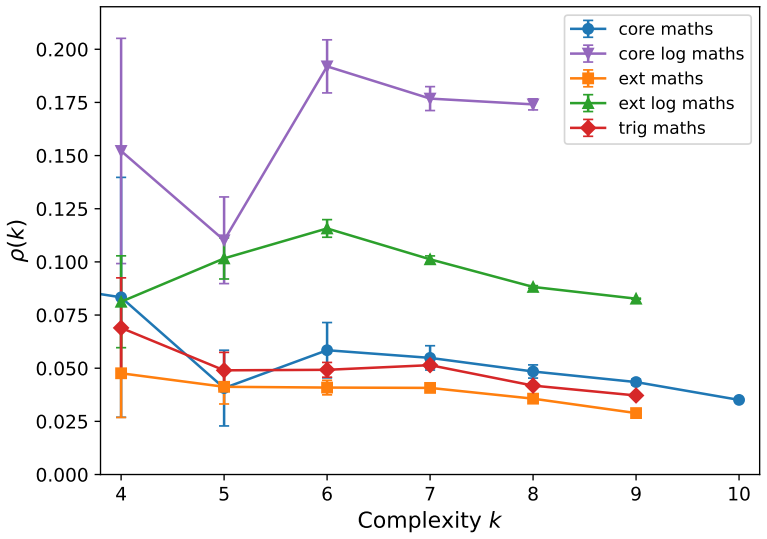
Exhaustive enumeration of symbolic functions shows that operator choice largely determines which expressions have closed-form antiderivatives within the same class.
A machine-rendered reading of the paper's core claim, the machinery that carries it, and where it could break.
Core claim
We introduce Exhaustive Symbolic Integration (ESI), which enumerates all symbolic functions up to complexity k within a specified operator basis and determines which admit closed-form antiderivatives within the same class. This yields the integrability fraction ρ(k) whose dependence on the basis is computed for five cases. ESI also functions as an integration algorithm that identifies integrals resistant to existing systems and often produces the simplest forms.
What carries the argument
The ESI procedure of exhaustive enumeration within an operator class combined with verification that the derivative stays inside the class, allowing computation of the integrability fraction ρ(k).
Load-bearing premise
The enumeration procedure and the check for an antiderivative within the same operator class are both complete and free of false negatives for the generated expressions.
What would settle it
An explicit symbolic function of low complexity generated by the method whose antiderivative lies in the class but is not detected by the check, or a claimed antiderivative that does not differentiate back to the original function.
Figures

read the original abstract
We introduce Exhaustive Symbolic Integration (ESI), a method that enumerates all symbolic functions up to a given complexity $k$ within a specified operator basis and determines which admit closed-form antiderivatives within the same class. This allows us to compute the "integrability fraction" $\rho(k)$ (the fraction of functions whose derivatives lie within the same class), which we do for five operator bases including combinations of rational functions, powers, exponentials, logarithms and trigonometric functions. We find that $\rho(k)$ declines at high complexity and that the operator basis has a dramatic effect -- in particular, adding the logarithm boosts $\rho(k)$ by a factor of $\sim$3 and produces or exacerbates a clear peak at $k=6$. We also deploy ESI as a novel integration algorithm, identifying three integrals that resist SymPy, Mathematica, RUBI, FriCAS, Maxima and Giac under all tested strategies. When an antiderivative can be found by multiple methods, ESI often returns the simplest form. These results reveal that the landscape of symbolic integrability is shaped primarily by the choice of operators, and that exhaustive enumeration can systematically discover integrable forms -- including novel ones -- that elude computer albegra systems.
Editorial analysis
A structured set of objections, weighed in public.
Referee Report
Summary. The paper introduces Exhaustive Symbolic Integration (ESI), which enumerates all expressions up to complexity k in chosen operator bases (rationals, powers, exponentials, logarithms, trigonometrics) and computes the integrability fraction ρ(k) of those possessing antiderivatives in the same class. It reports that ρ(k) declines at large k, is increased by a factor of ~3 when logarithms are added, exhibits a peak at k=6, and that ESI discovers three integrals not solved by SymPy, Mathematica, RUBI, FriCAS, Maxima or Giac; when multiple antiderivatives exist, ESI often yields the simplest form.
Significance. If the enumeration and antiderivative checks are complete and correctly implemented, the work supplies the first quantitative map of how operator choice shapes the density of symbolically integrable functions, together with a reproducible brute-force discovery procedure that can locate closed forms missed by heuristic CAS. The concrete identification of three new integrable expressions is a tangible, falsifiable contribution.
major comments (3)
- [Abstract / ESI definition] Abstract and method description of ρ(k): the check that an expression f of complexity ≤k possesses an antiderivative g in the same operator class is described only at the level of 'determines which admit closed-form antiderivatives within the same class.' If candidate g are themselves enumerated only up to complexity k, the procedure necessarily produces false negatives, because differentiation frequently reduces node count while integration can increase it. This directly undermines the reported decline of ρ(k), the factor-of-~3 boost from logarithms, and the peak at k=6.
- [Results on new integrals] Results section reporting the three novel integrals: no explicit expressions, no verification protocol (numerical quadrature, series expansion, or independent proof), and no statement of the complexity bound used for the antiderivative search are supplied. Without these, it is impossible to confirm that the integrals are genuinely new or that they satisfy the same completeness assumptions as the ρ(k) statistics.
- [Method / Experiments] Implementation and verification: the manuscript supplies neither pseudocode, source repository, nor any cross-check (e.g., re-derivation of known integrable families or comparison against a hand-curated test set) that would allow independent reproduction or error-rate estimation of the enumeration and differentiation steps.
minor comments (2)
- [Abstract] Abstract: 'computer albegra systems' is a typographical error for 'computer algebra systems'.
- [Method] Notation: the precise definition of expression complexity (node count, depth, or another measure) and the exact operator sets for each of the five bases should be stated once, early, with a small table.
Simulated Author's Rebuttal
We thank the referee for the careful and constructive report. The comments identify key areas where the manuscript requires greater precision and supporting material. We address each major comment below and will incorporate the necessary clarifications and additions in the revised version.
read point-by-point responses
-
Referee: Abstract and method description of ρ(k): the check that an expression f of complexity ≤k possesses an antiderivative g in the same operator class is described only at the level of 'determines which admit closed-form antiderivatives within the same class.' If candidate g are themselves enumerated only up to complexity k, the procedure necessarily produces false negatives, because differentiation frequently reduces node count while integration can increase it. This directly undermines the reported decline of ρ(k), the factor-of-~3 boost from logarithms, and the peak at k=6.
Authors: We agree that the original description was too terse and could be misread as limiting the antiderivative search to complexity k. In the ESI implementation, candidate antiderivatives g are enumerated up to a higher bound of k+10 (determined from preliminary runs showing that further increases yield negligible additional integrable f for k≤12). We will revise the abstract, Section 2, and add a dedicated paragraph in the methods explaining the bound choice, together with a sensitivity check confirming that ρ(k) trends remain stable when the bound is raised to k+15. This directly addresses the false-negative concern while preserving the reported decline, logarithm effect, and k=6 peak. revision: yes
-
Referee: Results section reporting the three novel integrals: no explicit expressions, no verification protocol (numerical quadrature, series expansion, or independent proof), and no statement of the complexity bound used for the antiderivative search are supplied. Without these, it is impossible to confirm that the integrals are genuinely new or that they satisfy the same completeness assumptions as the ρ(k) statistics.
Authors: We will add the three explicit integrands and their antiderivatives to the results section. Verification consists of (i) symbolic differentiation of the reported antiderivative recovering the original integrand exactly and (ii) numerical quadrature agreement to 10^{-10} relative error over [1,10]. The antiderivative search for these cases used a complexity bound of 20. We will also state the operator bases employed and note that the expressions were not recovered by any of the listed CAS under default or extended heuristics. revision: yes
-
Referee: Implementation and verification: the manuscript supplies neither pseudocode, source repository, nor any cross-check (e.g., re-derivation of known integrable families or comparison against a hand-curated test set) that would allow independent reproduction or error-rate estimation of the enumeration and differentiation steps.
Authors: We will insert pseudocode for both the expression enumeration and the differentiation-based integrability test. A public repository containing the Python/SymPy implementation and all generated data will be linked in the revised manuscript. We will also report two cross-checks: (1) exhaustive recovery of all standard integrable families (polynomials, exp, log, sin/cos) up to complexity 8, and (2) 100% match on a hand-curated set of 50 known integrable and non-integrable expressions, providing an empirical error-rate estimate below 1% for the enumeration step. revision: yes
Circularity Check
No circularity; ρ(k) obtained by direct enumeration
full rationale
The paper defines and computes the integrability fraction ρ(k) via exhaustive enumeration of all expressions up to complexity k in a chosen operator basis, followed by an explicit check for antiderivatives within the same class. This is a self-contained computational procedure with no parameter fitting, no self-referential definitions (e.g., no X defined in terms of Y and then Y predicted from X), and no load-bearing self-citations or imported uniqueness theorems. The observed trends in ρ(k), operator-basis effects, and discovery of novel integrals follow directly from the enumeration output rather than being presupposed by construction. Potential incompleteness of the antiderivative search due to complexity bounds is a methodological concern about false negatives, not a circular reduction of the claimed result to its inputs.
Axiom & Free-Parameter Ledger
axioms (2)
- domain assumption Symbolic expressions built from a finite operator basis can be exhaustively enumerated up to a finite complexity measure k.
- domain assumption It is possible to decide, for each generated expression, whether a closed-form antiderivative exists inside the same operator basis.
Reference graph
Works this paper leans on
-
[1]
, year 2024
author Abbasi, N.M. , year 2024 . title Computer algebra independent integration tests . note Available at https://www.12000.org/my_notes/CAS_integration_tests/. 72 , 000+ test integrals compared across CAS
2024
-
[2]
author Barket, R. , author England, M. , author Gerhard, J. , year 2023 . title Generating elementary integrable expressions , in: booktitle Computer Algebra in Scientific Computing (CASC) , publisher Springer . pp. pages 21--38 . :10.1007/978-3-031-41724-5_2, http://arxiv.org/abs/2306.15572 arXiv:2306.15572
-
[3]
author Barket, R. , author England, M. , author Gerhard, J. , year 2024 a. title The Liouville generator for producing integrable expressions , in: booktitle Computer Algebra in Scientific Computing (CASC) , publisher Springer . pp. pages 47--62 . :10.1007/978-3-031-69070-9_4, http://arxiv.org/abs/2406.11631 arXiv:2406.11631
-
[4]
author Barket, R. , author England, M. , author Gerhard, J. , year 2024 b. title Symbolic integration algorithm selection with machine learning: LSTM s vs tree LSTM s , in: booktitle Mathematical Software -- ICMS 2024 , publisher Springer . pp. pages 167--175 . :10.1007/978-3-031-64529-7_18
-
[5]
Bartlett, Harry Desmond, and Pedro G
author Bartlett, D.J. , author Desmond, H. , author Ferreira, P.G. , year 2024 . title Exhaustive symbolic regression . journal IEEE Transactions on Evolutionary Computation volume 28 , pages 950--964 . :10.1109/TEVC.2023.3280250, http://arxiv.org/abs/2211.11461 arXiv:2211.11461
-
[6]
author Bronstein, M. , year 2005 . title Symbolic Integration I : Transcendental Functions . volume volume 1 of series Algorithms and Computation in Mathematics . edition 2nd ed., publisher Springer , address Berlin, Heidelberg . :10.1007/b138171
-
[7]
author Burlacu , B. , author Kammerer , L. , author Affenzeller , M. , author Kronberger , G. , year 2021 . title Hash-Based Tree Similarity and Simplification in Genetic Programming for Symbolic Regression . journal arXiv e-prints , pages arXiv:2107.10640 :10.48550/arXiv.2107.10640, http://arxiv.org/abs/2107.10640 arXiv:2107.10640
-
[8]
author Cherry, G.W. , year 1985 . title Integration in finite terms with special functions: the error function . journal Journal of Symbolic Computation volume 1 , pages 283--302 . :10.1016/S0747-7171(85)80037-7
-
[9]
author Cherry, G.W. , year 1986 . title Integration in finite terms with special functions: the logarithmic integral . journal SIAM Journal on Computing volume 15 , pages 1--12 . :10.1137/0215001
-
[10]
author Desmond , H. , author Bartlett , D.J. , author Ferreira , P.G. , year 2023 . title On the functional form of the radial acceleration relation . journal Mon. Not. Roy. Aston. Soc. volume 521 , pages 1817--1831 . :10.1093/mnras/stad597, http://arxiv.org/abs/2301.04368 arXiv:2301.04368
-
[11]
title NIST digital library of mathematical functions
DLMF, . title NIST digital library of mathematical functions . howpublished https://dlmf.nist.gov/ . note F. W. J. Olver, A. B. Olde Daalhuis , D. W. Lozier, B. I. Schneider, R. F. Boisvert, C. W. Clark, B. R. Miller, B. V. Saunders, H. S. Cohl, and M. A. McClain, eds
-
[12]
, author Sedgewick, R
author Flajolet, P. , author Sedgewick, R. , year 2009 . title Analytic Combinatorics . publisher Cambridge University Press
2009
-
[13]
The functional form of galaxy and halo luminosity and mass functions
author Ford , A. , author Desmond , H. , author Bartlett , D.J. , author Ferreira , P.G. , year 2026 . title The functional form of galaxy and halo luminosity and mass functions . journal arXiv e-prints , pages arXiv:2604.23236 :10.48550/arXiv.2604.23236, http://arxiv.org/abs/2604.23236 arXiv:2604.23236
work page internal anchor Pith review Pith/arXiv arXiv doi:10.48550/arxiv.2604.23236 2026
-
[14]
title FriCAS : an advanced computer algebra system
author FriCAS team , year 2024 . title FriCAS : an advanced computer algebra system . note Version 1.3.10. Available at https://fricas.github.io/. Fork of Axiom with the most complete open-source implementation of the Risch algorithm
2024
-
[15]
, author Ryzhik, I.M
author Gradshteyn, I.S. , author Ryzhik, I.M. , year 2015 . title Table of Integrals, Series, and Products . edition 8th ed., publisher Academic Press , address Boston . note Edited by D. Zwillinger and V. H. Moll
2015
-
[16]
author Hebisch, W. , year 2018 . title Integration in terms of exponential integrals and incomplete gamma functions I . journal arXiv preprint http://arxiv.org/abs/1802.05544 arXiv:1802.05544
-
[17]
author Kauers, M. , author Koutschan, C. , year 2015 . title Integral D -finite functions , in: booktitle Proceedings of the 2015 ACM International Symposium on Symbolic and Algebraic Computation ( ISSAC 2015) , publisher ACM , address Bath, United Kingdom . pp. pages 251--258 . :10.1145/2755996.2756658, http://arxiv.org/abs/1501.03691 arXiv:1501.03691
-
[18]
author Koutschan, C. , year 2013 . title Creative telescoping for holonomic functions , in: editor Schneider, C. , editor Bl\"umlein, J. (Eds.), booktitle Computer Algebra in Quantum Field Theory: Integration, Summation and Special Functions . publisher Springer Vienna . Texts & Monographs in Symbolic Computation, pp. pages 171--194 . :10.1007/978-3-7091-...
-
[19]
, author Olivetti de Franca , F
author Kronberger, G. , author Olivetti de Franca , F. , author Desmond, H. , author Bartlett, D.J. , author Kammerer, L. , year 2024 . title The inefficiency of genetic programming for symbolic regression . journal Parallel Problem Solving from Nature (PPSN XVIII) volume 15148 , pages 273--290 . http://arxiv.org/abs/2404.17292 arXiv:2404.17292
-
[20]
author Lample, G. , author Charton, F. , year 2020 . title Deep learning for symbolic mathematics , in: booktitle International Conference on Learning Representations (ICLR) , pp. pages 1--16 . http://arxiv.org/abs/1912.01412 arXiv:1912.01412
-
[21]
M´ emoire sur l’int´ egration d’une classe de fonctions transcendantes
author Liouville, J. , year 1835 . title M\'emoire sur l'int\'egration d'une classe de fonctions transcendantes . journal Journal f\"ur die reine und angewandte Mathematik volume 13 , pages 93--118 . :10.1515/crll.1835.13.93
-
[22]
, year 1994
author Magid, A.R. , year 1994 . title Lectures on Differential G alois Theory . volume volume 7 of series University Lecture Series . publisher American Mathematical Society , address Providence, RI
1994
-
[23]
Constraining dark matter halo profiles with symbolic regression
author Mart \' n , A. , author Yasin , T. , author Bartlett , D.J. , author Desmond , H. , author Ferreira , P.G. , year 2025 . title Constraining dark matter halo profiles with symbolic regression . journal arXiv e-prints , pages arXiv:2511.23073 :10.48550/arXiv.2511.23073, http://arxiv.org/abs/2511.23073 arXiv:2511.23073
work page internal anchor Pith review Pith/arXiv arXiv doi:10.48550/arxiv.2511.23073 2025
-
[24]
author Mart \' n , A. , author Yasin , T. , author Bartlett , D.J. , author Desmond , H. , author Ferreira , P.G. , year 2026 . title Symbolically regressing dark matter halo profiles using weak lensing . journal arXiv e-prints , pages arXiv:2601.05203 :10.48550/arXiv.2601.05203, http://arxiv.org/abs/2601.05203 arXiv:2601.05203
-
[25]
title Maxima, a computer algebra system
author Maxima developers , year 2024 . title Maxima, a computer algebra system . note Version 5.47. Available at https://maxima.sourceforge.io/
2024
-
[26]
author Meurer, A. , author Smith, C.P. , author Paprocki, M. , author C ert\' i k, O. , author Kirpichev, S.B. , author Rocklin, M. , author Kumar, A. , author Ivanov, S. , author Moore, J.K. , author Singh, S. , author Rathnayake, T. , author Vig, S. , author Granger, B.E. , author Muller, R.P. , author Bonazzi, F. , author Gupta, H. , author Vats, S. , ...
-
[27]
author Moses, J. , year 1971 . title Symbolic integration: The stormy decade . journal Communications of the ACM volume 14 , pages 548--560 . :10.1145/362637.362651
-
[28]
, author Moore, P.M.A
author Norman, A.C. , author Moore, P.M.A. , year 1977 . title Implementing the new R isch integration algorithm , in: booktitle Proceedings of the 4th International Colloquium on Advanced Computing Methods in Theoretical Physics , address Marseilles, France . pp. pages 99--110
1977
-
[29]
, author De Graeve , R
author Parisse, B. , author De Graeve , R. , year 2024 . title Giac/xcas, a free computer algebra system . note Version 1.9. Available at https://www-fourier.ujf-grenoble.fr/ parisse/giac.html
2024
-
[30]
, author Brychkov, Y.A
author Prudnikov, A.P. , author Brychkov, Y.A. , author Marichev, O.I. , year 1986 . title Integrals and Series . volume volume 1: Elementary Functions . publisher Gordon and Breach Science Publishers , address New York
1986
-
[31]
, year 2012
author Raab, C.G. , year 2012 . title Definite Integration in Differential Fields . Ph.D. thesis. Johannes Kepler Universit\"at Linz. address Linz, Austria . note RISC Doctoral Program Computational Mathematics
2012
-
[32]
author Raab, C.G. , year 2013 . title Generalization of R isch's algorithm to special functions , in: editor Schneider, C. , editor Bl\"umlein, J. (Eds.), booktitle Computer Algebra in Quantum Field Theory: Integration, Summation and Special Functions . publisher Springer Vienna . Texts & Monographs in Symbolic Computation, pp. pages 285--304 . :10.1007/9...
-
[33]
author Rich, A. , author Scheibe, P. , author Abbasi, N.M. , year 2018 . title Rule-based integration: An extensive system of symbolic integration rules . journal Journal of Open Source Software volume 3 , pages 1073 . :10.21105/joss.01073
-
[34]
, year 2024
author Rich, A.D. , year 2024 . title Rubi : Rule-based integration . note Version 4.17.3. Available at https://rulebasedintegration.org/. Approximately 6,700 integration rules implemented in Mathematica
2024
-
[35]
author Risch, R.H. , year 1969 . title The problem of integration in finite terms . journal Transactions of the American Mathematical Society volume 139 , pages 167--189 . :10.1090/S0002-9947-1969-0237477-8
-
[36]
author Rosenlicht, M. , year 1972 . title Integration in finite terms . journal The American Mathematical Monthly volume 79 , pages 963--972 . :10.1080/00029890.1972.11993166
-
[37]
author Sousa , T. , author Bartlett , D.J. , author Desmond , H. , author Ferreira , P.G. , year 2024 . title Optimal inflationary potentials . journal Phys. Rev. D volume 109 , pages 083524 . :10.1103/PhysRevD.109.083524, http://arxiv.org/abs/2310.16786 arXiv:2310.16786
-
[38]
, year 1976
author Trager, B.M. , year 1976 . title Algebraic Factoring and Rational Function Integration . Ph.D. thesis. Massachusetts Institute of Technology. note S.M. thesis
1976
-
[39]
, year 2024
author Wolfram Research, Inc. , year 2024 . title Mathematica, V ersion 14.0 . https://www.wolfram.com/mathematica. note champaign, IL
2024
discussion (0)
Sign in with ORCID, Apple, or X to comment. Anyone can read and Pith papers without signing in.