Recognition: unknown
Mean-Field and Pairwise Approaches for the SIRI Model on Poisson Networks
Pith reviewed 2026-05-08 06:49 UTC · model grok-4.3
The pith
When transmission per contact is small relative to recovery, SIRI dynamics on Poisson networks align with mean-field ODE trajectories.
A machine-rendered reading of the paper's core claim, the machinery that carries it, and where it could break.
Core claim
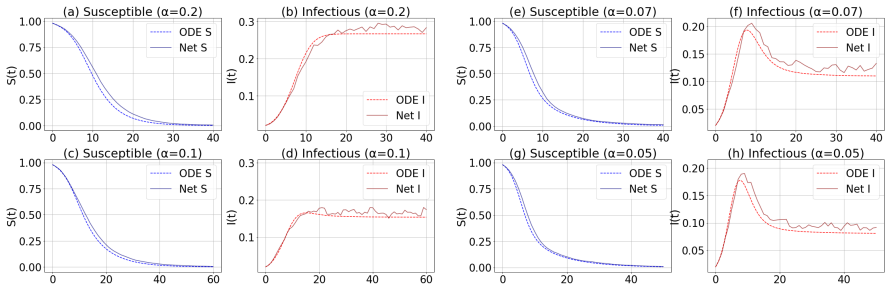
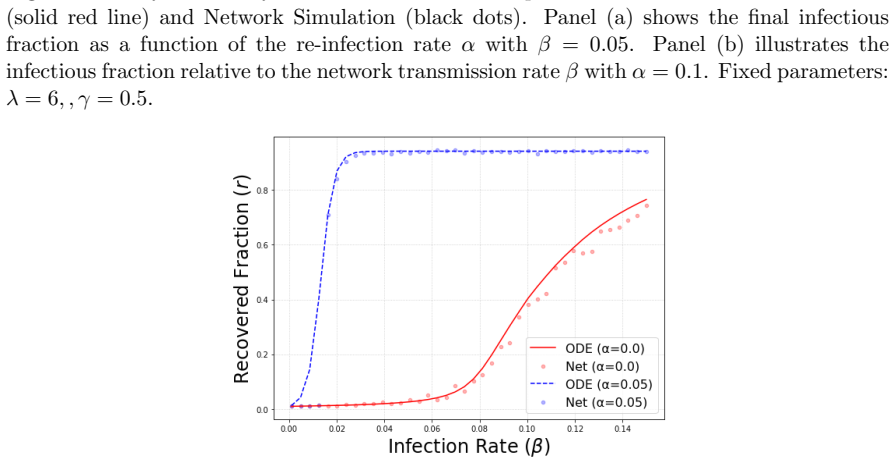
For the SIRI model on Poisson networks, parameter relationships exist such that when transmission per contact is small relative to recovery, the susceptible and infectious trajectories of the pairwise model closely follow the mass-action mean-field ODE trajectories.
What carries the argument
Parameter relationships between the pairwise SIRI equations on a Poisson graph and the mass-action ODEs, active in the regime where transmission per contact is small relative to recovery.
If this is right
- Nonlinear SIRI dynamics on Poisson networks reduce to tractable mean-field ODEs under the identified regime.
- The approximation captures both susceptible decay and infectious rise accurately.
- The same correspondence that holds for SIR extends to models containing relapse from the recovered class.
- Mass-action kinetics become usable for network-based epidemic scenarios with reactivation.
Where Pith is reading between the lines
- The alignment may not survive on non-Poisson networks such as scale-free graphs.
- Numerical checks at intermediate transmission-to-recovery ratios would map the regime boundaries more precisely.
- The result suggests testing whether similar reductions apply to other compartmental models with additional states.
Load-bearing premise
The network is a Poisson random graph and transmission per contact remains small relative to the recovery rate.
What would settle it
Simulate both the pairwise network model and the mean-field ODEs at a transmission rate much larger than recovery and check whether the susceptible and infectious time series diverge.
Figures


read the original abstract
Compartmental epidemic models, grounded in mass-action kinetics, often assume homogeneous mixing. Although this neglects network structure, recent results show that for Poisson random graphs, the classical SIR model, especially the susceptible decay curve, matches the susceptible decay dynamics of its network counterpart. Motivated by this, we investigate whether the extended SIRI model with relapse from the recovered class admits a similar correspondence. SIRI dynamics arise in sevaral scenarios like spread of diseases with reactivation and behavioral contagion with relapse. We derive parameter relationships under which the pairwise SIRI model on a Poisson network closely follows the mass-action ODE trajectories. When transmission per contact is small relative to recovery, the susceptible and infectious trajectories of both systems align. This establishes conditions under which nonlinear SIRI dynamics on networks can be effectively approximated by tractable mean-field equations.
Editorial analysis
A structured set of objections, weighed in public.
Referee Report
Summary. The manuscript investigates the SIRI model (with relapse) on Poisson random graphs. It derives parameter relationships between transmission and recovery rates under which the susceptible and infectious trajectories from the pairwise network model align with those of the corresponding mass-action mean-field ODEs. The alignment is shown to hold when transmission per contact is small relative to the recovery rate, thereby identifying conditions for approximating nonlinear network SIRI dynamics by tractable mean-field equations.
Significance. If the derivations and numerical alignments hold under the stated conditions, the work usefully extends prior SIR results on Poisson graphs to the SIRI case. It supplies concrete, scoped conditions (Poisson networks, transmission ≪ recovery) under which mean-field approximations remain accurate despite network structure and relapse, which is relevant for modeling reactivation diseases or behavioral contagion with relapse. The explicit scoping avoids overclaiming generality.
minor comments (2)
- [Abstract] Abstract: 'sevaral' is a typographical error and should read 'several'.
- [Discussion] The manuscript could briefly note (e.g., in the discussion or a short supplementary figure) the sensitivity of the alignment to modest deviations from the transmission ≪ recovery regime or to non-Poisson degree distributions, even if only to confirm the boundaries of the claimed regime.
Simulated Author's Rebuttal
We thank the referee for their positive assessment of our manuscript on the SIRI model on Poisson networks and for recommending minor revision. The referee's summary correctly identifies the key contribution: deriving conditions under which pairwise network dynamics align with mean-field ODEs when transmission per contact is small relative to recovery. As the major comments section contains no specific points requiring response, we have no changes to propose at this stage but are prepared to address any editorial suggestions.
Circularity Check
No significant circularity; derivation derives independent conditions
full rationale
The paper derives explicit parameter relationships under which pairwise SIRI trajectories on Poisson networks align with mass-action ODEs, specifically when transmission per contact is small relative to recovery. This is presented as an approximation result motivated by prior SIR findings on the same network class, without any reduction of the target trajectories to fitted inputs by construction, self-definitional closures, or load-bearing self-citations. The central claim is scoped to the stated regime and network type, with the alignment obtained through analysis rather than tautological renaming or imported uniqueness theorems.
Axiom & Free-Parameter Ledger
Reference graph
Works this paper leans on
-
[1]
4, e0265815
H AlQadi and M Bani-Yaghoub,Incorporating global dynamics to improve the accuracy of disease models: Example of a COVID-19 SIR model, PLoS One17(2022), no. 4, e0265815. 13
2022
-
[2]
6, 1875–1951
Frank Ball, Tom Britton, Ka Yin Leung, and David Sirl,A stochasticSIRnetwork epidemic model with preventive dropping of edges, Journal of Mathematical Biology78 (2019), no. 6, 1875–1951
2019
-
[3]
none, 1 – 30
Andrew Barbour and Gesine Reinert,Approximating the epidemic curve, Electronic Jour- nal of Probability18(2013), no. none, 1 – 30
2013
-
[4]
Sally Blower,Modelling the genital herpes epidemic, HERPES-CAMBRIDGE-11(2004), 138A–146A
2004
-
[5]
19–79, Springer Berlin Heidel- berg, Berlin, Heidelberg, 2008
Fred Brauer,Compartmental models in epidemiology, pp. 19–79, Springer Berlin Heidel- berg, Berlin, Heidelberg, 2008
2008
-
[6]
Carlos Castillo-Garsow, Guarionex Jordan-Salivia, Ariel Rodriguez-Herrera, et al.,Math- ematical models for the dynamics of tobacco use, recovery and relapse, (1997)
1997
-
[7]
H De Jong MCMDiekmann OHeesterbeck,How does transmission of infection depend on population size? mollison d epidemic models, their structure and relation to data, 1995
1995
-
[8]
20, 13330–13335
Ken TD Eames and Matt J Keeling,Modeling dynamic and network heterogeneities in the spread of sexually transmitted diseases, Proceedings of the National Academy of Sciences 99(2002), no. 20, 13330–13335
2002
-
[9]
Subrata Ghosh, Abhishek Senapati, Joydev Chattopadhyay, Chittaranjan Hens, and Dibakar Ghosh,Optimal test-kit-based intervention strategy of epidemic spreading in het- erogeneous complex networks, Chaos: An Interdisciplinary Journal of Nonlinear Science 31(2021), no. 7
2021
-
[10]
20, 208701
Thilo Gross, Carlos J Dommar D’Lima, and Bernd Blasius,Epidemic dynamics on an adaptive network, Physical Review Letters96(2006), no. 20, 208701
2006
-
[11]
4, 403–412
Chittaranjan Hens, Uzi Harush, Simi Haber, Reuven Cohen, and Baruch Barzel,Spa- tiotemporal signal propagation in complex networks, Nature Physics15(2019), no. 4, 403–412
2019
-
[12]
Hethcote,Three basic epidemiological models, pp
Herbert W. Hethcote,Three basic epidemiological models, pp. 119–144, Springer Berlin Heidelberg, Berlin, Heidelberg, 1989
1989
-
[13]
1, 012313
Flavio Iannelli, Andreas Koher, Dirk Brockmann, Philipp H¨ ovel, and Igor M Sokolov, Effective distances for epidemics spreading on complex networks, Physical Review E95 (2017), no. 1, 012313
2017
-
[14]
1, 746–788
Karly A Jacobsen, Mark G Burch, Joseph H Tien, and Grzegorz A Rempa la,The large graph limit of a stochastic epidemic model on a dynamic multilayer network, Journal of Biological Dynamics12(2018), no. 1, 746–788
2018
-
[15]
Peng Ji, Jiachen Ye, Yu Mu, Wei Lin, Yang Tian, Chittaranjan Hens, Matjaˇ z Perc, Yang Tang, Jie Sun, and J¨ urgen Kurths,Signal propagation in complex networks, Physics Reports1017(2023), 1–96. 14
2023
-
[16]
Matt J Keeling and Pejman Rohani,Modeling infectious diseases in humans and animals, Princeton University Press, 2008
2008
-
[17]
Series B: Biological Sciences266(1999), no
Matthew J Keeling,The effects of local spatial structure on epidemiological invasions, Proceedings of the Royal Society of London. Series B: Biological Sciences266(1999), no. 1421, 859–867
1999
-
[18]
Series B: Biological Sciences264(1997), no
MJ Keeling, DA Rand, and AJ Morris,Correlation models for childhood epidemics, Proceedings of the Royal Society of London. Series B: Biological Sciences264(1997), no. 1385, 1149–1156
1997
-
[19]
William Ogilvy Kermack and A. G. McKendrick,A contribution to the mathematical theory of epidemics, Proceedings of the Royal Society of London. Series A, Containing Papers of a Mathematical and Physical Character115(1927), no. 772, 700–721
1927
-
[20]
Series A, Containing papers of a Mathematical and Physical Character115(1927), no
William Ogilvy Kermack and Anderson G McKendrick,A contribution to the mathemati- cal theory of epidemics, Proceedings of the Royal Society of London. Series A, Containing papers of a Mathematical and Physical Character115(1927), no. 772, 700–721
1927
-
[21]
Wasiur R KhudaBukhsh, Caleb Deen Bastian, Matthew Wascher, Colin Klaus, Saumya Yashmohini Sahai, Mark Weir, Eben Kenah, Elisabeth Root, Joseph H Tien, and Grzegorz Rempala,Projecting covid-19 cases and subsequent hospital burden in Ohio, Journal of Theoretical Biology561(2023), 111404
2023
-
[22]
1, 20190048
Wasiur R KhudaBukhsh, Boseung Choi, Eben Kenah, and Grzegorz A Rempa la,Sur- vival dynamical systems: individual-level survival analysis from population-level epidemic models, Interface Focus10(2020), no. 1, 20190048
2020
-
[23]
Istv´ an Z Kiss, Eben Kenah, and Grzegorz A Rempa la,Necessary and sufficient conditions for exact closures of epidemic equations on configuration model networks, Journal of Mathematical Biology87(2023), no. 2, 36
2023
-
[24]
2017, 31
Istv´ an Z Kiss, Joel C Miller, P´ eter L Simon, et al.,Mathematics of epidemics on networks, Cham: Springer598(2017), no. 2017, 31
2017
-
[25]
Santiago Lamata-Ot´ ın, Adriana Reyna-Lara, David Soriano-Pa˜ nos, Vito Latora, and Jes´ us G´ omez-Garde˜ nes,Collapse transition in epidemic spreading subject to detection with limited resources, Physical Review E108(2023), 024305
2023
-
[26]
2-3, 161–180
Michael Molloy and Bruce Reed,A critical point for random graphs with a given degree sequence, Random Structures & Algorithms6(1995), no. 2-3, 161–180
1995
-
[27]
Helmar Nunes Moreira and Wang Yuquan,Global stability in anS→I→R→Imodel, SIAM Review (1997), 496–502
1997
-
[28]
2, 026118
Mark EJ Newman, Steven H Strogatz, and Duncan J Watts,Random graphs with ar- bitrary degree distributions and their applications, Physical Review E64(2001), no. 2, 026118. 15
2001
-
[29]
3, 925–979
Romualdo Pastor-Satorras, Claudio Castellano, Piet Van Mieghem, and Alessandro Vespignani,Epidemic processes in complex networks, Reviews of Modern Physics87 (2015), no. 3, 925–979
2015
-
[30]
DA Rand,Correlation equations and pair approximations for spatial ecologies, Advanced Ecological Theory: Principles and Applications (1999), 100–142
1999
-
[31]
2, 2311237–2311237
Grzegorz A Rempa la,Equivalence of mass action and poisson network sir epidemic mod- els, BIOMATH12(2023), no. 2, 2311237–2311237
2023
-
[32]
1, 52–60
Sebasti´ an Risau-Gusm´ an and Dami´ an H Zanette,Contact switching as a control strategy for epidemic outbreaks, Journal of Theoretical Biology257(2009), no. 1, 52–60
2009
-
[33]
Series A, Containing papers of a mathematical and physical character92(1916), no
Ronald Ross,An application of the theory of probabilities to the study of a priori pathom- etry.—partI, Proceedings of the Royal Society of London. Series A, Containing papers of a mathematical and physical character92(1916), no. 638, 204–230
1916
-
[34]
Anika Roy, Ujjwal Shekhar, Aditi Bose, Subrata Ghosh, Santosh Nannuru, Syamal Ku- mar Dana, and Chittaranjan Hens,Impact of diffusion on synchronization pattern of epidemics in non-identical meta-population networks, Chaos: An Interdisciplinary Jour- nal of Nonlinear Science34(2024), no. 10
2024
-
[35]
353– 368
Fabio S´ anchez, Xiaohong Wang, Carlos Castillo-Ch´ avez, Dennis M Gorman, and Paul J Gruenewald,Drinking as an epidemic—a simple mathematical model with recovery and relapse, Therapist’s guide to evidence-based relapse prevention, Elsevier, 2007, pp. 353– 368
2007
-
[36]
1, 136–139
David Tudor,A deterministic model for herpes infections in human and animal popula- tions, SIAM Review32(1990), no. 1, 136–139
1990
-
[37]
van den Driessche and X
P. van den Driessche and X. Zou,Modeling relapse in infectious diseases, Mathematical Biosciences207(2007), no. 1, 89–103
2007
-
[38]
Cruz Vargas-De-Le´ on,On the global stability of infectious diseases models with relapse, Abstraction & Application9(2013), 50–61
2013
-
[39]
3, 293–310
Erik Volz,Sir dynamics in random networks with heterogeneous connectivity, Journal of Mathematical Biology56(2008), no. 3, 293–310. 16
2008
discussion (0)
Sign in with ORCID, Apple, or X to comment. Anyone can read and Pith papers without signing in.