Pulsed Vertical Electric Dipole Over a Lossy Halfspace: On the Time-Domain Zenneck Wave
Pith reviewed 2026-05-08 07:27 UTC · model grok-4.3
The pith
A modal contribution tied to the Zenneck pole can dominate the late-time transient field radiated by a pulsed vertical electric dipole above a lossy half-space.
A machine-rendered reading of the paper's core claim, the machinery that carries it, and where it could break.
Core claim
Double contour deformation applied successively in the transverse-wavenumber and frequency planes isolates a modal-pole contribution generated by the frequency-plane deformation and directly related to the frequency-domain Zenneck pole. This term exhibits reduced-time invariance together with the spatial attenuation expected of a surface wave. For appropriate source and observation conditions the modal term dominates the radiated field throughout a broad finite late-time interval. The strict asymptotic tail at fixed distance remains algebraic of order t^{-5/2} with contributions from both the residual continuous spectrum and the modal-pole family.
What carries the argument
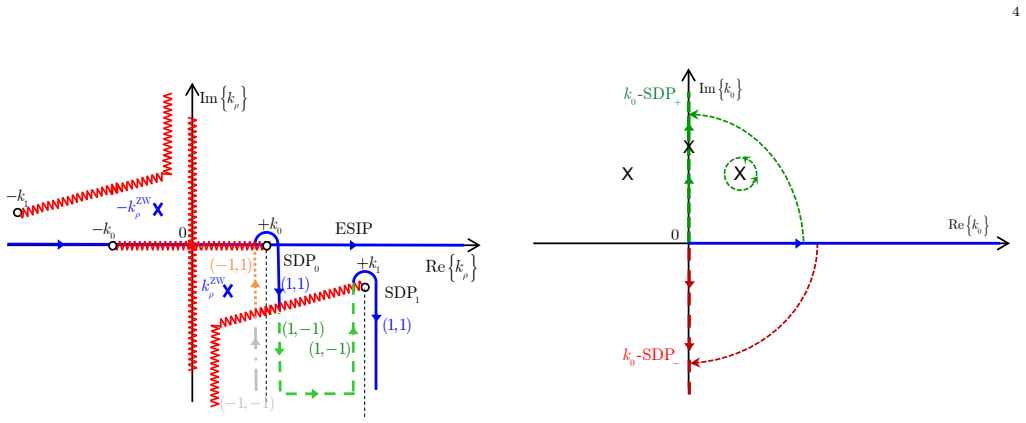
Successive contour deformations in the transverse-wavenumber plane followed by the frequency plane, which isolate the modal-pole term associated with the Zenneck pole while preserving causality.
If this is right
- The decomposed expressions satisfy causality exactly for any excitation.
- The ultimate late-time decay at fixed distance is algebraic of order t^{-5/2} regardless of the modal term.
- The modal contribution can be the leading term over a broad, physically relevant late-time window under suitable source and receiver geometry.
- The decomposition supplies a rigorous time-domain signature of the frequency-domain Zenneck wave.
Where Pith is reading between the lines
- The same deformation sequence could be applied to other pulsed sources or layered media to extract surface-wave content without full numerical inversion.
- The reduced-time invariance of the modal term suggests that late-time waveforms recorded at different distances may be related by a simple scaling once the Zenneck contribution dominates.
- Numerical schemes for ground-penetrating or over-ground radar could retain only the modal term in late-time windows to reduce computational cost while retaining accuracy.
Load-bearing premise
The double contour deformations can be carried out so that the resulting expressions remain strictly causal and capture all physical contributions without non-causal artifacts or omitted branch-cut effects.
What would settle it
Direct numerical evaluation of the double inverse Fourier transform at a late but finite observation time, followed by comparison of the isolated modal term against the total field to verify whether the modal term accounts for the dominant amplitude and reduced-time invariance in the claimed interval.
Figures





read the original abstract
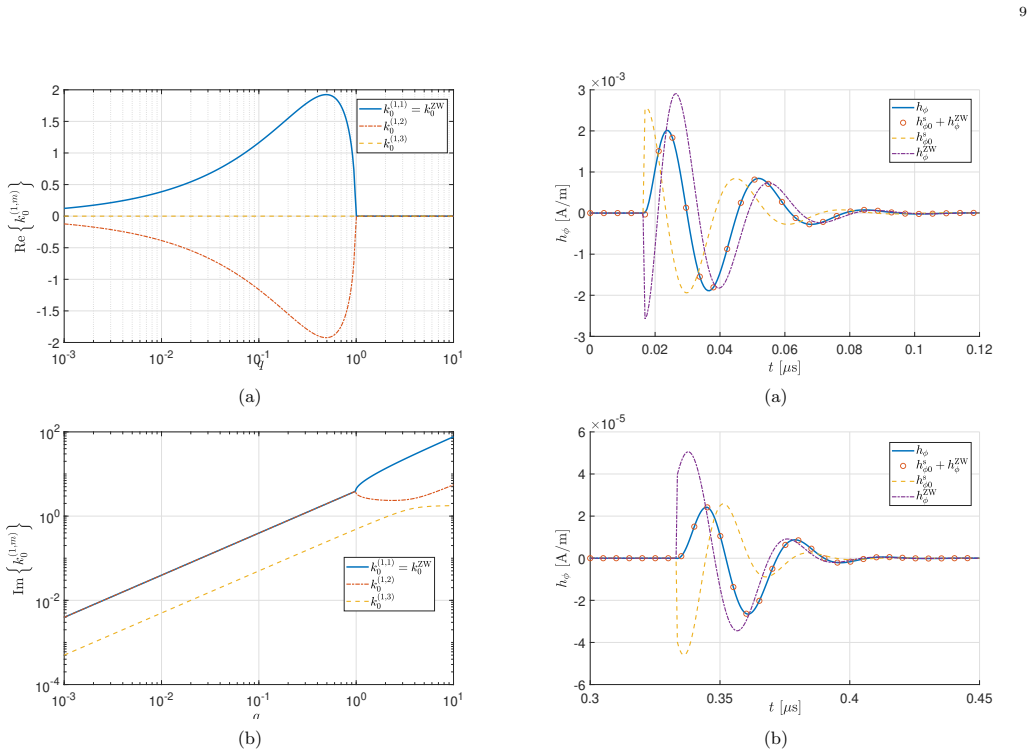
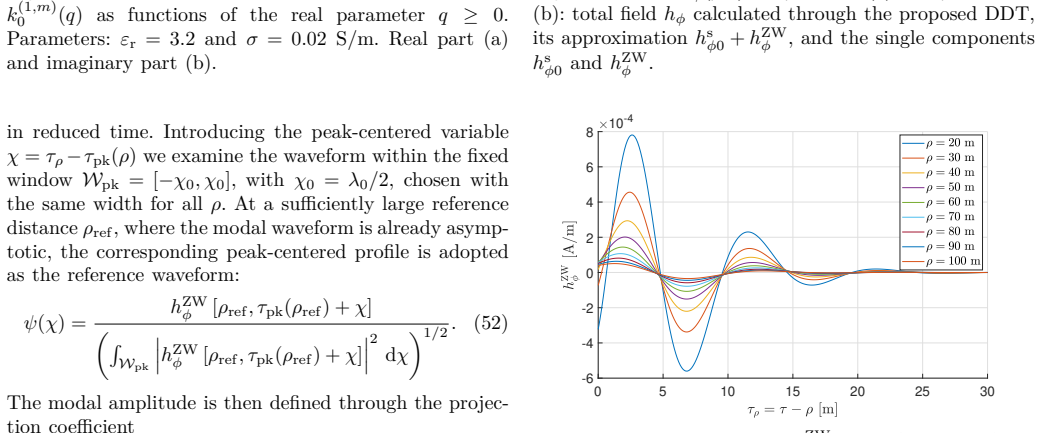
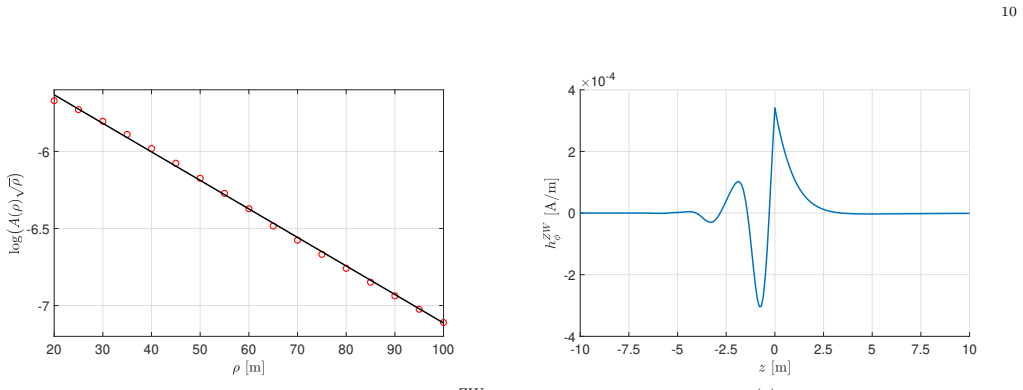
We investigate the transient electromagnetic field radiated by a pulsed vertical electric dipole above a lossy half-space and identify its time-domain signatures associated with the Zenneck wave. Starting from the classical Sommerfeld representation, we derive a causal time-domain formulation based on the double-deformation technique, with successive contour deformations in the transverse-wavenumber and frequency planes. This yields an explicit decomposition of the field into source-pole, loss-pole, modal-pole, and residual steepest-descent contributions. The resulting expressions exactly satisfy causality and are validated against a reference solution obtained through a standard double inverse transform. The analysis shows that one modal contribution, generated by the frequency-plane deformation and related to the frequency-domain Zenneck pole, exhibits reduced-time invariance and a spatial attenuation consistent with a surface-wave component. Under suitable source and observation conditions, this term can dominate the field over a broad and physically relevant finite late-time interval. At the same time, for the considered damped-sinusoidal excitation, the strict asymptotic tail at fixed distance remains algebraic of order $t^{-5/2}$, with contributions from both the residual continuous spectrum and the modal-pole family. These results provide a rigorous and physically interpretable time-domain manifestation of the frequency-domain Zenneck wave in the pulsed half-space problem.
Editorial analysis
A structured set of objections, weighed in public.
Referee Report
Summary. The manuscript investigates the transient electromagnetic field from a pulsed vertical electric dipole above a lossy half-space. Starting from the Sommerfeld integral, it applies successive contour deformations in the transverse-wavenumber and frequency planes to obtain a causal time-domain decomposition into source-pole, loss-pole, modal-pole (linked to the Zenneck pole), and residual steepest-descent contributions. The expressions are validated against a reference double inverse Fourier transform, shown to satisfy causality exactly, and used to demonstrate that the modal term exhibits reduced-time invariance with surface-wave attenuation and can dominate the late-time field under suitable conditions, while the asymptotic tail at fixed distance decays algebraically as t^{-5/2} for the damped-sinusoidal excitation considered.
Significance. If the central decomposition and validation hold, the work supplies a rigorous time-domain interpretation of the Zenneck wave for pulsed excitations over lossy media, distinguishing its modal contribution from other terms and clarifying its potential dominance in a finite late-time window alongside the ultimate algebraic decay. The explicit validation against the standard double inverse transform and the parameter-free contour-based derivation are strengths that enhance the physical interpretability and reproducibility of the results.
major comments (2)
- Abstract: the claim that the modal-pole term 'can dominate the field over a broad and physically relevant finite late-time interval' under 'suitable source and observation conditions' is central to the physical interpretation, yet the manuscript provides neither the explicit conditions (e.g., ranges of height, distance, or conductivity) nor supporting numerical comparisons showing the relative magnitude of this term versus the residual contributions.
- Abstract: while validation against the double inverse Fourier transform is asserted to confirm causality and isolation of the modal term without non-causal artifacts, no quantitative measures (error norms, time windows of agreement, or specific excitation parameters) are supplied, leaving the accuracy of the decomposition unverified at the level of detail needed to support the strongest claim.
minor comments (3)
- The term 'reduced-time invariance' is introduced without an accompanying mathematical definition or equation showing how the modal contribution depends only on a reduced time variable.
- The explicit form of the damped-sinusoidal excitation (amplitude, frequency, damping factor) should be stated to allow reproduction of the t^{-5/2} asymptotic result.
- Notation for the transverse wavenumber and frequency contours could be clarified with a brief diagram or reference to standard Sommerfeld contour conventions to aid readers unfamiliar with the double-deformation technique.
Simulated Author's Rebuttal
We thank the referee for the positive assessment and the constructive comments on the abstract. We address each major comment below. The revisions will strengthen the explicit support for the physical claims while preserving the manuscript's core contributions.
read point-by-point responses
-
Referee: [—] Abstract: the claim that the modal-pole term 'can dominate the field over a broad and physically relevant finite late-time interval' under 'suitable source and observation conditions' is central to the physical interpretation, yet the manuscript provides neither the explicit conditions (e.g., ranges of height, distance, or conductivity) nor supporting numerical comparisons showing the relative magnitude of this term versus the residual contributions.
Authors: We agree that the abstract would benefit from greater specificity on this point. The body of the manuscript (particularly the numerical examples) already illustrates the modal term's dominance for selected parameter sets, but we will revise the abstract to include indicative ranges of height, distance, and conductivity. We will also add a new figure or table in the main text that directly compares the relative magnitudes of the modal-pole contribution against the residual steepest-descent term over the relevant late-time window. revision: yes
-
Referee: [—] Abstract: while validation against the double inverse Fourier transform is asserted to confirm causality and isolation of the modal term without non-causal artifacts, no quantitative measures (error norms, time windows of agreement, or specific excitation parameters) are supplied, leaving the accuracy of the decomposition unverified at the level of detail needed to support the strongest claim.
Authors: The validation is shown through direct comparison of the decomposed field to the reference double inverse Fourier transform in the numerical results, confirming exact causality and close agreement. To address the request for quantitative detail, the revised manuscript will report relative L2 error norms over specified time windows, the exact damped-sinusoidal excitation parameters employed, and the time intervals of agreement. revision: yes
Circularity Check
No significant circularity: derivation self-contained from classical Sommerfeld integral
full rationale
The paper starts from the classical Sommerfeld integral representation and applies standard double contour deformations in the transverse-wavenumber and frequency planes to obtain an explicit decomposition into source-pole, loss-pole, modal-pole, and steepest-descent terms. The modal contribution linked to the Zenneck pole is isolated via residue evaluation during deformation rather than by any fitting, normalization, or self-referential definition. Causality is asserted to hold exactly for the resulting expressions, with direct validation against an independent reference obtained by standard double inverse Fourier transform. No load-bearing self-citations, uniqueness theorems from prior author work, or ansatz smuggling appear in the derivation chain; the central claims retain independent grounding in classical complex-analysis techniques applied to a well-established integral representation.
Axiom & Free-Parameter Ledger
axioms (2)
- standard math Sommerfeld integral representation of the radiated field over a half-space
- domain assumption Physical causality of the electromagnetic response
Reference graph
Works this paper leans on
-
[1]
J. Zenneck, “Über die fortpflanzung ebener elektromagnetischer wellen längs einer ebenen leiterfläche und ihre beziehung zur drahtlosen telegraphie,” Ann. Phys., vol. 328, no. 10, pp. 846– 866, 1907
work page 1907
-
[2]
Über die ausbreitung der wellen in der draht- losen telegraphie,
A. Sommerfeld, “Über die ausbreitung der wellen in der draht- losen telegraphie,” Ann. Phys., vol. 333, no. 4, pp. 665–736, 1909
work page 1909
-
[3]
Ausbreitung elektromagnetischer wellen über einem ebenen leiter,
H. Weyl, “Ausbreitung elektromagnetischer wellen über einem ebenen leiter,” Ann. Phys., vol. 365, no. 21, pp. 481–500, 1919
work page 1919
-
[4]
The propagation of radio waves over the surface of the earth and in the upper atmosphere,
K. A. Norton, “The propagation of radio waves over the surface of the earth and in the upper atmosphere,” Proc. IRE, vol. 25, no. 9, pp. 1203–1236, 1937
work page 1937
-
[5]
Fock, Electromagnetic Diffraction and Propagation Prob- lems
V. Fock, Electromagnetic Diffraction and Propagation Prob- lems. Pergamon Press, 1965
work page 1965
-
[6]
Hertzian dipole radiating over a lossy earth or sea: Some early and late 20th-century controversies,
R. E. Collin, “Hertzian dipole radiating over a lossy earth or sea: Some early and late 20th-century controversies,” IEEE Antennas Propag. Mag., vol. 46, no. 2, pp. 64–79, 2004
work page 2004
-
[7]
On the theory of the Zenneck surface wave,
J. R. Wait, “On the theory of the Zenneck surface wave,” IRE Trans. Antennas Propag., vol. 5, no. 3, pp. 272–275, 1957
work page 1957
-
[8]
T. K. Sarkar, W. M. Dyab, M. N. Abdallah, M. Salazar-Palma, M. V. S. N. Prasad, and S.-W. Ting, “Application of the Schelkunoff formulation to the Sommerfeld problem of a vertical electric dipole radiating over an imperfect ground,” IEEE Trans. Antennas Propag., vol. 62, no. 8, pp. 4162–4170, 2014
work page 2014
-
[9]
T. K. Sarkar, M. N. Abdallah, M. Salazar-Palma, and W. M. Dyab, “Surface plasmons/polaritons, surface waves, and Zen- neck waves: Clarification of the terms and a description of the concepts and their evolution,” IEEE Antennas Propag. Mag., 2017
work page 2017
-
[10]
Excitation of the Zenneck surface wave by a vertical electric dipole,
D. A. Hill and J. R. Wait, “Excitation of the Zenneck surface wave by a vertical electric dipole,” Radio Sci., vol. 13, no. 5, pp. 969–972, 1978
work page 1978
-
[11]
K. A. Michalski and J. R. Mosig, “The Sommerfeld halfspace problem redux: Alternative field representations, role of Zenneck and surface plasmon waves,” IEEE Trans. Antennas Propag., vol. 63, no. 12, pp. 5777–5790, 2015
work page 2015
-
[12]
K. A. Michalski and J. R. Mosig, “The Sommerfeld half-space problem revisited: From radio frequencies and Zenneck waves to visible light and Fano modes,” J. Electromagn. Waves Appl., vol. 30, no. 1, pp. 1–42, 2016
work page 2016
-
[13]
Sommerfeld pole or Brewster zero? Zenneck wave or surface plasmon?,
K. A. Michalski and J. R. Mosig, “Sommerfeld pole or Brewster zero? Zenneck wave or surface plasmon?,” IEEE Antennas Propag. Mag., vol. 64, no. 6, pp. 70–80, 2022
work page 2022
-
[14]
A leaky-wave interpretation of the Zenneck wave,
D. R. Jackson, F. Mesa, K. A. Michalski, and J. R. Mosig, “A leaky-wave interpretation of the Zenneck wave,” URSI Radio Sci. Lett., vol. 4, 2022
work page 2022
-
[15]
Excitation of the Zenneck wave by a tapered line source above the earth or ocean,
F. Mesa and D. R. Jackson, “Excitation of the Zenneck wave by a tapered line source above the earth or ocean,” IEEE Trans. Antennas Propag., vol. 68, no. 6, pp. 4848–4859, 2020
work page 2020
-
[16]
Analysis of two-media structures using longitudinal spectrum: Space, surface, and Zenneck waves,
A. K. Bhattacharyya, “Analysis of two-media structures using longitudinal spectrum: Space, surface, and Zenneck waves,” IEEE Antennas Propag. Mag., 2019
work page 2019
-
[17]
H. Haddad and D. C. Chang, “Transient electromagnetic field generated by a vertical electric dipole on the surface of a dissipative earth,” Radio Sci., vol. 16, no. 2, pp. 169–177, 1981
work page 1981
-
[18]
B. J. Kooij, “The electromagnetic field emitted by a pulsed current point source above the interface of a nonperfectly conducting earth,” Radio Sci., vol. 31, no. 6, pp. 1345–1360, 1996
work page 1996
-
[19]
Modified modal theory of transient response in layered media,
L. Tsang and J. A. Kong, “Modified modal theory of transient response in layered media,” J. Math. Phys., vol. 20, no. 6, pp. 1170–1182, 1979
work page 1979
-
[20]
A. Ezzeddine, J. A. Kong, and L. Tsang, “Time response of a vertical electric dipole over a two-layer medium by the double deformation technique,” J. Appl. Phys., vol. 53, no. 2, pp. 813– 822, 1982
work page 1982
-
[21]
S. Y. Poh, Transient electromagnetic dipole radiation over a stratified medium. PhD thesis, Massachusetts Institute of Technology, 1986
work page 1986
-
[22]
Time- domain surface plasmon polaritons on a graphene sheet,
P. Burghignoli, G. Lovat, R. Araneo, and S. Celozzi, “Time- domain surface plasmon polaritons on a graphene sheet,” Phys. Rev. B, vol. 97, no. 24, p. 245418, 2018
work page 2018
-
[23]
An appraisal of numerical ap- proaches for a VED over the earth or ocean,
F. Mesa and D. R. Jackson, “An appraisal of numerical ap- proaches for a VED over the earth or ocean,” IEEE Trans. Antennas Propag., vol. 70, no. 7, pp. 4837–4852, 2022
work page 2022
-
[24]
Explaining the Routh–Hurwitz criterion: A tu- torial presentation,
M. Bodson, “Explaining the Routh–Hurwitz criterion: A tu- torial presentation,” IEEE Control Syst. Mag., vol. 40, no. 1, pp. 45–51, 2020
work page 2020
-
[25]
A highly accelerated automatic transient field eval- uation in planar multilayered structures,
G. Lovat, “A highly accelerated automatic transient field eval- uation in planar multilayered structures,” submitted to IEEE Trans. Electromagn. Compat
discussion (0)
Sign in with ORCID, Apple, or X to comment. Anyone can read and Pith papers without signing in.