Recognition: unknown
Messaging strategies and the emergence of echo chambers in collective decision-making
Pith reviewed 2026-05-08 06:35 UTC · model grok-4.3
The pith
Observing only actions and having limited attention can trap collectives in echo chambers that ignore environmental changes.
A machine-rendered reading of the paper's core claim, the machinery that carries it, and where it could break.
Core claim
Nonlinear dynamical models demonstrate that when individuals observe only discrete actions of neighbors and operate under limited attention, collective accuracy becomes highly sensitive to the weight on social information through the spontaneous emergence of echo chamber-like states. In these states, agents receive and transmit homogeneous social messages, creating self-reinforcing locked configurations that block adaptation to environmental changes. The effect appears in both abstract models and applied ones for neural circuits, eusocial insects, and mobile groups, with biologically plausible adjustments able to mitigate the issue for robust decisions.
What carries the argument
Echo chamber-like states arising in nonlinear dynamical models of collective decision-making, where homogeneous message transmission locks subgroups into self-reinforcing patterns insensitive to external changes.
If this is right
- Collectives become locked in states that fail to track environmental changes when social weighting falls in certain ranges.
- The sensitivity to social weight and echo chamber formation occurs across generic models and specific biological systems including neural circuits and animal groups.
- Biologically plausible mechanisms such as adjusting attention or promoting message diversity can reduce echo chamber risk and support robust decisions without parameter fine-tuning.
- Accurate collective performance requires balancing personal and social information sources to avoid self-reinforcing traps.
Where Pith is reading between the lines
- Similar constraints in human organizations could explain persistent failures to adapt to new evidence despite available data.
- Empirical tests in real animal groups could measure message homogeneity and tracking failure as social weighting is experimentally varied.
- The phase-transition-like sensitivity might connect to other dynamical systems where limited information flow creates stable but non-adaptive regimes.
Load-bearing premise
The nonlinear dynamical models accurately capture the essential constraints and dynamics of real biological collective decision-making without missing critical unmodeled factors or interactions.
What would settle it
A controlled experiment or simulation varying the social information weight in groups with action-only observation and limited attention, checking for a sharp threshold where homogeneous message clusters form and environmental tracking accuracy collapses.
Figures




read the original abstract
Collective decision-making arises from individual agents integrating their own personal observations with information obtained from social partners. In many biological systems that exhibit collective decision-making, the process by which social information is produced, transmitted, and used is subject to two key constraints. First, individuals often do not observe the internal states or personal observations of their neighbors; instead, they observe neighbors' discrete actions. Second, agents often have limited attention, such that, at any given moment, only a subset of social partners influences decisions. Using methods from nonlinear dynamics, we show that either of these constraints can cause collective accuracy to become extremely sensitive to the weight individuals place on the information they receive from others. This sensitivity arises from the spontaneous formation of echo chamber-like states in which individuals receive and transmit homogeneous social messages. Under such conditions, collectives become locked in self-reinforcing states that prevent them from tracking changes in the environment. We reveal the mathematical basis of this phenomenon, and show that it emerges not only in generic models of collective decision-making but also in models developed to describe specific biological systems, including neural circuits, eusocial insect colonies, and mobile animal groups. Finally, we identify biologically plausible mechanisms through which individuals may reduce the risk of echo chamber formation and achieve robust yet sensitive collective decisions without requiring fine-tuning parameters. Our results reveal how fundamental constraints on communication shape the dynamics and reliability of collective decisions across diverse biological systems.
Editorial analysis
A structured set of objections, weighed in public.
Referee Report
Summary. The manuscript analyzes how two common constraints in biological collective decision-making—observing only discrete actions rather than internal states, and limited attention to a subset of social partners—induce echo-chamber fixed points in nonlinear dynamical models. These states render collective accuracy hypersensitive to the social-information weight parameter, locking groups into self-reinforcing homogeneous messaging that prevents tracking of environmental changes. The result is derived in generic mean-field and network settings and instantiated in models of neural circuits, eusocial insect colonies, and mobile animal groups; the authors further supply explicit, parameter-free mitigation mechanisms that restore robustness without fine-tuning.
Significance. If the derivations hold, the work supplies a general, mathematically grounded explanation for fragility in collective decisions under biologically realistic communication limits, with direct relevance to neuroscience, behavioral ecology, and collective intelligence. The demonstration across both abstract and concrete biological models, together with the provision of parameter-free mitigation strategies, strengthens the result and offers testable predictions for when collectives remain robust versus when they become locked.
minor comments (4)
- The abstract would be strengthened by a single sentence summarizing the mathematical approach (nonlinear dynamics on mean-field/network models) and the existence of the mitigation mechanisms.
- In the sections presenting the biological instantiations, the mapping from the generic model variables to the specific system parameters (e.g., neural firing rates or colony recruitment thresholds) could be tabulated for immediate comparison.
- Figure captions describing the sensitivity curves should explicitly label the social-weight axis and indicate the location of the echo-chamber bifurcation points.
- A brief discussion of how the limited-attention constraint is implemented (e.g., random subset selection versus distance-dependent) would clarify whether the echo-chamber result is robust to that modeling choice.
Simulated Author's Rebuttal
We thank the referee for their positive and accurate summary of our manuscript, as well as for highlighting its significance for understanding fragility in collective decisions under realistic biological constraints. We appreciate the recommendation for minor revision. No specific major comments were raised in the report.
Circularity Check
No significant circularity; derivation self-contained in nonlinear analysis
full rationale
The paper derives its central results on echo-chamber formation and sensitivity to social weighting via nonlinear dynamical analysis applied to both generic mean-field/network models and three specific biological instantiations. The abstract and skeptic summary indicate explicit mathematical derivation of fixed points and stability conditions from the stated constraints (discrete action observation; limited attention), plus parameter-free mitigation mechanisms. No load-bearing step reduces by construction to a fitted parameter renamed as prediction, a self-citation chain, or an ansatz smuggled from prior work; the sensitivity result is shown to emerge from the model equations rather than being presupposed by them. The derivation is therefore self-contained within the model class.
Axiom & Free-Parameter Ledger
axioms (1)
- domain assumption Nonlinear dynamics govern the evolution of collective states under the stated constraints
Reference graph
Works this paper leans on
-
[1]
Here we present the general formulation for an arbitrary finite set of quantized messages Q={q j ∈R|j= 1,2,
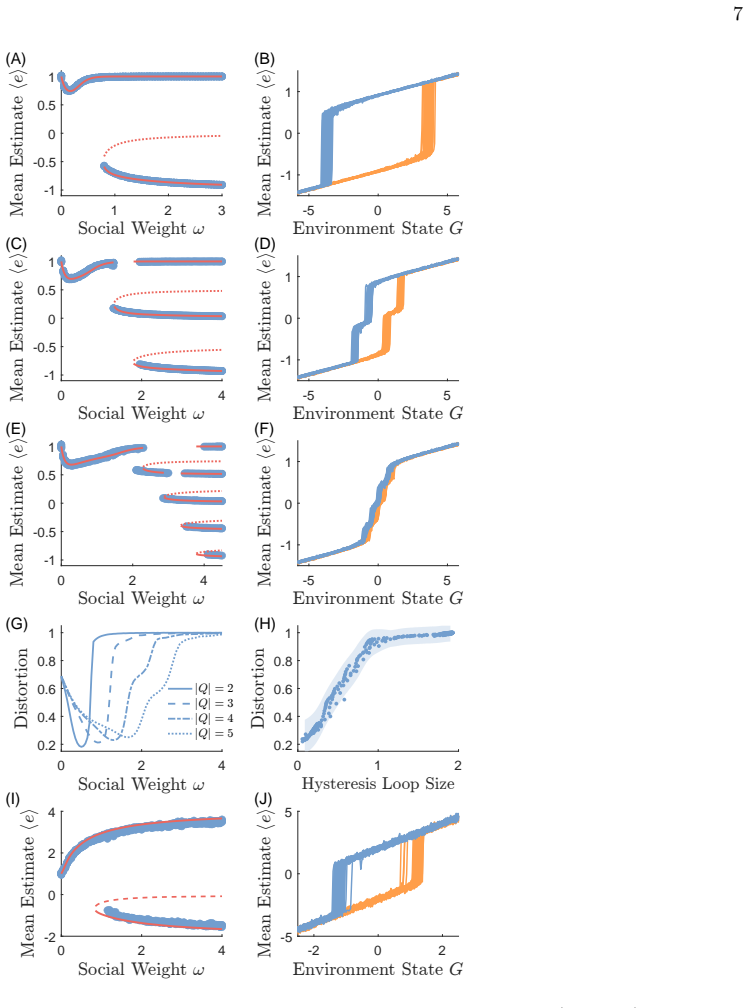
General explicit form of the mean-field theory for the quantized message model In the main text, we briefly discussed the mean-field theory for the quantized message model with binary messages. Here we present the general formulation for an arbitrary finite set of quantized messages Q={q j ∈R|j= 1,2, . . . , N Q}.(A1) Without loss of generality, assume q1...
-
[2]
We first use an example of the binary message scenarioQ={−1,+1}
Bifurcation analysis of the mean-field theory for the quantized message model We now show that the bifurcations observed in the quantized message model are governed by (unfolded) pitchfork bifurcations. We first use an example of the binary message scenarioQ={−1,+1}. As discussed in the main text, the iterative map{µ t−1, σt−1} → {µ t, σt}is as follows: µ...
-
[3]
Thus, the iterative map is as follows
Mean-field theory for the DeGroot-style model We can derive the mean-field theory for the DeGroot-style model by replacing the quantization functionf Q( ) by an identity function. Thus, the iterative map is as follows. µt = (1−ω s)Gt +ω sµt−1,(A14) σ2 t = (1−ω s)2σ2 n +ω 2 s σ2 t−1 k .(A15) Note that the two dimensions are independent.µ t does not depend ...
-
[4]
Mean-field theory for the limited attention model We develop a closed-form mean-field theory for the limited attention model. For each agent, while the social messages fromk i neighbors are available, it only takes in theLsocial messages with the largest absolute magnitude |m|and aggregates theseLsocial messages with the personal observation. For simplici...
-
[5]
9, we show the stable and unstable branches of the limited attention model withL= 2 and⟨k⟩= 8
Bifurcation analysis of the mean-field theory for the limited attention model In Fig. 9, we show the stable and unstable branches of the limited attention model withL= 2 and⟨k⟩= 8. We also show the corresponding eigenvalues of the Jacobian matrix at the fixed points with the largest absolute values. It appears that when the environment is neutral, there i...
-
[6]
Quantized message model: nonlinearity in encoding In the quantized message model,his linear averaging andf=f Q is the quantization function. In the limitω→ ∞, where personal observations vanish, the dynamics on a homogeneous network reduce to ei,t = 1 k X j Aij fQ(ej,t−1).(C1) We claim that the set of stable consensus fixed points of this system is exactl...
-
[7]
Sincehsatisfies the internality property (min{m j} ≤h≤max{m j}), every perfect consensuse i,t =e ∗ 21 for alliis trivially a fixed point
Limited attention model: nonlinearity in aggregation and the singularω→ ∞limit In the limited attention model,fis the identity function andhaverages the top-L(by absolute magnitude) messages. Sincehsatisfies the internality property (min{m j} ≤h≤max{m j}), every perfect consensuse i,t =e ∗ 21 for alliis trivially a fixed point. This means, when all messag...
-
[8]
In this limit, if the consensus-forming dynamics admits a nonzero steady statee ss ̸= 0, symmetry guarantees a corresponding state−e ss
Connecting collective decision-making and consensus formation It is tempting to understand the emergence of collective lock-in by examining the pure consensus limitω→ ∞, where personal observations play no role. In this limit, if the consensus-forming dynamics admits a nonzero steady statee ss ̸= 0, symmetry guarantees a corresponding state−e ss. Since th...
-
[9]
We assume that the food-bearing trail switches over time
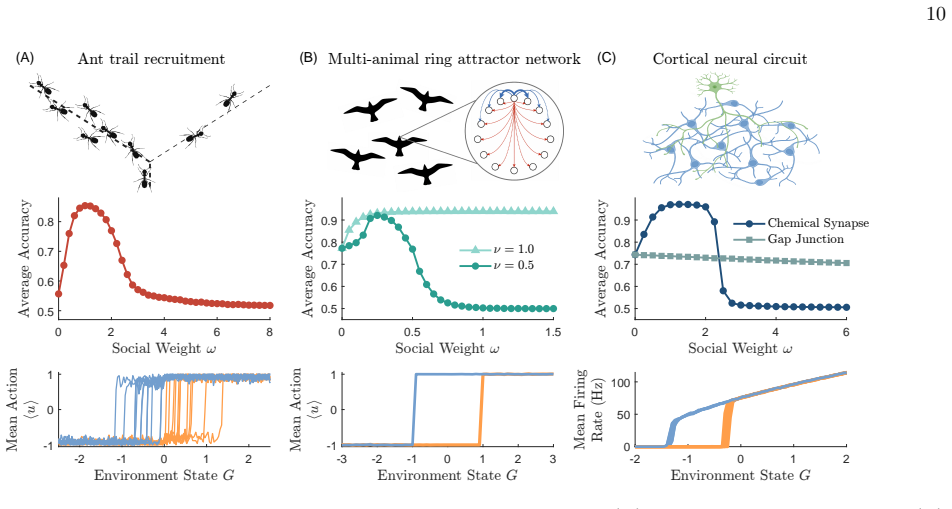
Model In our setting, each ant in the group must choose between two trails,AandB, and attempts to select the one that leads to food. We assume that the food-bearing trail switches over time. At each time step, each agent receives 30 a noisy private cue about the ground-truth environmental state of the food resource (denoted byg i(t)), while also sensing t...
-
[10]
4(A) in the main text
Results The main results are shown in Fig. 4(A) in the main text. Asωincreases, the model undergoes a transition to a lock-in state and we observe hysteresis in the system. 31 Appendix J: Multi-animal directional collective decision-making with ring attractor neural networks As an additional model that implements a (soft) winner-take-all (WTA) mechanism, ...
-
[11]
The ground truth optimal direction to the food resource is presented by the variableG t ∈(−π, π]
Model The action space of each agent is directional, whereu∈(−π, π]. The ground truth optimal direction to the food resource is presented by the variableG t ∈(−π, π]. To make things simpler and better aligned with other modes in this paper, assumed to always be in either direction +π/2 or−π/2. Thus,G t is still binary. At each time step, each agent has a ...
-
[12]
agents” are neurons and the “messages
Results In the ring attractor models, the coefficientνcontrols how soft or hard the WTA is. Whenν= 1.0, there is no WTA anymore and the neural network dynamics are equivalent to the average-taking model. As shown in Fig. 4 (B) middle panel, the accuracy versusωcurves for theν= 1.0 ring attractor model do not have a significant drop in high ωregions. Whenν...
-
[13]
Model a. Single-neuron dynamics Each neuroniis modeled as a leaky integrate-and-fire (LIF) unit [11, 17, 71], whose membrane potentialV i evolves according to τm dVi dt =−(V i −V L) +I ext i (t) +I rec i (t),(K1) whereτ m = 20 ms is the membrane time constant,V L =−70 mV is the leak reversal potential.I ext i (t) is the external input current, which corre...
-
[14]
4(C) in the main text
Results The main results are shown in Fig. 4(C) in the main text. Asωincreases, the chemical-synapse (spike train) model undergoes an abrupt transition. Beyond a criticalω, the network locks into a persistent high-firing state after stimulus removal, a neural analogue of the echo chambers identified in the generic quantized-message models. The gap-junctio...
-
[15]
Spread of (mis) information in social networks.Games and Economic Behavior, 70(2):194–227, 2010
Daron Acemoglu, Asuman Ozdaglar, and Ali ParandehGheibi. Spread of (mis) information in social networks.Games and Economic Behavior, 70(2):194–227, 2010
2010
-
[16]
Coevolutionary dynamics of actions and opinions in social networks.IEEE Transactions on Automatic Control, 68(12):7708–7723, 2023
Hassan Dehghani Aghbolagh, Mengbin Ye, Lorenzo Zino, Zhiyong Chen, and Ming Cao. Coevolutionary dynamics of actions and opinions in social networks.IEEE Transactions on Automatic Control, 68(12):7708–7723, 2023
2023
-
[17]
Conformity does not perpetuate suboptimal traditions in a wild population of songbirds.Proceedings of the National Academy of Sciences, 114(30):7830–7837, 2017
Lucy M Aplin, Ben C Sheldon, and Richard McElreath. Conformity does not perpetuate suboptimal traditions in a wild population of songbirds.Proceedings of the National Academy of Sciences, 114(30):7830–7837, 2017
2017
-
[18]
Multimodal cue integration and learning in a neural representation of head direction.Nature Neuroscience, 28(8):1729–1740, 2025
Melanie A Basnak, Anna Kutschireiter, Tatsuo S Okubo, Albert Chen, Pavel Gorelik, Jan Drugowitsch, and Rachel I Wilson. Multimodal cue integration and learning in a neural representation of head direction.Nature Neuroscience, 28(8):1729–1740, 2025
2025
-
[19]
Ralph Beckers, Jean-Louis Deneubourg, and Simon Goss. Modulation of trail laying in the ant lasius niger (hymenoptera: Formicidae) and its role in the collective selection of a food source.Journal of Insect Behavior, 6(6):751–759, 1993
1993
-
[20]
Electrical coupling and neuronal synchronization in the mammalian brain
Michael VL Bennett and R Suzanne Zukin. Electrical coupling and neuronal synchronization in the mammalian brain. Neuron, 41(4):495–511, 2004
2004
-
[21]
University of Chicago Press, 1988
Robert Boyd and Peter J Richerson.Culture and the Evolutionary Process. University of Chicago Press, 1988
1988
-
[22]
An evolutionary model of social learning: the effects of spatial and temporal variation
Robert Boyd and Peter J Richerson. An evolutionary model of social learning: the effects of spatial and temporal variation. InSocial Learning, pages 29–48. Psychology Press, 2013
2013
-
[23]
Braca, S
P. Braca, S. Marano, and V. Matta. Enforcing consensus while monitoring the environment in wireless sensor networks. IEEE Transactions on Signal Processing, 56(7):3375–3380, 2008
2008
-
[24]
Elsevier, 2013
Donald Eric Broadbent.Perception and communication. Elsevier, 2013
2013
-
[25]
Dynamics of sparsely connected networks of excitatory and inhibitory spiking neurons.Journal of Com- putational Neuroscience, 8(3):183–208, 2000
Nicolas Brunel. Dynamics of sparsely connected networks of excitatory and inhibitory spiking neurons.Journal of Com- putational Neuroscience, 8(3):183–208, 2000
2000
-
[26]
Consensus and disagreement: The role of quantized behaviors in opinion dynamics
Francesca Ceragioli and Paolo Frasca. Consensus and disagreement: The role of quantized behaviors in opinion dynamics. SIAM Journal on Control and Optimization, 56(2):1058–1080, 2018
2018
-
[27]
Collective motion of self-propelled particles interacting without cohesion.Physical Review E, 77(4):046113, 2008
Hugues Chat´ e, Francesco Ginelli, Guillaume Gr´ egoire, and Franck Raynaud. Collective motion of self-propelled particles interacting without cohesion.Physical Review E, 77(4):046113, 2008
2008
-
[28]
Computational principles of memory.Nature Neuroscience, 19(3):394–403, 2016
Rishidev Chaudhuri and Ila Fiete. Computational principles of memory.Nature Neuroscience, 19(3):394–403, 2016
2016
-
[29]
Electrical synapses in the mammalian brain.Annu
Barry W Connors and Michael A Long. Electrical synapses in the mammalian brain.Annu. Rev. Neurosci., 27(1):393–418, 2004
2004
-
[30]
Cover and Joy A
Thomas M. Cover and Joy A. Thomas.Elements of Information Theory. Wiley, 2nd edition, 2009
2009
-
[31]
MIT press, 2005
Peter Dayan and Laurence F Abbott.Theoretical neuroscience: computational and mathematical modeling of neural systems. MIT press, 2005
2005
-
[32]
Reaching a consensus.Journal of the American Statistical Association, 69(345):118–121, 1974
Morris H DeGroot. Reaching a consensus.Journal of the American Statistical Association, 69(345):118–121, 1974
1974
-
[33]
Persuasion bias, social influence, and unidimensional opinions
Peter M DeMarzo, Dimitri Vayanos, and Jeffrey Zwiebel. Persuasion bias, social influence, and unidimensional opinions. The Quarterly Journal of Economics, 118(3):909–968, 2003
2003
-
[34]
The self-organizing exploratory pattern of the argentine ant.Journal of Insect Behavior, 3(2):159–168, 1990
J-L Deneubourg, Serge Aron, Simon Goss, and Jacques M Pasteels. The self-organizing exploratory pattern of the argentine ant.Journal of Insect Behavior, 3(2):159–168, 1990
1990
-
[35]
On the evolution of random graphs.Publ
Paul Erd˝ os and Alfr´ ed R´ enyi. On the evolution of random graphs.Publ. Math. Inst. Hungar. Acad. Sci, 5(1):17–61, 1960
1960
-
[36]
Cognitive control of escape behaviour.Trends in Cognitive Sciences, 23(4):334–348, 2019
Dominic A Evans, A Vanessa Stempel, Ruben Vale, and Tiago Branco. Cognitive control of escape behaviour.Trends in Cognitive Sciences, 23(4):334–348, 2019
2019
-
[37]
A synaptic threshold mechanism for computing escape decisions.Nature, 558(7711):590–594, 2018
Dominic A Evans, A Vanessa Stempel, Ruben Vale, Sabine Ruehle, Yaara Lefler, and Tiago Branco. A synaptic threshold mechanism for computing escape decisions.Nature, 558(7711):590–594, 2018
2018
-
[38]
Wild animals suppress the spread of socially transmitted misinformation.Proceedings of the National Academy of Sciences, 120(14):e2215428120, 2023
Ashkaan K Fahimipour, Michael A Gil, Maria Rosa Celis, Gabriel F Hein, Benjamin T Martin, and Andrew M Hein. Wild animals suppress the spread of socially transmitted misinformation.Proceedings of the National Academy of Sciences, 120(14):e2215428120, 2023
2023
-
[39]
Connectionist models and their properties.Cognitive Science, 6(3):205–254, 1982
Jerome A Feldman and Dana H Ballard. Connectionist models and their properties.Cognitive Science, 6(3):205–254, 1982
1982
-
[40]
Joint centrality distinguishes optimal leaders in noisy networks.IEEE Transactions on Control of Network Systems, 3(4):366–378, 2015
Katherine Fitch and Naomi Ehrich Leonard. Joint centrality distinguishes optimal leaders in noisy networks.IEEE Transactions on Control of Network Systems, 3(4):366–378, 2015
2015
-
[41]
Social influence and opinions.Journal of Mathematical Sociology, 15(3-4):193–206, 1990
Noah E Friedkin and Eugene C Johnsen. Social influence and opinions.Journal of Mathematical Sociology, 15(3-4):193–206, 1990
1990
-
[42]
Vox populi, 1907
Francis Galton. Vox populi, 1907
1907
-
[43]
Potential disadvantages of using socially acquired information.Philosophical Transactions of the Royal Society of London
Luc-Alain Giraldeau, Thomas J Valone, and Jennifer J Templeton. Potential disadvantages of using socially acquired information.Philosophical Transactions of the Royal Society of London. Series B: Biological Sciences, 357(1427):1559– 1566, 2002
2002
-
[44]
The wisdom of smaller, smarter crowds
Daniel G Goldstein, Randolph Preston McAfee, and Siddharth Suri. The wisdom of smaller, smarter crowds. InProceedings of the Fifteenth ACM Conference on Economics and Computation, pages 471–488, 2014
2014
-
[45]
Naive learning in social networks and the wisdom of crowds.American Economic Journal: Microeconomics, 2(1):112–149, 2010
Benjamin Golub and Matthew O Jackson. Naive learning in social networks and the wisdom of crowds.American Economic Journal: Microeconomics, 2(1):112–149, 2010
2010
-
[46]
Geometrical structure of bifurcations during spatial decision-making.PRX 36 Life, 2(1):013008, 2024
Dan Gorbonos, Nir S Gov, and Iain D Couzin. Geometrical structure of bifurcations during spatial decision-making.PRX 36 Life, 2(1):013008, 2024
2024
-
[47]
Rhythm interaction in animal groups: selective attention in communication networks.Philosophical Transactions of the Royal Society B: Biological Sciences, 376(1835), 2021
Michael D Greenfield, Ikkyu Aihara, Guy Amichay, Marianna Anichini, and Vivek Nityananda. Rhythm interaction in animal groups: selective attention in communication networks.Philosophical Transactions of the Royal Society B: Biological Sciences, 376(1835), 2021
2021
-
[48]
Modulation of pheromone trail strength with food quality in pharaoh’s ant, monomorium pharaonis.Animal Behaviour, 74(3):463–470, 2007
Duncan E Jackson and Nicolas Chˆ aline. Modulation of pheromone trail strength with food quality in pharaoh’s ant, monomorium pharaonis.Animal Behaviour, 74(3):463–470, 2007
2007
-
[49]
Non-bayesian social learning.Games and Economic Behavior, 76(1):210–225, 2012
Ali Jadbabaie, Pooya Molavi, Alvaro Sandroni, and Alireza Tahbaz-Salehi. Non-bayesian social learning.Games and Economic Behavior, 76(1):210–225, 2012
2012
-
[50]
Decision accuracy in complex environments is often maximized by small group sizes
Albert B Kao and Iain D Couzin. Decision accuracy in complex environments is often maximized by small group sizes. Proceedings of the Royal Society B: Biological Sciences, 281(1784), 2014
2014
-
[51]
Reinforcement learning signal predicts social conformity.Neuron, 61(1):140–151, 2009
Vasily Klucharev, Kaisa Hyt¨ onen, Mark Rijpkema, Ale Smidts, and Guill´ en Fern´ andez. Reinforcement learning signal predicts social conformity.Neuron, 61(1):140–151, 2009
2009
-
[52]
A brief natural history of misinformation.Journal of The Royal Society Interface, 22(233), 2025
Ling-Wei Kong, Lucas Gallart, Abigail G Grassick, Jay W Love, Amlan Nayak, and Andrew M Hein. A brief natural history of misinformation.Journal of The Royal Society Interface, 22(233), 2025
2025
-
[53]
Springer, 1998
Yuri A Kuznetsov.Elements of applied bifurcation theory. Springer, 1998
1998
-
[54]
Motion cues tune social influence in shoaling fish.Scientific Reports, 8(1):9785, 2018
Bertrand Lemasson, Colby Tanner, Christa Woodley, Tammy Threadgill, Shea Qarqish, and David Smith. Motion cues tune social influence in shoaling fish.Scientific Reports, 8(1):9785, 2018
2018
-
[55]
Bertrand H Lemasson, James J Anderson, and R Andrew Goodwin. Collective motion in animal groups from a neurobio- logical perspective: the adaptive benefits of dynamic sensory loads and selective attention.Journal of Theoretical Biology, 261(4):501–510, 2009
2009
-
[56]
Fast and flexible multiagent decision-making.Annual Review of Control, Robotics, and Autonomous Systems, 7, 2024
Naomi Ehrich Leonard, Anastasia Bizyaeva, and Alessio Franci. Fast and flexible multiagent decision-making.Annual Review of Control, Robotics, and Autonomous Systems, 7, 2024
2024
-
[57]
Distributed consensus with limited communication data rate.IEEE Transactions on Automatic Control, 56(2):279–292, 2010
Tao Li, Minyue Fu, Lihua Xie, and Ji-Feng Zhang. Distributed consensus with limited communication data rate.IEEE Transactions on Automatic Control, 56(2):279–292, 2010
2010
-
[58]
Singularities and symmetry breaking in swarms.Physical Review E, 77(2):021920, 2008
Wei Li, Hai-Tao Zhang, Michael ZhiQiang Chen, and Tao Zhou. Singularities and symmetry breaking in swarms.Physical Review E, 77(2):021920, 2008
2008
-
[59]
How social influence can undermine the wisdom of crowd effect.Proceedings of the National Academy of Sciences, 108(22):9020–9025, 2011
Jan Lorenz, Heiko Rauhut, Frank Schweitzer, and Dirk Helbing. How social influence can undermine the wisdom of crowd effect.Proceedings of the National Academy of Sciences, 108(22):9020–9025, 2011
2011
-
[60]
On the computational power of winner-take-all.Neural Computation, 12(11):2519–2535, 2000
Wolfgang Maass. On the computational power of winner-take-all.Neural Computation, 12(11):2519–2535, 2000
2000
-
[61]
Heterogeneous stochastic interactions for multiple agents in a multi-armed bandit problem
Udari Madhushani and Naomi Ehrich Leonard. Heterogeneous stochastic interactions for multiple agents in a multi-armed bandit problem. In2019 18th European Control Conference (ECC), pages 3502–3507. IEEE, 2019
2019
-
[62]
How do ants assess food volume?Animal Be- haviour, 59(5):1061–1069, 2000
Anne-Catherine Mailleux, Jean-Louis Deneubourg, and Claire Detrain. How do ants assess food volume?Animal Be- haviour, 59(5):1061–1069, 2000
2000
-
[63]
The cocktail party problem.Current Biology, 19(22):R1024–R1027, 2009
Josh H McDermott. The cocktail party problem.Current Biology, 19(22):R1024–R1027, 2009
2009
-
[64]
Quorum sensing as a mechanism to harness the wisdom of the crowds.Nature Communications, 14(1):3415, 2023
Stefany Moreno-G´ amez, Michael E Hochberg, and GS Van Doorn. Quorum sensing as a mechanism to harness the wisdom of the crowds.Nature Communications, 14(1):3415, 2023
2023
-
[65]
Decentralized quantized kalman filtering with scalable communication cost.IEEE Transactions on Signal Processing, 56(8):3727–3741, 2008
Eric J Msechu, Stergios I Roumeliotis, Alejandro Ribeiro, and Georgios B Giannakis. Decentralized quantized kalman filtering with scalable communication cost.IEEE Transactions on Signal Processing, 56(8):3727–3741, 2008
2008
-
[66]
On distributed averaging algorithms and quantization effects.IEEE Transactions on Automatic Control, 54(11):2506–2517, 2009
Angelia Nedic, Alex Olshevsky, Asuman Ozdaglar, and John N Tsitsiklis. On distributed averaging algorithms and quantization effects.IEEE Transactions on Automatic Control, 54(11):2506–2517, 2009
2009
-
[67]
Oxford University Press, 2018
Mark Newman.Networks. Oxford University Press, 2018
2018
-
[68]
Olfati-Saber and R
R. Olfati-Saber and R. M. Murray. Consensus problems in networks of agents with switching topology and time-delays. IEEE Transactions on Automatic Control, 49(9):1520–1533, 2004
2004
-
[69]
Distributed kalman filter with embedded consensus filters
Reza Olfati-Saber. Distributed kalman filter with embedded consensus filters. InProceedings of the 44th IEEE Conference on Decision and Control, pages 8179–8184. IEEE, 2005
2005
-
[70]
A simple cognitive model explains movement decisions in zebrafish while following leaders.Physical Biology, 20(4):045002, 2023
Lital Oscar, Liang Li, Dan Gorbonos, Iain D Couzin, and Nir S Gov. A simple cognitive model explains movement decisions in zebrafish while following leaders.Physical Biology, 20(4):045002, 2023
2023
-
[71]
Leader selection for optimal network coherence
Stacy Patterson and Bassam Bamieh. Leader selection for optimal network coherence. In49th IEEE Conference on Decision and Control (CDC), pages 2692–2697. IEEE, 2010
2010
-
[72]
Individual rules for trail pattern formation in argentine ants (linepithema humile).PLoS Computational Biology, 8(7):e1002592, 2012
Andrea Perna, Boris Granovskiy, Simon Garnier, Stamatios C Nicolis, Marjorie Lab´ edan, Guy Theraulaz, Vincent Four- cassi´ e, and David JT Sumpter. Individual rules for trail pattern formation in argentine ants (linepithema humile).PLoS Computational Biology, 8(7):e1002592, 2012
2012
-
[73]
Selective social interactions and speed-induced leadership in schooling fish.Proceedings of the National Academy of Sciences, 121(18):e2309733121, 2024
Andreu Puy, Elisabet Gimeno, Jordi Torrents, Palina Bartashevich, M Carmen Miguel, Romualdo Pastor-Satorras, and Pawel Romanczuk. Selective social interactions and speed-induced leadership in schooling fish.Proceedings of the National Academy of Sciences, 121(18):e2309733121, 2024
2024
-
[74]
MIT Press, 1999
Fred Rieke, David Warland, Rob de Ruyter Van Steveninck, and William Bialek.Spikes: exploring the neural code. MIT Press, 1999
1999
-
[75]
The behavioral mechanisms governing collective motion in swarming locusts.Science, 387(6737):995–1000, 2025
Sercan Sayin, Einat Couzin-Fuchs, Inga Petelski, Yannick G¨ unzel, Mohammad Salahshour, Chi-Yu Lee, Jacob M Graving, Liang Li, Oliver Deussen, Gregory A Sword, et al. The behavioral mechanisms governing collective motion in swarming locusts.Science, 387(6737):995–1000, 2025
2025
-
[76]
A study of some social factors in perception.Archives of Psychology (Columbia University), 1935
Muzafer Sherif. A study of some social factors in perception.Archives of Psychology (Columbia University), 1935
1935
-
[77]
A model of the neural basis of the rat’s sense of direction.Advances in Neural Information Processing Systems, 7, 1994
William Skaggs, James Knierim, Hemant Kudrimoti, and Bruce McNaughton. A model of the neural basis of the rat’s sense of direction.Advances in Neural Information Processing Systems, 7, 1994
1994
-
[78]
The geometry of decision-making in individuals and collectives.Proceedings of the National Academy of Sciences, 118(50):e2102157118, 2021
Vivek H Sridhar, Liang Li, Dan Gorbonos, M´ at´ e Nagy, Bianca R Schell, Timothy Sorochkin, Nir S Gov, and Iain D 37 Couzin. The geometry of decision-making in individuals and collectives.Proceedings of the National Academy of Sciences, 118(50):e2102157118, 2021
2021
-
[79]
Chapman and Hall/CRC, 2024
Steven H Strogatz.Nonlinear dynamics and chaos: with applications to physics, biology, chemistry, and engineering. Chapman and Hall/CRC, 2024
2024
-
[80]
Vintage, 2005
James Surowiecki.The Wisdom of Crowds. Vintage, 2005
2005
discussion (0)
Sign in with ORCID, Apple, or X to comment. Anyone can read and Pith papers without signing in.